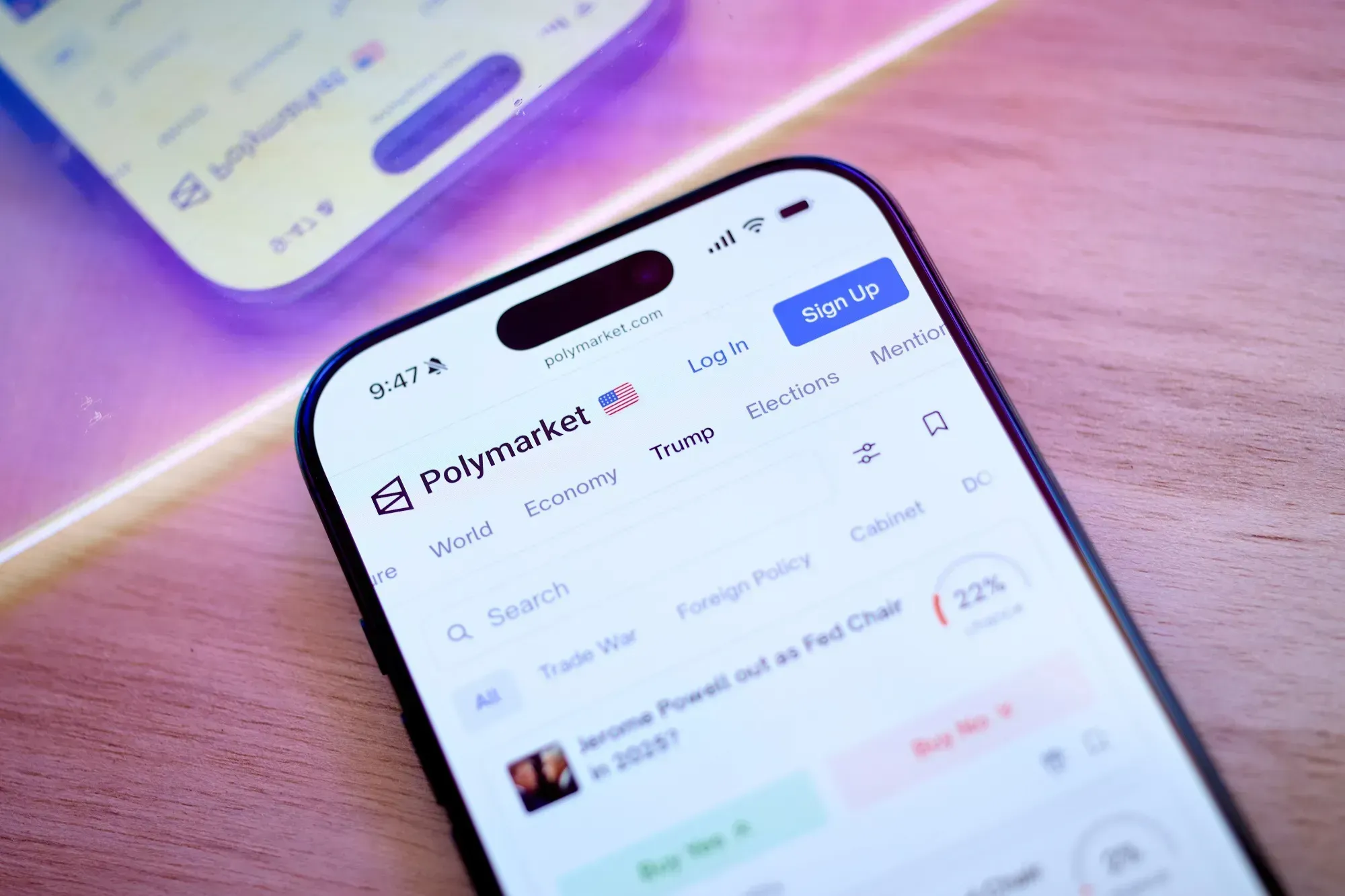
Premier info portal for prediction markets. The start point of information market.
Polymarket Steps Into Legal Gray Area by Hosting Trades on War
News
GeopoliticsPrediction Market

Polymarket Steps Into Legal Gray Area by Hosting Trades on War

Politics

Even as prediction-market platforms have tested legal and regulatory norms like never before, most have drawn a line at one category: direct wagers on war.

Not Polymarket.

In recent weeks, the startup — newly backed by Intercontinental Exchange Inc., the parent company of the New York Stock Exchange — has listed a growing roster of contracts related to active military conflicts, including the possibility of China invading Taiwan and Russia capturing various cities in Ukraine. One market, tied to US strikes on Iran, has generated more than $18 million in trading.

This week, a group of 12 Democratic senators raised alarms about platforms facilitating bets on war, arguing that federal law expressly prohibits such contracts. The American Gaming Association echoed the concern from a different angle, saying contracts tied to armed conflicts would not be permitted under state or tribal law.

Polymarket did not respond to requests for comment. The company has broadly argued that its contracts are valuable because they crowdsource information in volatile situations and help the public gauge risk, especially when conventional reporting lags or lacks clarity.

On some markets related to Middle East violence, Polymarket includes a disclaimer explaining that the company has spoken with people directly affected by attacks who “had dozens of questions” that weren’t being answered by traditional media. “Prediction markets,” the platform wrote, “gave them answers in ways that TV news and X could not.”

While some of Polymarket’s rivals, such as Kalshi Inc., allow bets on geopolitical outcomes, they have so far stopped short of anything that references military action or invasion. Kalshi’s closest equivalents include contracts on whether politicians — in the United States and abroad — will be out of office by a specific date.

“Kalshi avoids markets based on war altogether due to the extremely harmful incentives they can create,” a spokesperson said.

Polymarket operates under a different regulatory regime than Kalshi because it has technically been off limits to US customers since a 2022 settlement with the Commodity Futures Trading Commission. It uses cryptocurrency-based accounts that can allow trading pseudonymously without the kind of identity verification typical on US-regulated platforms.

Polymarket is now in the process of opening a US platform after acquiring a CFTC-approved exchange. The beta version of the US operation has emphasized mostly sports event contracts.

Cheryl Isaac, a partner at K&L Gates who advises clients on derivatives law, said that the Commodity Exchange Act gives the CFTC the authority to bar event contracts related to war, terrorism and assassination if it determines that they are contrary to the public interest.

“It is not yet clear how the new CFTC Chair will address some of these issues, and the CFTC has largely been silent on this topic under the current administration,” Isaac said.

In 2024, the CFTC proposed — but did not finalize — changes to its rules that would have clamped down on these kinds of wagers. The agency wrote at the time that speculation of this sort “at a base level, is offensive” and could potentially “increase the risk of a terrorist attack, assassination or act of war by creating financial incentives for a perpetrator to take a position and then profit by carrying out the heinous act themselves.”

The CFTC did not respond to requests for comment.

Catherine Cortez Masto, a Democratic senator from Nevada, and 11 other senators recently released a joint letter arguing that the law “expressly prohibits” the kinds of financial contracts Polymarket has offered.

“If prediction market contracts that implicate military operations or other national security considerations are manipulated by insider information, or even listed, it is possible for foreign adversaries to use this to their advantage,” the letter to the incoming chair of the CFTC said.

A spokesperson for ForecastEx, a prediction market owned by Interactive Brokers Group Inc., said the firm is regulated by the CFTC whose rules, it said, “prohibit” contracts tied to terrorism, assassination or war.

The stakes in these fights continue to escalate because prediction markets have become so much bigger with increasing ties to the traditional financial system. Intercontinental Exchange agreed last year to invest as much as $2 billion in Polymarket.

The military and geopolitical contracts offered by Polymarket are still a relatively small part of its business — with the category accounting for less than 10% of the volume, according to user-compiled data on Dune Analytics. But they have been a big source of growth in recent weeks as conflicts around the world have heated up.

The current slate of war-related contracts is only the latest instance of prediction market companies testing the boundaries of what’s legally permissible as they open up new corners of American life to financial speculation.

Before it was barred from operating in the US, Polymarket came under scrutiny for offering unregulated financial products to American customers. Kalshi, meanwhile, got approval to run its exchange from the CFTC, but later challenged the agency in court in order to offer trading on the outcome of elections. Kalshi and other prediction markets have recently been accused of violating state laws with their contracts tied to the outcomes of sports games.

Source: https://www.bloomberg.com/news/articles/2026-01-14/polymarket-faces-scrutiny-for-hosting-prediction-markets-on-war-and-conflict

Matchbook to Launch UK Prediction Markets Ahead of US Entry
News
RegulatoryLegalPrediction Market

Matchbook to Launch UK Prediction Markets Ahead of US Entry

Economics & FinancePolitics

Matchbook, a sports betting exchange, is launching a prediction market platform in the UK as it prepares to compete with rivals Kalshi and Polymarket in the US.

The British debut in January will be a “road test” of its technology before Matchbook — registered in Guernsey — obtains US regulatory approval, which it expects as early as March, interim chief executive officer Ronan McDonagh said in an interview.

Matchbook is majority-owned by Zeljko Ranogajec, a professional gambler originally from Australia, after Matthew Benham, the owner of Brentford FC, pared his stake to a small interest. The launch in the UK, a country with a long tradition of legal sports betting, will test how widely American enthusiasm for prediction markets has spread overseas.

Betting exchanges, like Matchbook, function by matching buyers and sellers, unlike traditional sportsbooks which take the opposite side of a customer’s bet. The key difference for a British audience is largely in the presentation. While Matchbook is already a betting exchange, its new offering changes the display of contracts from the fractional odds typical in the UK to a percentage probability for ‘yes’ or ‘no’ outcomes.

Platforms such as Kalshi and Polymarket have played a major role in elevating the profile of prediction markets, particularly since the 2024 US election. These entities function as federally regulated financial exchanges, offering event contracts that cover politics, sports, and pop culture. This regulatory status enables them to offer what are fundamentally sports wagers nationwide, thereby bypassing state-specific gambling restrictions.

Matchbook will launch the product under its existing exchange license with the UK Gambling Commission, with a focus on sports, McDonagh added. It will also introduce a prediction market as a white-label provider for easyBet, which is part of easyJet founder Stelios Haji-Ioannou’s group.

“It’s not new in the sense that it works on the same engine as an exchange,” McDonagh said from Cork, Ireland. “It should be more understandable, so I think we’re hopeful that it captures a new audience or it intrigues people to have a look.”

Matchbook, whose legal entity is Triplebet Ltd., has been operating a sports exchange for about 20 years. The company’s US partner RSBIX LLC in September filed with the US Commodity Futures Trading Commission to launch an exchange. Led by Jeff Ifrah, who is in business with one of President Donald Trump’s former defense attorneys, RSBIX had tried — and failed — five years ago to seek the agency’s approval for NFL contracts with a different partner.

While the UK has no shortage of betting platforms, Kalshi and Polymarket remain unavailable in the country. Unlike the US, new entry would likely come under the purview of gambling regulators.

Robinhood has previously said it’s exploring bringing prediction markets overseas and has spoken to the UK Financial Conduct Authority about that.

With less brand recognition in the US, Matchbook is open to partnering with another company for distribution, said McDonagh.

“We’re not sentimental about going in as Matchbook,” he said. “We’ve been in the exchange business so long and we’ve got a really strong tech platform. We’ve got strong market making partners, liquidity and a great product. We’ll be able to complete on day one in the US.”

Source: https://www.bloomberg.com/news/articles/2025-12-10/matchbook-to-launch-uk-prediction-markets-ahead-of-us-entry

Polymarket Testing US Prediction Market in Move to Reopening
News
RegulatoryPrediction Market

Polymarket Testing US Prediction Market in Move to Reopening

Economics & FinancePolitics

Polymarket has begun live testing its US exchange by quietly opening up to some users and matching trades ahead of its planned relaunch in the American betting market.

The prediction platform says the exchange is fully functional, with select users placing bets on real contracts, as it moves to complete the final steps needed to open up.

“The US Exchange is actually live and operational and people are being onboarded,” founder Shayne Coplan said at Cantor Fitzgerald’s Crypto & AI Infrastructure Conference in Miami. “It’s effectively in a beta test.”

Bloomberg reported last month that Polymarket would be launching in the US in November in a limited roll out.

Read More: Polymarket Plans US Return Within Weeks With Sports Focus

Polymarket’s return to the US comes after the company moved offshore and paid a $1.4 million penalty in 2022 to settle allegations from the Commodity Futures Trading Commission that it ran afoul of regulations.

After surging to prominence during last year’s presidential election, the company has joined the rush to capture a resurgent interest in wagering on real-world events that has upended the US gambling industry. Its closest rival, Kalshi Inc., has been open to US customers for years. And on Wednesday, FanDuel, the US online gambling division of Flutter Entertainment Plc said it would launch its own prediction market product in December.

Polymarket has been looking to raise money at a valuation between $12 billion and $15 billion since announcing an investment of as much as $2 billion from Intercontinental Exchange Inc.

After the Justice Department and the CFTC dropped investigations into the crypto-betting platform earlier this year, Polymarket acquired QCX, a firm that has CFTC approval to operate a derivatives exchange and clearinghouse.

“It’s the fastest anyone has ever gotten to market,” Coplan said. “Definitely a difficult task, but our team has been incredible and made that happen.”

The move will position Polymarket to challenge established sports gambling companies. The company has already established a partnership with the National Hockey League and announced on Thursday a multi-year partnership with TKO Group Holdings Inc. that has made it the official prediction market partner of the Ultimate Fighting Championship and Zuffa Boxing.

“By partnering with Shayne and his team at Polymarket, we’re unlocking a new dimension of fan engagement,” Ari Emanuel, CEO and executive chair of TKO, said in a statement. “Integrating Polymarket with the UFC and Zuffa Boxing live experience will help fans interact with these events in real time, transforming passive viewership into active participation.”

In conventional betting, users trade against the house, which sets odds, limits liquidity, and bans profitable players. Coplan argued the model is structurally flawed compared with Polymarket’s model, which allows users to set prices and back either side of an outcome – a design it says is more like an exchange than a casino.

“I don’t think anyone would argue that the sports book model is the optimal model,” Coplan said. “There’s a monopoly on pricing. You trade against the house every time and they can set whatever prices they want and to make matters worse, if you make any money, they can ban you.’

Source: https://www.bloomberg.com/news/articles/2025-11-12/polymarket-reopens-in-us-in-beta-mode-as-prediction-markets-grow

Prediction Markets Boom as Volumes Surpass 2024 Election
News
Prediction Market

Prediction Markets Boom as Volumes Surpass 2024 Election

Politics

The trading volume on the leading prediction markets platforms, Polymarket and Kalshi, has hit a new record high, surpassing the previous peak reached during the US presidential election last year.

The recent jump in trading activity offers one of the clearest indications yet of the growing excitement around the exchanges that allow investors to bet on the likelihood of real-world events, just as financial firms like CME Group Inc. and Intercontinental Exchange Inc. look for a way into these hot markets.

Kalshi and Polymarket saw notional trading volume rise above $2 billion for the first time, during the week ending Oct. 19, according to publicly available data collated by the user dunedata on Dune Analytics. That figure eclipses the frenzied trading seen during last year’s US presidential election, when the two platforms first entered the financial mainstream.

The growth over the past two months has been driven in large part by the popularity of sports betting on the New York-based exchange Kalshi, which has used its financial license to offer gambling nationwide, in defiance of state gaming regulators. But betting on politics, cultural events and economic indicators has also generally been trending up.

These platforms have captured the attention of sports gamblers, retail investors and professional traders by blurring the line between speculation and information.

To their backers, prediction markets are the next step in the democratization of trading — crowdsourced probability engines that reveal sentiment faster than polls or analysts. To critics, they are simply financialized entertainment, built on the same adrenaline loops that have fueled meme stocks and crypto tokens.

Sports-focused bets were the top category on both platforms last week, pulling in $867 million in trading on Kalshi and $415 million on Polymarket, which is not legally available to US customers. The return of college football in August and the NFL season in September prompted a significant uptick in volumes across both platforms, but particularly on Kalshi, where a partnership with trading app Robinhood Markets Inc. has drawn in new users.

In prediction markets, customers purchase contracts that will settle at either zero or $1 after the event in question is resolved. The figures on Dune capture notional volume — a measure that counts one side of each trade — to make volumes on the two exchanges more directly comparable. Polymarket’s data is sourced from its public blockchain, while Kalshi’s comes from exchange disclosures.

A Kalshi spokesperson confirmed the dashboard data for its platform was accurate. A Polymarket spokesperson said the data was the best available publicly, adding that “there are always nuances to it.”

Betting surrounding the US election supercharged growth on Polymarket and Kalshi last year, after Kalshi won a lawsuit against its regulator, the Commodity Futures Trading Commission, that allowed it to legally open trading on who would win the presidential vote.

Traders on both exchanges gave President Donald Trump high odds of winning, and Trump and his family embraced the nascent industry, with Donald Trump Jr. joining both companies as an adviser.

It was previously assumed that sports betting would be prohibited by the CFTC, which oversees Kalshi. But after Trump won the election, another player in these markets, Crypto.com, opened trading on sports, and Kalshi followed suit.

Several state gaming regulators have claimed that Kalshi’s markets run afoul of their laws. But Kalshi has fought back in court and other financial firms are now looking to enter the fray.

The exchange giant CME is planning to introduce contracts tied to sports games, Bloomberg reported last week. The owner of the New York Stock Exchange, ICE, recently announced that it is investing $2 billion for a stake in Polymarket.

Polymarket currently bars US customers after previous legal tangles with US regulators, but it is now planning to re-enter the US and recently purchased a CFTC-regulated derivatives exchange, QCX.

The expansion into sports has hit the shares of online gambling platforms like DraftKings Inc. and FanDuel owner Flutter Entertainment Inc., which generally only operate in states where gaming regulators allow it.

Kalshi made a further push into the business when it recently debuted parlays, low-odds wagers on a series of outcomes bundled together

While Polymarket was the larger of the two rivals, the boost in sports betting pushed Kalshi above Polymarket in overall notional volume in late August, data showed. Polymarket reclaimed the crown last week, with sports volumes more than doubling relative to a month earlier.

Some users reported technical issues when attempting to trade on Kalshi on Oct. 18, during peak hours for Saturday football games. The same Kalshi spokesperson said the exchange had encountered data loading delays “due to extreme demand,” but that its back-end exchange remained online throughout. The issues have since been resolved, they added.

Source: https://www.bloomberg.com/news/articles/2025-10-21/prediction-markets-boom-anew-as-volumes-surpass-2024-election