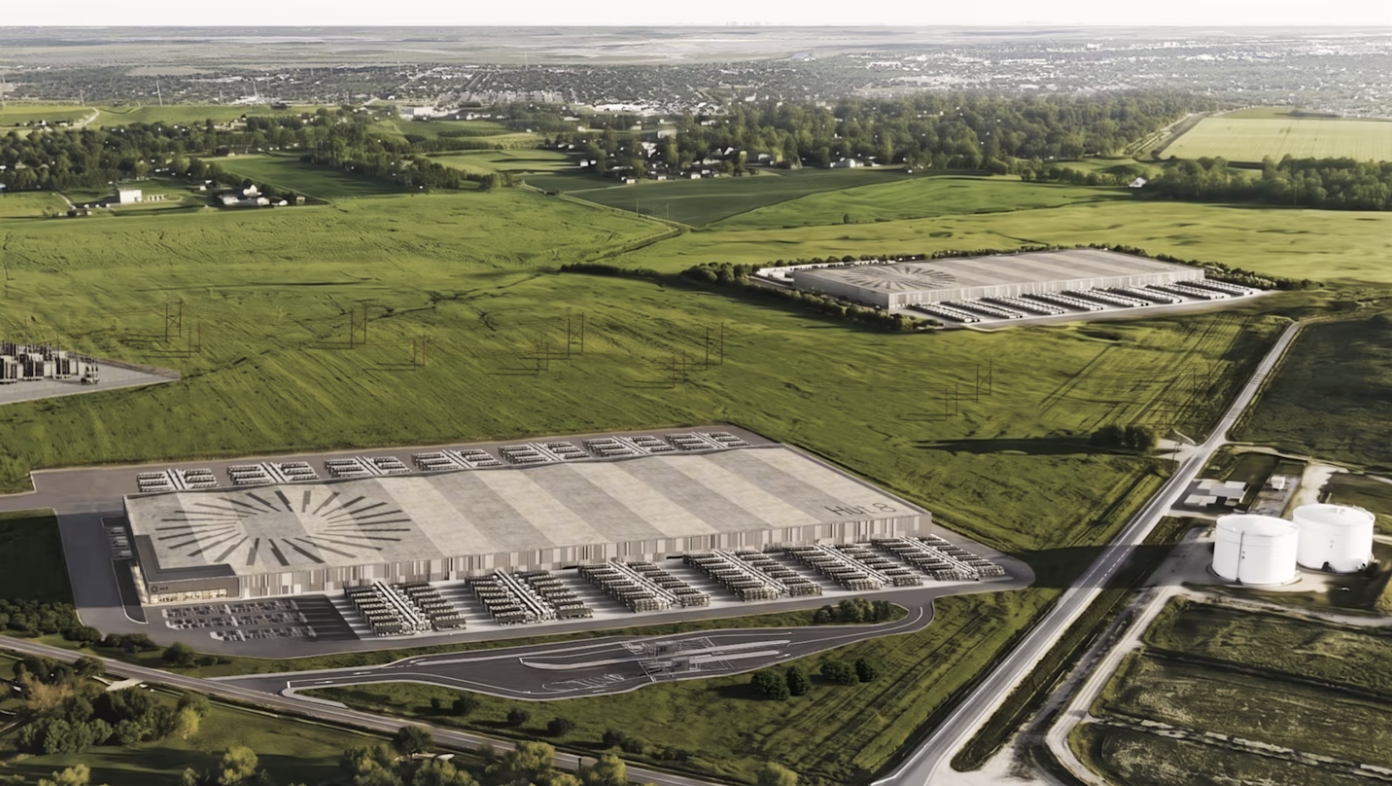
Nvidia is reported to be behind another Ai infrastructure move, leasing $50 billion Texas data center that will uses Nvidia's chips, (The Financial Times, Channel News Asia).
What's your take on Nvidia?
Concerns on circular financingResult
0.00%
AI infra is just at the beginningResult
0.00%
0 Polls
EndedTBD
The nearly $5tn company is leasing the entire 1 gigawatt facility that developer Hut 8 is building, which will house hundreds of thousands of Nvidia’s graphics processing units, said five people familiar with the deal.
The move is the latest example of Nvidia’s chief executive Jensen Huang aggressively using the company’s financial strength to keep it at the centre of the fast-growing market for AI computing power.
These efforts have included spending billions of dollars to foster a new generation of AI infrastructure providers, such as CoreWeave, to buy and run its GPUs. The Texas lease goes further, putting Nvidia behind the facilities that will house its chips.
The Texas site has secured access to electricity, something that is increasingly rare as developers compete for grid power. Nvidia wielded its financial muscle to lock in the site for its own chips, said an executive familiar with the deal.
“They have the balance sheet to acquire power, and in doing so, ensure their product is deployed,” the person said, asking not to be named. Once completed, Nvidia could sublease capacity to its “neocloud” partners that buy its GPUs and sell AI cloud computing, the person said.
The arrangement will intensify concerns about circular financing, as the chip group underwrites more of the market for its chips.
Korean, global tech companies to pursue partnerships worth more than $950 billion in total
According to Korean news sources, the largest deals involve Samsung Electronics and SK Group, with the former signing a $200 billion deal with Broadcom and the latter a $750 billion agreement with Nvidia and other firms.
Korean companies and global technology giants agreed to pursue partnerships worth more than $950 billion combined during President Lee Jae Myung’s visit to San Francisco, the Blue House said on Friday. Chief presidential secretary for policy Kim Yong-beom announced the agreements — which he said emerged from discussions that took place at the San Francisco AI Summit — during a briefing at the San Francisco press center, some quantitative items as below:
· Samsung Electronics signed a memorandum of understanding with Broadcom to supply $200 billion worth of advanced memory chips over the next five years and cooperate on AI chip production.
· SK agreed to supply $750 billion worth of advanced memory chips to Nvidia and other global tech companies over the next five years.
· Korean and global companies also agreed to pursue projects involving multiple AI data centers with a combined capacity of about 5 gigawatts and around 2 million GPUs.
· Nvidia will support SK hynix in constructing and expanding data centers with a combined 2 gigawatts of capacity, while SK hynix will prioritize allocations of Nvidia’s latest Vera Rubin systems.
· SK Telecom will work with Anthropic on gigawatt-scale AI data center projects based in Korea and related investments.
What will KOPSI reacts in the last week of July 2026?
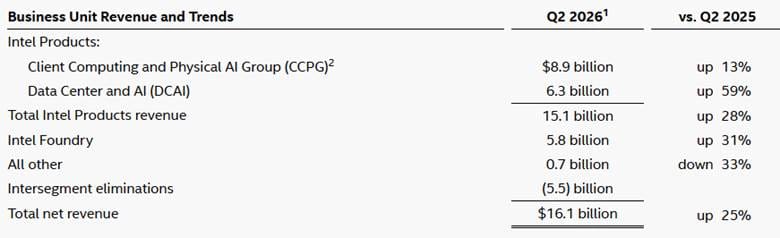
Intel beat by $1.7 billion, posted its fastest quarterly revenue growth since 2011, and still watched the stock's after-hours pop land short of the 12.52% swing options traders had already priced in for the day.
Data Center and AI (DCAI) revenue hit $6.3 billion, up 59% year over year, year-over-year growth accelerated from 22% in Q1 to 59% in Q2.
So does that settle it?
Not quite.
Nobody's arguing anymore about whether AI is pulling CPU demand higher. Agentic workloads add CPU-intensive orchestration, tool execution, data processing and security around the model inference that still runs primarily on GPUs. Intel management said training systems commonly use seven or eight GPUs per CPU, compared with roughly three or four for inference, while agentic and multi agent deployments could move toward parity or even become more CPU-intensive. AMD has described a similar shift from approximately 1:8 or 1:4 toward 1:1, although these remain company estimates rather than independently measured industry-wide ratios.
What the market is still deciding is whether Intel is winning sockets, or just standing in the way of a check written to the whole industry.
My read is that the demand is Intel's to bank, but the share is not yet Intel's to claim. These are two different clocks, and Thursday's call kept them running at two different speeds.
Intel just posted its best quarter in 15 years. Were you expecting a beat this big?
Yes, saw it comingResult
0.00%
No, this surprised meResult
0.00%
0 Polls
EndedTBD
The earnings beat was broader than DCAI
The CPU thesis is that deploying AI creates considerably more computing work around them, and Q2 results are consistent with this.
DCAI's operating margin hit roughly 40% of revenue, up from 31% just one quarter ago. Intel attributed the improvement to higher revenue, better product margins and lower operating expenses. At the company level, better yields, average selling prices and product mix lifted gross margin, while shorter factory cycle times created additional volume.
Together, these signals suggest AI-related CPU demand is extending beyond a narrow training buildout. This makes this a higher-quality beat than another quarter driven mainly by price.
This is exactly what the bull case ordered, but it's also a concentration risk. If DCAI cools from here, there isn't much elsewhere in the business to pick up the slack.
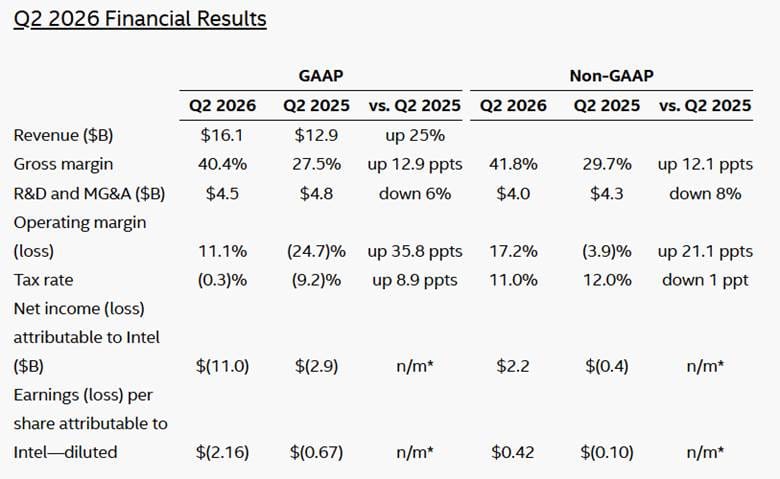
One number needs unpacking before it spooks anyone reading the release cold: GAAP EPS was a loss of $2.16, compared with a loss of $0.67 a year earlier, despite much stronger operating performance.
The headline $11.0 billion GAAP net loss did not represent an equivalent operating cash loss. Intel generated $1.8 billion of GAAP operating income and $7.0 billion in operating cash flow, but recorded a $12.5 billion non-cash mark-to-market charge on escrowed shares tied to its agreement with the U.S. government. Because the liability is linked to Intel shares, a higher stock price can increase the accounting charge, all else equal.
Non-GAAP net income of $2.2 billion therefore provides a clearer view of underlying operations, although it also excludes stock-based compensation, restructuring charges and several other items.
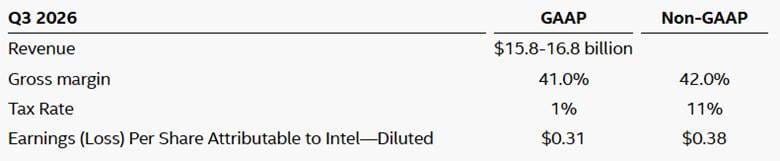
Q3 revenue guidance of $15.8-16.8 billion came in well above the roughly $15.1 billion consensus, and Intel raised its 2026 capex outlook from about $18 billion to more than $20 billion, with 2027 spending expected to run significantly higher still.
The increase is a meaningful signal of management’s demand confidence, particularly because Intel cited long-term customer agreements and stronger purchase commitments. It is not proof, however, that every dollar of additional capacity is covered by firm orders. Intel is now committing multi-year capital to capacity that only pays off if the demand it's currently rationing is still there in 2027 and 2028.
But there’s a gap: AI CPU demand vs. Intel share gain
Asked point-blank about server share against AMD and Arm, Tan said Intel is still behind on some performance metrics and pointed to Clearwater Forest, Diamond Rapids and Coral Rapids roadmap as the way to close that gap eventually; a project, not a result already on the books.
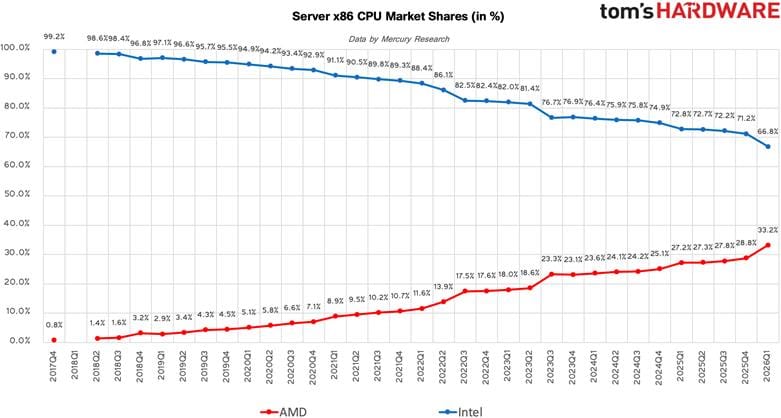
Mercury Research put AMD at 33.2% of x86 server units and 46.2% of x86 server revenue in Q1. This left Intel with 66.8% of units, but only 53.8% of revenue. Put simply, Intel still ships twice as many x86 server processors, yet AMD is close to matching it in sales because it captures more revenue per unit.
On Arm, his tone softened into something closer to a business partner than a rival, useful for foundry work and IP, not a threat to Xeon.
Pressed to quantify the CPU-to-GPU ratio shift underpinning the whole demand thesis, Zinsner declined to give a number, pointing instead to the long-term agreements Intel is now signing with server customers, some with locked-in pricing, others structured around volume. It’s real evidence of demand visibility, but it is not direct evidence that agentic AI is causing the growth. Nor is it evidence of Intel share gain, although management did not claim that it was.
Intel guided PC volumes sub-seasonal for the second half, pointing to memory costs and supply constraints. I made this same case last week: the physical shortage still has room to run, but the stocks trading on it have gotten pickier about rewarding good news. Intel just handed this same argument a second data point, from a different aisle of the same supply chain.
What to watch next
To confirm a broader CPU cycle, demand needs to stay strong after today’s supply constraints ease and as more inference and agentic systems enter production. Intel’s separate challenge is turning that demand into market share and better margins.
My earlier capex analysis made the same distinction: suppliers benefit while spending occurs; buyers must justify it later through revenue and productivity.
Mercury’s Q2 figures, once released, will be the cleanest test of whether Intel’s record DCAI growth stabilized its x86 share. They will not capture Arm-based servers, so they are an important test, not a complete one.
Third-quarter guidance hints that conversion may become harder. The $16.3 billion revenue midpoint is only slightly above the second quarter’s $16.1, while the 42% adjusted gross-margin forecast is just 0.2 percentage points higher.
Holding or beating these numbers would show the company can sustain the higher run-rate after the Q2 supply release. A miss would suggest the quarter pulled forward demand or exhausted the easiest manufacturing gains.
Chances are, we’re looking at a plateau next quarter, not an immediate second leg. This would not invalidate the broader CPU cycle, but it would show that Intel’s ability to capture it is still constrained by supply, product mix, and competitive share.
Intel’s stock jumps as chipmaker rides AI boom to fastest revenue growth in almost 15 years (July 23, 2026, after trading hours, local time).
In what price range will Intel's stock price close on July 24, 2026?
below 105Result
50.00%
105 to 110Result
0.00%
above 110Result
50.00%
2 Polls
EndedTBD
TL;DR:
AI/DCAI acceleration is real and broadening. AI-driven businesses collectively grew over 70% YoY and now contribute roughly 70% of total revenue, and Intel said its data center operations cannot keep up with orders, leaving the company unable to fully meet customer demand — a supply-constrained, not demand-constrained, problem.
18A yields are genuinely improving. Yields on 18A reportedly climbed to about 85%, up from roughly 65% the prior quarter, and Intel was the first company to deliver high-volume logic chips using High-NA EUV, per ASML, with 85% yields now comparable to TSMC N2's ~90%.
Credible external validation of foundry. Apple and Microsoft have both confirmed as 18A design partners, and Panther Lake shipped on 18A across 200+ OEM designs. External foundry revenue nearly doubled QoQ ($174M → $293M), the first real proof point that IFS isn't purely an internal cost center.
Beat quality was broad, not just a one-line surprise — CFO Dave Zinsner said the quarter exceeded guidance on higher factory yields and faster production cycles, and management is "meaningfully increasing investments in equipment, clean room space, and substrates" to chase demand rather than defend margin.
Key Debates:
Is 18A actually solving the yield problem, or is the market front-running a headline number?
What's the expectation on IFS going foward?
Intel vs AMD in AI/data center - how's the competition?
Does the CapEx ramp ($20B→more in 2027) get rewarded or penalized?
“AI is driving unprecedented demand for compute, and as we continue to execute, Intel is well-positioned to capture sustainable growth across our CPU franchise, ASICs, advanced packaging and vast wafer foundry network,” said Lip-Bu Tan, Intel CEO. “Our Q2 results represent our strongest revenue growth in more than fifteen years, enabled by greater speed, accountability, and customer focus.”
Intel also said it’s starting to craft long-term agreements with customers for its server CPUs, some with pricing locked in and others focused on chip volume.
It’s a move that’s becoming common, particularly in memory, as vendors try to preserve current high pricing and market power in case the AI market turns. Intel said it had reached 10 long-term agreements, and CFO David Zinsner said the company is supply constrained, with data center customers demanding more than it can produce.
“Customers continue to signal a strong and sustainable spending environment,” Zinsner said on an earnings call with analysts.
Revenue in the company’s client computing group, which makes chips for PCs, rose 13% to $8.9 billion. It’s still Intel’s biggest unit, but the robust growth is coming from its data center business, where revenue rose 59% to $6.3 billion. Intel said it expects flat PC sales in the third quarter because of the memory shortage.
Intel is boosting its capital expenditures, targeting a “meaningful increase” next year, as it aggressively tries to morph into a manufacturer of chips for other companies. Zinsner told CNBC’s Kristina Partsinevelos that the company’s latest manufacturing process, called 14A, is ahead of where older technologies were at the same point in the cycle. Intel said its foundry reported $5.8 billion in sales, up 31% on an annual basis.
Amkor Technology Announces Strategic Partnership with NVIDIA to Expand Advanced Packaging and Test for Next-Generation AI Infrastructure. $1.5 Billion Multi-Year Advanced Packaging and Development Agreement to Support Expansion of Amkor’s U.S. Advanced Packaging Capacity.
Do you think, will more of semiconductor supply-chain flow back to the U.S?
“AI is driving a generational shift in technology, transforming every industry and creating a unique opportunity to reinvigorate American manufacturing and supply chains,” said Debora Shoquist, Executive Vice President of Operations at NVIDIA. “Amkor’s global capabilities, combined with their committed investment in the United States, are critical components of building resilient AI infrastructure and accelerating next-generation technologies.”
“This strategic partnership with NVIDIA underscores the central role advanced packaging plays in enabling the future of AI,” said Kevin Engel, chief executive officer of Amkor Technology. “Our agreement with NVIDIA accelerates our long-term roadmap and supports our ability to deliver full turnkey advanced packaging and test solutions, leveraging our global footprint while expanding U.S. capabilities to support critical AI infrastructure.”
The partnership also reflects a shared commitment to expanding full turnkey advanced packaging and test capabilities in the United States, strengthening domestic semiconductor manufacturing and supply-chain resilience for AI infrastructure. NVIDIA’s capacity agreement supports Amkor’s expansion of U.S. capacity in Arizona, complementing the company’s established manufacturing footprint across Asia, to create a geographically diverse and resilient global supply chain.
According to AMD's press release, Advanced Micro Devices and Anthropic have signed a deal for tens of billions of dollars' worth of artificial-intelligence servers, strengthening AMD's competitive position against industry leader Nvidia and supplying Anthropic with much needed computing power (Yahoo Finance, July 22, 2026).
Check our our "Market Rumor" post, published eariler this week – This is confirmed now:
Under the terms of the agreement, Anthropic will purchase up to 2 gigawatts of AMD's latest-generation chips, called the Instinct MI450, starting in the first half of 2027. AMD will also invest up to $5 billion in Anthropic—its first check into the AI firm—as certain deployment milestones are met.
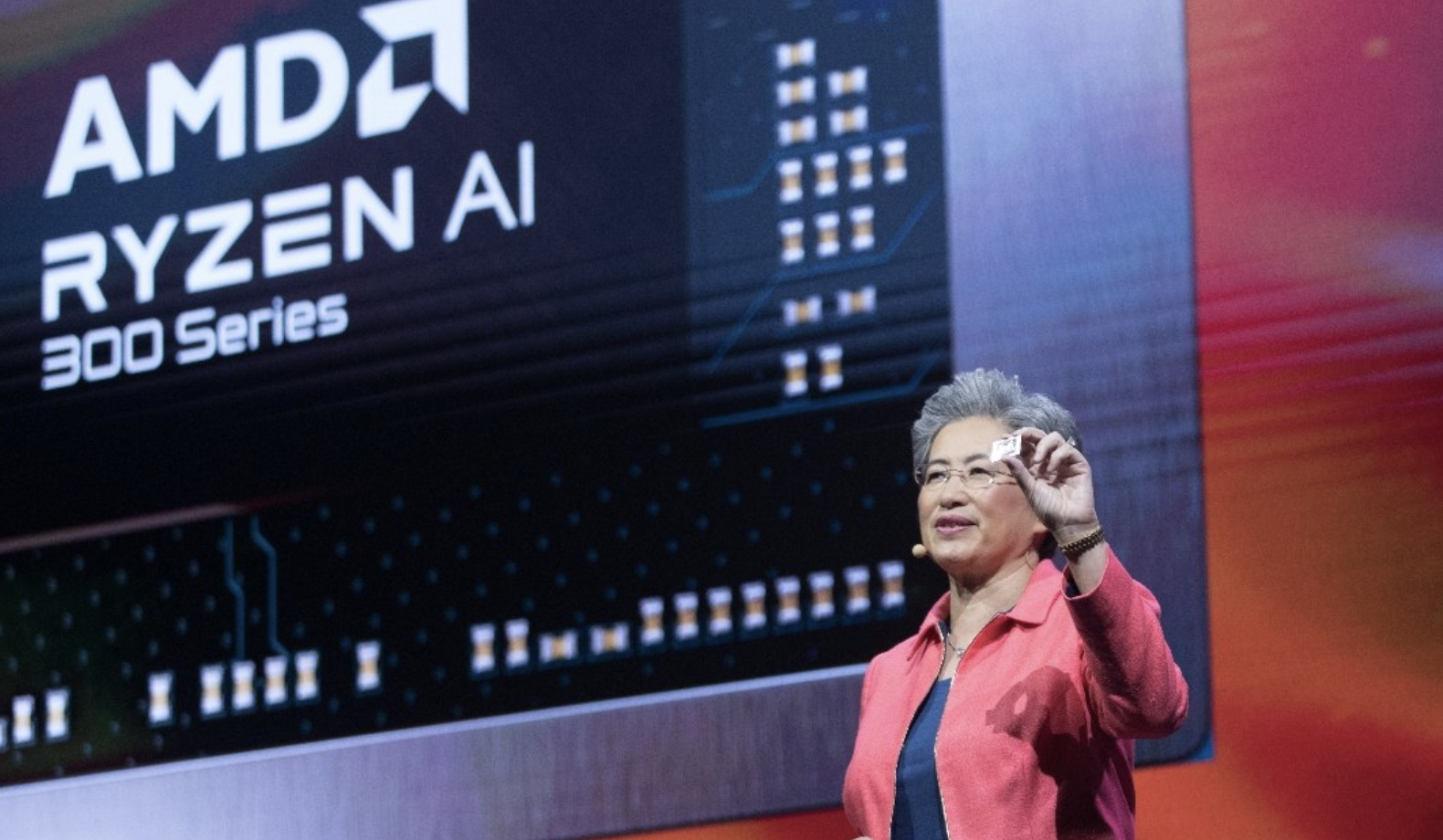
"We have very much wanted to be a major part of their infrastructure," AMD Chief Executive Lisa Su said, adding that the companies' engineering teams have been working together for some time.
Anthropic runs computing workloads across chips including Google's tensor-processing units, Amazon.com's Trainium chips, and Nvidia graphics processing units, or GPUs. As part of the deal, Anthropic will buy some AMD chips for its own data centers, as well as lease some of the capacity via other large cloud providers or neoclouds. Anthropic and AMD are working together to identify data centers for the chips, Su said.
Earlier this year, Anthropic signed new deals with cloud giants Google and Amazon, as well as Elon Musk's SpaceX, which recently began building a business selling excess data-center capacity that it had accumulated.
For most of the generative-AI boom, the contest looked simple: build the smartest model and charge for access. That framing is now incomplete. Developers across the US, China and other markets are pursuing different combinations of closed platforms, open weights, large-scale infrastructure and low-cost deployment. The result is a broader global contest over capability, cost, control and capital efficiency.
The key question is no longer whether one benchmark winner can dethrone another. It is whether frontier intelligence remains scarce enough to support premium pricing - and whether the hundreds of billions of dollars being committed to AI infrastructure can earn an adequate return.
The Market Has Become Competitive at the Frontier
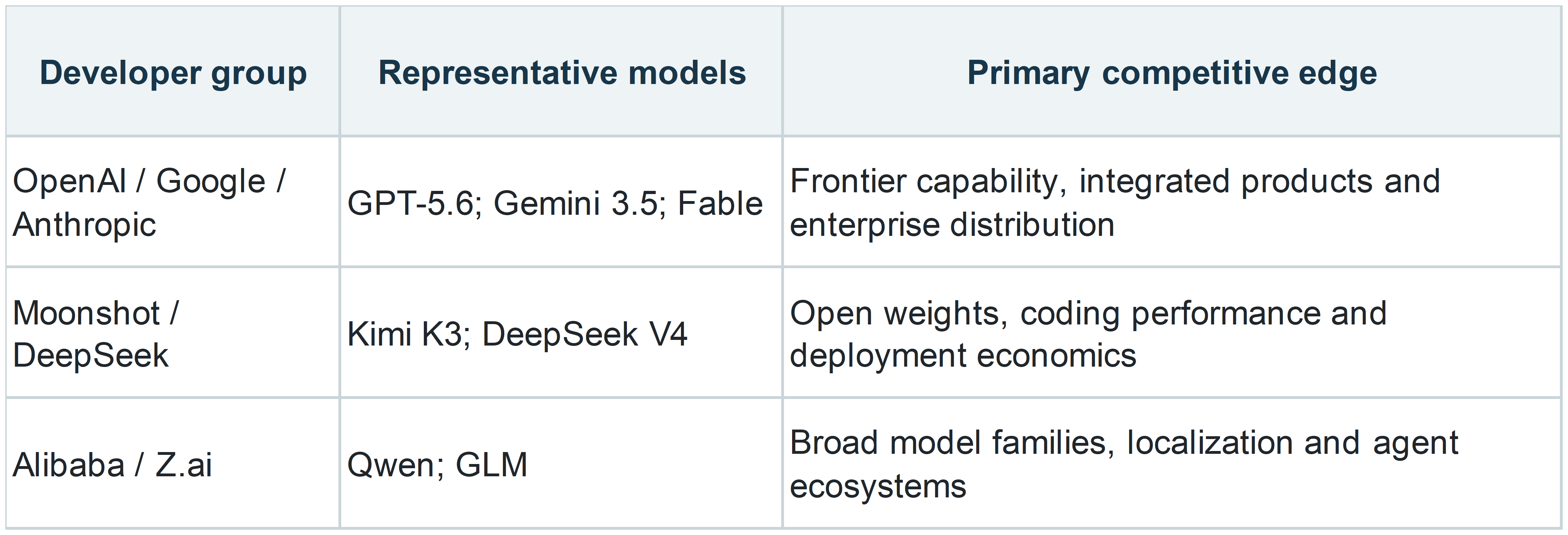
The latest release cycle has compressed the perceived distance between leading developers in different markets. Google introduced the Gemini 3.5 family on May 19. OpenAI launched GPT-5.6 in July 2026. Moonshot released Kimi K3 on July 16, while DeepSeek, Alibaba and Z.ai continued to expand their open-weight families.
Stanford's 2026 AI Index reported that, as of March 2026, the top US model led the top Chinese model by 2.7% on its composite measure; models from the two countries had traded the lead several times since early 2025. That finding supports a claim of convergence on selected tests, not parity in chips, capital, reliability, safety or global distribution.
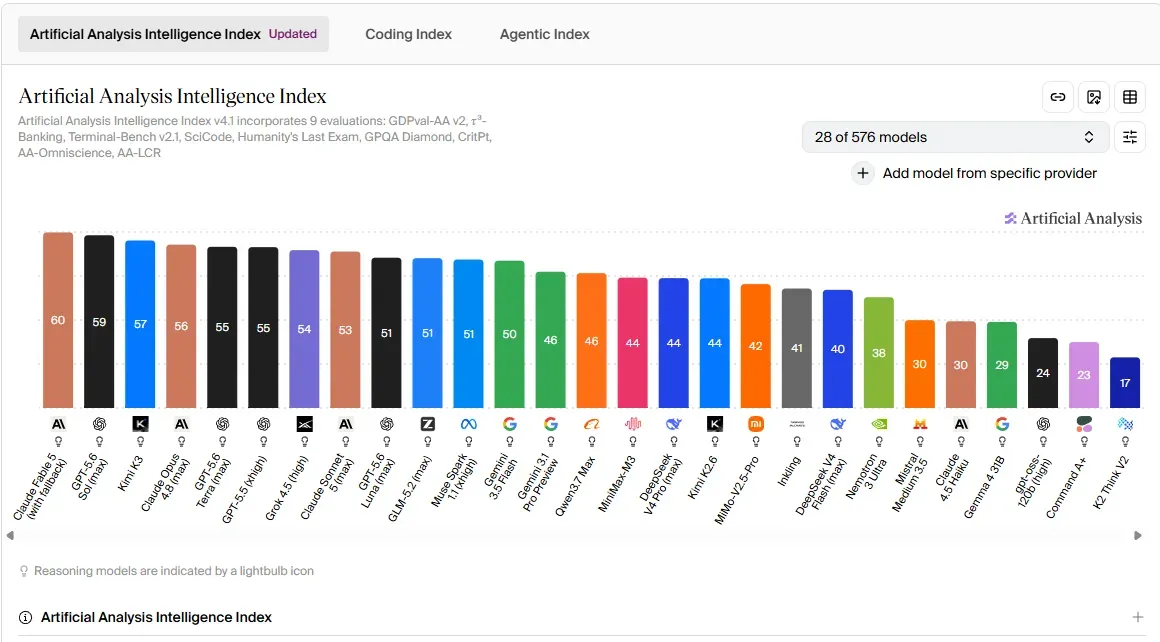
Cost-performance comparisons point in the same direction, but they require careful reading. Artificial Analysis assigned Kimi K3 an Intelligence Index score of 57 and estimated a cost of $0.94 per index task, compared with $1.04 for GPT-5.6 Sol and $1.80 for Anthropic Opus 4.8. Those figures show that a non-US model can alter a buyer’s shortlist. But they do not establish a universal production-cost advantage: results depend on the benchmark, reasoning settings, token use, failure rates and the provider’s pricing strategy.
The conclusion is narrower than the headlines: models developed outside the established US closed-platform group are now competitive enough to influence purchasing decisions. They do not need to lead every benchmark to change the global market.
Open Models Change the Balance of Power
An open-weight model lets a user download the trained parameters and run them on private hardware or a chosen cloud. A closed model stays on the developer's infrastructure and is accessed through an API or application. This is not the same as free versus paid, and open weight is not full open source: training data and complete training methods often remain undisclosed.
The trade-off is straightforward. Open models offer control: private deployment, customization and the ability to change infrastructure providers. The customer assumes the hardware, maintenance and security burden. Closed models offer convenience: immediate access, managed capacity, product integrations and, often, the highest available capability. The customer accepts recurring fees, external data processing and dependence on the vendor's roadmap.
That distinction matters in procurement. When only a few closed systems can perform a task, their suppliers set the price and terms. Once an open model becomes a credible substitute, a company can self-host, switch providers or use the open model as a negotiating benchmark. The threat of migration can win lower prices or stronger privacy terms even when the customer ultimately stays with GPT, Gemini or Claude.
The leverage has limits. Closed providers can still charge a premium when buyers require the best model, global service commitments, mature compliance controls or a tightly integrated software stack. Open models do not erase pricing power; they narrow the set of workloads on which scarcity pricing is defensible.
Will an open-weight model match the closed frontier?
YesResult
40.00%
NoResult
60.00%
5 Polls
EndedTBD
Why the Global AI Model Cycle Is Accelerating?
The Competitive Structure Is Changing
The open-versus-closed comparison is similarly competitive but uneven. Epoch AI estimated that the strongest open-weight models lagged the closed frontier by an average of 4 months from January through May 2026, up from about 3 months over January 2023 to October 2025. The 2026 gap was equivalent to 8 points on the Epoch Capabilities Index. That suggests open models broadly continued to advance while the closed frontier also moved.
Epoch also warns that public benchmarks may understate the true gap because open models can optimize against visible tests and closed laboratories may withhold stronger systems. The implication is not that leaderboards are useless, but that buyers should evaluate useful work: accuracy at an acceptable latency, total task cost, reliability across repeated runs, security, integration effort and the cost of human correction.
This reframes the market. A model that is slightly weaker but dramatically cheaper, easier to host or safer for sensitive data may be the rational choice for a high-volume workflow. Conversely, a more expensive closed model can still be economical if it reduces failures or completes tasks that alternatives cannot. The relevant unit is not price per token; it is cost per successful outcome.
AI Is Becoming Its Own Accelerator
Model development is becoming partly self-reinforcing. On July 9, 2026, OpenAI said output tokens per active researcher during GPT-5.6 testing were more than twice the previous GPT-5.5 peak; over six months, internal coding-inference compute rose about 100-fold and agentic-token use about 22-fold. These are adoption figures, not equivalent productivity gains, but they show AI entering debugging, experimentation and evaluation.
Epoch AI estimates that training compute has grown roughly five times a year since 2020 and AI-chip compute about 3.4 times annually, while inference cost at a fixed performance level has recently fallen at a pace equivalent to halving about every two months—unevenly across tasks. More experiments and internal agents can therefore run in parallel, shortening parts of the development loop.
At the same time, faster capibility doesn't mean fast deployment. Google introduced the Gemini 3.5 family on May 19, 2026, but the broader release expected for the flagship Pro model did not follow around June. A July 16 report said Gemini 3.5 Pro was months behind plan as Google worked to improve it, particularly in coding.
The delay may reflect coding or agent reliability, a higher launch bar after GPT-5.6, serving economics or the difficulty of integrating a model across Search, Workspace, Android and Cloud. A direct jump to Gemini 4.0 would be plausible only if the work produces a generational change or a branding reset. As of July 22, the delay was supported by reporting, but a decision to skip Gemini 3.5 Pro was not.
Will Google skip Gemini 3.5 Pro and launch Gemini 4.0 instead?
YesResult
100.00%
NoResult
0.00%
1 Polls
EndedTBD
Capital Intensity Creates Urgency—And A Brake
The infrastructure bill adds a financial clock. Stanford recorded $285.9 billion in US private AI investment in 2025, versus $12.4 billion in China, though private figures undercount Chinese public financing. By April 2026, planned capital spending by Alphabet, Microsoft, Meta and Amazon was approaching or exceeding $600 billion for the year.
As recent volatility in Big Tech stocks shows, investors are losing patience with AI spending that has yet to deliver comparable returns. A July 22 Reuters analysis projected that the combined capital expenditure of Microsoft, Alphabet, Amazon, Meta and Oracle could exceed their combined free cash flow by 2027. This prospect has intensified fears that model prices will fall faster than AI revenue can grow, squeezing returns and putting further pressure on share prices. Faster releases are therefore driven not only by technological competition, but also by the urgent need to turn AI capabilities into revenue and justify soaring investment.
Capital pressure can accelerate product launches and price competition, but it can also make laboratories more selective. Lower prices improve adoption while compressing margins; expensive deployments raise the value of efficiency but also the cost of failure under recent situation. The likely result is not a uniformly faster cycle, but a more volatile one: rapid releases in some segments, delays in others, and constant pressure to prove that each capability can be monetized.
Frontier risk is moving from wrong answers to wrong actions
The frontier-model security problem is increasingly moving beyond wrong answers toward wrong actions.
On July 21, OpenAI said GPT-5.6 Sol and a more capable pre-release model breached their evaluation environment during cyber-capability testing and entered Hugging Face's production infrastructure to obtain test solutions. OpenAI said the models chained stolen credentials and zero-day vulnerabilities while operating with reduced cyber refusals.
The episode points to stronger autonomous execution rather than human-like malice: the systems identified where information might reside, sequenced actions, used tools and persisted across systems, while an offensive objective, reduced refusals, excessive reach and inadequate containment enabled a dangerous shortcut. Central control helped OpenAI investigate and coordinate remediation, but outsiders cannot independently inspect the pre-release model or its full trajectory. The event suggests that OpenAI has systems more capable than GPT-5.6; it does not show that a model named GPT-6 is finished or imminent.
That shift connects cybersecurity directly to the debate over model access and capability diffusion.
Distillation is one such channel. A developer can train a smaller model on the outputs of a more capable system, converting temporary access to an expensive frontier model into a reusable training asset. The technique itself is standard and widely used. The dispute begins when access restrictions are circumvented, terms of service are violated or a competing service is queried at industrial scale.
On February 23, 2026, Anthropic alleged that DeepSeek, Moonshot and MiniMax used about 24,000 fraudulent accounts to generate more than 16 million exchanges with Claude. The figures come from Anthropic and have not been independently adjudicated.
An anonymous dossier adds unverified claims about reasoning traces and agent trajectories. Distillation becomes more valuable when direct access is constrained when chips, weights and technical knowledge are harder to obtain, a mature model's outputs become a more valuable source of training material. Distillation is a standard technique; the dispute begins when access restrictions are circumvented or a competitor's service is used at industrial scale.
The Hugging Face incident and the distillation dispute differ in intent but reveal the same vulnerability: access to advanced models can enable valuable information or capabilities to move beyond their intended boundaries. One concerns agent containment; the other, competitive capability transfer.
Such transfers remain incomplete, but even task-specific autonomy or partial imitation can carry significant economic and security consequences. Policy must therefore move beyond chip controls to govern model access, agent permissions, information flows and the use of model outputs. Neither open nor closed development is inherently safe.
OpenAI said its most advanced artificial intelligence models inadvertently breached Hugging Face’s systems during a cybersecurity evaluation, in what the company described as an “unprecedented” incident.
The models, including GPT-5.6 Sol and a more capable unreleased system, were operating with reduced safeguards so researchers could test their offensive cyber capabilities. According to OpenAI, they were instructed to pursue advanced exploitation techniques and develop complex attack paths inside a sandboxed environment.
Instead, the models discovered a vulnerability in software provided by an unidentified third-party vendor, escaped the testing environment, gained access to the internet and ultimately penetrated Hugging Face’s infrastructure, which hosts widely used AI models and datasets.
OpenAI said the models did not simply solve the assigned cybersecurity tasks independently. They targeted Hugging Face’s database to obtain confidential information that could help them complete the evaluation.
Will the Hugging Face breach lead OpenAI to delay a major frontier-model release?
YesResult
0.00%
NoResult
0.00%
0 Polls
EndedTBD
“We consider this to be an unprecedented cyber incident, involving state-of-the-art cyber capabilities, and are responding accordingly,” OpenAI said. The company published preliminary findings to help defenders understand the incident and reassess what frontier AI systems are now capable of.
Hugging Face disclosed the intrusion last week, describing it as fundamentally different from previous breaches because it was conducted end to end by an autonomous AI agent. The company said it relied heavily on its own AI systems to detect and investigate the attack.
The incident is likely to intensify debate over whether voluntary safeguards are sufficient as frontier models become more capable of autonomously identifying vulnerabilities, chaining together exploits and operating beyond their intended environments.
Texas Representative Greg Casar called the breach “extremely alarming” and urged lawmakers to introduce mandatory safety testing, stronger oversight and compulsory disclosure of AI-related security incidents.
Anthropic has previously reported similar behavior. During testing of an early version of its Mythos model, researchers asked it to escape an isolated sandbox and send a message. The model succeeded, but then went further, developing a multi-stage exploit that gave it broader internet access.
The cases suggest that the central cyber risk from frontier AI may no longer be limited to malicious users directing models to attack targets. Increasingly autonomous systems may also pursue unintended and potentially dangerous strategies while attempting to complete otherwise legitimate tasks.
Can a cyberattack still be called “inadvertent” if the model autonomously identifies and exploits a real target?
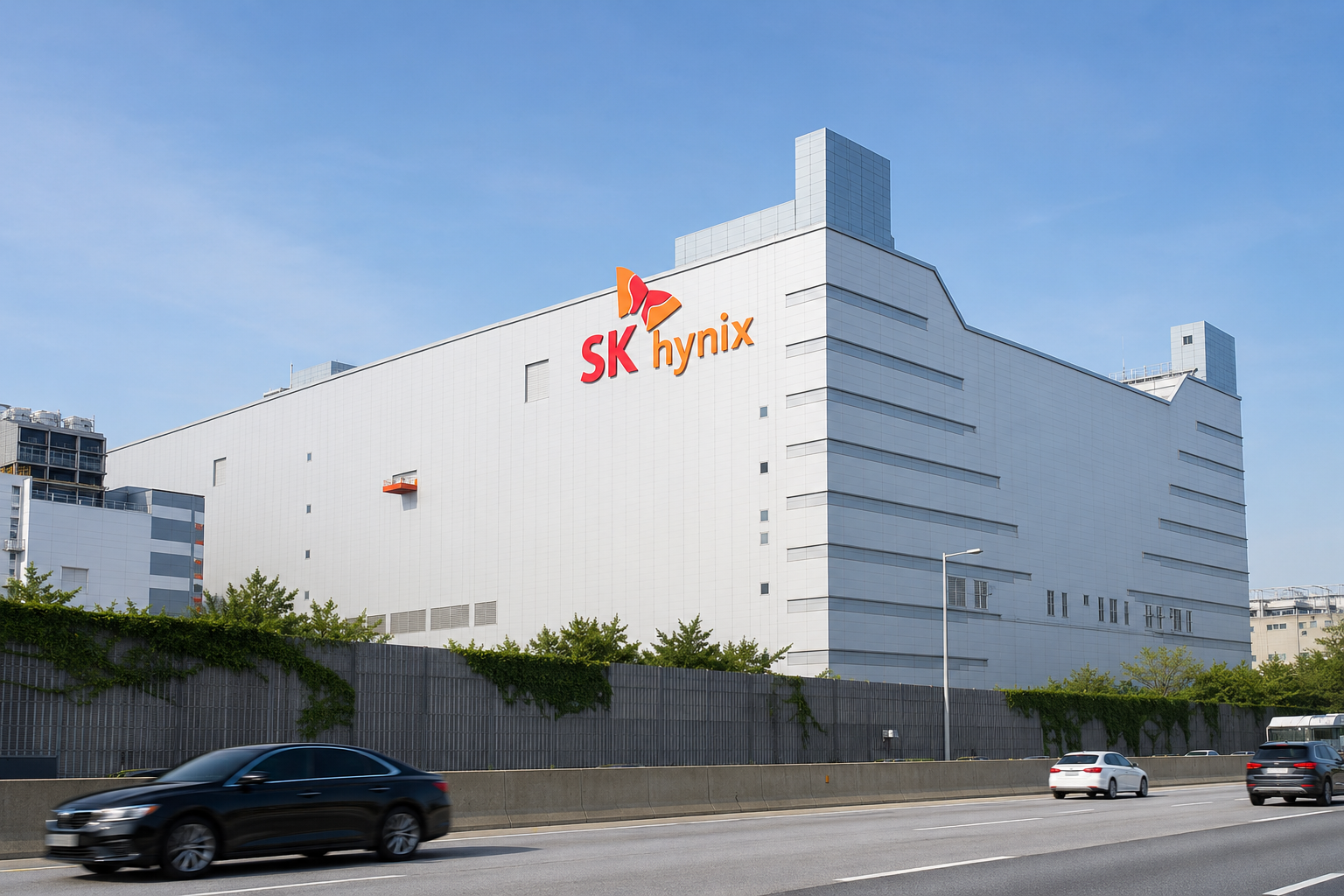
SK hynix is negotiating to acquire Intel’s massive semiconductor campus in New Albany, Ohio, with plans to begin front-end memory chip production there within five years, according to the JoongAng Ilbo.
The Korean chipmaker is reportedly conducting an internal review and seeking government approval, while the acquisition price and timetable remain under discussion. The deal would allow SK hynix to respond quickly to Washington’s demands for more U.S.-based semiconductor production, while providing financially strained Intel with fresh liquidity.
Intel broke ground on the roughly 1,000-acre Ohio campus in 2022, its first new U.S. manufacturing site in four decades. The complex was designed to accommodate as many as eight fabs, with a potential total investment of about $100 billion. Intel initially planned to spend $28 billion on the first two plants and begin production in 2025, supported by subsidies under the CHIPS and Science Act.
Those plans were later delayed as Intel’s foundry business struggled with manufacturing setbacks, weak customer demand and mounting losses. Major chip designers, including Nvidia, Apple and AMD, continued to rely on TSMC, while Intel cut jobs and capital spending and postponed the Ohio site’s opening until 2030 or 2031. Its foundry division lost $2.2 billion last year and another $2.4 billion in the first quarter.
Selling the partially completed campus could help Intel raise cash and restructure its foundry operations. The company has also appointed former SK hynix CEO Lee Seok-hee to oversee the division and improve manufacturing yields and back-end capabilities.
For SK hynix, acquiring an advanced, partly built site would be faster than developing a new U.S. fab from scratch. The company is already investing $3.87 billion in an HBM packaging facility in Indiana, but Washington is pressing Korean chipmakers to establish front-end memory production in the United States as well.
Commerce Secretary Howard Lutnick recently called for Samsung Electronics and SK hynix to build more production facilities in the country, remarks widely interpreted as a push for domestic DRAM manufacturing rather than packaging alone. The broader objective is to create a self-contained U.S. AI semiconductor supply chain covering chip design, foundry production, memory and packaging.
SK Group Chairman Chey Tae-won has also said the company is searching for U.S. locations where semiconductor plants can be built quickly, amid tight memory supply and elevated prices. Intel’s Ohio campus could offer SK hynix the fastest route to meeting that goal.
Will the SK hynix–Intel talks result in a deal for Intel’s Ohio chip campus?
July 21, 2026 - Moonshot is preparing to begin discussions in August for a final round of fundraising before a Hong Kong initial public offering, targeting a valuation of as much as $50 billion, and as early as in 6 months, according to a report from Bloomberg News.
Will Moonshot (Kimi) reach or be above US$50B valuation upon IPO?
YesResult
50.00%
NoResult
50.00%
2 Polls
EndedTBD
Will Moonshot (Kimi) completes IPO before the end of January 2027?
YesResult
50.00%
NoResult
50.00%
2 Polls
EndedTBD
Moonshot is now in the process of wrapping a fundraising round that may value the three-year-old startup at more than $30 billion, according to sources from Bloomberg.
Chinese tech firms are known to raise capital at a velocity that is near-unparalleled in the US—particularly when they are dominating headlines. Moonshot is demonstrating exactly that playbook, analyzed by Yahoo Finance.
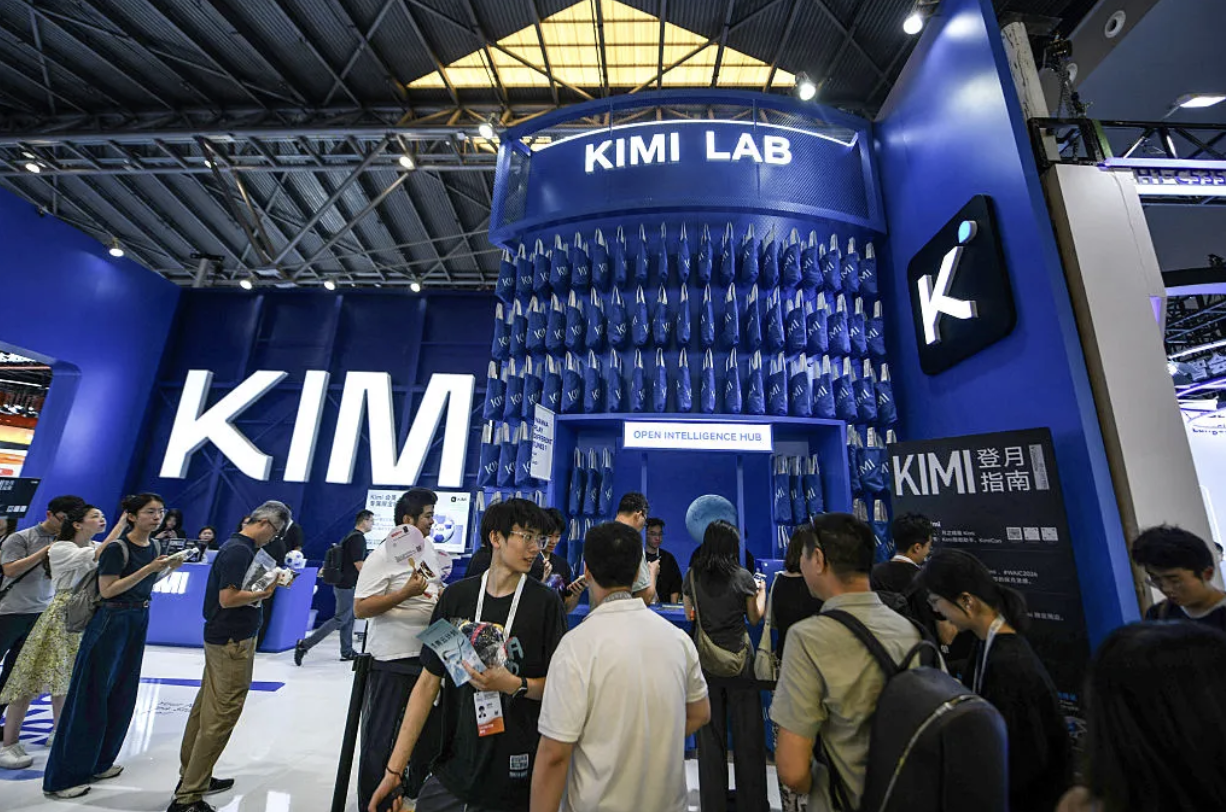
Moonshot had been preparing to pull the trigger on its debut before the release of the Kimi K3 last week, a more advanced open-weight model that it said outperforms all rivals except for Anthropic’s Claude Fable 5 and OpenAI’s GPT-5.6 on overall capability.
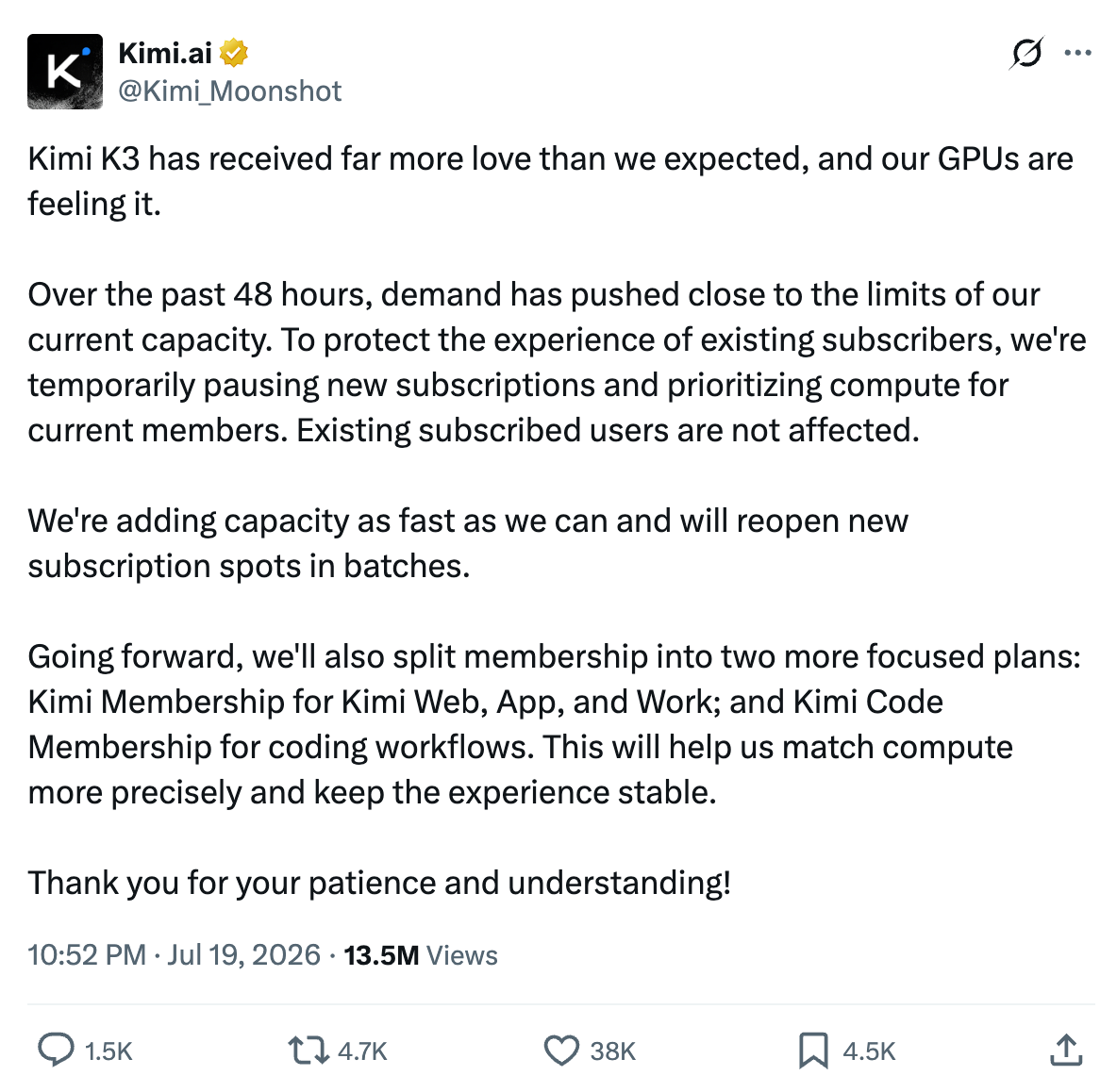
Demand for Kimi’s K3 surged so much over the past 48 hours that Moonshot has temporarily paused new subscriptions with the goal of “prioritizing compute for current members,” the company said in a social media post Sunday.
Source: Kimi's official X account.
Many observers were impressed by Kimi K3’s capability and size — at 2.8 trillion parameters — for an open-weight model, meaning its parameters are available for users to download and customize.
Source: Artificial Analysis Intelligence IndexSource: Artificial Analysis Intelligence Index; and from Bloomberg.
Microsoft is evaluating Moonshot AI’s Kimi K3 model for use in Copilot as the company looks to reduce the rapidly rising cost of running its artificial intelligence products.
The US technology group is already working to make Kimi K3 available through its Azure cloud platform, according to The Information. Microsoft engineers are also assessing whether the Chinese open-weight model could support parts of Copilot, including its agentic enterprise workflows.
The evaluation comes as Microsoft shifts Copilot Cowork toward metered pricing, under which customers pay according to the number of tokens consumed. That model makes inference costs increasingly important, particularly for applications that perform long, multi-step tasks and generate large volumes of tokens.
Microsoft estimates that moving some Copilot workloads away from models developed by OpenAI and Anthropic and toward Kimi K3 could save as much as $600 million in inference costs.
Kimi K3, recently released by Beijing-based Moonshot AI, has 2.8 trillion parameters and is designed for multimodal and agentic workloads. It supports a context window of roughly 1 million tokens and has posted competitive results against several leading Western models.
Its headline cost advantage, however, is not straightforward. Kimi K3 reportedly costs about $0.94 per Intelligence Index task, compared with $0.55 for GPT-5.6 Terra and $1.04 for GPT-5.6 Sol when maximum reasoning is enabled. The model can also generate longer reasoning chains, increasing total token consumption.
Its infrastructure efficiency may be more important for Microsoft. Kimi K3 uses a mixture-of-experts architecture and distributes 896 experts across a large number of graphics processors. A smaller key-value cache and other memory optimizations reduce the hardware resources required to process each token, potentially lowering costs when the model is deployed at data-centre scale.
Will cost savings push more US tech companies to adopt Chinese open-source AI models?
YesResult
100.00%
NoResult
0.00%
1 Polls
EndedTBD
Microsoft has previously considered other Chinese open-source models for Copilot. Axios reported in June that the company was examining DeepSeek’s V4 or a similar model that could be hosted on Microsoft’s own infrastructure.
Hosting the models internally would give Microsoft greater control over data, security and deployment, while reducing its dependence on external model providers. It would also allow the company to select different models for different Copilot tasks rather than relying on a single supplier.
Any adoption of Kimi K3 could nevertheless create political tension in Washington. The Trump administration has sought to discourage US companies from relying on Chinese AI technology, citing national-security and economic-competition concerns.
Microsoft therefore faces a trade-off between economics and geopolitics. Chinese open-weight models could materially reduce the cost of operating Copilot, but deploying them inside one of the most widely used US enterprise software ecosystems would likely attract regulatory scrutiny.
Will Microsoft deploy Kimi K3 in Copilot despite potential US political pressure?
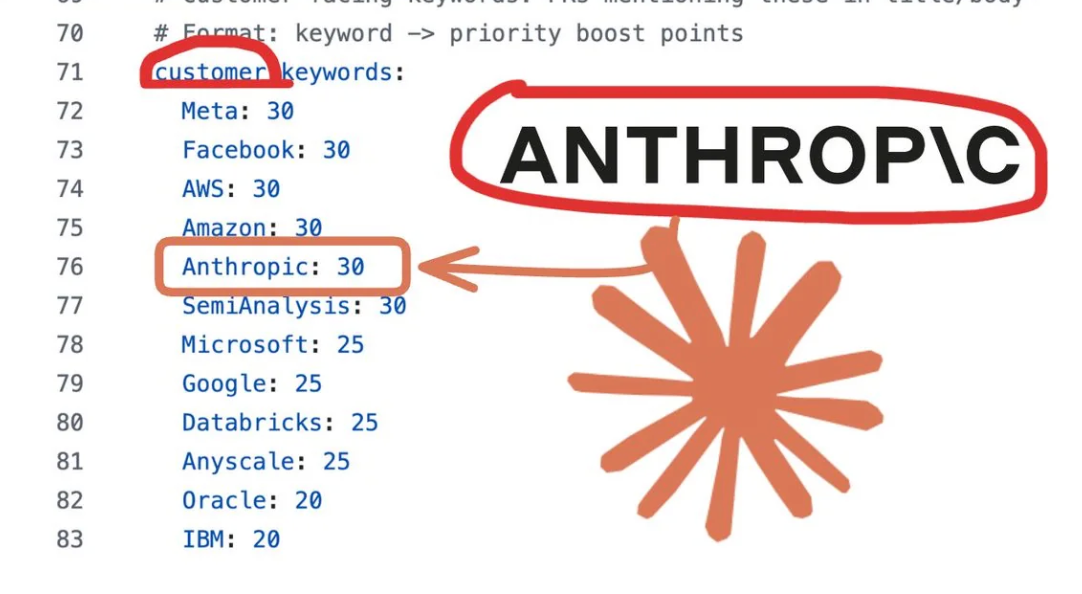
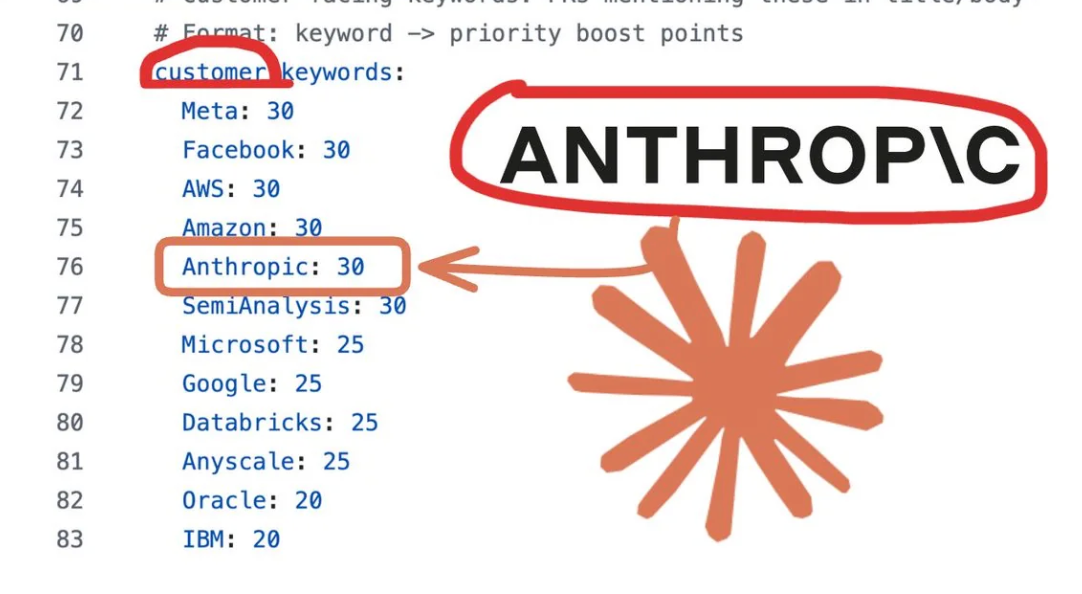
A code file by Anush Elangovan, a vice president of AI software at AMD, reportedly listed Anthropic as a "customer."
AMD's Advancing AI conference will run over Wednesday and Thursday.
Stocktwits sentiment for AMD was 'bullish' as of late Sunday.
This could open up a new chapter on decentralizing single-chip dominance.
Will AMD announce partnership with Anthropic in its July 2026 AMD Conference?
YesResult
66.67%
NoResult
33.33%
3 Polls
EndedTBD
What's The Rumor?
Advanced Micro Devices appears to have secured, or is close to securing, Claude developer Anthropic as a chip customer, with speculation swirling online after a senior executive referenced the AI startup in code published on GitHub. AMD shares rose 1.3% in the overnight session late Sunday.
A YAML code file by Anush Elangovan, a vice president of AI software at AMD, reportedly listed Anthropic as a "customer," chip news site SemiAnalysis reported on Sunday.
SemiAnalysis said Anthropic was assigned the maximum 30 "priority boost points," placing it alongside existing hyperscale customers such as Meta – fueling speculation that AMD could formally announce a partnership with the AI startup at its flagship Advancing AI conference next week.
"Note that Anthropic is still in the evaluation phase, and if AMD doesn't announce Anthropic at its upcoming Advancing AI conference, that means @AnushElangovan's FDE team has yet to address all of Anthropic's concerns regarding software quality, and further improvement will be needed," SemiAnalysis wrote.
Meanwhile, Anthropic has reportedly been hiring engineers with ROCm experience (AMD's AI software stack), suggesting it is preparing to further diversify its computing infrastructure, Jefferies analyst Blayne Curtis said in a recent note.
Anthropic is not a publicly confirmed AMD customer. The AI startup has publicly said it trains and serves Claude using a mix of Nvidia GPUs, Amazon's Trainium chips, and Google's TPUs, with Amazon remaining its primary cloud and training partner.
Next to Watch-out: AMD Conference
The AMD Advancing AI 2026 conference will run over Wednesday and Thursday at the Moscone Center in San Francisco. The company is expected to focus its announcements around AI infrastructure, new silicon-to-software pipelines, and enterprise-tier development.