
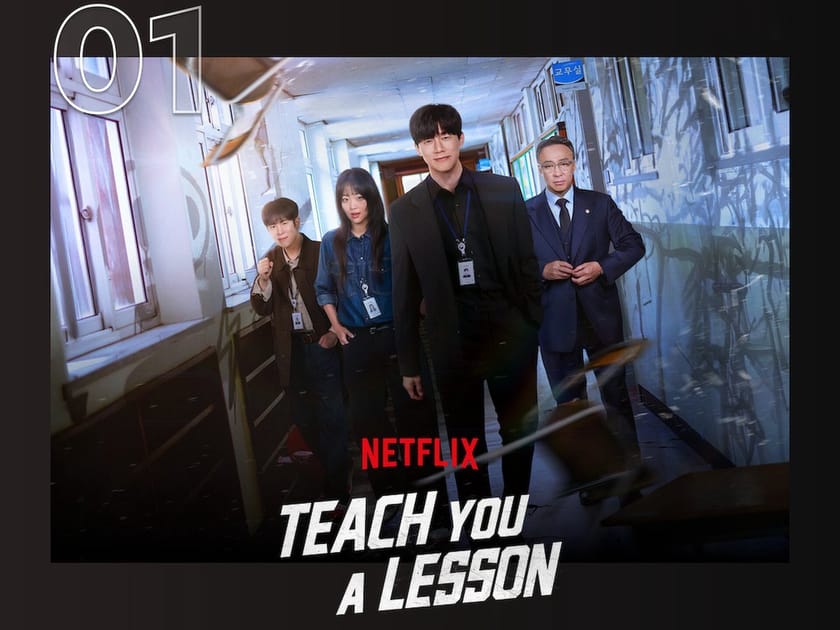
Since its premiere on June 5, Netflix's original Korean drama Teach You a Lesson has held the No.1 spot on the Netflix Global Non-English TV chart for two consecutive weeks. According to data from Netflix's official Tudum platform, in its second week (June 8–14), the series racked up 21.1 million views and 225.8 million hours viewed, outperforming all English-language series in the same period to rank as the No.1 title across all Netflix programming worldwide. Forbes hailed it as "one of the best shows of the year so far."
Backed by both commercial dominance and global conversation, Teach You a Lesson has evolved into a cultural phenomenon that is actively polarizing public opinion. Across social platforms, the debate is intensifying: Can it hold onto its global No.1 position for a third consecutive week?
Why Has Teach You a Lesson Gone Global?
Teach You a Lesson imagines an institution that doesn't exist in reality: the "Education Rights Protection Bureau"—staffed by investigators with special forces backgrounds, empowered to intervene in schools with virtually no constraints, using physical force and psychological deterrence to deal with bullies, corrupt teachers, and overstepping parents.Looking at Netflix's global non-English hit landscape, crime thrillers, survival games, and revenge dramas have long been the three representative genres. School-set productions, meanwhile, have tended to focus either on youthful romance or the classic "bullying victim endures and fights back" narrative. Almost none have turned their lens on the structural failures of the education system itself. Teach You a Lesson seized this narrative blue ocean market, delving into the erosion of teacher authority and the breakdown of administrative grievance channels. It retains the pacing and catharsis of a "guilty pleasure" drama while grounding its story in an educational setting that the vast majority of viewers have personally experienced.

This "blue ocean effect" is reflected in the numbers. Within the same "vicarious gratification" drama category, Taxi Driver focuses on vigilante justice centered around a relatively niche professional group—taxi drivers; Weak Hero Class touches on school bullying but operates on a much smaller scale. Neither broke the 10-million-view mark in its opening week. Teach You a Lesson, by contrast, uses the education system as its entry point, posting 6.4 million views in its first week (with only three days on air) and surging to 21.1 million in the second week, a 3.3x week-over-week growth rate that far exceeds the historical performance of comparable titles.

From a psychological standpoint, this breakout can be attributed to two key mechanisms at play. First, the short-term feedback mechanism. Teach You a Lesson, however, presents a complete feedback loop: "problem emerges—iron fist intervenes—problem resolved." Viewers receive in 45 minutes the kind of resolution that might take months or even years to obtain in the real world. This high-frequency, high-certainty feedback model has a natural stickiness advantage in an era of fragmented attention spans.Second, the compensatory effect. When individuals are persistently eroded by institutional powerlessness in reality, a psychological need for compensation emerges. Teachers silenced by the system and students suffering from bullying find a powerful, cathartic response in the drama.In short, Teach You a Lesson creatively uses a fictional solution to fill a narrative void, tapping into universally shared anxiety.
When "The Iron Fist" Becomes the Only Certainty
Yet the show's true value extends far beyond its visceral thrill. The inspector's iron fist is undeniably effective, but as the story unfolds, viewers begin to see the cost: the very system of "fighting violence with violence" begins to corrupt itself.Unlike The Glory, which offers a neatly contained arc of revenge and resolution, Teach You a Lesson presents a legitimized coercive institution. Viewers find themselves both rooting for the inspectors and quietly disturbed by what they're rooting for—an unease they cannot easily dismiss. When the system fails to deliver justice, vigilante justice becomes the only alternative; yet once that alternative becomes the rule, it rapidly mutates into a new form of violence. This cognitive dissonance, namely the simultaneous activation of conflicting beliefs in psychology, drives viewers back to the series in search of answers. The show's IMDb rating has held steady at 8.6 two weeks after its premiere, and the proportion of long-form reviews is notably higher than that of comparable hits. This suggests that audiences need more time to articulate their "mixed feelings"—which in itself is a market-side reflection of the show's narrative depth.
Week 3: Holding the Throne, or Sliding Off?
Which brings us back to the question everyone is asking: Can Teach You a Lesson hold its No.1 position on Netflix's global charts in Week 3?As a Netflix original produced by YLAB PLEX and GTist, adapted from a popular webtoon, Teach You a Lesson benefits from a proven production model while delivering a degree of narrative depth that is rare in its genre. Nevertheless, the Netflix series typically follows a trajectory of "first-week breakout, second-week peak, third-week decline." Teach You a Lesson, however, posted a second-week viewership 3.3 times its first—a level of explosive growth that may have consumed a significant portion of its remaining runway.Besides, critics have pointed out that the show's "vicarious gratification" may be a "one-time consumption" experience. Once viewers have released that pent-up emotional pressure, rewatch rates and long-tail engagement tend to be limited.
So, back to the now: do you think Teach You a Lesson will maintain its No.1 spot on Netflix's global lists for a third week?