The semiconductor industry is officially entering its $1 trillion era, fueled by a massive $600 billion hyperscale capex surge projected for 2026. Industry consultants view this as a structural revolution beyond cyclicals. As the market begins to look past GPUs & Hyperscalers, the question remains: what will the next wave be?
AI Infrastructure Boom - A Rising Tide Lifts All Boats
- The global semiconductor market is undergoing a seismic transformation. IDC’s latest forecast projects the industry will surge past the $1 trillion revenue threshold in 2026, significantly ahead of prior expectations. The growth will be driven overwhelmingly by AI infrastructure investment, which is reshaping the entire market. (IDC).
- Hyperscale capital expenditure exceeded $100 billion for the first time in Q3 2025, and the i4 are expected to increase capex by 70% year over year to approximately $600 billion in 2026. IDC forecasts data center semiconductor revenues to reach $477.1 billion in 2026. By 2030, data center semiconductors will account for $843.2 billion, nearly half the total semiconductor market.
- It seems the growth is self-sustaining rather than cyclical:
- 1) Compute intensity continues to rise. Generative AI and agentic workloads require far more compute density per rack than prior architectures, increasing the overall silicon footprint.
- 2) Inference demand compounds on itself. Each new model generation increases the volume of inference, requiring ongoing hardware upgrades
- 3) AI is spreading beyond the data center. As enterprises, edge deployments, and client devices begin running AI workloads locally, demand becomes more distributed.
Segments That Are Soaring - by Consensus
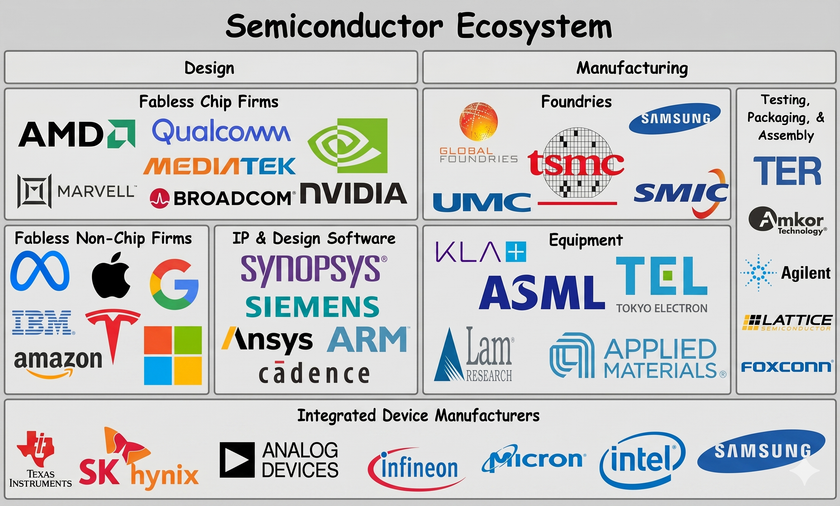
- High-Bandwidth Memory (HBM3e / HBM4): Memory is no longer a "commodity" cycle; it’s the primary bottleneck for AI. Hyperscalers are paying massive premiums to secure HBM3e and early HBM4 supply. Micron (+136% YTD) and SK Hynix (+70% in last 30 days) are the star performers here, as AI accelerators cannot function without these specialized, high-density stacks.
- Custom Silicons & AI ASICs: Companies are shifting away from general GPUs to bespoke "homegrown" chips to cut costs and power consumption. Broadcom’s long-term contracts with Google & Meta provides revenue visibility. Marvell Technology (+50% in a month) is a fast-growing challenger, winning orders from Amazon and Microsoft, outpacing the industry’s growth.
- Co-Packaged Optics (CPO) & 1.6T Connectivity: The "Copper Wall" has been hit; data must now move via light. The upgrade from 800G to 1.6T networking is the new margin expansion story. As the leader in Indium Phosphide components, Coherent (+42% YTD) is the "arms dealer" for the 1.6T transceiver upgrade. Lumentum (+28% YTD) is benefiting from the rapid adoption of CPO technology so solve heat and power issues in massive data center clusters. (note: all as of mid May 2026)
What Has The Market Not Priced-in?
- Besides the obsession over GPU shipments and HBM capacity, what are elements yet to be fully-priced in?
- The agentic CPU re-rating story, as CPUs return to the center of the AI stack?
- The machinery-to-data-center pivot, where traditional industrial cyclical players move into the power generation space for AI-infrastructure?
- Niche players that are integrated into the upgraded supply-chain of hyperscalers?
Drop a comment below on what is trendy and will be the next wave of growth!