Premier info portal for prediction markets. The start point of information market.
Embodied AI - 300 plus AI products set to make their global debuts at WAIC 2026 with strong focus on practical applications
News
Embodied AITechnologyAI Infrastructure

Embodied AI - 300 plus AI products set to make their global debuts at WAIC 2026 with strong focus on practical applications

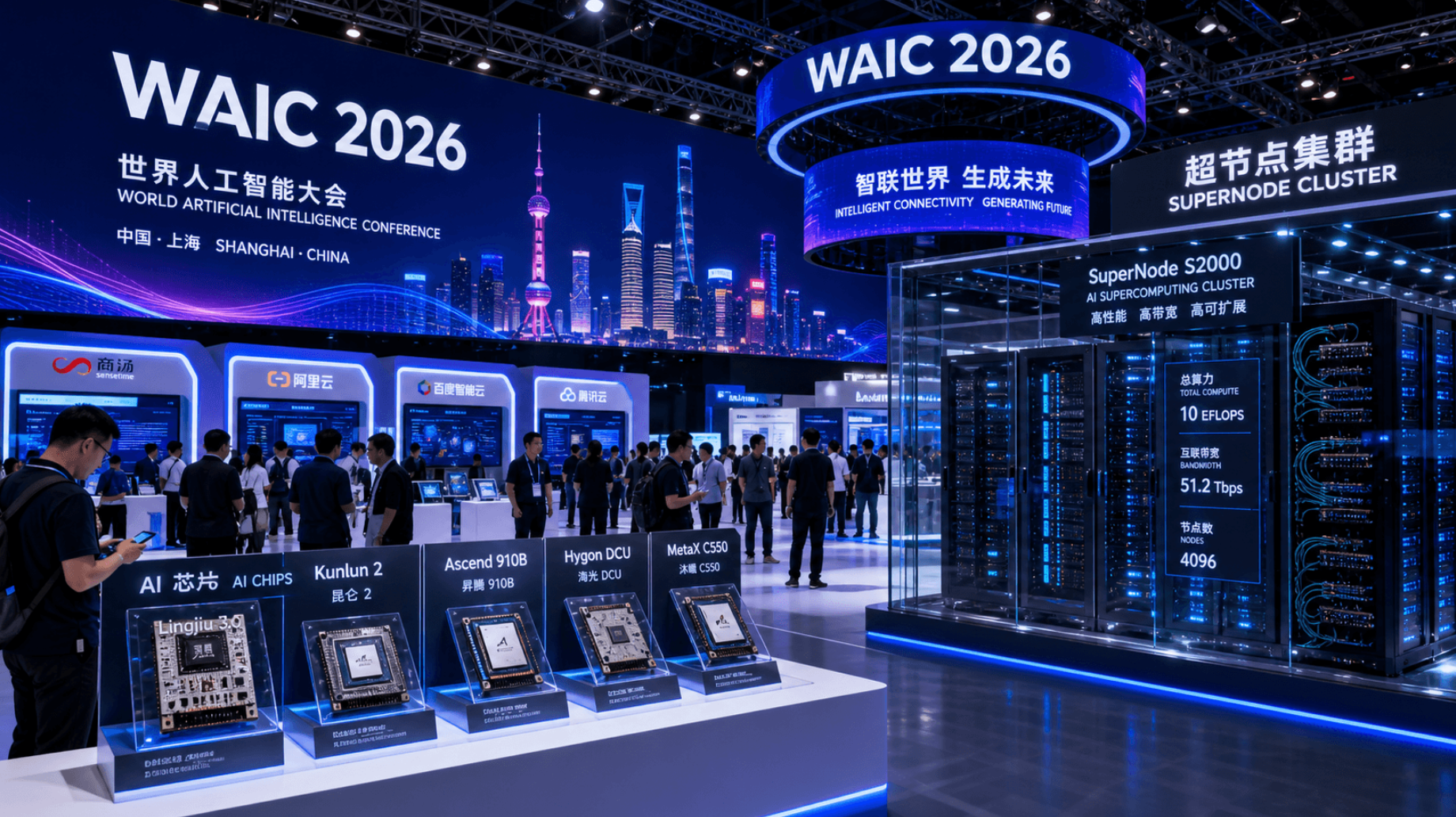
In Shanghai, July 16, 2026, the final countdown to one of the world's largest artificial intelligence (AI) events has entered its last stage.

TechEconomics & Finance

BEIJING, July 16, 2026 /PRNewswire/ – In Shanghai, the final countdown to one of the world's largest artificial intelligence (AI) events has entered its last stage. Inside the exhibition halls, interactive screens are being tested, robotic arms are undergoing repeated adjustments, and engineers are making final preparations before thousands of AI products meet global visitors, the Global Times observed while walking through the exhibition halls on Thursday. 

Will Humanoid company Unitree be listed on stock exchange by the end of 3Q2026?

Yes
65.02%
No
34.98%
832 Polls

The 2026 World AI Conference (WAIC) & High-Level Meeting on Global AI Governance will offer visitors a vivid glimpse into how AI is evolving - from being perceived as cold industrial machinery to becoming intelligent companions that are increasingly integrated into work, daily life and entertainment.

Under the theme of "Intelligent Partners, Co-create the Future," the most prominent feature of this year's conference is its strong focus on practical applications, the exhibition's organizer told the Global Times on Thursday.

Twenty-nine countries on Thursday signed an agreement in Shanghai on establishing the World Artificial Intelligence Cooperation Organization (WAICO), the Xinhua News Agency reported. 

The WAICO will be an independent intergovernmental international organization headquartered in Shanghai, according to the agreement.

The organization will uphold the purposes of the UN Charter, be committed to extensive consultation and joint contribution for shared benefit and adhere to a people-centered approach, according to the agreement. It aims to promote international cooperation and global governance on AI, ensuring that AI is beneficial, safe and fair, thereby promoting its healthy and orderly development to benefit all humanity, Xinhua said.

Set to open on Friday in Shanghai, WAIC 2026 is bringing together more than 1,100 companies and over 3,000 exhibits, with more than 300 AI products making their global debuts, the latest official data showed.

Visitors will not only get a close look at the latest AI breakthroughs, but also see how these technologies are being applied in real-world scenarios spanning manufacturing, healthcare, education and elderly care, the organizer said.

Hundreds of application-driven exhibits will highlight a broader transformation: AI is becoming a new type of productive force, injecting fresh momentum into industries across the board.

Global debuts closer to daily life

Ahead of the conference, some Chinese advanced intelligent manufacturing companies exclusively shared with the Global Times details of cutting-edge AI products that are set to make their public debuts at the event.

The rapid improvement in humanoid robots' dexterity will be showcased through several products.

At the conference, AGILINK will debut and showcase its OmniHand 3 Ultra-M dexterous hand, and the visitors will see a bimanual balloon-dog folding demonstration, which represents the world's only publicly showcased demonstration of such a function, the company told the Global Times on Thursday in a statement. 

The OmniHand 3 Ultra-M is designed to match the size of a human hand, featuring 20 degrees of freedom, visual-tactile sensors integrated into the fingertips of all five fingers, and distributed three-dimensional tactile sensing points across the palm. These features enable the dexterous hand to perform highly precise manipulation tasks. 

Also, Agibot, together with JD Logistics, has jointly developed a new-generation safety-certified heavy-duty embodied intelligent robot, Genie G2 Max, Agibot said in a statement to the Global Times on Thursday. 

The robot features an 18-kilogram payload capacity for a single arm and a standard 38-kilogram payload capacity for dual arms, with a peak payload of 50 kilograms, making it one of the industry's strongest in terms of load capacity, the company said. It can also perform sub-millimeter-level precision operations and supports autonomous charging and battery swapping, enabling uninterrupted 24/7 operations.

Meanwhile, SenseMart Go, an AI retail solution developed by SenseTime, will showcase its new embodied intelligent robotic store, where humanoid robots flexibly and efficiently handle retail operations, SenseTime said in a statement to the Global Times.

Visitors can scan a QR code to experience the complete shopping process, with in-store robots capable of independently picking and placing products, organizing shelves, conducting inventory checks, and handling basic exceptions, according to the statement.

Beyond embodied intelligence, WAIC 2026 will also showcase breakthroughs in AI models and computing infrastructure that support broader applications.

During the exhibition, MiniMax will showcase its next-generation native multimodal flagship model, M3. Supporting up to 1 million tokens of context, the model is built on MiniMax's proprietary MSA (MiniMax Sparse Attention) architecture, delivering enhanced performance in long-context processing, Coding, and Agentic tasks. 

A Chinese brain-computer interface company BrainCo will officially launch what the company describes as the world's first integrated, graphical, one-stop AI research platform for brain-controlled robotics research and development - the BrainCo Brain-Controlled Robot Training Platform - during the exhibition, the company said in a statement to the Global Times on Thursday.

With the platform, developers without prior BCI expertise can enable "mind-controlled" robot operations within just 10 minutes.

In addition, the Securities Times reported that Huawei's Atlas 950, the industry's largest commercial supernode, will make its debut at the conference. The system features a minimum configuration of 64 cards per cabinet and can scale up to 8,192 NPUs, specifically designed for training and inference of trillion-parameter AI models.

From breakthroughs to applications

The breakthroughs showcased at WAIC 2026 are not limited to technological advances, with some cutting-edge innovations already being integrated into industrial chains and transforming daily manufacturing.

Notably, the Global Times has learned that the exhibition has built a humanoid robot manufacturing workshop, featuring a fully automated new energy vehicle production line operating in real time. 

Covering five major processes - from battery module assembly to interior speaker installation - the production line replicates a real new energy vehicle manufacturing process. Each operational scenario corresponds to real-world industrial applications, offering visitors a firsthand look at how AI is reshaping industrial manufacturing, the organizers told the Global Times on Thursday.

For example, visitors will see intelligent robots perform tasks such as picking, screw fastening, power connection, and fully automated assembly and lighting tests for vehicle lamps, demonstrating highly precise and efficient operations, according to the organizers.

The booming AI ecosystem showcased at WAIC 2026 reflects China's sustained efforts to strengthen technological innovation and develop new quality productive forces, Chinese experts said.

As China's 15th Five-Year Plan period (2026-30) begins, AI has been identified as one of the key emerging technologies driving industrial upgrading and future economic growth. This year's top policies have emphasized accelerating the integration of AI with manufacturing, services and scientific research.

Such applications reflect a broader push to accelerate the commercialization of AI through policy support, industrial capacity and market demand.

As AI rapidly moves from laboratories to solve problems in factories, hospitals and supply chains, Chinese policymakers have set their sights high, anticipating the rise of a "smart economy." 

China's 2026 Government Work Report also supports the creation of new forms of the smart economy: "We will advance and expand the AI Plus Initiative. We will promote faster application of new-generation intelligent terminals and AI agents and encourage large-scale commercial application of AI in key sectors and fields, so as to foster new forms and models of AI-native business. We will support the development of open-source AI communities and build a vibrant open-source ecosystem." 

The global AI industry is moving beyond a phase of rapid technological breakthroughs and entering a new stage where deep applications and global governance advance in parallel, Chen Jing, vice president of the Technology and Strategy Research Institute, told the Global Times on Thursday.

In the past, AI was often measured by its technological capabilities. Today, both industries and society are placing greater emphasis on its ability to deliver practical services. This is a shift from a technology-driven approach toward a more human-centered one, Chen said.

"China's experience shows that AI can achieve greater value by integrating with the real economy, leveraging extensive manufacturing capabilities and diverse application scenarios to create a positive cycle between technology development and practical needs. With policy support and market-driven innovation working together, AI is moving from laboratories into factories, homes and cities. The future of AI will be defined not by computing power or model parameters alone, but by its ability to solve real-world problems," he added.

Source:

Yahoo Finance, July 17, 2026; https://sg.finance.yahoo.com/news/global-times-300-plus-ai-013400308.html
EM Stocks Headed For Weekly Loss on Tech Selloff, Rising Crude
News
SemiconductorCapital Markets

EM Stocks Headed For Weekly Loss on Tech Selloff, Rising Crude

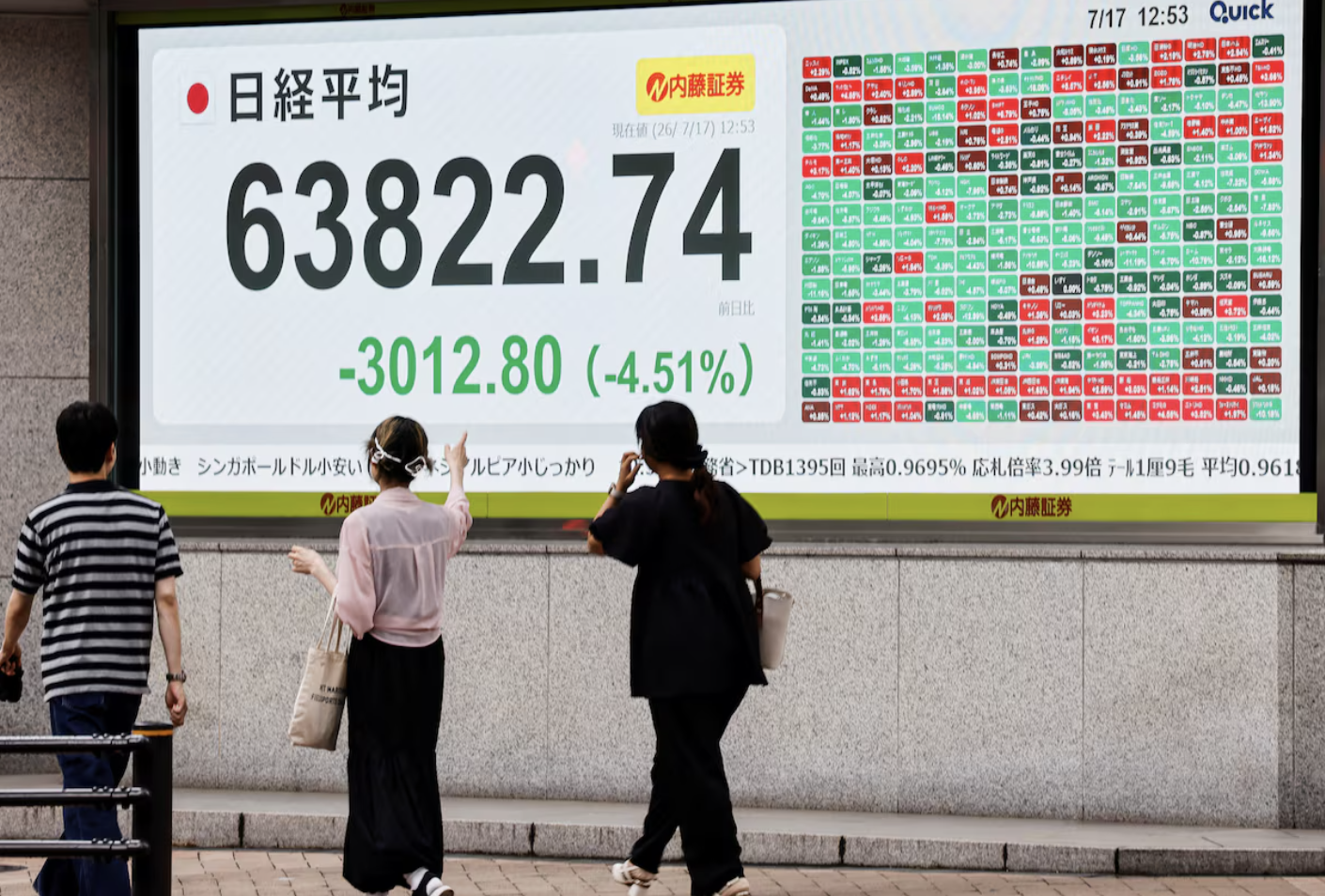
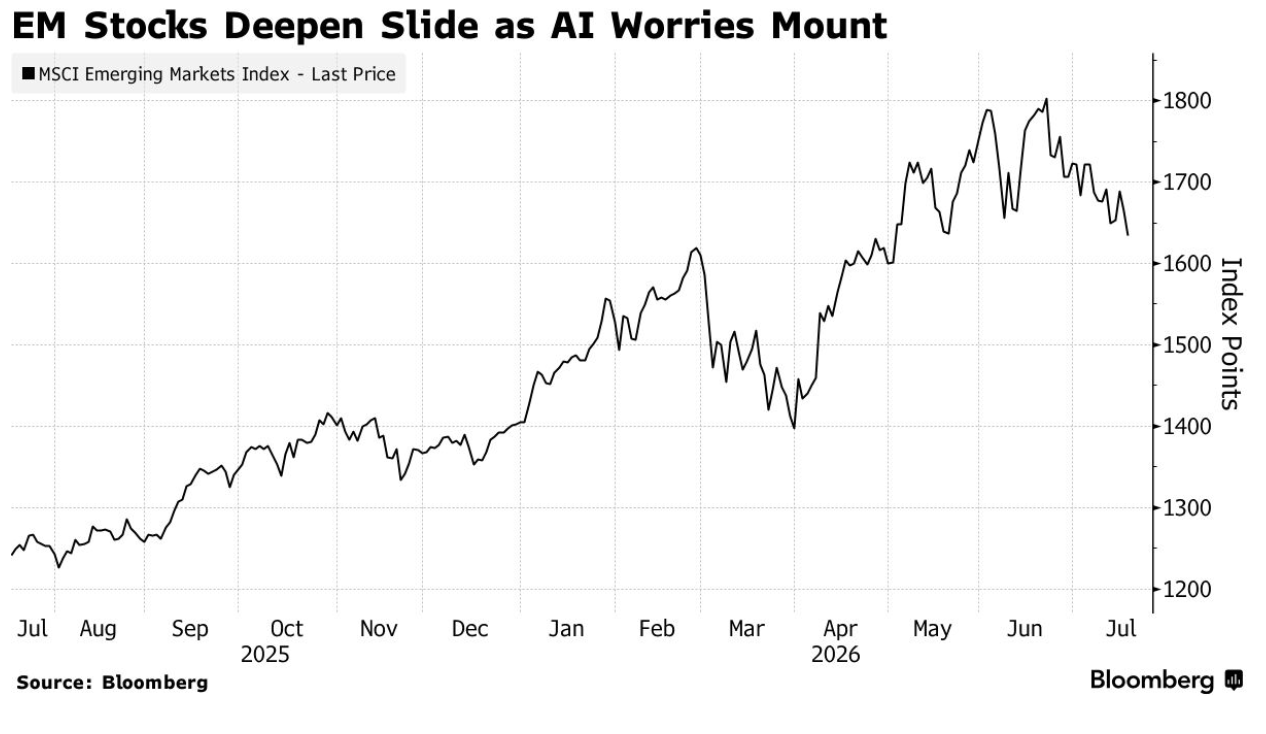
Bloomberg: July 17, 2026, Emerging-market equities fell for a second day and are headed for a weekly decline as concerns over stretched AI valuations dragged technology shares lower, triggering a selloff across Asia.

Economics & Finance

Bloomberg: July 17, 2026, Emerging-market equities fell for a second day and are headed for a weekly decline as concerns over stretched AI valuations dragged technology shares lower, triggering a selloff across Asia.

Will this round of sell-off reach the bottom by week 3 of July 2026?

Yes
50.65%
No
49.35%
997 Polls

MSCI’s gauge for developing markets dropped 1.8% and is down 3% for the week. Benchmark stock indexes in Japan and Taiwan, both heavy on technology shares, fell more than 3%, with AI bellwether Taiwan Semiconductor Manufacturing Co. sliding after a lofty spending forecast. An index of EM currencies edged lower while Bloomberg’s dollar spot index was little changed.

“Growing concerns over semiconductor valuations following their vertiginous rise through the end of June has pushed investors toward greater caution,” said Rajeev De Mello, global macro portfolio manager at Gama Asset Management SA. “Seasonally thinner liquidity during the Northern Hemisphere summer has amplified the selloff.”

The region-wide plunge in equities came even as South Korea’s Kospi index — the poster boy of the blistering AI rally and a gauge that’s seen wild swings — was closed for a holiday.

The fresh escalations in the war between the US and Iran also hurt risk sentiment, with a continued rise in crude prices stoking inflation and straining public finances for fuel importers. Oil is headed for its biggest weekly advance since April following the latest flare-up in tensions.

“The extended elevated oil prices have also started to weigh on net importing countries’ currencies, notably the Thai baht and the Indian rupee,” said Wee Khoon Chong, senior Asia-Pacific market strategist at BNY. The Thai currency was the worst performer among peers on Friday.

Meanwhile, India’s rupee is now approaching a record low, having surrendered most gains after authorities took steps to attract capital.

Source:

Bloomberg, July 17, 2026; https://www.bloomberg.com/news/articles/2026-07-17/em-stocks-headed-for-weekly-loss-on-tech-selloff-rising-crude

First US LNG Cargo in a Year Docks in China, Ship Data Shows
News
GeopoliticsMaritimeEnergy

First US LNG Cargo in a Year Docks in China, Ship Data Shows

A liquefied natural gas carrier with a US shipment appears to have reached a Chinese terminal, potentially marking the first American cargo taken by China since it imposed tariffs more than a year ago.

Economics & Finance

A liquefied natural gas carrier with a US shipment appears to have reached a Chinese terminal, potentially marking the first American cargo taken by China since it imposed tariffs more than a year ago.

Source: Bloomberg

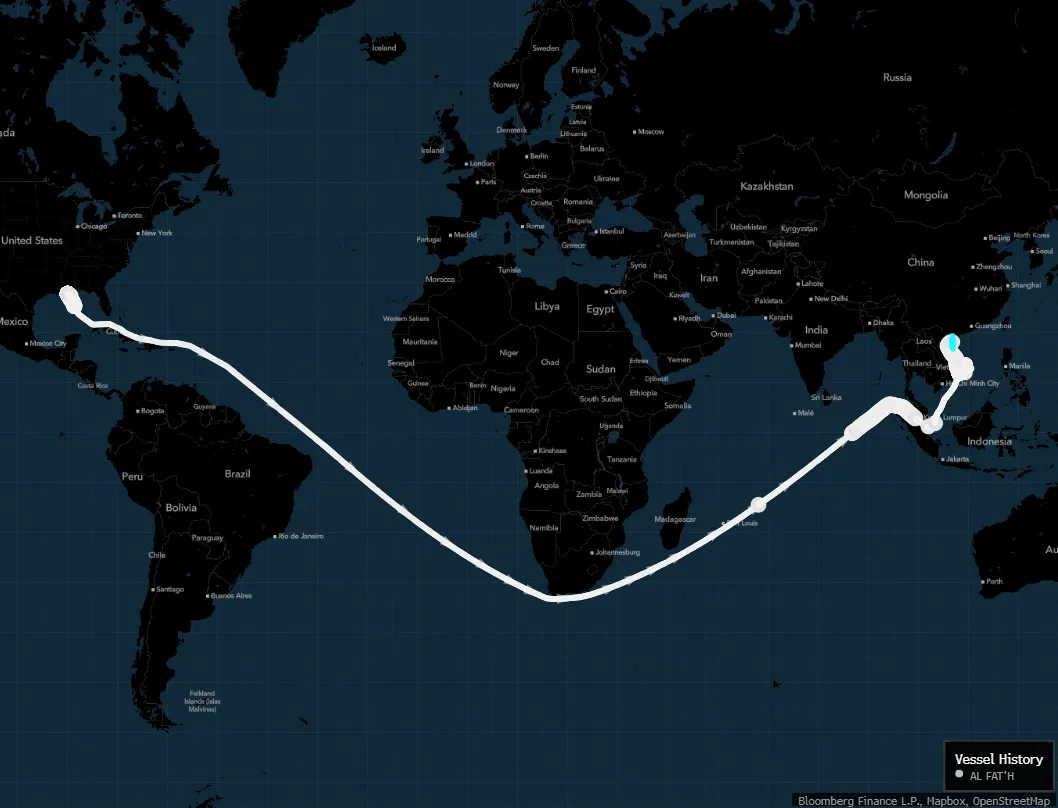
The Al Fat’h, which loaded at Venture Global’s Plaquemines facility in Louisiana in June, was moored at Yangpu port in southern China on Thursday. The port has reloaded several cargoes over the past year, indicating that the shipment may be re-exported.

If the cargo unloads at the port, it would be the first since tensions escalated between the countries in February 2025.

China’s imports of US LNG subsequently plunged as trade between the world’s largest seller and buyer of seaborne gas unraveled. Beijing slapped tariffs on US LNG in retaliation to levies on Chinese goods by the Trump administration. LNG has been caught up in trade conflicts between the two countries before. In President Donald Trump’s first term, China didn’t take a shipment from the US for about 400 days.

The latest thaw also highlights how the war in the Middle East is altering LNG flows, after the conflict largely choked shipments from major exporters in the Persian Gulf and prompted Asian nations to seek cargoes from elsewhere.

Will direct US LNG exports to China resume on a sustained basis in 2026?

Yes
75.00%
No
25.00%
4 Polls

Source: https://www.bloomberg.com/news/articles/2026-07-16/bhp-iron-ore-workers-stage-first-port-hedland-strike-since-2000

Anthropic Plans IPO Investor Meetings as Mega-Listing Nears
News
IPOsLLMsMust ReadAI Infrastructure

Anthropic Plans IPO Investor Meetings as Mega-Listing Nears

Anthropic PBC is seeking to meet with investors ahead of its potential mega-IPO, according to people familiar with the matter, as the company prepares to join the rush of artificial intelligence-driven stock market debuts.

Economics & FinanceTech

Anthropic PBC is seeking to meet with investors ahead of its potential mega-IPO, according to people familiar with the matter, as the company prepares to join the rush of artificial intelligence-driven stock market debuts.

Banks leading the offering are scheduling meetings between investors and the Claude chatbot maker in the coming weeks. Anthropic is considering an initial public offering as soon as in October, Bloomberg News has reported.

Will Anthropic complete its IPO by the end of October 2026?

Yes
74.51%
No
25.49%
506 Polls

Moving ahead with the IPO would put Anthropic ahead of rival OpenAI, which is now looking at going public in 2027 after having earlier targeted a fall 2026 debut. Both companies have filed confidentially for their respective listings.

An IPO this fall would also see Anthropic debut before DeepSeek, the Chinese AI firm that has been grabbing an increasing share of the market for the technology. DeepSeek is preparing for an IPO and could file as soon as this year.

DeepSeek Is Preparing For IPO Filing as Soon as This Year
Chinese AI pioneer DeepSeek has begun preparations for an initial public offering and may file as soon as this year, setting the stage for what could be a landmark debut for the country’s technology industry.

The listing plans follow a period of strong revenue growth for Anthropic fueled by traction for its AI models, including tools that help streamline the process of coding. However, the company also faces lingering uncertainty over its relationship with the Trump administration, which briefly imposed foreign access restrictions on two of Anthropic’s top models. Anthropic also previously sued the Defense Department for declaring it posed a risk to the US supply chain.

Anthropic is working with Morgan Stanley, Goldman Sachs Group Inc. and JPMorgan Chase & Co. on its IPO. The company was valued at $965 billion after a funding round in May, making it one of the world’s largest private companies and eclipsing OpenAI’s valuation for the first time...

Source: https://www.bloomberg.com/news/articles/2026-07-15/anthropic-is-said-to-plan-ipo-investor-meetings-as-listing-nears

Results Review - TSMC 2Q2026 Profit Jumps as AI Boom Funds Costly Shift to N2
News
SemiconductorEarnings & OperationsAI Infrastructure Semi Analysis

Results Review - TSMC 2Q2026 Profit Jumps as AI Boom Funds Costly Shift to N2

TSMC delivered a notably strong second quarter in 2026, combining rapid revenue growth, record-level profitability and the first meaningful contribution from its 2-nanometer, or N2, technology.

Economics & Finance

Taiwan Semiconductor Manufacturing Co.(TSMC) delivered a notably strong second quarter in 2026, combining rapid revenue growth, record-level profitability and the first meaningful contribution from its 2-nanometer, or N2, technology.

TSMC reported second-quarter revenue of NT$1.27 trillion, equivalent to US$40.2 billion. Revenue increased 36.0% from a year earlier and 12.0% from the first quarter. Net income attributable to shareholders reached NT$706.6 billion, rising 77.4% year on year and 23.4% sequentially. Diluted earnings per share increased to NT$27.25 from NT$15.36 a year earlier.

TSMC reported second-quarter revenue of NT$1.27 trillion (US$40.2 billion), up 36.0% year on year and 12.0% sequentially. Net income rose 77.4% to NT$706.6 billion, while diluted EPS increased to NT$27.25.

Revenue reached the top of guidance, and margins exceeded forecasts, with gross margin at 67.7% and operating margin at 60.3%. The quarter also marked the first revenue contribution from TSMC’s N2 process, which accounted for 3% of wafer sales, alongside higher inventories and capital expenditure.

Profit Grew Faster Than Revenue

The earnings increase was not simply the result of selling more wafers. TSMC’s cost structure and product mix also improved significantly.

Gross margin rose to 67.7% from 58.6% a year earlier, allowing gross profit to increase 57%, well ahead of the 36% rise in revenue. Operating margin climbed to 60.3% from 49.6% yoy, and operating income increased 65%.

Management attributed the margin improvement to cost-reduction efforts and higher capacity utilization, partly offset by the lower profitability of overseas fabs. The figures suggest that strong orders allowed TSMC to spread the high fixed costs of its factories across a larger revenue base.

The sales mix also moved further toward high-value products. High-performance computing, or HPC, represented 66% of revenue, up from 60% a year earlier. HPC revenue increased 20% from the first quarter, while smartphone revenue declined 4%, indicating that AI-related demand was a major contributor to profitability.

Operating leverage provided another benefit. Operating expenses increased 17% year on year, but fell to 7.8% of revenue from 9.1%. In other words, expenses grew considerably more slowly than sales.

Not all of the 77% net-income increase came from manufacturing operations. TSMC recorded NT$63.2 billion of disposal and mark-to-market gains related to its holdings in Vanguard International Semiconductor. The gain helped lift non-operating income to NT$95.8 billion from NT$29.6 billion a year earlier.

The distinction matters: the underlying business was exceptionally strong, but the headline net-profit growth was further amplified by an investment gain that may not recur.

N2 Debuts as Inventories Rise

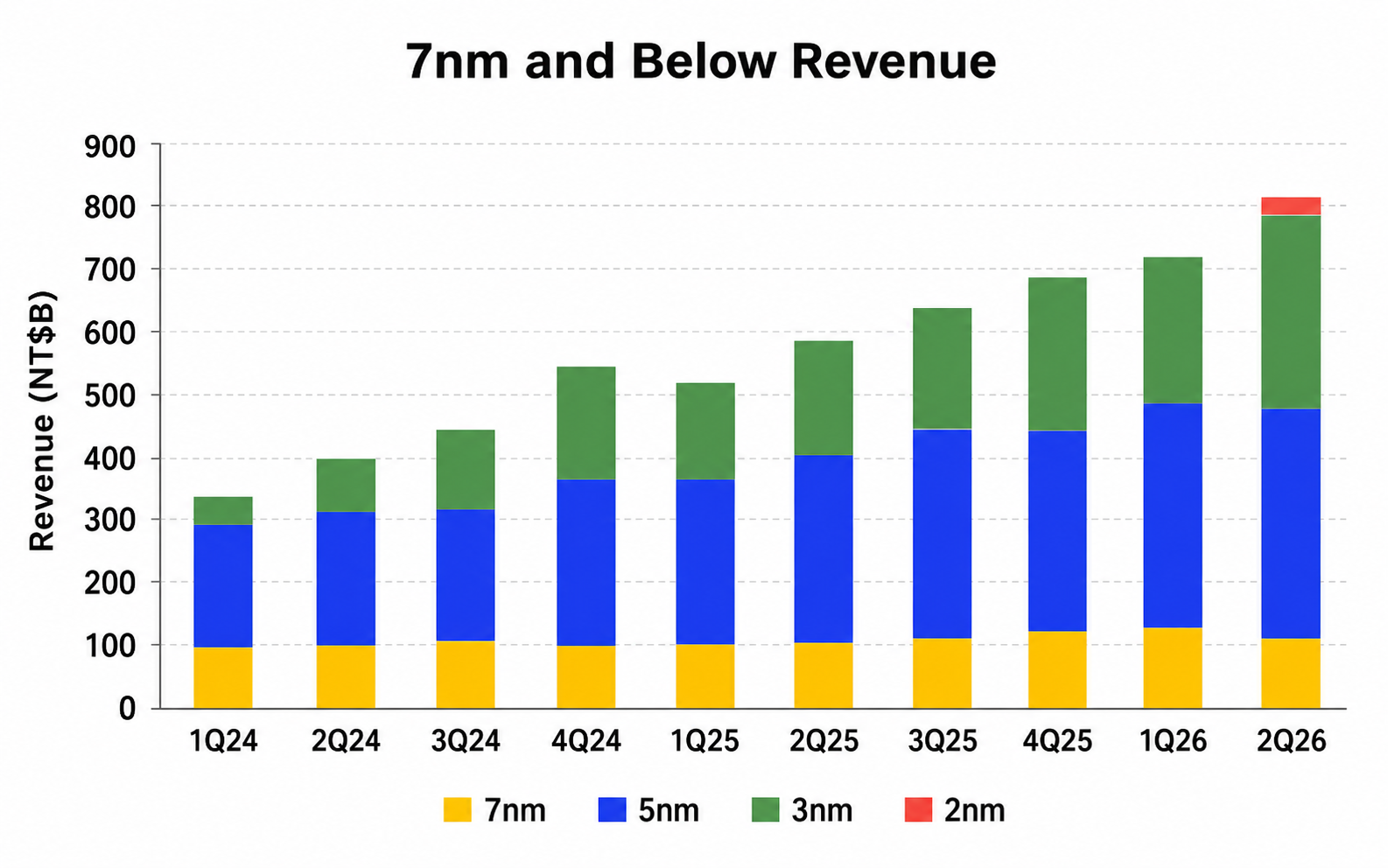
N2 accounted for 3% of wafer revenue in the second quarter, its first reported contribution. TSMC says the technology entered volume production in the fourth quarter of 2025, with a rapid ramp expected in 2026. Its enhanced N2P process is scheduled for volume production in the second half of this year, according to the company’s technology roadmap.

N2’s 3% contribution is relatively small, but it provides measurable evidence that the process has moved beyond development and customer testing into commercial production. Together, processes at 7 nanometers and below accounted for 77% of wafer revenue.

TSMC is not the only chipmaker operating at this generation. Samsung has begun mass production of its 2-nanometer process, while Intel has ramped its comparable 18A technology. Node names are not standardized measures, however, and do not by themselves establish which process is more advanced. TSMC stands out for explicitly disclosing N2’s share of company-wide wafer revenue.

The ramp is already visible elsewhere in the accounts. Inventories increased 23.8% from the previous quarter to NT$385.5 billion, while Inventory days rose to 87 from 80, with management attributing the seven-day increase primarily to the N2 ramp.

Free Cash Flow Falls as Capex Accelerates

TSMC’s cash generated from operations increased to NT$783.4 billion from NT$699.0 billion in the first quarter, while free cash flow fell, because capital expenditure rose much faster. Quarterly capital spending increased 41% to NT$496.0 billion, or $15.7 billion. As a result, free cash flow declined 17% to NT$287.4 billion.

The company has said that the capital required to build a given amount of N2 capacity is substantially higher than for N3 because equipment costs and process complexity continue to rise.

The spending supports N2, future N2P and A16 capacity, advanced packaging and overseas manufacturing. It also reflects customer demand: capacity for leading-edge AI chips remains tight, giving TSMC an incentive to install equipment before the next wave of orders arrives.

Will TSMC keep increasing its CapEx again in 3Q2026?

Yes
52.35%
No
47.65%
831 Polls

Investment And Concentration Create Risks

TSMC is converting today’s AI demand into fixed investment on an exceptional scale, accepting weaker near-term free cash flow in order to secure future advanced-node capacity.

Revenue concentration adds another risk. North American customers generated 78% of second-quarter revenue, whose growth is increasingly tied to North American technology companies and the AI investment cycle.

The concentration makes TSMC particularly sensitive to changes in data-center capital expenditure, export controls, geopolitical policy and the spending decisions of a relatively small group of major chip designers and cloud companies.

The second quarter therefore offered two related signals about TSMC’s future. AI demand is producing exceptional current profits, and management is using those profits to finance N2 and the capacity that will determine whether the growth can continue.

Commodity Desk - Why War Is No Longer Enough to Drive Gold Higher
Analysis
GoldCapital MarketsCommodityCommodity Desk

Commodity Desk - Why War Is No Longer Enough to Drive Gold Higher

War is escalating, yet gold is falling. Central-bank demand, interest rates and investor positioningWar is escalating, yet gold is falling. Central-bank demand, interest rates and investor positioning are pulling the market in different directions. are pulling the market in different directions.

Economics & Finance

As of July 15, gold trades near $4,000 an ounce, about 28% below the record above $5,590 it hit in January.

Over the same stretch, the US and Iran have gone from ceasefire to renewed strikes and back, oil has spiked repeatedly, and geopolitical risk hardly went away.

But gold's price action has not moved in lockstep with it. It fell the day Trump called the ceasefire "over" and it jumped 2.25% the morning June's CPI came in soft.

The more defensible hierarchy is that rates, the dollar and geopolitical developments create the catalyst; ETF and futures investors transmit that catalyst into the market.

Two different sources of demand therefore influence gold over different horizons. Structural buyers shape the long-term market, while financial investors dominate short-term price discovery. Which one is actually in control answers all three questions worth asking about gold right now.

Is gold becoming a "strategic asset" rather than a safe haven? Why hasn't it rallied with the fighting? What will move it most over the next year?

Who's setting gold's price right now(July 2026)?

Fed- and dollar-sensitive traders
34.03%
Central banks and strategic buyers
9.16%
Geopolitical risk
24.35%
No single force is in control
32.46%
1,146 Polls

Gold is adding a strategic role to its safe-haven one

In the World Gold Council’s latest survey, 89% of reserve managers expected global official holdings to rise over the following 12 months. A record 45% planned to increase their own institution’s holdings, while 83% expected gold’s share of reserves to be higher in five years.

In fact, gold has already overtaken US Treasuries as the largest single asset in foreign central-bank reserves at the end of 2025, per the European Central Bank.

This does not mean gold is shedding its safe-haven role; its crisis performance is one reason central banks want it as a permanent allocation. In the same survey, 90% cited gold’s performance during crises, alongside its value as a long-term store of wealth and portfolio diversifier.

The two roles are really two sides of the same coin. Gold is becoming strategic because it has proved useful in a crisis.

The vault owns the gold, but traders price it

Central banks have been annual net buyers since 2010, but they buy on a different clock from ETF investors, hedge funds and futures traders.

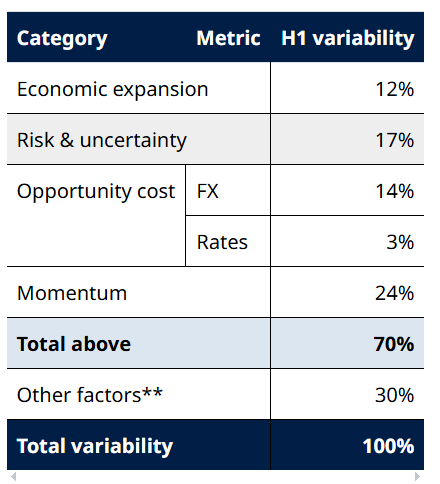
The World Gold Council analyzed what actually moved gold in the first half of 2026: momentum, including investor positioning and trend-following, was the largest named source of price variability at 24%. Risk and uncertainty 17%, foreign exchange 14%, and rates only 3%.

Source: Gold.org

What this means is simple: central banks may own the gold, but traders are pricing it. This is because central banks buy slowly and rarely respond to daily macro surprises.

This does not prove positioning will dominate the next 12 months, but it does show that the identity of long-term holders and the force setting the next price are not the same thing.

So, rates, the dollar, and geopolitical developments may influence why investors act, but ETF and futures positioning decides how strongly that view is expressed in the market. Positioning is therefore likely to produce the largest direct price swings, while rate and dollar expectations determine the direction of those flows.

Continuing wars are not the same as rising risk

Markets trade changes in expectations, not simply the level of danger. Once a war premium is in the price, another day of fighting does not automatically add to it.

In fact, escalation can even work against bullion. On July 15, renewed US threats against Iran pushed oil higher, reviving inflation and rate concerns. Gold fell despite the geopolitical deterioration. During the March selloff, the dollar (not gold) became the preferred haven as the Middle East war increased expectations of tighter policy.

Still, this is not evidence that gold’s haven function has disappeared. It means geopolitical risk reaches gold through competing channels: direct defensive demand on one side, oil, inflation, yields and the dollar on the other.

The next move needs flow confirmation

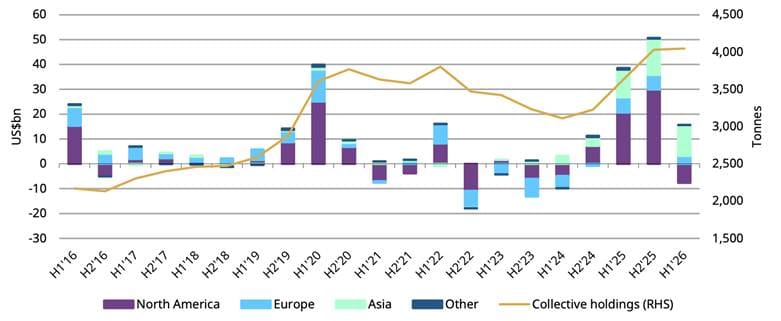
In June, global gold ETFs lost $8.9 billion and 74 tonnes, with every region recording outflows. First-half flows remained positive by $8 billion, but total holdings increased by only 18 tonnes. This means that investors were taking some risk off even while the long-term gold story remained intact.

Source: Gold.org

According to the CFTC, COMEX managed money held 134,941 long contracts and 18,780 shorts on July 7, which is a net long of about 116,000 contracts.

The cleanest bullish signal would be ETF holdings and futures length turning higher together. ETF flows represent sustained investor allocation, whereas futures positioning can reverse quickly and is often more speculative. Futures buying on its own could just be a short-lived squeeze.

Next, rates provide the upstream test. The Council estimates that, all else equal, a 25-basis-point fall in the US 10-year yield could lift gold approximately 1.75%. But you should watch the dollar alongside yields: lower yields accompanied by dollar weakness would be considerably more constructive than a rates move caused by renewed confidence in US policy.

What would put $5,000 back on the map?

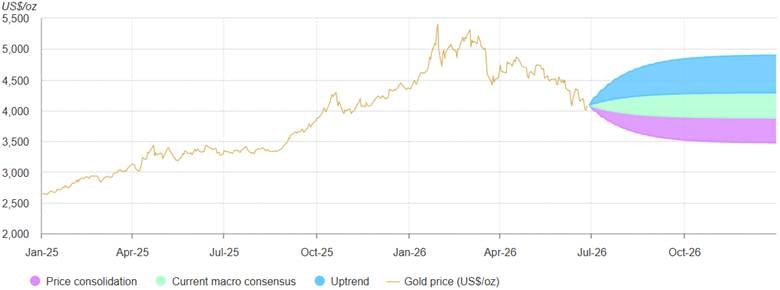
Using $4,100 as its reference point, the Council’s model implies a broad consensus range of about $3,900 to $4,300. A bullish scenario points to roughly $4,300 to $4,900, while bearish consolidation could take gold toward $3,500 to $3,900.

The bullish path likely needs the pieces to line up: falling yields, a weaker dollar and investors putting money back into ETFs and futures. With a dovish Fed turn, a financial shock or faster central-bank buying, the rally would have something solid behind it. Without this follow-through, even a break above $4,500 could turn out to be another short-lived squeeze.

On the downside, if the dollar strengthens and gold funds keep losing money, the structural buyers will have to absorb a lot more selling. A weekly break below $3,860 would be the clearest sign that they are not arriving quickly enough.

But this argument could also be wrong. Gold may keep rising while ETF holdings and futures positions go nowhere. This would suggest the real buying is happening in less visible corners of the market, through central banks, physical markets or private OTC trades. Rising official purchases would make this case much stronger.

The framework, then, is straightforward. Structural demand sets the floor, macroeconomic expectations determine the direction, and investor positioning determines the speed and magnitude of the move.

Where will gold be trading by July 2027?

Below $3,900
18.87%
$3,900-$4,499
33.28%
$4,500-$4,999
32.29%
$5,000 or higher
15.56%
604 Polls

Sources

BLS: Consumer Price Index – June 2026

CFTC: Disaggregated Commitments of Traders - Futures Only, July 07, 2026

ECB: The international role of the euro, June 2026

GoldSilver: Gold Is Sitting on $4,000. The World Gold Council Has a Model for What Happens Next.

GoldSilver: Gold Jumped $90 This Morning. June CPI Just Explained Why.

GoldSilver: Gold Price Outlook July 2026: The Price Fell. Case Intact.

TradingView: Gold Spot / U.S. Dollar

World Economic Forum: Here's how central banks have used gold in the last 30 years

Aviation Radar - AI Frenzy Fills Asian Airlines’ Cargo Bays With Semiconductors
News
TransportAI InfrastructureAviation RadarSupply ChainAviationAerospaceAirlinesIndustry Pulse

Aviation Radar - AI Frenzy Fills Asian Airlines’ Cargo Bays With Semiconductors

Asian airlines are the latest beneficiaries of growing demand for AI servers and computer chips, creating a windfall that’s helping mitigate the surge in jet fuel costs.

Economics & Finance

Asian airlines are the latest beneficiaries of growing demand for AI servers and computer chips, creating a windfall that’s helping mitigate the surge in jet fuel costs.

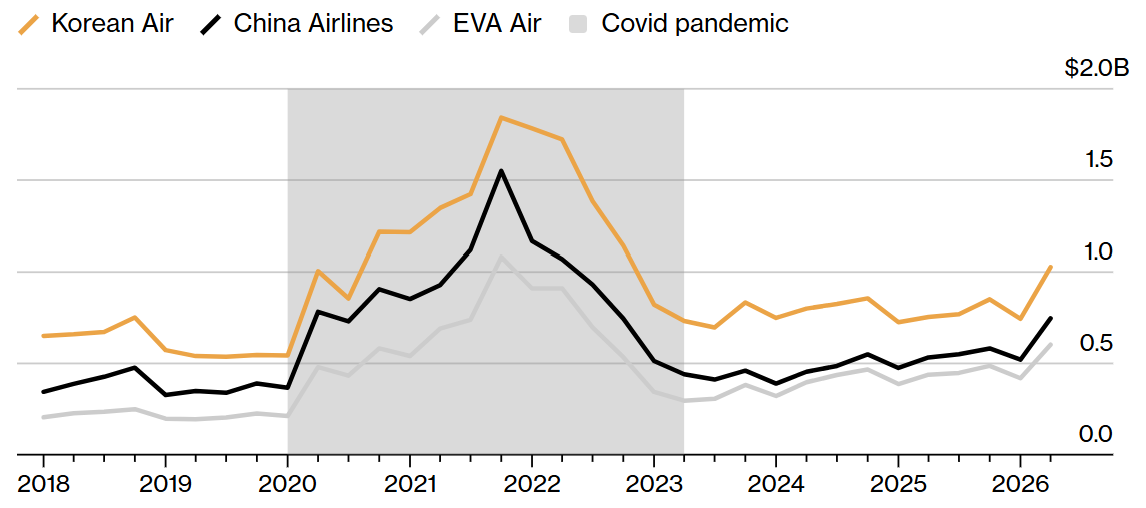
The latest quarterly financial data from Korean Air Lines Co., as well as Taiwan’s China Airlines Ltd. and EVA Airways Corp. show cargo revenue hit their highest levels in more than three years.

The carriers credited shipments of semiconductors and other equipment for driving a new wave of cargo demand. The growth for Korean and China Airlines marked the biggest quarterly rise in freight income since 2022 when the Covid pandemic drove up delivery prices and pushed cargo revenues to records.

“Cargo has been the key bright spot for Asia Pacific airlines,” Nathan Gee, head of Asia-Pacific transportation research at Bank of America Corp., said in an interview. “We are bullish on the outlook for air cargo fundamentals into 2027,” he added, pointing to the recent birth of an AI supercycle, healthy e-commerce flows and tighter supply “supporting strong pricing power.”

Quarterly cargo revenue jumps on shipping AI equipment. Source: Bloomberg

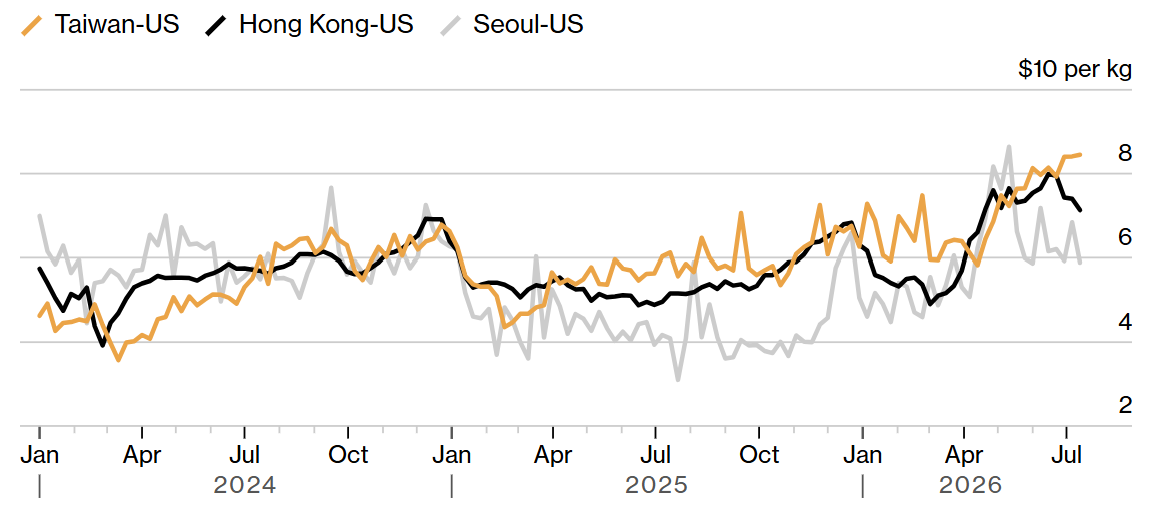
Cargo rates on major air freight lanes from key locations, including Hong Kong, Seoul and Taiwan to the US, in recent weeks have risen to the highest levels since 2022, official cargo pricing TAC Index data shows.

Pricing on Major Air Cargo Lanes From Asia to US. Source: Bloomberg

The surge in demand comes on the back of a worldwide race to build out artificial intelligence data farms and other infrastructure. Other winners from the AI frenzy include manufacturers of construction equipment, commodity-grade batteries, power generators and turbines.

Will AI-driven cargo demand keep Asia–US air freight rates elevated through 2027?

Yes
61.48%
No
38.52%
976 Polls

Source: https://www.bloomberg.com/news/articles/2026-07-15/ai-frenzy-fills-asian-airlines-cargo-bays-with-semiconductors

Fly Me to The Moon - SpaceX Falls Below IPO Price as Short Bets Mount
News
IPOsAI InfrastructureCapital MarketsFly Me to The MoonSpace

Fly Me to The Moon - SpaceX Falls Below IPO Price as Short Bets Mount

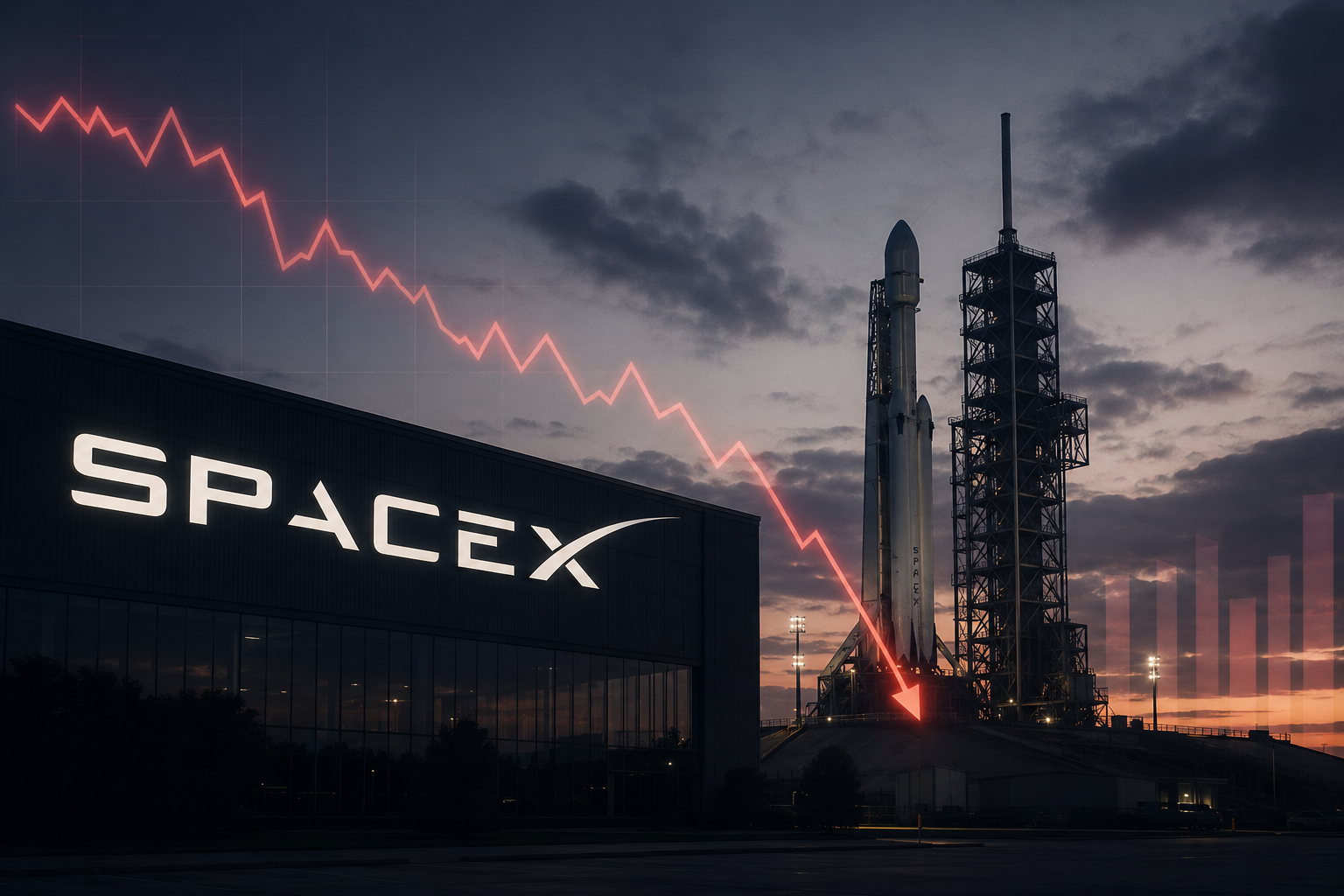
SpaceX shares slumped to their lowest level since the rocket, satellite, and AI company went public, briefly falling below their initial public offering price, as investor fanfare quickly evaporated in the month since its trading debut.

Economics & Finance

SpaceX shares slumped to their lowest level since the rocket, satellite, and AI company went public, briefly falling below their initial public offering price, as investor fanfare quickly evaporated in the month since its trading debut.

The stock was headed for a fourth day of losses after slumping as low as $132.15, ending the day just above the $135 per share level that SpaceX sold them to investors at last month as part of a record $86 billion offering.

A company’s shares falling below the IPO price within days or weeks of its first trading day punctures the narrative that’s been carefully choreographed by the company and its bankers to hype up expectations. Putting shareholders in the red at such an early stage is a blow to confidence that some newly-listed firms don’t recover from.

SpaceX shares have been subject to volatility usually associated with new IPOs, surging nearly 50% over their first three days of trading, only to lose nearly a quarter of their value over the next three sessions.

“Investors are becoming more cognizant that much of SpaceX is about its xAI ambitions,” said Dec Mullarkey, managing director at SLC Management. “As markets get more cautious on the cost and efficacy of the intensive buildout, SpaceX plans may sound too far removed from immediate cash flow,” he added.

There could be more pain ahead too. The first of many share lockups that have kept early investors from selling shares are set to expire once the company reports its first set of quarterly results — something it must do in the coming weeks and will enable some holders to sell shares for the first time. That will kick off a stretch of weeks where millions of shares will become available.

Some of the stock’s early gains may have also been fueled by forced buying from passive index-tracking funds. Shares of the Elon Musk-led company were added to the Nasdaq 100 Index in July after Nasdaq Inc. changed its rules to allow newly listed, large-cap companies to be included in the index in as little as 15 trading days, down from the previous three-month minimum.

Of course, being included in the indexes could be putting extra downside pressure on SpaceX shares also swept up in the artificial intelligence trade. The Nasdaq 100 shed 0.3% Wednesday, led by a selloff in chip stocks as investor concerns over the health of the AI trade continue.

“There’s so much out there all at the same time, not just negative sentiment about what IBM said yesterday, but also negative sentiment about Elon as a personality and public figure, all of that kind of collides into this extra momentum to the downside in a moment in time where there’s pressure and profitability is going to be a key metric,” said Brian Mulberry, chief market strategist at Zacks Investment Management.

Despite the slump, Wall Street remains largely upbeat on the stock. The end of a quiet period for analysts at banks that participated in the IPO ushered in a spate of bullish analyst reports, including Raymond James’ Street-high $800 price target.

Meanwhile, SpaceX bears are minting billions on paper as the company’s stock price cracks ahead of a closely-watched rocket launch and upcoming earnings that will unlock a flood of shares.

Short-selling investors have seen paper profits jump to $3.88 billion, data compiled by S3 Partners show. Investors have been adding to their bets against the company as share prices have slumped with nearly 37 million shares sold short, worth about $5 billion, over the past week, the data show.

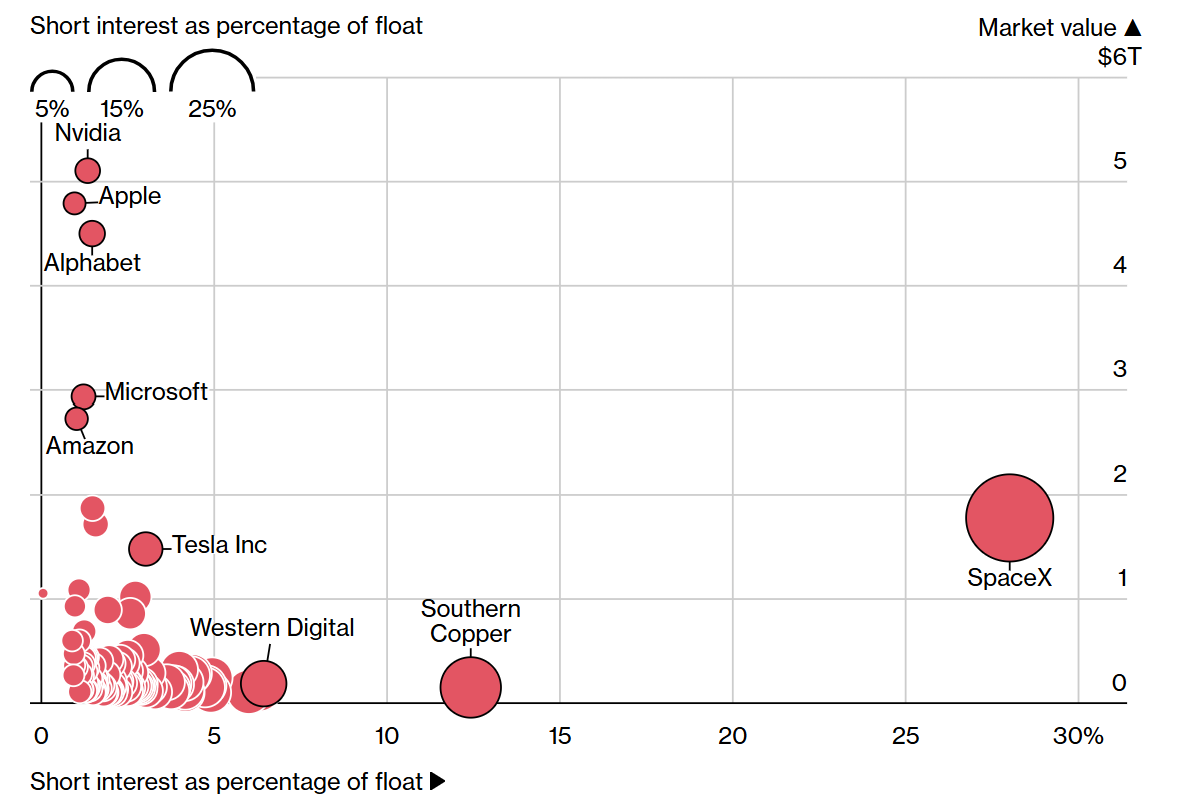
Data for US-listed stocks with at least $100 billion in market value. Source: S3 Partners, Bloomberg

The returns for skeptics came as bearish investors added to their bets with roughly 181 million shares, or 28% of the available stock for trading, sold short, the data show. That’s one of the highest levels for a newly-public company in its first month, according to S3’s Ihor Dusaniwsky.

Will SpaceX shares experience a short squeeze by its first public quarterly reporting?

Yes
100.00%
No
0.00%
2 Polls

Source: https://www.bloomberg.com/news/articles/2026-07-15/spacex-shares-fall-below-ipo-price-for-first-time-as-hype-fades;

https://www.bloomberg.com/news/articles/2026-07-15/spacex-shares-fall-below-ipo-price-for-first-time-as-hype-fades

Defense & Aerospace Radar - After the NATO Summit: What's Next for Western Security?
Analysis
GeopoliticsEconomicsIndustry PulseDefenseAerospaceDefense & Aerospace Radar

Defense & Aerospace Radar - After the NATO Summit: What's Next for Western Security?

Economics & FinancePolitics

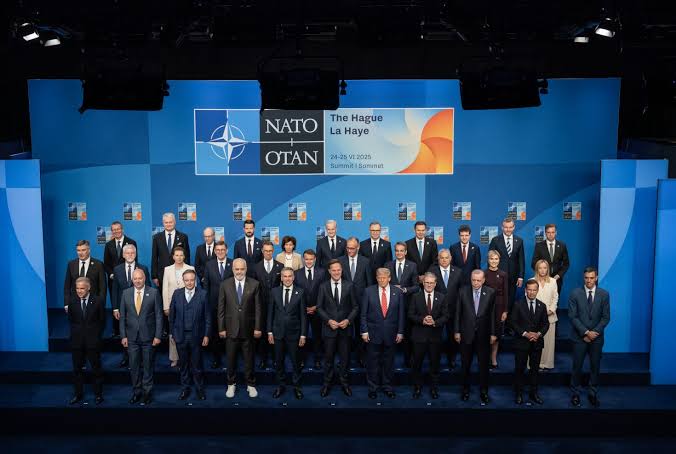
The latest NATO summit ended with familiar headlines: higher defense spending, stronger commitments to collective security, continued support for Ukraine, and new initiatives on defense production and military technology. NATO leaders emphasized that the alliance is moving from setting spending targets to delivering concrete capabilities, including expanded defense industrial cooperation and investments in drones, logistics, and critical infrastructure.

But the summit's significance is not defined by the final communiqué. More important is whether the NATO is entering a fundamentally different phase. That Western security can more influenced by long-term economic, industrial and political adjustments rather than direct military crises.

What will be the biggest challenge for NATO over the next decade?

Turning higher defense spending into real military capability
41.04%
Maintaining unity among members
18.42%
Reducing reliance on U.S. military support
27.84%
Expanding defense industrial capacity
12.70%
1,401 Polls

From Burden Sharing to Burden Building

For years, NATO debates focused on burden sharing: how much each member should spend on defense. This conversation is evolving.

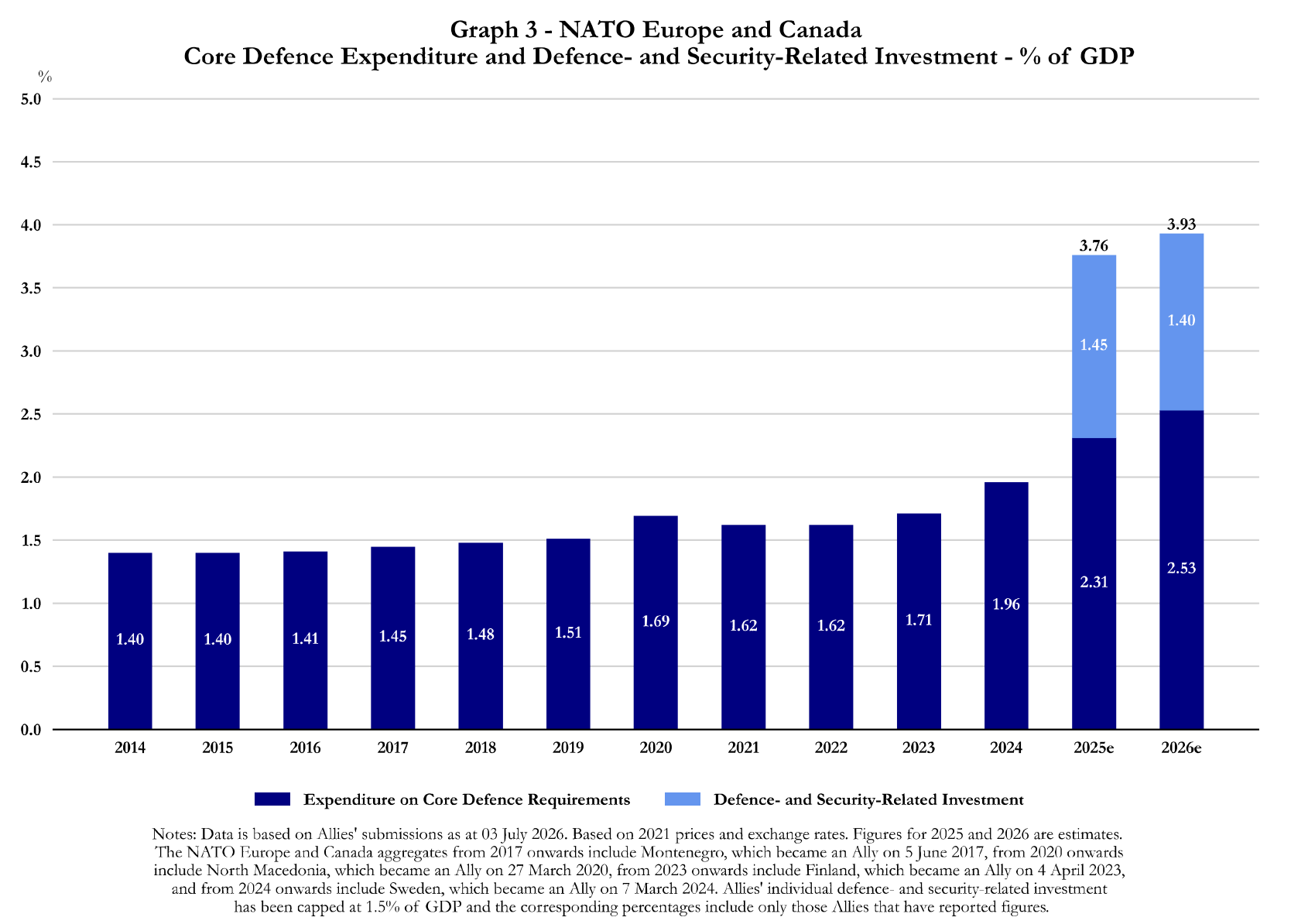
The challenge is no longer simply reaching spending targets. It is whether member states can translate higher budgets into usable military capabilities. At the summit, leaders highlighted expanding defense production, accelerating procurement, improving logistics, and strengthening Europe's industrial base alongside commitments to continued support for Ukraine.

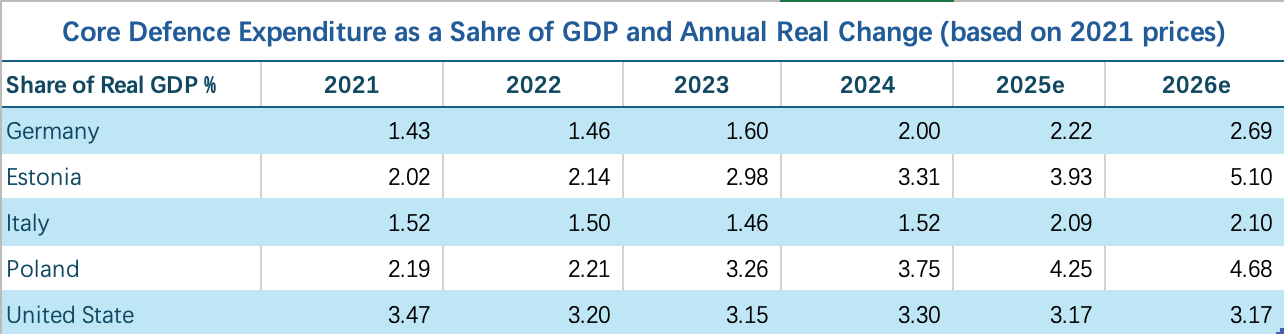
Sourced: Defense Investment of NATO Countries(2014-2026) https://www.nato.int/content/dam/nato/webready/documents/finance/def-exp-2026-en.pdf

This distinction matters because defense spending is only one input. Modern military readiness also depends on manufacturing capacity, supply chains, workforce skills, energy infrastructure, and the ability to replenish equipment during prolonged conflicts.

In other words, NATO's next challenge is more about building industrial resilience rather than allocating money.

Europe Is Taking Greater Responsibility—But Unevenly

Another noticeable shift is Europe's growing role within the alliance.

The U.S. has continued encouraging European allies to assume a larger share of regional security responsibilities, while many European governments have responded by increasing defense budgets and expanding domestic defense industries.

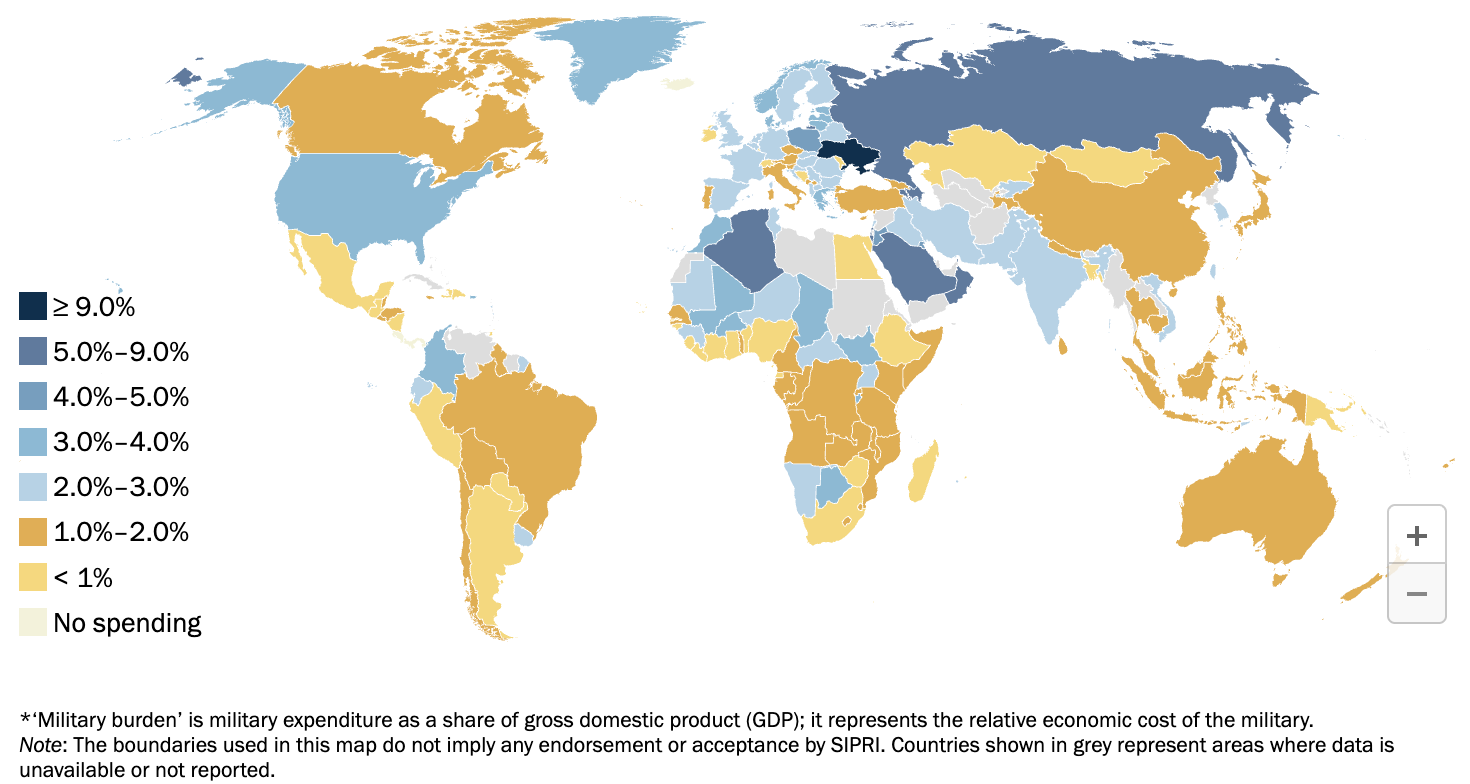
SourceSIPRI Military Expenditure Database, Apr. 2026.

Yet the pace of adjustment remains uneven.

Countries closer to NATO's eastern flank generally view military investment as an urgent security necessity. Others are facing more fiscal trade offs. They have to balance the defense commitments against aging populations, public services, and slower economic growth. Reuters reported that while Germany and several Eastern European allies have significantly expanded defense budgets, larger economies including the UK, France, and Italy are facing greater difficulty sustaining higher military spending because of fiscal constraints.

This divergence does not necessarily threaten NATO's unity, but it does suggest that implementation may prove more challenging than political commitments.

Security Now Extends Beyond the Battlefield

One of the most significant changes is how NATO increasingly defines security itself.

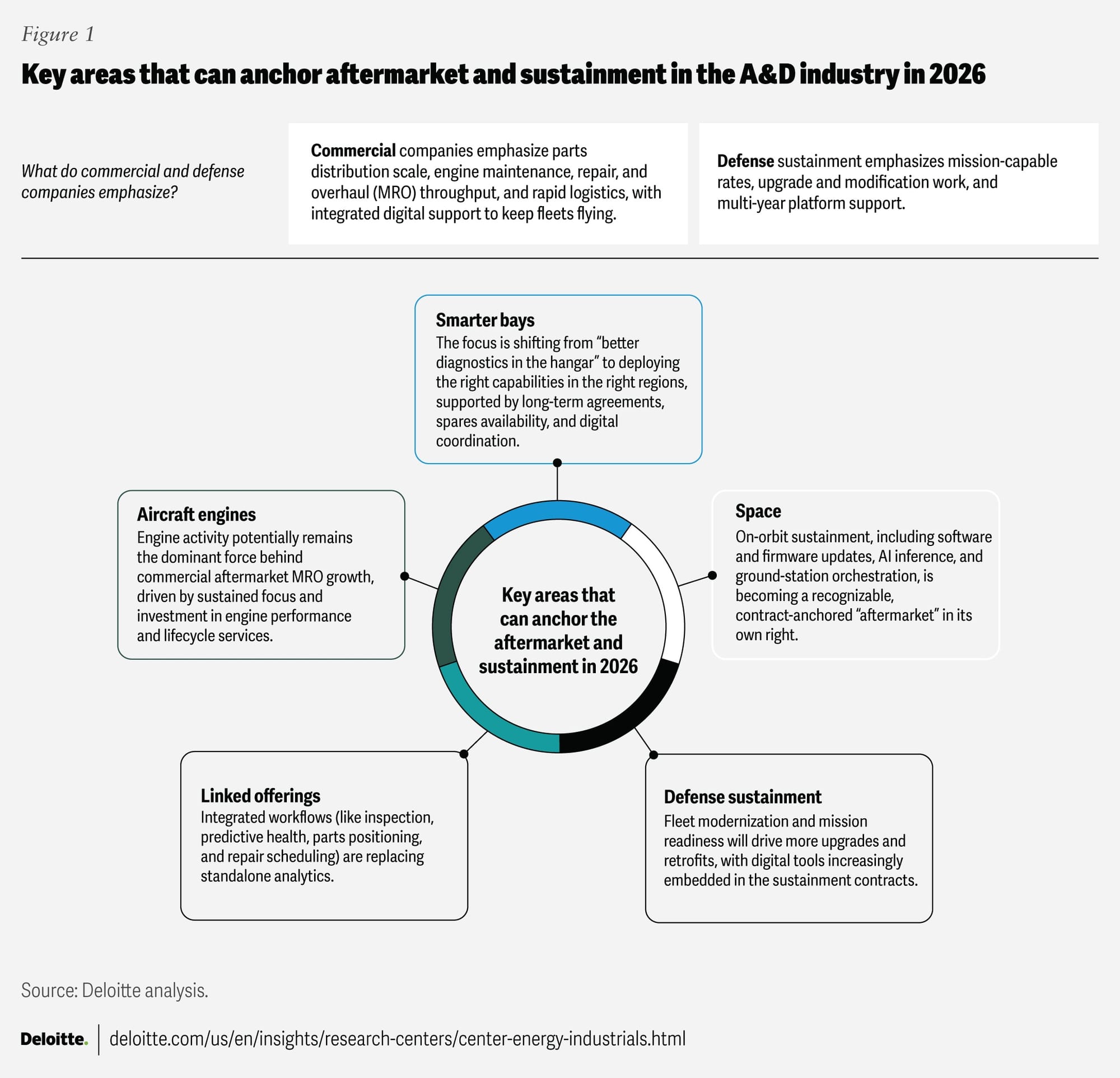
The summit emphasized drones, AI-enabled capabilities, logistics, energy infrastructure, and defense supply chains alongside traditional military forces. The new procurement commitments and investment in unmanned systems illustrate that future deterrence will not only depends on the number of troops, but also rely on industrial capacity and technological innovation.

This reflects a broader strategic lesson drawn from recent conflicts.

Wars are no longer determined solely by battlefield performance. They are increasingly shaped by whether countries can sustain production, secure critical materials, protect digital infrastructure, and maintain resilient supply chains over extended periods.

As a result, economic capacity has become an increasingly important component of national security.

Alliance Unity Still Faces Political Tests

The summit also highlighted a reality that has become increasingly visible in recent years: NATO's military commitments continue to coexist with political differences among members.

Discussions around defense spending, the future balance of responsibilities between the U.S. and European allies, and broader strategic priorities reflected ongoing debates within the alliance. Although European members have increased defense investment, there are still doubts over how responsibilities should be shared across the alliance.

At the same time, these differences did not prevent NATO members from reaffirming their core security commitments. In the Ankara Summit Declaration, leaders reiterated their commitment to collective defense under Article 5 and emphasized that alliance unity and solidarity remain central to NATO's security framework.

The broader challenge for NATO is therefore not eliminating political disagreements, but maintaining strategic alignment while members pursue different national priorities.

The Broader Strategic Challenge for NATO

The Ankara summit was not a single announcement, it is more about accelerating a broader transition already underway.

NATO is increasingly expanding its focus beyond traditional deterrence to include industrial capacity, technological competitiveness, and long-term economic resilience. The alliance's recent commitments have placed greater emphasis on defense production, innovation, and the ability to sustain capabilities over time.

Whether this strategy succeeds will depend not only on defense spending, but also on whether member states can translate political commitments into stronger industrial capacity, faster procurement, and deeper cooperation.

The next phase of Western security may therefore be shaped not simply by military strength, but by the economic and industrial foundations that make long-term deterrence possible.

What will impact most on Western security over the next two years?

Increased defense spending
41.94%
Stronger defense industrial capacity
17.91%
Advances in military technology and AI
27.59%
Greater political coordination among allies
12.56%
1,178 Polls

Source:

  1. Defence investment and NATO’s 5% commitment, June 29, 2026 https://www.nato.int/en/what-we-do/introduction-to-nato/defence-expenditures-and-natos-5-commitment
  2. The Ankara Summit Declaration, Jul 8, 2026 https://www.ncia.nato.int/newsroom/news/the-ankara-summit-declaration
  3. PRESS RELFASE COMMLINIOUÉ NE DDECS, 2026 https://www.nato.int/content/dam/nato/webready/documents/finance/def-exp-2026-en.pdf
  4. NATO defence push already strains Europe's budgets, July 7, 2026 https://www.reuters.com/world/europe/nato-defence-push-already-strains-europes-budgets-2026-07-06/
  5. Global defence spending continues to grow amid geopolitical uncertainty, Feb 24, 2026 https://www.iiss.org/online-analysis/military-balance/2026/02/global-defence-spending-continues-to-grow-amid-geopolitical-uncertainty/
  6. 2026 Aerospace and Defense Industry Outlook, Nov 13,2025 https://www.deloitte.com/us/en/insights/industry/aerospace-defense/aerospace-and-defense-industry-outlook.html
Alibaba  Joins Apple To Bring Qwen AI To Devices In China
News Flash
LLMsConsumer SpendingSemiconductorAI InfrastructureMag 7 Semi News

Alibaba Joins Apple To Bring Qwen AI To Devices In China

BEIJING, July 15 (Reuters) - China's cyberspace regulator said on Wednesday ‌that Apple's on-device generative AI service, Apple Intelligence, has been registered for use on iPhones in China, paving the way for the long-anticipated ​rollout of the service in the country.

Economics & FinanceTech

BEIJING, July 15 (Reuters) - China's cyberspace regulator said on Wednesday ‌that Apple's on-device generative AI service, Apple Intelligence, has been registered for use on iPhones in China, paving the way for the long-anticipated ​rollout of the service in the country.

Will Apple announce Qwen AI configuration upon the release of next generation iPhone?

Yes
63.39%
No
36.61%
579 Polls

Apple Intelligence ​will incorporate capabilities from AI models developed by Baidu and ​Alibaba, a source familiar with the matter said, speaking on condition of anonymity.

The development ​could help bolster Apple's position in China, where consumers have ​been waiting for the rollout of Apple Intelligence.Alibaba said in a ‌statement ⁠to Reuters that its Qwen model will be integrated into Apple Intelligence across Apple's iPhone (iOS), iPad (iPadOS), Mac (macOS) and Vision Pro (visionOS) operating systems in China.

Apple is also working with Baidu to develop ​Apple Intelligence features ​for Chinese ⁠iPhone users, a Baidu spokesperson said.

The regulator's statement did not give a launch date for ​Apple Intelligence in China.

Source: Reuters; July 15, 2026 (local time); https://www.reuters.com/technology/apple-intelligence-ai-service-registered-with-chinas-cyberspace-regulator-2026-07-15/

AI Speedrun - AI Propped Up the Global Economy. Can It Keep Doing So?
Analysis
Capital MarketsAI InfrastructureHyperscalersLLMsIndustry PulseAI Speed Run

AI Speedrun - AI Propped Up the Global Economy. Can It Keep Doing So?

AI investment helped cushion global growth, but with hyperscaler capex nearing $725 billion, can demand and productivity justify the cost?

Economics & FinanceTech

Artificial intelligence has already become a macroeconomic force, just not in the way its most ambitious advocates predicted. The near-term boost is coming less from robots transforming offices and more from companies spending staggering sums on chips, data centers and power infrastructure.

The BIS says this investment helped sustain global growth, supported Asian technology supply chains and kept financial conditions relatively easy through 2025. When war in the Middle East triggered a severe energy shock, the global economy proved unusually resilient, and AI investment was part of the reason.

Amazon, Alphabet, Meta and Microsoft are tracking toward a combined roughly $725 billion in 2026 capex, up 77% from about $410 billion in 2025.

But none of this total tells you whether the growth contribution from this spending is accelerating or running out, so is the headline number actually the one that matters, or is the market reading the wrong line on the page?

What do you think is AI’s biggest economic impact right now?

Higher business productivity
9.42%
Massive spending on chips and data centers
47.11%
Stronger growth in AI-exporting economies
11.29%
Higher demand for energy and infrastructure
23.13%
Mostly higher technology valuations
9.05%
1,072 Polls

AI has become a global growth engine

In the first quarter, the biggest positive surprises came from the countries most closely tied to the AI hardware trade. Taiwan, Korea, Thailand and Malaysia recorded an average growth surprise of 4.4 percentage points on a seasonally adjusted annualized basis. The rest of the world averaged a negative surprise of 0.3 percentage points.

Much of the bullish case, though, rests on an assumption that is rarely stated explicitly: that spending will continue growing rapidly next year.

Here’s why the market is watching the wrong number

Investors remain fixated on the sheer amount of money being spent, but the total alone can be misleading.

For GDP growth, supplier revenues and earnings revisions, the more important variable is the rate of change in this spending, known as the capex impulse. A company spending $200 billion this year after spending $200 billion last year is investing at a historic level and contributing roughly nothing incremental to growth. In real (inflation-adjusted) terms, its investment would actually be lower.

For example, Meta raised its full-year 2026 capex guidance this spring, from $115-135 billion to $125-145 billion, citing higher component prices and additional data-center costs.  

Meta's stock fell more than 9% the day the raise was disclosed, the clearest sign yet the market won’t automatically reward higher spending without clearer evidence of returns.

So, the question is not whether AI spending will remain large, but rather: Can it continue rising in real terms to deliver another meaningful boost to growth?

The strongest case for the boom: Two years of being wrong

Betting against rapid AI capex growth has been the losing trade for two years running. At the start of both 2024 and 2025, Wall Street consensus penciled in roughly 20% capex growth; actual growth exceeded 50% both times. A market that's been that wrong about deceleration twice in a row has earned some benefit of the doubt.

But spending is not the same as returns. BIS research finds that AI can generate time savings of 20-50% in specific tasks, including coding, consulting and clerical work. Yet estimates of the economy-wide productivity effect generally remain below 1% over a much longer period.

For instance, a tool can make one task dramatically faster without transforming an entire company, let alone an entire economy. Productivity gains from general-purpose technologies take years to diffuse, as companies need to redesign workflows, restructure organizations, train staff, and make additional investments in data, software, and infrastructure. Adoption takes time, workflows have to change, and staff need training.

The spending is happening now, while the broader productivity gains remain uncertain and delayed.

If productivity catches up, today’s spending could look like the foundation of a long expansion, but if it does not, the same boom could leave companies with too much capacity, rising depreciation charges and weaker returns.

How to tell whether the boom is still working

The next tests arrive soon. Alphabet reports on July 22, followed by Microsoft and Meta on July 29, and Amazon on July 30, although Meta and Amazon are still unconfirmed, as of this writing.

1.    Are customers actually using all this new computing power?

The clearest early signal will come from the cloud businesses of Microsoft, Amazon and Google. If Azure, AWS and Google Cloud keep growing strongly, it suggests demand is keeping pace with the new data centers being built.

If growth slows while spending continues to surge, that would raise a more uncomfortable possibility: companies may be building capacity faster than customers can absorb it.

2.    Can these companies afford to keep spending at this pace?

The largest technology groups still generate enormous amounts of cash, but AI infrastructure is consuming a growing share of it. The quickest test is to compare capital expenditure with operating cash flow.

As long as operating cash flow comfortably covers the investment, the boom remains relatively secure. If companies begin relying more heavily on debt, leases or outside financing, the risks increase, especially if interest rates remain high or demand disappoints.

3.    Is the investment producing enough revenue and productivity to justify its cost?

Building data centers is only the first step, the question is whether businesses pay to use them, and whether AI helps those businesses earn more, cut costs or work more efficiently.

If these gains arrive, today’s spending could support years of growth. If they do not, companies may be left with expensive data centers, rising power bills and large depreciation charges on infrastructure that is not earning enough.

The bottom line

The market isn't wrong that AI capex has cushioned the global economy against a severe war-driven downturn this year. But "AI capex remains historically large" and "AI capex is still accelerating enough to keep lifting growth" are different claims, and most coverage treats them as the same one.

The first will probably stay true through 2026. The second is being tested right now, and the infrastructure being built must eventually generate enough revenue and productivity to cover its energy, depreciation and financing costs.

This leaves three possible paths: if productivity catches up with investment, AI could underpin a long expansion; if capex slows naturally while demand remains robust, it may settle into a more modest contribution to growth; if demand disappoints, excess capacity and rising costs could turn the boom into an overinvestment cycle.

Which sign would convince you the AI boom is turning into overcapacity?

Cloud growth slows while capex keeps rising
0.00%
AI revenue fails to catch up with spending
100.00%
Free cash flow falls sharply
0.00%
Companies rely more heavily on debt and leases
0.00%
Data-center utilization starts falling
0.00%
None, I think demand will keep absorbing the investment
0.00%
1 Polls

Sources

  1. Alphabet Investor Relations: Alphabet Announces Date of Second Quarter 2026 Financial Results Conference Call,
  2. Amazon Investor Relations: Events
  3. Bank for International Settlements: I. Progress and peril
  4. Goldman Sachs: Why AI Companies May Invest More than $500 Billion in 2026,
  5. International Monetary Fund: July 2026 World Economic Outlook Update
  6. Meta Investor Relations: Investor Events
  7. Meta Investor Relations: Meta Reports First Quarter 2026 Results
  8. Microsoft: Microsoft Announces Quarterly Earnings Release Date,
  9. Reuters Breakingviews: Meta’s fall shows punters crave clearer AI payoff
  10. Reuters: Meta shares fall on concerns over AI spending, legal scrutiny
  11. The Motley Fool: Stock Market Today, April 30
  12. Tom’s Hardware: Google, Microsoft, Meta, and Amazon capex spending to hit $725 billion in 2026, up 77% from last year
  13. Yahoo Finance: Meta stock sinks after Q1 earnings as company raises 2026 AI spending forecast
DeepSeek Is Preparing For IPO Filing as Soon as This Year
News Flash
IPOsLLMs

DeepSeek Is Preparing For IPO Filing as Soon as This Year

Chinese AI pioneer DeepSeek has begun preparations for an initial public offering and may file as soon as this year, setting the stage for what could be a landmark debut for the country’s technology industry.

Economics & FinanceTech

Chinese AI pioneer DeepSeek has begun preparations for an initial public offering and may file as soon as this year, setting the stage for what could be a landmark debut for the country’s technology industry.

The Hangzhou-based company has started planning for an IPO in the mainland and targeted a filing this year that would allow it to debut in 2027, said the people, asking not to be identified because the discussions are confidential. The startup is in talks with accounting and banking advisors, one of the people said.

DeepSeek is also seeking to raise more funds in the private market ahead of the IPO, mere weeks after closing a record $7 billion financing round, the people said. It has begun talks with new backers about a fresh round targeting a pre-money valuation of at least 480 billion yuan ($71 billion), they said.

That’s an increase from the roughly $50 billion price tag DeepSeek drew in its first round of external financing, which closed in early June with big names including Tencent Holdings Ltd. and Contemporary Amperex Technology Co. Ltd. DeepSeek is aiming to raise at least 10 billion yuan of additional funds, though the final amount could go several times higher depending on the number of investors that sign on, the people said.

Discussions remain in flux, and the IPO timing and funding plans could change. Execution will depend on market conditions and the company’s performance.

Will DeepSeek complete an IPO by the end of 2027?

Yes
66.67%
No
33.33%
3 Polls

The startup is working with accounting firms to finish its financial report by the end of December, a necessary step for the IPO filing, one person said, the company plans to make the filing near the end of this year or early in 2027, depending on when the financials are ready.

DeepSeek has drawn enormous interest from would-be investors because it’s one of a clutch of companies that sit at the heart of China’s effort to compete globally on AI. It developed a model last year that stunned the industry, demonstrating the ability to build a cutting-edge yet efficient platform with fewer computing resources. The breakthrough demonstrated that Chinese companies could compete with the best of Silicon Valley despite US export restrictions on advanced hardware

The startup is now chasing more funds to support an ambitious expansion plan, including an increase in computing capacity. AI labs around the world are striking deals to secure the data center infrastructure they need to train and operate AI services.

Founded in 2023, DeepSeek is owned by hedge fund Zhejiang High-Flyer Asset Management. Its earlier fundraising set a record for first-time financing by a Chinese tech startup. Apart from Tencent and CATL, it also notably drew the backing of the National Artificial Intelligence Industry Investment Fund, one of the vehicles that spearheads Beijing’s over-arching endeavors in the sector.

DeepSeek's founder, Wenfeng Liang

DeepSeek’s senior management has told potential investors that the startup will prioritize groundbreaking AI research over short-term commercialization, Bloomberg News has reported. Founder Liang Wenfeng pledged in at least one meeting with investors to keep developing open-source AI models while pursuing the broader goal of achieving artificial general intelligence, underscoring the company’s focus on advancing the frontiers of AI rather than monetization.

Liang’s net worth more than doubled after his firm’s most recent fundraising round, making the Chinese entrepreneur the world’s richest among creators of AI models.

He’s now worth $36 billion, up from about $16.7 billion previously. That ranks him well above Anthropic PBC co-founder Dario Amodei and OpenAI’s Greg Brockman.

The startup is now expanding into agentic AI in the wake of OpenClaw’s emergence, tapping a wave of enthusiasm for software that can carry out tasks without human intervention.

Source: https://www.bloomberg.com/news/articles/2026-07-14/deepseek-mulls-new-funding-weeks-after-7-billion-round-ft-says