Taiwan Semiconductor Manufacturing Co.(TSMC) delivered a notably strong second quarter in 2026, combining rapid revenue growth, record-level profitability and the first meaningful contribution from its 2-nanometer, or N2, technology.
TSMC reported second-quarter revenue of NT$1.27 trillion, equivalent to US$40.2 billion. Revenue increased 36.0% from a year earlier and 12.0% from the first quarter. Net income attributable to shareholders reached NT$706.6 billion, rising 77.4% year on year and 23.4% sequentially. Diluted earnings per share increased to NT$27.25 from NT$15.36 a year earlier.
TSMC reported second-quarter revenue of NT$1.27 trillion (US$40.2 billion), up 36.0% year on year and 12.0% sequentially. Net income rose 77.4% to NT$706.6 billion, while diluted EPS increased to NT$27.25.
Revenue reached the top of guidance, and margins exceeded forecasts, with gross margin at 67.7% and operating margin at 60.3%. The quarter also marked the first revenue contribution from TSMC’s N2 process, which accounted for 3% of wafer sales, alongside higher inventories and capital expenditure.
Profit Grew Faster Than Revenue
The earnings increase was not simply the result of selling more wafers. TSMC’s cost structure and product mix also improved significantly.
Gross margin rose to 67.7% from 58.6% a year earlier, allowing gross profit to increase 57%, well ahead of the 36% rise in revenue. Operating margin climbed to 60.3% from 49.6% yoy, and operating income increased 65%.
Management attributed the margin improvement to cost-reduction efforts and higher capacity utilization, partly offset by the lower profitability of overseas fabs. The figures suggest that strong orders allowed TSMC to spread the high fixed costs of its factories across a larger revenue base.
The sales mix also moved further toward high-value products. High-performance computing, or HPC, represented 66% of revenue, up from 60% a year earlier. HPC revenue increased 20% from the first quarter, while smartphone revenue declined 4%, indicating that AI-related demand was a major contributor to profitability.
Operating leverage provided another benefit. Operating expenses increased 17% year on year, but fell to 7.8% of revenue from 9.1%. In other words, expenses grew considerably more slowly than sales.
Not all of the 77% net-income increase came from manufacturing operations. TSMC recorded NT$63.2 billion of disposal and mark-to-market gains related to its holdings in Vanguard International Semiconductor. The gain helped lift non-operating income to NT$95.8 billion from NT$29.6 billion a year earlier.
The distinction matters: the underlying business was exceptionally strong, but the headline net-profit growth was further amplified by an investment gain that may not recur.
N2 Debuts as Inventories Rise
N2 accounted for 3% of wafer revenue in the second quarter, its first reported contribution. TSMC says the technology entered volume production in the fourth quarter of 2025, with a rapid ramp expected in 2026. Its enhanced N2P process is scheduled for volume production in the second half of this year, according to the company’s technology roadmap.
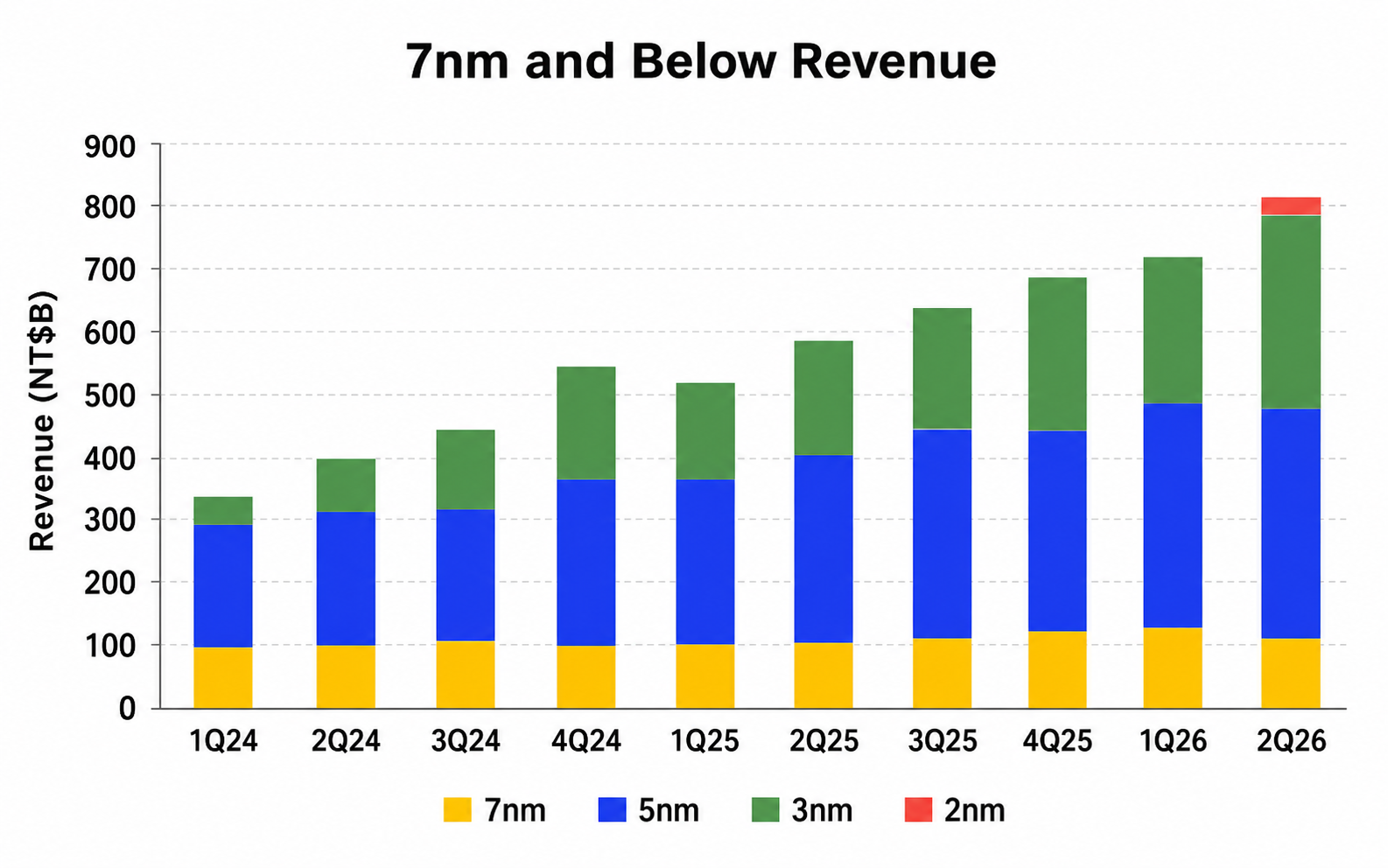
N2’s 3% contribution is relatively small, but it provides measurable evidence that the process has moved beyond development and customer testing into commercial production. Together, processes at 7 nanometers and below accounted for 77% of wafer revenue.
TSMC is not the only chipmaker operating at this generation. Samsung has begun mass production of its 2-nanometer process, while Intel has ramped its comparable 18A technology. Node names are not standardized measures, however, and do not by themselves establish which process is more advanced. TSMC stands out for explicitly disclosing N2’s share of company-wide wafer revenue.
The ramp is already visible elsewhere in the accounts. Inventories increased 23.8% from the previous quarter to NT$385.5 billion, while Inventory days rose to 87 from 80, with management attributing the seven-day increase primarily to the N2 ramp.
Free Cash Flow Falls as Capex Accelerates
TSMC’s cash generated from operations increased to NT$783.4 billion from NT$699.0 billion in the first quarter, while free cash flow fell, because capital expenditure rose much faster. Quarterly capital spending increased 41% to NT$496.0 billion, or $15.7 billion. As a result, free cash flow declined 17% to NT$287.4 billion.
The company has said that the capital required to build a given amount of N2 capacity is substantially higher than for N3 because equipment costs and process complexity continue to rise.
The spending supports N2, future N2P and A16 capacity, advanced packaging and overseas manufacturing. It also reflects customer demand: capacity for leading-edge AI chips remains tight, giving TSMC an incentive to install equipment before the next wave of orders arrives.
Will TSMC keep increasing its CapEx again in 3Q2026?
Investment And Concentration Create Risks
TSMC is converting today’s AI demand into fixed investment on an exceptional scale, accepting weaker near-term free cash flow in order to secure future advanced-node capacity.
Revenue concentration adds another risk. North American customers generated 78% of second-quarter revenue, whose growth is increasingly tied to North American technology companies and the AI investment cycle.
The concentration makes TSMC particularly sensitive to changes in data-center capital expenditure, export controls, geopolitical policy and the spending decisions of a relatively small group of major chip designers and cloud companies.
The second quarter therefore offered two related signals about TSMC’s future. AI demand is producing exceptional current profits, and management is using those profits to finance N2 and the capacity that will determine whether the growth can continue.