Over the past decade, Wall Street has steadily shortened the lifespan of its trades. Options that once lasted months now sit alongside ones that last weeks, or even a single day.
Faster markets and better technology have made it possible to wager on shorter and shorter stretches of market action. Now, crypto traders are compressing that time even further — making bets that barely outlast a coffee break.
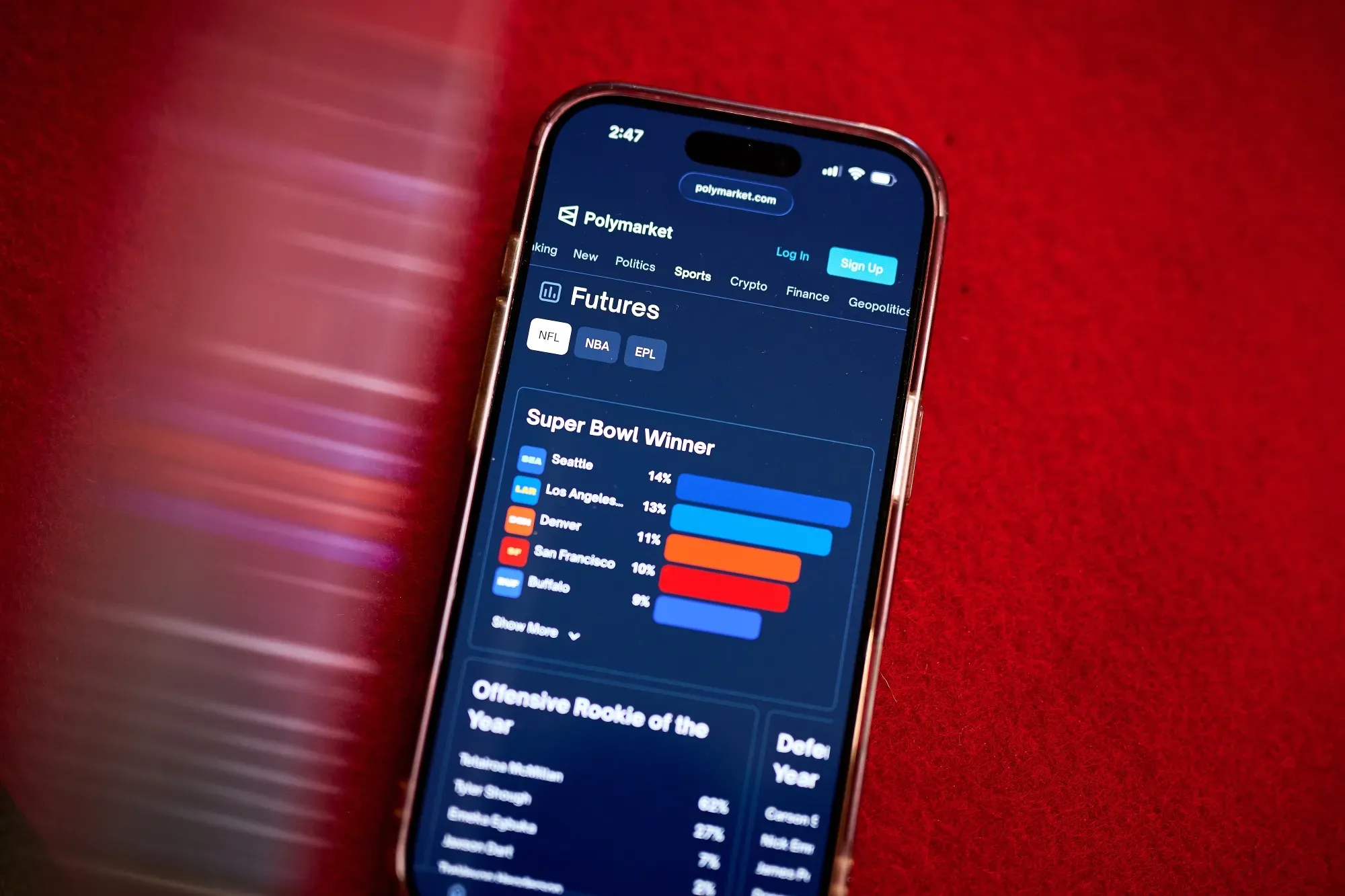
On prediction markets platform Polymarket, you can bet on where Bitcoin will be five or 15 minutes from now. The rules are as simple as a coin flip: pick whether Bitcoin will be higher or lower when the clock runs out. Win or lose, it resets. Then do it all over again.
In little over a month, five-minute bets have become some of the busiest on Polymarket’s website, with as much as $60 million changing hands every day, according to user-compiled data on Dune Analytics. With each new shortening of the clock, turnover has surged and the advantage has tilted further toward participants with the fastest systems. Polymarket’s daily crypto markets — tracking whether Bitcoin will be above or below a certain price by the end of the day — pull in far less volume, often netting less than $1 million a day.
That speed has drawn waves of automated trading bots, run by both retail bettors running simple programs and more sophisticated participants with systems built for speed. While the volumes are small compared to the tens of billions of dollars traded daily on crypto exchanges, prediction market bettors are glued to their screens.
Jon Lourie, founder of prediction markets research firm Polyfactual, said it was election betting that first caught his eye when he began trading on Polymarket. But when he found out that those contracts could take months to resolve, he pivoted to sports markets, before landing on 15-minute crypto bets. The speed at which such trades conclude became “addictive,” he said.
“It’s like people just want to get to the resolution time faster and faster and faster,” Lourie said. “I wouldn’t be surprised if we see crazy things, like one-minute markets or something like that, in the near future.”
For professional traders, stacking your portfolio with bets that take days or weeks to expire can come with operational costs that add up quickly. Five-minute crypto markets could be a more cost-efficient way to hedge against risk held elsewhere, said Jake Brukhman, chief executive officer of crypto venture firm CoinFund.
“You want the hedging instruments to be as precise as possible and as cost effective as possible,” said Brukhman.
Crypto, which already trades around the clock, has taken that logic further. There is no bell to anchor the day, no overnight pause. Volatility that once played out over 24 hours can now erupt in five-minute intervals. The market has been sliced into ever smaller pieces, each one a fresh chance to win, lose, or get picked off.
On paper, prediction markets promise democratized access. The fact that anyone can participate is part of what makes them more accurate, harnessing the wisdom of the crowd to produce forecasts that can inform risk-taking and policy decisions.
In practice, shortened trading windows tend to reward those utilizing automation. A human tapping a phone screen cannot compete with software calibrated to exploit tiny price discrepancies in milliseconds. Polymarket charges a small transaction fee on its short-dated crypto markets, but redistributes a portion of those fees to whoever posted the resting orders that got filled. It’s a rebate that in theory is open to anyone, but in practice rewards those who can keep orders live around the clock, which overwhelmingly means automated systems.
“Because the time to expiry is very low, that means the price is just super volatile, and retail loves volatility,” said Annanay Kapila, a former quant trader who’s now chief executive officer of derivatives exchange QFEX. “If there wasn’t so much genuine retail demand, it wouldn’t be the only market that I know people are making a lot of money in on Polymarket, because it’s very inefficient.”
Speed bumps — small trading delays designed to encourage liquidity provision — are common on mainstream exchanges. In November, Polymarket introduced its own version — a 500-millisecond execution advantage for market makers on hourly and 15-minute crypto contracts. That edge was quietly removed in mid-February, according to traders who noticed the change.
Soon after, volumes across 15-minute durations started to slide. Weekly volume starting on Feb. 16 slumped by 45%, blockchain data showed, dropping from $260 million a week earlier to just $143 million. Even on five-minute bets where the speed bump hadn’t been implemented, daily volume on Bitcoin bets trended downward — though the arrival of new markets tracking smaller tokens like Ether, Solana and XRP helped bump up overall figures.
When markets are measured in minutes, half a second can decide everything. In Polymarket’s Discord chatroom, traders vented their frustration at the delay being removed. A Polymarket staffer later apologized for not announcing the change sooner, the messages show. On Feb. 25, the exchange rolled out a replacement — a new 250-millisecond delay across five-minute, 15-minute and hourly crypto markets.
Polymarket didn’t respond to a request for comment on the changes.
The platform’s crypto contracts rely on prices generated by a third-party oracle, which analyzes pricing from a variety of exchanges to come up with one final figure. In the world of digital assets, however, a single exchange, Binance Holdings, has long dominated pricing by generating the lion’s share of token trading volume.
Traders watching Binance’s price feed closely could, in theory, see moves before they show up on Polymarket. Each of Polymarket’s short-dated crypto contracts includes a disclaimer that live data can be delayed by a few seconds.
The result is a market that fulfills the prediction market promise of open access while quietly concentrating its rewards among those with the infrastructure to move fastest. Anyone can play. Not everyone can win.
DraftKings’s strategy to become the leader in prediction markets is to do exactly what it did to dominate the online sports betting industry.
The company is gearing up to operate in all 50 states, something that seemed like a long way off just 12 months ago, due to varying regulations. As federal policymakers grapple with how to regulate predictions markets, DraftKings is going all-in on its predictions product and aims to overtake industry leader Kalshi.
Its first step is to make the look and feel of the platform a mirror of its sports-betting operations.
“We know the minds of a fan who wants to get in on the action,” DraftKings’ head of Predictions, Jeanine Hightower-Sellitto, said. “That’s how we’re building Predictions. It will feel like DraftKings.”
DraftKings tapped into its existing infrastructure and user base from daily fantasy sports to secure a place for itself in the online gaming industry, and compete with FanDuel to be the biggest online sports betting operator. It now plans to use that same successful playbook for it expands into prediction markets.
The Boston-based company said Monday it will integrate its prediction markets platform, which it launched in December, into its core app. The new app will be called DraftKings Sports & Casino, removing the word “sportsbook” to reflect the fact that prediction markets aren’t legally classified as gambling.
“We will now have a sports product everywhere for customers across the country,” Chief Executive Jason Robins said in an interview.
In 17 states where DraftKings isn’t a licensed betting operator, users will only be able to access its predictions product on the app. The product will look similar to the sports-betting platform, but players will put money on outcomes of events, rather than betting against a sportsbook. That way they can place money, or “trade,” on whether they think a team will win or a player will score a certain number of points.
The goal is to follow the same strategy DraftKings used to become one of the top U.S. sports-betting platforms. Right now, sporting events are the most popular category to trade in prediction markets.
Robins said he is primarily focused on building out predictions markets for sports events, rather than political or cultural events. He estimates prediction markets may represent a $10 billion revenue opportunity for the company.
Until now, betting companies like DraftKings had to fight on a state-by-state basis to gain operating licenses. DraftKings’s latest move represents a significant shortcut to accessing potentially lucrative states like California, Florida and Texas. Its most recent launch in Missouri took more than a year to roll out after the state approved sports gambling in November 2024.
Because prediction markets aren’t subject to state taxes, they are expected to have margins that are 10 to 30 percentage points higher than traditional sports betting, DraftKings said. Later this year, the company also plans to debut “combos,” which is the equivalent of betting parlay. Parlays wrap multiple bets into one and are especially profitable for DraftKings because they tend to favor the sportsbook.
The biggest challenges will be building out the product, developing its technology and ramping up marketing in new markets, Robins said. “It’s just getting it done, just a matter of time,” he said.
He expects the fully integrated app will be ready before the new NFL season begins later this year, with combos launching some time in the second quarter, he added.
The potential spoils from prediction markets haven’t done much to help DraftKings. In February, the company’s financial outlook for 2026 came in below Wall Street estimates. Robins told investors at the time that he wasn’t including any potential revenue from prediction markets in that guidance.
Investors have gotten impatient about DraftKings’s prediction markets timeline. Shares lost about 10% of their value in 2025 as the company delayed entering the industry for fear of ruining relationships with state regulators.
The main concern now is that DraftKings is losing customers to competitors such as Kalshi, a private company that is considered the current leader in prediction markets. Kalshi was an early mover in the industry, gaining popularity around the 2024 presidential election.
Robins said that once prediction markets are integrated into DraftKings’ core app, the company will be on its way to having the best product on the market.
“We’re probably less than a year behind Kalshi and we’re ahead of everybody else at this point,” Robins said.
A little-known prediction market platform with Asia roots burst onto the scene late last year, but already its fast start appears to be running out of steam.
Opinion Labs debuted in October and within weeks began recording notional trading volumes rivaling those of market-leaders Polymarket and Kalshi, according to user data compiled by Artemis Analytics.
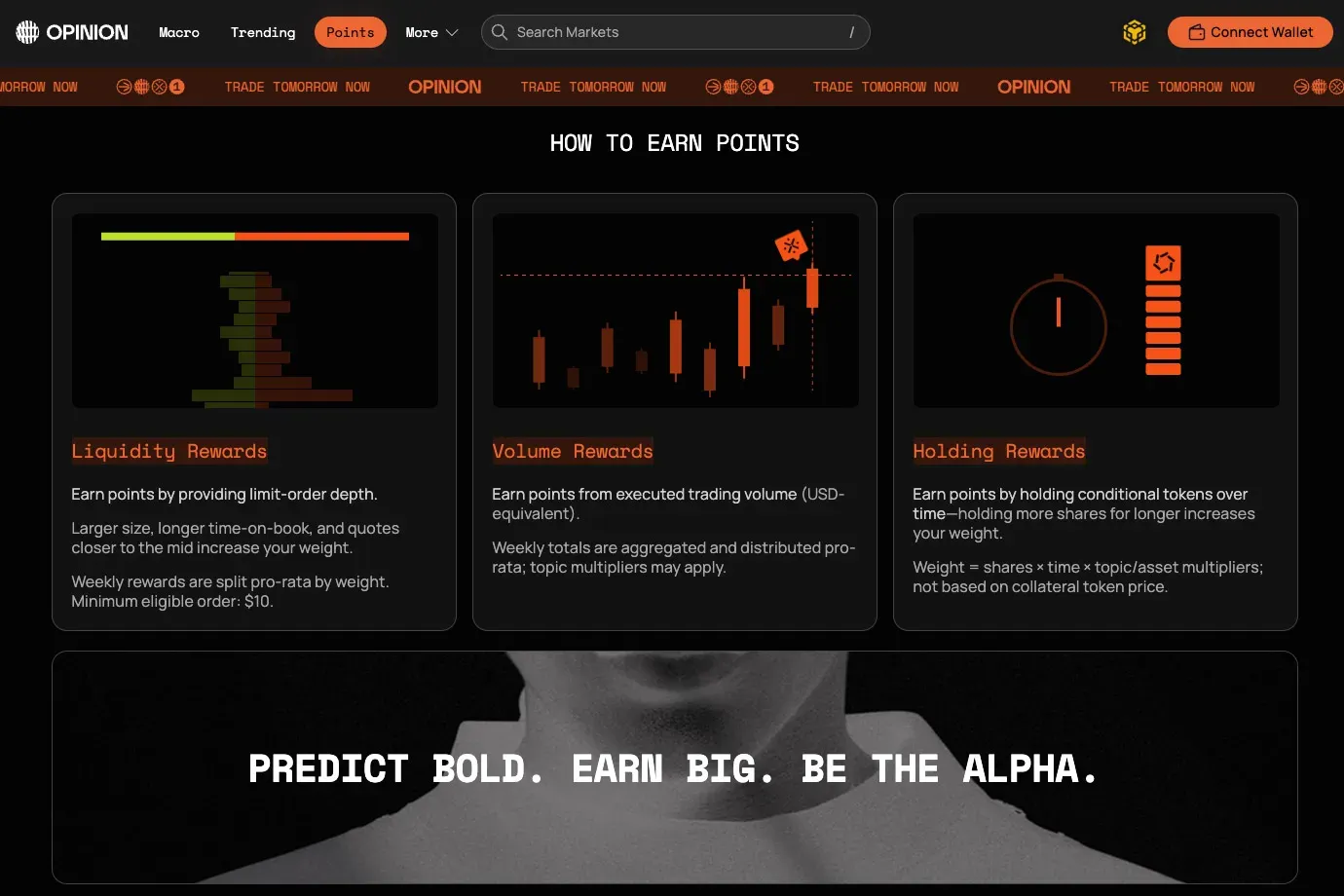
To compete, Opinion uses a crypto-oriented incentive system that rewards loyal customers for their patronage. Opinion processed almost $2 billion of trades in the week ending Jan. 25, surpassing Polymarket and just shy of Kalshi’s total in the same period, the data show. But now the flywheel is faltering: Opinion’s $604 million of trades in the week ending Feb. 22 were less than half the volumes seen by Polymarket and Kalshi.
Opinion didn’t respond to questions from Bloomberg News about its trading volumes.
Prediction markets give punters a platform for betting on just about anything, from regime change to the outcome of the Super Bowl. They have grown quickly over the last year, drawing in traditional financial firms including CME Group Inc. and Intercontinental Exchange Inc., while earning Kalshi and Polymarket valuations of around $10 billion.
The platforms have faced criticism for making it possible to bet on things that used to be outside the realm of speculation, including matters of life and death, such as war.
Most of the growth has happened in the US, where regulators recently opened the door to these new financial contracts. That has led to interest in whether the same idea might take off overseas.
Opinion is an upstart backed by YZi Labs, the family office of Changpeng Zhao, co-founder and former chief executive officer of Binance, the world’s largest crypto exchange. YZi Labs backed Opinion in August 2024 as part of an accelerator program for BNB Chain, a blockchain with close ties to Binance.
Like Binance in its early days, Opinion has gained a foothold in Asia. About 42% of its web visits came from the region in January, compared with just 19% and 7% for Polymarket and Kalshi, respectively, according to Similarweb data.
Kaviish Sethi, a data engineer at Artemis Analytics, said the Asia skew is a direct result of Opinion’s links to the Binance universe, “which puts it in an ecosystem that already has large, highly active retail communities in Asia.”
Binance didn’t respond to a request for comment. YZi Labs had no comment.
Opinion’s contracts, too, have a strong regional flavor. Users are currently wagering on the Chinese Grand Prix, when Japanese cherry blossoms will fully bloom and the outcome of Korean local elections.
Token Rewards
For early traction, Opinion deployed a points system that may translate to rewards denominated in digital tokens for its most active traders. But that same system brings with it the risk that growth could suddenly peter out.
“Points programs often drive inorganic, reward-driven volume that can drop sharply once incentives end,” Sethi said.
In the 30 days to Feb. 25, Opinion’s volumes fell about 47% to $4.14 billion, while volumes on Polymarket and Kalshi grew 15% and 16%, respectively, according to Artemis Analytics. Sethi said Opinion’s top-10 volume traders as of Jan. 19 accounted for roughly half the decline. He couldn’t pinpoint a reason for their retreat. Opinion’s website suggests the rewards program is still active.
“Opinion’s reported volume may reflect a large share of repeated trades rather than genuine net positions,” Cho Junkee, an analyst at SK Securities Co. wrote in a report published in January about the three biggest prediction markets.
The recycling of capital — repeatedly buying and selling the same contracts — to harvest points may result in artificially inflated volume that isn’t a true reflection of economic activity, he added.
A better gauge is “turnover ratio,” which weighs weekly traded volume against open interest. For Opinion, it was at 15.32 as of the week of Dec. 29, compared with 4.25 on Polymarket, according to Junkee’s report.
Similar concerns have been raised over Polymarket trading. A study by Columbia Business School posted in November found that artificial trading on the platform accounted for an average of 25% of all buying and selling over the past three years. Many active traders hoped to improve their odds of getting access to a proprietary digital token that Polymarket has said it may release, the researchers said. Polymarket didn’t respond to a request for comment.
Such tokens are typically distributed via so-called “airdrops” that serve as a reward for early adoption.
A report by blockchain security and intelligence platform Certik-Skynet in February predicted that the “triopoly” of Polymarket, Kalshi and Opinion would likely persist in 2026, but the authors wrote that Opinion’s ability to retain users after any airdrop is a key variable.
Asia Focus
Its geographic edge is, for now at least, what Opinion is focused on preserving. The company announced raising another $20 million in early February in a round featuring crypto-native investors Hack VC, Jump Crypto and Primitive Ventures. Dovey Wan, founding partner of Primitive, said Opinion’s regional focus is among its key strengths.
Opinion said it would deploy the funds to “deepen its foothold in Asia-Pacific,” where its platform “already dominates regional event liquidity.” The firm will also look to expand globally ahead of the 2026 World Cup and upcoming elections, it added.
“Opinion has very strong local cultural instinct that can keep their mid-to-long-term market really lively,” Wan said. “We want to back the underdogs.”
The rise of prediction markets offers statisticians and social scientists the kind of help that astronomers get from a new space telescope or particle physicists from a bigger supercollider. We finally get to test theories and resolve questions that people, held back by poor data, have been wrangling over for decades.
Most importantly: Are prediction markets superior to experts and market instruments in forecasting future macroeconomic events? And can the prices on platforms including Polymarket and Kalshi Inc. guide important individual and social policy decisions?
Earlier venues that allowed people to wager on the outcomes of economically relevant events were basically laboratory studies with narrow participation, infrequent trading and low stakes. Gambling markets avoided these problems but seldom considered questions that generated data comparable to implied financial market prices or expert judgments.
With prediction markets now teeming with customers and contracts on everything from whether the US economy will be hit by stagflation to the chance of a US strike on Iran in 2026, we can finally start to understand their value — as two recent papers attempt to do by zeroing in on monetary policy forecasting.
The first, “Testing Polymarket’s ‘Most Accurate’ Claim,” considers the actions of central banks in the US, UK, European Union and Japan over the last two years and seems to point to a negative evaluation of prediction markets, though a deeper analysis shows that to be not entirely true.
It leverages the work of Wharton School professor Philip Tetlock, who gained fame 20 years ago with his book Expert Political Judgment. In it, he compiled exhaustive evidence that prominent experts were terrible at prediction, easily beaten by monkeys throwing darts or simple statistical models. The more prominent the expert, the worse the performance. The two main problems were psychological biases and poor incentives.
Tetlock exploited his knowledge of psychology and economics to offset biases and provide proper incentives, turning ordinary folk without specialized expertise or education into what he dubbed “superforecasters.” When tested using questions submitted by policymakers, Tetlock’s superforecasters blew away not only other academic teams but also the professional forecasts made by highly trained specialists with access to classified intelligence.
But how do superforecasters fare against prediction markets? In “Testing Polymarket’s ‘Most Accurate’ Claim,” the authors used an academic criterion known as “Brier score” to judge accuracy and found superforecaster teams had a better (lower) score than Polymarket prices.
Most Bloomberg readers will probably find a different metric more meaningful. If you bought every Polymarket contract for which the superforecasters thought the probability was greater than the contract price and sold every contract where the superforecaster probability was lower than the price, you’d have made $477 over the 6,393 one-dollar bets, a 7.5% edge.
Before deciding that superforecasters know everything Polymarket traders know and more, I dug a little deeper and calculated the actual frequency of events versus probability predictions. The blue line is perfect prediction — events predicted to have 50% probability happen half the time and so on.
Both superforecasters and Polymarket are bad in the tails and better — though far from perfect — around the center. Events predicted to have under 20% probability almost never happen, while those with over 80% probability almost always happen. Polymarket is best with prediction probabilities between 35% and 65%; superforecasters are better between 20% and 35% and 65% to 80%.
What if we consider the optimal combination of the two forecasts? My calculations put 60% of the weight on the superforecasters and 40% on Polymarket. Superforecasters beat Polymarket, but the combination beats both individual forecasts. Polymarket’s prices contain significant information that can be used to improve superforecaster estimates.
In “Kalshi and the Rise of Macro Markets,” published by the Federal Reserve, the authors tackled a different question, one of utility. Unlike traders who want to make money betting on macro trades or decision makers making plans that depend on macro factors, the Fed wants to manage macroeconomic expectations.
Their main finding is Kalshi provides much richer information about the distribution of expectations, not just what the average or median market participant expects. After all, the economy is driven by billions of decisions by hundreds of millions of individuals, not the average or median person and not just a few highly paid Wall Streeters.
The researchers also found that Kalshi prices have comparable accuracy to the New York Fed Survey of Market Expectations as well as Bloomberg’s consensus forecasts; it even beat the Bloomberg consensus for the consumer price index. Kalshi is particularly good — or experts and financial markets are particularly bad — at quantifying tail risks. These are more important to the Fed than the everyday ups and downs of markets.
Even if the Kalshi predictions were not this accurate, they would be useful in helping the Fed understand what people think. Moreover, since Kalshi prices are continuous and intraday, they allow the Fed to see the immediate effect of single events — an announcement, a press conference, a speech. The paper confirms that these rapid responses are meaningful.
While the paper is limited to the perspective of central bankers, we could expect similar results for all decision makers concerned with public opinion. Some obvious fields are election analytics, real estate development and investment, fashion and entertainment, and social and news media.
In one sense, both papers are perishable. Prediction markets are evolving rapidly, and artificial intelligence is coming up in the rear review mirror. With more trading volume, contracts, liquidity and users, prediction markets should up their game. But AI is nipping at their heels already. While AI prediction algorithms have not yet matched superforecasters, they’re moving up the leaderboard rapidly. In fact, an elite team of human forecasters at online prediction platform Metaculus puts a 95% probability on AI beating them — and all other humans — in forecasting by 2030.
That is one of many questions that came up Thursday after the latest set of profitable, well-timed trades came under scrutiny on Polymarket, one of the largest exchanges in the nascent prediction market industry.
The case cropped up after a well-known crypto researcher, who operates under the pseudonym ZachXBT, said on social media that he was preparing to release the name of a company whose employees he believed had used non-public information to place profitable trades.
Polymarket created a contract that allowed customers to bet on the name of the company that ZachXBT would reveal, attracting around $40 million in trading since it went up on Monday.
After ZachXBT released his findings and the name of the company — Axiom — on Thursday morning, a number of online sleuths immediately identified several profitable bets that suggested someone knew the answer early and traded on the information before it was released.
“Did Axiom employees commit more insider trading on the ZachXBT market?” Polysights, a data terminal for prediction markets that tracks such behavior, wrote in a post on X on Thursday.
The allegations suggest an ouroboros of insider trading that underscores the novel regulatory problems created by prediction markets as they swiftly rise in popularity and offer a new form of financial speculation with unclear guardrails.
Polysights, which is not affiliated with Polymarket, operates a tool that looks for signs of insider trading on Polymarket’s public ledger. It does so by identifying large bets from newly created wallets, highlighting those whose bets are concentrated in a single market or who place trades immediately after setting up their account.
Five wallets identified by Polysights bet around $50,000 collectively on Axiom to be named, netting the holders a combined profit of roughly $266,000.
A separate analysis by researchers at Lookonchain, another analytics firm, found 12 potential insider wallets that had bet on Axiom. Those wallets made a combined profit of around $1 million.
Axiom, for its part, said it was “shocked and disappointed” by the ZachXBT’s findings, adding in an X post that it would continue to investigate the matter. It didn’t immediately respond to a request for comment on whether it was aware of any employees trading on the Polymarket wager.
Polymarket didn’t immediately respond to a request for comment.
For now, those are just allegations, and it’s unclear what sort of insiders might have been involved. It could have been people who knew about ZachXBT’s findings. It could have been the people who did the original insider trading and thus had a sense of what ZachXBT might discover.
ZachXBT said on social media that he had contacted Axiom for comment and conducted several interviews before publishing, making a leak “probably inevitable.” The blockchain records offer few hints in this direction, and Polymarket’s offshore platform that hosted the bets doesn’t conduct identity checks.
In the days leading up to publication, another crypto trading platform called Meteora had been the market’s front-runner. When a Meteora co-founder appeared to deny any involvement in a social media post on Wednesday, the wager quickly flipped in Axiom’s favor, where its odds reached a peak of 46.2%.
The controversy ramps up the concerns about the vulnerability of prediction markets to such issues, as regulators race to get their heads around the fast-growing sector.
Just this week, rival trading platform Kalshi said it had caught and punished an employee of the YouTuber, MrBeast, who had made profitable trades on contracts tied to what would happen in MrBeast videos. It also fined a former candidate for California governor who’d placed a bet on his own campaign.
The Commodity Futures Trading Commission, which has taken responsibility for overseeing prediction markets, has exercised a light-touch approach to regulating the space under the current Trump administration. But after Kalshi’s announcement, the agency said in an advisory that it “has full authority to police illegal trading practices.”
Polymarket is opening a US exchange that is under CFTC oversight, primarily offering sports bets. But the Axiom wager occurred on Polymarket’s much larger international venue, which doesn’t answer to the agency.
Dustin Gouker is one the most well-known and respected reporters in the gaming industry.
He’s spent more than 20 years as a sports journalist, and nearly six heading up content at Catena Media. Today, Dustin writes two of the industry’s hottest newsletters—The Closing Line and Event Horizon—where he covers anything from states’ sports betting numbers to the burgeoning prediction markets landscape.
In two weeks, Dustin will be opening up NEXT’s Emerging Vertical event with a prediction markets-focused session alongside Sporttrade CEO Alexander Kane and Duane Morris Partner Bill Gantz.
We connected with Dustin ahead of his talk to get his read on where he thinks prediction markets are headed, how likely “new” entrants are to find success in this space, and what other verticals are piquing his interest.
This interview has been lightly edited for flow and clarity.
BettingStartups:You're moderating the opening session "The Prediction Market Momentum and the New Wave of Emerging Verticals" — what are the topics you're most eager to dig into with the panelists during the talk?
Dustin Gouker:I think there has been so much noise and disruption because of prediction markets... I am not sure how many people have taken a breath and thought more about the opportunity and where it is headed. And there's so much focus on operators, when there are opportunities far beyond just being the place where prediction markets trades happen. My hope is this panel and the overarching event gets people thinking beyond the deluge of news we have seen around prediction markets in the past year.
I also think skill gaming is a vertical that is going to get increasing attention in the gambling industry. I am eager to dig into that over the course of the panels at the Emerging Verticals event.
BS:Prediction markets have evolved rapidly over the last 12 months—big growth, sports team partnerships, OSB operators getting involved—if you could consult a crystal ball about where the space is headed over the next 12–24 months, what is a single uncertainty (or a few) you'd want clarity on, and why?
DG: Obviously, the biggest of all the elephants in the room is whether sports event contracts will survive beyond the next couple of years. There are people that believe with 100% certainty that prediction markets will disappear or will be here into perpetuity. The real probability of that is of course somewhere in the middle, and pricing the final outcome in the courts is difficult at best. Regardless, the legal certainty on prediction markets and sports event contracts is the biggest unknown.
Beyond that: will people bet/trade/speculate on the "everything else" outside of sports and big elections? Polymarket has proven that this is possible with its international site, but the non-sports markets have not taken off in the CFTC-regulated space beyond a few one offs.
And of course, will Congress do anything? That seems unlikely but also isn't impossible.
BS:Right now, prediction markets are primarily dominated by two players, but there are a growing number of competitors entering the space, from smaller brands to OSB leaders like DraftKings and FanDuel—given the major first-mover advantage behind Kalshi and Polymarket, how competitive do you think these other brands can and will be?
DG: The head-start by Kalshi is definitely meaningful, but the sheer number of operators coming into the space to contest it B2C is huge, and is limited only by your imagination. Anyone with a customer's wallet or a web presence could be a prediction market (or use markets from Kalshi and others to power their own product). I think on the sports side of things, I wouldn't bet against the sports betting and fantasy companies. DraftKings and FanDuel are clearly going to spend to contest the market.
I also think Robinhood is the current biggest threat to lead the market. They already account for a huge percentage of trading volume via Kalshi as a partner. They have a huge user base that is already using prediction markets and store their money or other assets on their app. That's a really good starting place.
BS:Of the other "emerging verticals" in play in the broader real-money gaming industry, which do you think are best positioned for growth, or at risk of losing relevance, in the next 12–24 months and why?
DG: Sweepstakes isn't going away entirely, but the size of the industry's addressable market is still under assault. I will be interested to see how they pivot… some of that pivot may be to other emerging verticals, including prediction markets.
I think skill gaming will have its moment in the coming years. Triumph is a huge company in the space and I think everyone is just now waking up to this opportunity.
When Federal Reserve Chair Jerome Powell stepped up to the podium on Jan. 28, the room hushed in anticipation. The reporters attending the Federal Open Market Committee press conference in Washington hung on Powell’s every market-moving word. Would he hint at adjustments to the overnight lending rate? Would he discuss the effect of tariffs on prices? Would he address questions about his successor?
Online, another group was monitoring Powell’s performance no less closely, but for a very different reason. On Discord and X, dozens of traders had been discussing their bets on which words would come out of Powell’s mouth. Many were sure he’d say “good afternoon.” (He usually does.) Others wagered on “shutdown,” “layoff,” “yield curve” or “egg,” among the 44 different terms offered on the prediction market platform Kalshi.
From his parents’ house in Orlando, Austin Minton, a 23-year-old livestreamer with shaggy blond hair, shared his thesis that Powell wouldn’t say “Trump,” pointing out that the Fed chair hadn’t done so in recent remarks. Minton had also wagered that Powell wouldn’t say “projection,” since the recent government shutdown meant there was less economic data available, but that he would say “renovation,” in reference to the reconstruction of the Federal Reserve building, which critics including the president were saying raised questions about Powell’s integrity. Before the speech even began, bettors had traded more than $2.8 million on Kalshi’s Powell market.
“Good afternoon,” Powell said. Minton pumped his fists. “Yes!” he exclaimed. “Easy three bucks.”
Powell began reading his prepared remarks. His words echoed an earlier FOMC release, but he added new material, mentioning a “shutdown” (market odds had been at 67%), “softening” (59%) and “layoffs” (76%). Moving on to the Q&A with reporters, he hit “restrictive” (62%), “Beige Book” (the Fed’s biquarterly report, 30%) and “tariff inflation” (13%). When Powell fielded a question about the Justice Department investigation of the Fed building project, Minton braced himself, hoping not to hear the president’s name. Powell dodged the question, prompting Minton to rejoice and praise him: “That’s the GOAT!”
As the presser went on, the percentage odds on the remaining words declined on Kalshi, as they typically do on a “mention market” like this. By the last question, it seemed a safe bet Powell wouldn’t utter “pandemic” (now at 17%), “projection” (12%), “uncertainty” (8%), “trade war” (3%) or “renovation” (2%).
Then, however, he did something astonishing. Responding to the final questioner, he went on a mention spree. “The Summary of Economic Projections … we hadn’t had a pandemic in 100 years … a trade war of this scope … there’s great uncertainty at different points.” It was the prediction market equivalent of a last-second pass leading to a 60-yard zigzag run through defenders, capped by a headlong dive across the goal line. Minton, who’d bet that Powell wouldn’t say “projection,” was devastated. “Oh my God, at the end? Last question? C’mon, Powell!”
The press conference ended. The traders on Discord debriefed on their wins and losses. But something was off. On Kalshi, the odds on “renovation” were suddenly climbing. (Kalshi doesn’t resolve markets and pay out winnings until some time after an event finishes.) Minton was confused. “Did he say ‘renovation’? This is crazy.” He pulled up a clip and saw that one of Powell’s final answers included a rare slip of the tongue: “When it comes to technological developments that raise potential output, some kind of technological renovation”—Powell then corrected himself—“you know, revolution like happened in the ’90s here, and like may be happening now with AI ... .” The tape didn’t lie: Powell had said “renovation.” Minton speculated that it had been a Freudian slip fueled by Powell’s determination not to talk about the investigation.
The Discord chats went berserk. One trader, Foster McCoy, who was on a voice channel with a dozen others, heard grown men screaming. “I lost my mind,” McCoy later recalled. “Like, what are the odds it hits as a buzzer beater?” “IVESTIGATE POWELL [sic]” wrote one Discord user, jokingly implying that Powell had made insider trades. “Might be the most insane market I’ve ever traded,” tweeted a respected 21-year-old trader who goes by Esoteric Catboy and who said he’d made more than $5,000 on the press conference.
Mention markets are the high-octane, fast-twitch speed competitions of the prediction market world. But they’re just one corner of it. Users of Kalshi and its primary rival, Polymarket, can bet on events major and minor, from politics to sports to culture to the weather. Recent markets on Kalshi have included whether certain words would be used during a Palantir Technologies Inc.earnings call, whether Elon Musk would win his court case against OpenAI and whether the highest temperature in Seattle on Feb. 4 would be within a certain range. Polymarket users have bet on whether the US would strike Iran on a particular date, whether a given Trump cabinet member would be the first to leave office and whether Jesus Christ would return before 2027.
Prediction markets were once a fringe obsession of economists and election wonks, but in the past year or so, they’ve gone from obscure to everywhere. The industry is booming thanks to a combination of marketing, distrust in traditional sources of information and a newly friendly regulatory environment. Late last year, Kalshi Inc. and Polymarket, both headquartered in New York City, raised funds at valuations of $11 billion and $8 billion, respectively. In the weeks leading up to the Super Bowl, Kalshi users were betting more than $2 billion a week, while Polymarket users were just shy of that, according to user-compiled data on Dune Analytics.
The companies are also rapidly insinuating themselves into American media. Both have struck deals with major sports leagues to provide data during games. Kalshi has partnered with CNN and CNBC, while Polymarket has a contract with Dow Jones, meaning prediction odds are likely to be integrated into coverage of elections and other events. During the Golden Globes on CBS in January, a Polymarket chyron flashed before each award was handed out, correctly predicting nearly all 28 winners. “Seeing people look at the Polymarket odds for certain things that otherwise they would just be pontificating or talking past each other about, that’s the thing that really makes me excited,” says Polymarket’s chief executive officer, Shayne Coplan.
In October, Polymarket announced an investment of up to $2 billionfrom Intercontinental Exchange Inc., which owns the New York Stock Exchange, a deal that will likely lead prediction market data to be integrated into financial tools used by institutional traders. Susquehanna International Group, Jump Trading and other major firms are providing liquidity on Kalshi to facilitate trading. In January, Goldman Sachs Group Inc. CEO David Solomon called prediction markets “super interesting” and said he had a team looking into them.
Boosters say prediction markets create economic and social value by providing better information about what will happen in the world. People could use them to hedge against risk—by betting that a hurricane will hit, say, or that the US government will shut down—or simply to make better decisions in the face of uncertainty.
Both Polymarket and Kalshi pitch themselves as sources of truth in a time of epistemic precarity. Coplan says his platform is a guide for “when you’re thinking about the world, you’re thinking about government, and you’re thinking about macro trends and headwinds that could impact your life.” Kalshi co-founder and CEO Tarek Mansour says prediction markets “take debate from the realm of subjective emotion to the realm of objective math. And that’s why it ends up being a little bit more truthful.” The company’s other co-founder, Chief Operating Officer Luana Lopes Lara, has called betting on one’s beliefs a “tax on bullshit.”
Detractors call prediction markets glorified gambling. Indeed, the vast majority of the volume on Kalshi is betting—or, as the company puts it, “trading”—on sports. For all the highbrow talk of price discovery and revealed truths, it can be hard to discern the economic or social value of knowing the likelihood Pete Davidson will attend the Super Bowl. (“People care about the things they care about, and it’s not necessarily our job to decide what people are going to care about,” Mansour says. Coplan says of betting on celebrity appearances: “I don’t care for those markets.”)
And the markets’ relationship with truth is complicated. They can be vulnerable to manipulation, insider trading and other shenanigans. In many cases, they influence reality as much as reflect it. Not to mention that their rules and decisions about what did or didn’t happen can be inconsistent.
The companies are also facing headwinds. While Kalshi is regulated federally, by the Commodity Futures Trading Commission, it’s either the plaintiff or defendant in at least a dozen lawsuits with states or Native American tribes claiming it’s an unlicensed gambling platform that falls under state or local jurisdiction. Polymarket was recently banned in Nevada, at least temporarily, while a state gambling commission lawsuit plays out there. Several individuals have initiated class actions against Kalshi and Polymarket alleging that they’re operating illegal gambling sites and promoting addiction. (Asked for comment on the suits, a Kalshi spokesperson pointed to a statement by Lopes Lara calling one of them “baseless.” Polymarket didn’t respond to a request for comment.) The companies argue they should continue to be regulated by the CFTC—which is currently well-disposed to prediction markets—but a victory by the states could deal a blow to their business models. Even if the CFTC does maintain its jurisdiction, it’s unclear what happens if and when a new, more skeptical administration takes over.
Furthermore, many people don’t like the platforms’ sudden ubiquity. “I am worried about potential backlash and how long that could last,” says Robin Hanson, an associate professor of economics at George Mason University who’s considered a founding father of prediction markets. Coplan acknowledges there’s been a “vibe shift” the past few months: “You always get told eventually you’ll cross this chasm where you’ll go from the underdog to everyone thinking it’s a big thing, and people turn against it. And I think that’s this moment.”
Whether prediction markets will persist, never mind fulfill their founders’ vision of life guided by the wisdom of crowds, depends on how the companies handle these challenges. Can they show customers they can be trusted?
Source: @datadashboards at Dune
The allure of prediction markets lies in their simplicity: You’re asked whether a given event will occur, and you pick “Yes” or “No.” Technically, on Kalshi and Polymarket, you’re buying one or more contracts that pay out $1 each if you’re right and nothing if you’re wrong. As hundreds or thousands or millions of those yes-or-no contracts are bought and sold, the price fluctuates somewhere between 1¢ and 99¢. That price (20¢, say) is intended to serve as the implied probability of the event occurring (20%), which translates into a prediction.
Just as prices in a stock market aggregate information, so do prices in prediction markets. In an election market, for example, one bettor might have analyzed a candidate’s county-by-county support. Another might have created a sophisticated turnout model. Another might learn that a candidate is sick. Another might even have conducted a poll. No single person will have access to all of this. But when they place bets based on their information, it all gets channeled into a single figure.
Prediction markets aren’t new. Betting on papal conclaves was common in Italian city-states until Pope Gregory XIV banned the practice in 1591. (It continued underground.) In the 18th century, British gamblers wagered on whether the Tea Act would be repealed, and during World War II Londoners bet on how many German planes would be shot down. Election betting has been rampant in the US going back almost to the country’s founding, with New York City a particular hotbed; newspapers would cite odds, and patrons would show support for candidates by placing large public bets. Even a century ago, election odds were impressively accurate, according to research by Paul Rhode of the University of Michigan and Koleman Strumpf of Wake Forest University. The markets got only one of the 15 presidential elections between 1884 and 1940 wrong—1916, when underdog Woodrow Wilson prevailed.
Election markets declined in the US after that, which Rhode and Strumpf ascribe to the rise of scientific polling, a crackdown on gambling by New York City Mayor Fiorello La Guardia and the legalization of racehorse betting in New York state. But they began a slow comeback in 1988, when researchers at the University of Iowa created the Iowa Electronic Markets, getting a carve-out from existing law because their purpose was academic and the wagers were capped. It soon proved to be more accurate than polling.
Around the same time, Hanson, the future George Mason economist, was working in Silicon Valley and pushing prediction markets beyond mere prognostication. Convinced they could guide leaders to make better decisions, he helped create the first internal corporate prediction markets in 1990. (One such market asked employees to bet on when the company would deliver its product.) In 1995 he proposed “ideas futures” to ascertain which academic research questions were most promising and deserving of funding. And in a 2000 academic paper he suggested a form of government called “futarchy,” in which prediction markets would shape policy decisions—legislators might, for example, pass whichever gun law the markets predicted would result in the lowest murder rate. (He also flagged many potential drawbacks, including, as one section title had it, “You Can Not Pay Off Bets If Earth Is Destroyed.”)
Hanson got a chance to implement some of his ideas at a high level in 2001, when the Defense Advanced Research Projects Agency (Darpa) agreed to fund a project he and his team called the Policy Analysis Market. The plan was to create markets that would help predict events in the Middle East. But critics called it a “terror market” and warned that it would incentivize terrorist attacks. The project was scuttled in 2003.
“Nothing is more valuable than the truth”
Prediction markets’ reputation improved gradually as that of polls declined. But tough regulation in the US meant they got limited traction. In 2016, Mansour, then a student at the Massachusetts Institute of Technology, was interning at Goldman Sachs when clients asked his team to find ways to hedge against Brexit. They came up with a complex set of financial levers they guessed would correlate with Britain leaving the European Union. But it struck Mansour as silly that the clients couldn’t just bet on the event itself. In 2018 he and Lopes Lara, a friend from MIT, founded Kalshi. They envisioned an exchange where anyone could make a trade based on almost any real-world event. (Kalshi means “everything” in Arabic.)
Two years later, in 2020, Coplan, a New York University dropout, created Polymarket in what he described as his “bathroom office.” He’d been deep into crypto and was inspired by Hanson’s writings to build a prediction market on the blockchain. Polymarket reflected the libertarian ethos of its crypto ecosystem: anonymity, zero fees, minimal intervention. On a podcast at the time, Coplan described the operation as “basically nonprofit.”
For both companies, the timing was bad. Joe Biden’s administration took a dim view of prediction markets, and at first the CFTC approved only a handful of relatively tame offerings on Kalshi, such as predictions about inflation or Federal Reserve interest rates. The administration was “as hostile as it gets,” Mansour said on Bloomberg’s Odd Lots podcast last year. “They just didn’t want it to exist.” The CFTC accused Polymarket of operating an unlicensed exchange, and, as part of a 2022 settlement, the company agreed to pay $1.4 million and blocked Americans from trading on the platform, without admitting wrongdoing. (In practice, Americans could still access the site using software that hides their location.) Two years later, the CFTC banned Kalshi from posting some political betting markets and proposed an outright ban on event contracts related to sports, elections and awards shows.
Everything changed in late 2024. That September, Kalshi won a lawsuit challenging the CFTC’s political markets ban, which cleared the way for legal betting on the presidential election. Kalshi began drawing massive volume, as did Polymarket, though it was still blocked in the US. On Election Day, both had Trump favored to win. His victory wasn’t just a vindication for prediction markets; it was a godsend. Where the Biden administration had been “hostile” to prediction markets, Trump’s team embraced them.
In January 2025, Kalshi named Donald Trump Jr. as a paid adviser, and a few months later Polymarket brought him on as an investor and adviser. In July the Justice Department ended an investigation of Polymarket that had led federal agents to bust down Coplan’s apartment door in a raid. And in November the company was cleared to operate in the country. Its US app soft-launched in December. So far, it offers only sports bets.
The day Polymarket announced the $2 billion Intercontinental Exchange deal, Coplan reflected on his company’s journey on X: “I knew we were entering an era where ways to find truth would matter more than ever, and Polymarket could play a critical role in that. After all, nothing is more valuable than the truth.”
Source: @datadashboards at Dune
Last summer, British YouTuber Miles Routledge, aka Lord Miles, announced that he would film himself spending 40 days fasting in a tent in a Saudi desert, consuming nothing but water and electrolytes. Viewers could bet on Polymarket (and, later, Kalshi) whether he would complete the fast.
Routledge is a kind of shock tourist, who since 2021 has been traveling around the Middle East and Central Asia getting into trouble. He’s also made racist comments online, particularly against Black people and Indians, and once wrote that he would “happily commit genocide.” Still, Polymarket promoted the stunt on X, including hosting an advance livestream with Routledge. When someone on X pointed out that it would be “easy to cheat” in such a market, Polymarket assured them that the stunt would be livestreamed 24/7. Once the fast began and Routledge started posting photos and updates, the company would sometimes add cheeky replies, like “do you want us to send you pizza.”
As the days went by, Routledge’s odds of success on Polymarket gradually climbed from their original 18% to a high of 74% two weeks in. But then, on Day 28, he told viewers the electric grid was going down and he would go briefly offline. The feed cut off. Routledge didn’t come back on.
The market eventually resolved to “No.” Traders were furious. Their rage deepened when they learned that a crypto wallet that had bet “No” on Routledge, netting $60,000, was linked to another wallet he’d previously revealed was his. It appeared to many people to be a case of market manipulation and insider trading. Routledge finally surfaced in December and denied that he’d bet against himself, blaming a colleague who he said controlled the wallet and made the trade.
Routledge didn’t answer emailed questions for this story, and Polymarket didn’t respond to questions about the incident. The spokesperson for Kalshi (whose market didn’t see as much volume) says, “We absolutely do not endorse this person’s statements or behavior. With the benefit of hindsight, this market would not meet our internal standards for product quality today.”
The Lord Miles saga was an extreme case, but it highlighted how wild and unaccountable prediction markets can be. In December a trader whose blockchain trail showed they’d previously profited from a Google-related trade cashed out $1.2 million in Polymarket bets on Google’s most-searched people in 2025, drawing suspicion of insider activity. And in late December and early January, an anonymous blockchain user placed a series of Polymarket bets on Nicolás Maduro’s ouster, including a final one hours before US special forces descended on the Venezuelan president’s compound. In all, the bets turned a $400,000 profit. Polymarket didn’t respond to questions about the incidents.
Kalshi says it has rules in place to prevent insider trading and refers suspicious activity to regulators. Coplan has pointed out that such instances on Polymarket are quickly exposed online. Others, including Brian Armstrong, CEO of crypto exchange Coinbase Global Inc., have argued that insider trading in prediction markets can make them more accurate, albeit less fair. In a recent appearance on CNBC, Mansour said that if Bad Bunny wanted to tell someone what his first song at the Super Bowl halftime show would be and they bet on it, that would be “fair game” and “part of what the risk in the market is.” (Mansour clarifies that such a bet would constitute insider trading if the person had a “legal obligation” to keep the information secret.)
Source: Pew Research
Prediction markets can also drive events rather than merely anticipate them. In August, after multiple WNBA games were interrupted by attendees throwing dildos onto the court, Polymarket encouraged users to bet on whether it would happen again; to no one’s surprise, more dildos were tossed, with no clear way of telling whether anyone involved had bet beforehand. Polymarket didn’t respond to a request for comment.
At the end of January, as a partial government shutdown loomed, Kalshi and Polymarket users could bet on whether it would happen. The Kalshi market’s contract said it would base the outcome on a single data point: whether or not the website of the Office of Personnel Management posted a notice about the shutdown by 11 a.m. Eastern time on Saturday, Jan. 31. (Polymarket had a midnight deadline.) On X, a trader with the handle @GroyperFinance_ publicly asked the director of OPM, Scott Kupor, if the agency’s website would be updated to reflect the shutdown. Once the shutdown was confirmed, Kupor replied: “You got your wish - website will be updated!” The Kalshi spokesperson declined to comment on the incident. Polymarket didn’t respond to a request for comment.
Adding to the messiness are instances of poor rules design and seemingly arbitrary decisions by the platforms. When Timemagazine announced its 2025 Person of the Year as “The Architects of AI,” with a cover photo of OpenAI CEO Sam Altman, Nvidia Corp. CEO Jensen Huang and others, Polymarket changed its rules at the last minute to include “Architects of AI/Other” and decided that “Artificial Intelligence” was incorrect. In early 2025, Kalshi took bets on whether the sitting US president would meet Canada’s then-Prime Minister Justin Trudeau that year. Biden soon did—and even shook hands with Trudeau on TV—but “Yes” bettors lost anyway, since the meeting wasn’t reported by the two sources Kalshi had designated in its market rules. Last summer, Polymarket traders fought for weeks on Discord over whether Ukraine President Volodymyr Zelenskiy had worn a suit. Some argued that a black jacket and shirt he’d worn to a NATO dinner qualified; others said it didn’t. The market ultimately resolved to “No,” spurring more uproar. Kalshi declined to comment on specific resolution decisions. Polymarket didn’t respond to a request for comment on some of its resolution outcomes.
In Polymarket’s case, some blame the regular spats on its unique process for resolving markets. The platform delegates outcome decisions to holders of a crypto token, UMA, that anyone can buy. Unsurprisingly, this produces some bizarre results. The chat room for disputes on the UMA Discord is a morass of hair-splitting and bad faith arguments. One recent quarrel involved the market “Who will Trump talk to in January?” Some bettors who’d wagered that Trump would speak with Russian President Vladimir Putin noted that Trump said he “personally asked” Putin on a “call” to halt strikes on Kyiv and that the Kremlin had confirmed the “personal request.” Yet UMA holders resolved the market to “No,” owing to ostensible ambiguities about the timing and nature of the call.
Some Polymarket traders argue that this system biases decisions toward users who hold large quantities of UMA tokens. According to an analysis by data platform Sentora, UMA whales—those who each own at least 1% of all tokens—control 95% of the total pool. In that light, Polymarket’s “decentralized” resolution system appears to be anything but. The company didn’t respond to a request for comment.
“Apparently they think engagement outweighs trust”
Kalshi has an internal team to resolve disputes. The spokesperson says it includes former finance associates, consultants and debate champions. Their decisions, too, can be controversial. In January, a mention market dedicated to a Netflix Inc. earnings call included the option to bet on someone saying “Warner Bros.” An executive did say “Warner Brothers,” but the market resolved to “No” because the person didn’t pronounce it like “bros.”
Some observers argue that the platforms’ social media presence further undermines user trust. In one notable example from January, Polymarket posted inaccurately on X: “BREAKING: Iranian Regime security forces have lost nearly all control” of Tehran and two other cities. Kalshi and Polymarket have both run into issues with their affiliate marketing programs, including giving special “badges” for promoting the companies to accounts on X that then posted false information about sports figures. Kalshi revoked the badges. (“They’re not acting on our behalf,” the spokesperson says.) Polymarket didn’t respond to a request for comment.
“I don’t know how you can be over here saying, ‘We’re the greatest source of truth mankind has ever known,’ and then your social media team is just lying,” says Dustin Gouker, author of prediction markets newsletter Event Horizon. “Apparently they think engagement outweighs trust.”
Coplan says that ultimately, Polymarket’s trustworthiness comes from its transparency on the blockchain. “You can see the activity, you can see the top holders, you can see the order book and liquidity and the price trending over time,” he says. “You don’t need to trust me.”
In September the Securities and Exchange Commission and the CFTC held a joint roundtable with some CEOs of market platforms, including Nasdaq, Intercontinental Exchange and CME Group. Coplan and Mansour were on the panel too. Introducing himself, Coplan joked, “I was worried when I showed up here they were going to whisk me away to another room.” The group chuckled.
Coplan, his mop of dark curls looking extra-springy next to all the shiny or gray heads, argued that regulators should exempt “innovative” platforms such as Polymarket from certain rules, since as a crypto company it might not fit into the existing “regulatory matrix.” Sitting a couple of seats away, Terrence Duffy, the 67-year-old CEO of CME Group Inc., bristled at the idea. “Whether it’s in derivatives or securities, you have to have a single standard,” he said.
Coplan shot back that if innovative companies aren’t allowed to operate in the US, then consumers will be left “having to, you know, work with guys like you who are a lot older.” At this, Duffy jokingly flipped him off.
Polymarket and Kalshi’s biggest threat isn’t the old-guard exchanges, though—it’s the sports gambling industry. Sports makes up more than four-fifths of Kalshi’s trading and 100% of Polymarket’s US-based activity.
Source: Dune compiled by The Block
Note: As of Feb. 12, 2026
Traditional sportsbooks and casinos want prediction markets to be treated the same way they are—that is, as gambling companies, regulated by the states rather than the CFTC. The past year has seen a wave of actions by state regulators and Native American tribes, mostly against Kalshi, the earlier approved entrant to the US market, seeking this outcome.
Kalshi argues that it doesn’t offer gambling but rather trading on “event contracts,” a form of derivatives regulated by the CFTC. Mansour has also said there are key distinctions between what Kalshi does and what bookies and casinos do. At a casino, you’re betting against the house, and the house always wins in the end. Similarly, a bookie sets the odds, and if you win too much, they can ban you. Prediction markets, by contrast, are peer-to-peer. You’re betting against other people. (When you buy a “Yes” contract for 80¢ on a particular market, you’re matched with someone who’s buying a “No” contract for 20¢; whoever wins gets the $1 sum total of your bets.) Sure, the exchange takes a fee for every trade, but it’s not rooting for you to lose.
Mansour also distinguishes between the “artificial risk” created by a bookie and the “natural risk” of trading on real-world events. The risk created by the bookie traces purely to the odds he sets; it wouldn’t exist without him. The risk in prediction markets follows from the actual possibilities they describe—the risk of a wildfire, say, or of tariffs spiking—and the markets allow users to hedge against that natural risk. Finally, Mansour says, they serve a public benefit by providing accurate information to the world.
But is it gambling? On the one hand, yes, obviously, Gouker says. “I don’t care if you’re the house or not, this is sports betting.” On the other hand, when sophisticated prediction markets traders speak about their work, it can sound closer to academic research than gambling. A Russian trader named Alexey, who withheld his surname for safety reasons, says he made money on weather markets by figuring out NASA’s methodology for collecting and presenting weather data. Brandon Fean, a 25-year-old schoolteacher in Warminster, Pennsylvania, says he’s made more than $113,000 trading on music markets, predicting which album will reach No. 1 on the Billboard charts based on his understanding of patterns in album sales and streams. Another trader, Benjamin Freeman, says he drove two hours from his parents’ home in Memphis to speak with voters in another congressional district in hopes of getting an edge on a special election there.
As the court cases play out, Kalshi has tried to position itself as the adult in the room. Mansour has said that the company has safeguards in place to address the kind of problems that have plagued “unregulated, offshore platforms.” It requires users to register using their real name and show identification, and it has mechanisms to detect patterns that indicate insider trading in real time. Mansour says Kalshi has conducted 200 investigations in the past year and referred several cases to law enforcement. It has also formed the Coalition for Prediction Markets, an industry group that includes Coinbase and retail trading provider Robinhood Markets Inc., to promote an image of the companies as trustworthy and responsible. “We don’t do any markets that could create bad incentives,” Mansour says. “Both because it’s illegal and because it’s not a good thing for society.”
If the platforms get their way and retain CFTC oversight, that will likely mean favorable regulation for now, at least. In January the commission’s chairman, Michael Selig, said he planned to write new rules governing prediction markets, and a week later he formally withdrew the Biden-era proposal calling for a ban on markets related to sports and politics. The goal is to establish prediction markets firmly enough that a Democratic administration can’t undo their work. “We talk about future-proofing the industry to make sure that the next Gary Gensler”—the SEC chair who targeted the crypto industry under Biden—“doesn’t come along and blow it all down,” Selig said.
However the legal fights shake out, it’s hard to imagine prediction markets disappearing. J. Christopher Giancarlo, a former CFTC chairman and lawyer who has advised Polymarket in the past, compares the phenomenon to ride-share apps: It might face some barriers, but “once society gets used to it, there’s no going back.” Coplan says he sees them as just one part of a larger ecosystem of knowledge. “I’m not going to go here and say, ‘Hey, blindly believe in Polymarket and everything you see on there,’ ” he says. But “to go and look at Polymarket while also going and reading Bloomberg and looking at X and watching television—it’s indispensable at this point.”
Coinbase and Robinhood have added prediction markets to their offerings through partnerships with Kalshi, and both are poised to create their own in the future. Toni Gemayel, head of prediction markets at Coinbase, says it wants to focus on “serious use cases,” such as creating financial instruments for hedging. Vlad Tenev, CEO of Robinhood, said recently that he imagines prediction markets drawing first-time customers who might then open retirement accounts. Lopes Lara, the Kalshi co-founder, has speculated that prediction markets will become bigger than the stock market, since they’re more relatable to the average consumer. “The long-term vision is to financialize everything and create a tradable asset out of any difference in opinion,” Mansour said in November.
The question of what that world would look like is probably best left to writers of speculative fiction. But talk to the traders, and pieces of it come into focus. Minton, the Fed mentions trader, says he never used to pay attention to politics. Now it’s his life—and not just so he can predict the next word out of Jerome Powell’s mouth. He talks politics with his dad at the dinner table. Lately he’s been watching videos of George W. Bush to beef up his knowledge of history. “It gives you a real motive to be educated about something, because without that motive, there would be no reason to learn about anything,” Minton says.
There are trade-offs, though, says Natasha Schüll, a cultural anthropologist and associate professor at NYU who studies gambling. Betting on events that take place during a baseball game increases viewer engagement, she says, but it also shifts the bettor’s attention to certain slices of it. “It kind of financializes every micro event in the game,” she says. Prediction markets similarly chop the world up into pieces, essentially turning any event into an asset. Instead of watching a Powell speech for its substantive content, traders focus on individual words. Quantifying anything, Schüll says, inevitably reduces our experience of it. And in the process, “we get reduced.”
C. Thi Nguyen, a philosophy professor at the University of Utah who studies games, argues that prediction markets reflect a broader societal shift: “They’re part of a large-scale transfer of attention to things that are easily and publicly countable,” he says. “People are going to bet on who wins an Oscar. They’re not going to bet on what the deepest movie of the year is.”
It’s easy to see how prediction markets could evolve and become more deeply integrated in our lives. Polymarket recently announced it would expand into “attention markets,” in which you bet on what’s likely to go viral—a sort of hybrid of prediction markets and memecoins. Attention markets could change aesthetic experience itself, Schüll says. Anytime you listen to a new song, you’ll be anticipating what others will think of it. “You’re sort of listening with two sets of ears,” she says. “It splits your experience.”
Already, rather than clarifying reality, prediction markets can leave us questioning it. In January, after White House press secretary Karoline Leavitt cut off a press conference just before the 65-minute mark—a betting threshold—some speculated it was rigged. (Even though, as Kalshi pointed out, the top “No” bet was only $186.) Much as the mere existence of deepfakes can make you doubt your own eyes, the possibility of market manipulation can make any event seem unreal.
In a world where every difference of opinion is financialized, you could also create original tailored markets with your peers, betting on the words your boss will say during a meeting or whether your friends will get a divorce. It’s already happening in some corners: At Manifest, an annual prediction markets conference held in Berkeley, California, attendees once bet on whether an orgy would occur. (It did.)
Hanson says using prediction markets to inform personal decisions could make sense. You could create one if you were deciding whom to marry, for example. In that situation, “What you’d want to do is solicit the opinion of people in your social circle about potential partners, especially anonymous information—with that sort of thing, they might not be willing to say it to your face,” he says. The downside is you might not like what you hear. “You do have to be willing to get unpleasant answers.”
This hurdle, Hanson says, is why he worries about the future of prediction markets. “It messes with people’s ability to control the narrative.” In his view, that’s why corporations haven’t fully embraced them and why media organizations are harping on problems like insider trading and manipulation.
Legacy media, he points out, is vulnerable to manipulation and insider influence too. “But there’s this story that journalists are proper people, respectable people, and that’s the sort of people you want in charge of this process of revealing insider information, and maybe inducing events,” he says. “Markets, they’re not in the control of proper people. And that’s dangerous.” —With Emily Nicolle
As the US gambling industry grapples with the emergence of prediction markets, Brazil financial regulators are opening up to similar event markets.
The Brazilian Securities and Exchange Commission, CVM, this week gave a green light to B3 to become the first prediction market operator in Brazil. B3 plans to launch in the first quarter this year, per BNL Data.
CVM will initially restrict the event trading to professional investors with assets of more than R$10 million. B3 will initially offer binary options including “yes” or “no” scenarios on the dollar, Ibovespa and bitcoin.
“The world of derivatives is increasingly approaching the frontier of the predictive market,” B3 President Gilson Finkelsztain said in an interview with Valor.
Brazil prediction markets grey area
The CVM regulation keeps B3 under securities rather than Brazil’s sports betting framework. Brazilian online gambling launched last year under the Ministry of Finance’s Secretariat of Prizes and Bets.
While this is the first federally approved prediction market, there are other options in Brazil, according to BNL.
And like the US, there is disagreement over regulation of the prediction markets. Along with the CVM, they could fall under the Central Bank or the Ministry of Finance. There are already other operators offering futures markets in a regulatory grey area, like Previas and Palpitada. Futuriza announced a launch in March, offering Brazilians options on political, economic, sports and entertainment markets.
Major prediction markets with their feet in the US have not ventured to Brazil. Kalshi, however, is potentially looking to launch in Brazil this year.
Are Brazil prediction markets headed for US-like situation?
In the US, prediction market operators are operating under the purview of the federal Commodity Futures Trading Commission. Under that regulation, the operators contend they can offer event trading nationwide.
However, state gambling regulators have taken issue with the markets, particularly sports event trades. There are more than 20 lawsuits pending involving prediction market operators, primarily Kalshi. As the lawsuits work their way through the court system, some state legislatures are also looking at potential prohibition or regulation of the prediction markets. However, those laws would likely carry minimal weight until a Supreme Court ruling settles the issue.
Kalshi is fighting state bodies that argue sports event trades are circumventing state gambling laws. Kalshi said its CFTC regulation preempts state laws and regulations. Multiple judges have ruled in favor of the state regulators as the cases work their way through the court system, including in Maryland, Massachusetts, New Jersey and New York.
This week, the Ninth Circuit Court of Appeals ruled in favor of the Nevada Gaming Control Board, allowing it to ban Kalshi from offering sports contracts in Nevada. Approximately 90% of Kalshi’s trading volume is on sports. The appellate court backed a judge’s ruling from November.
Kalshi did secure a victory in California, where tribes argue the operator is violating the Indian Gaming Regulatory Act. In November, a judge ruled in that case that the CFTC’s regulation of event markets means the event contracts are not bets and therefore do not violate IGRA.
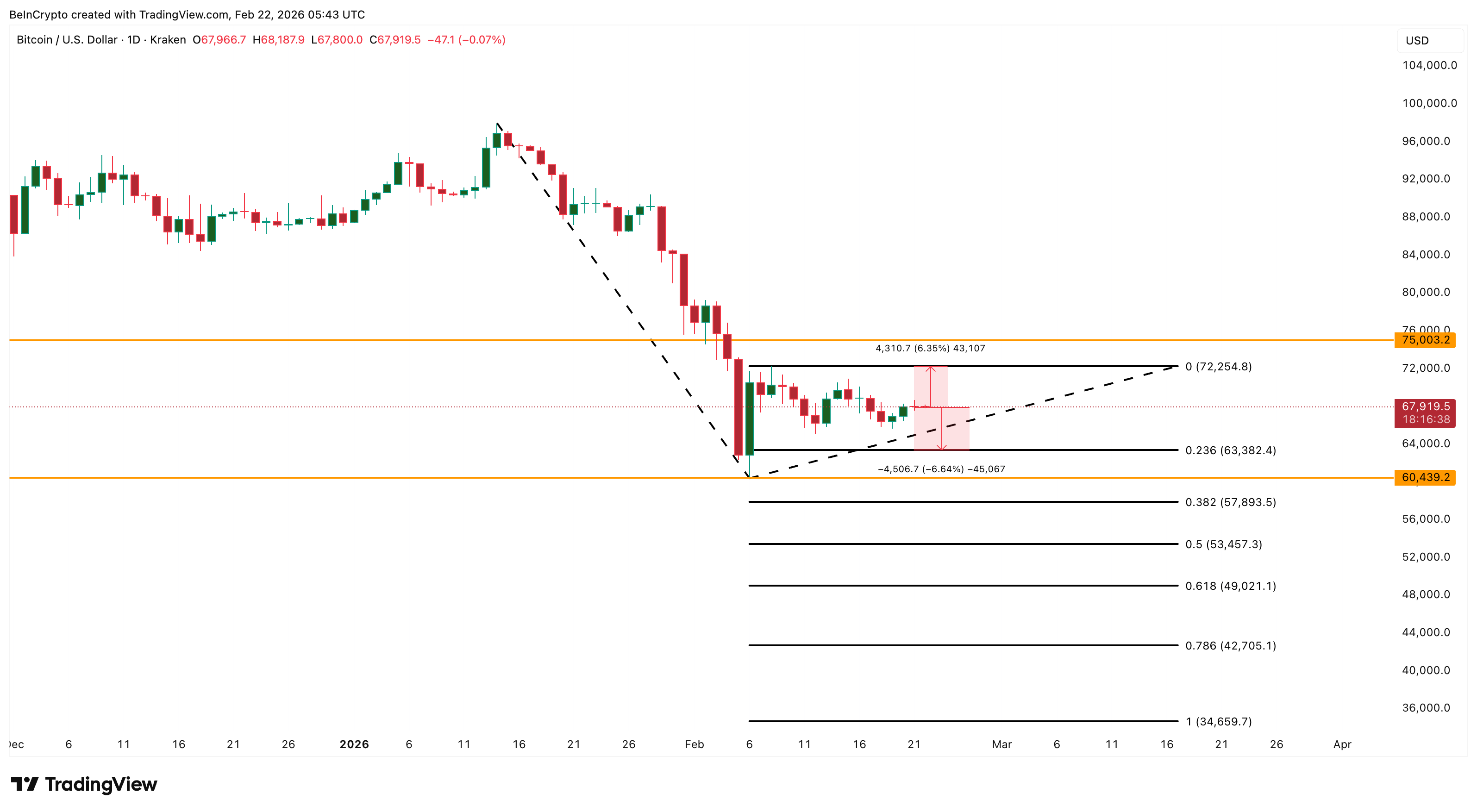
Bitcoin price has traded mostly flat over the past 24 hours near $68,000, reflecting continued indecision. The broader seven-day trend still shows a mild decline, highlighting the lack of strong bullish momentum. Yet one prediction market’s positioning is telling a far more optimistic story.
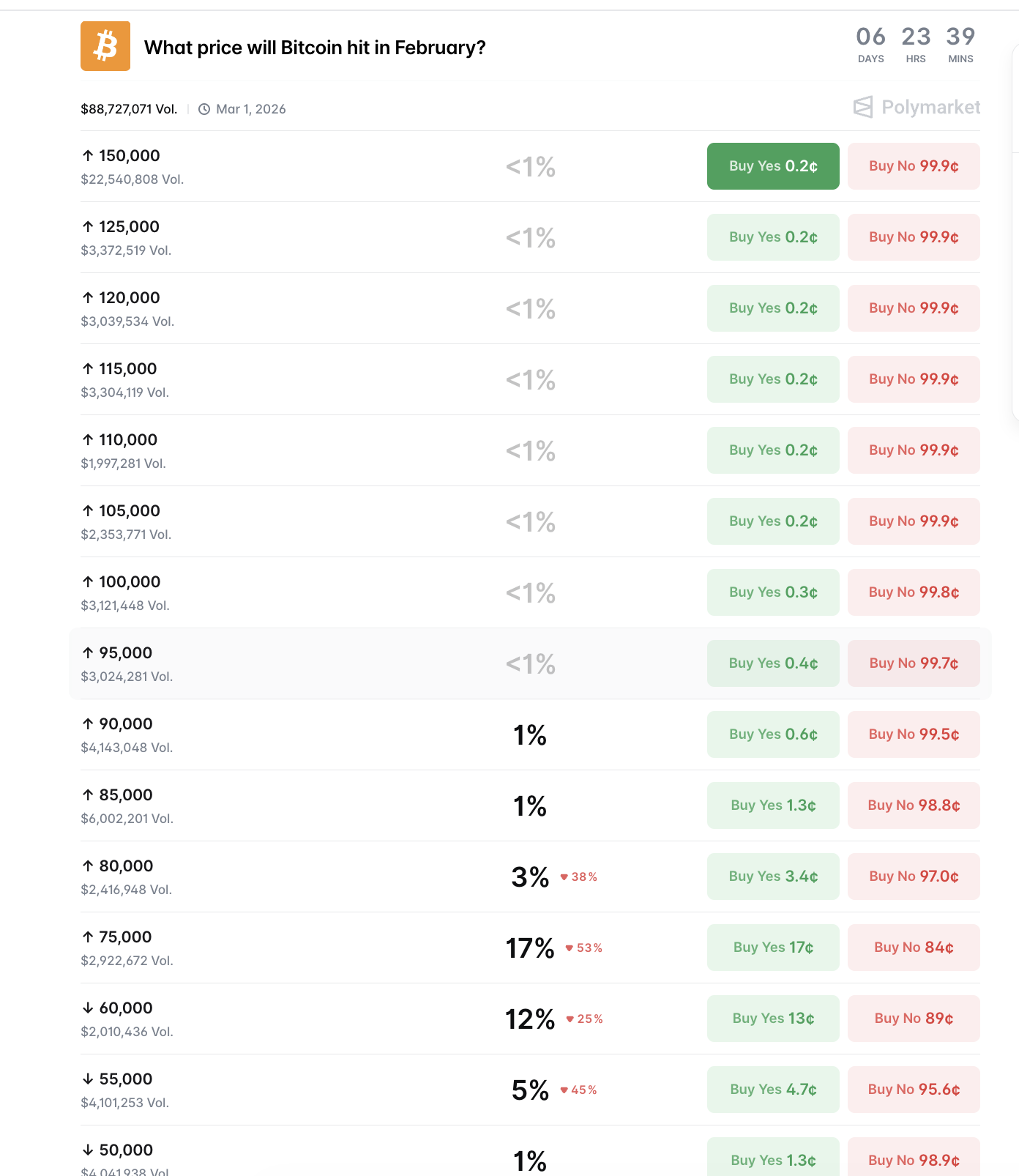
On Polymarket, the single largest February outcome, at 17%, expects Bitcoin to cross $75,000. This makes it the most popular directional bet as the month approaches its final week. However, market structure, on-chain activity, and whale positioning suggest reality may not align with this bullish expectation.
Prediction market data shows ‘above $75,000’ remains the most favored February target despite weakening sentiment. Polymarket volumes, for this bet, exceed $88 million, with millions in active liquidity.
However, the probability of the $75,000 outcome has already declined by more than 50%, reflecting fading confidence.
At the same time, the next most likely outcome sits at ‘under $60,000’ with a 12% probability. This positioning reveals a growing split in expectations. While many traders still hope for upside, a large portion of the market is increasingly preparing for a deeper correction instead.
This growing caution aligns closely with Bitcoin’s technical structure.
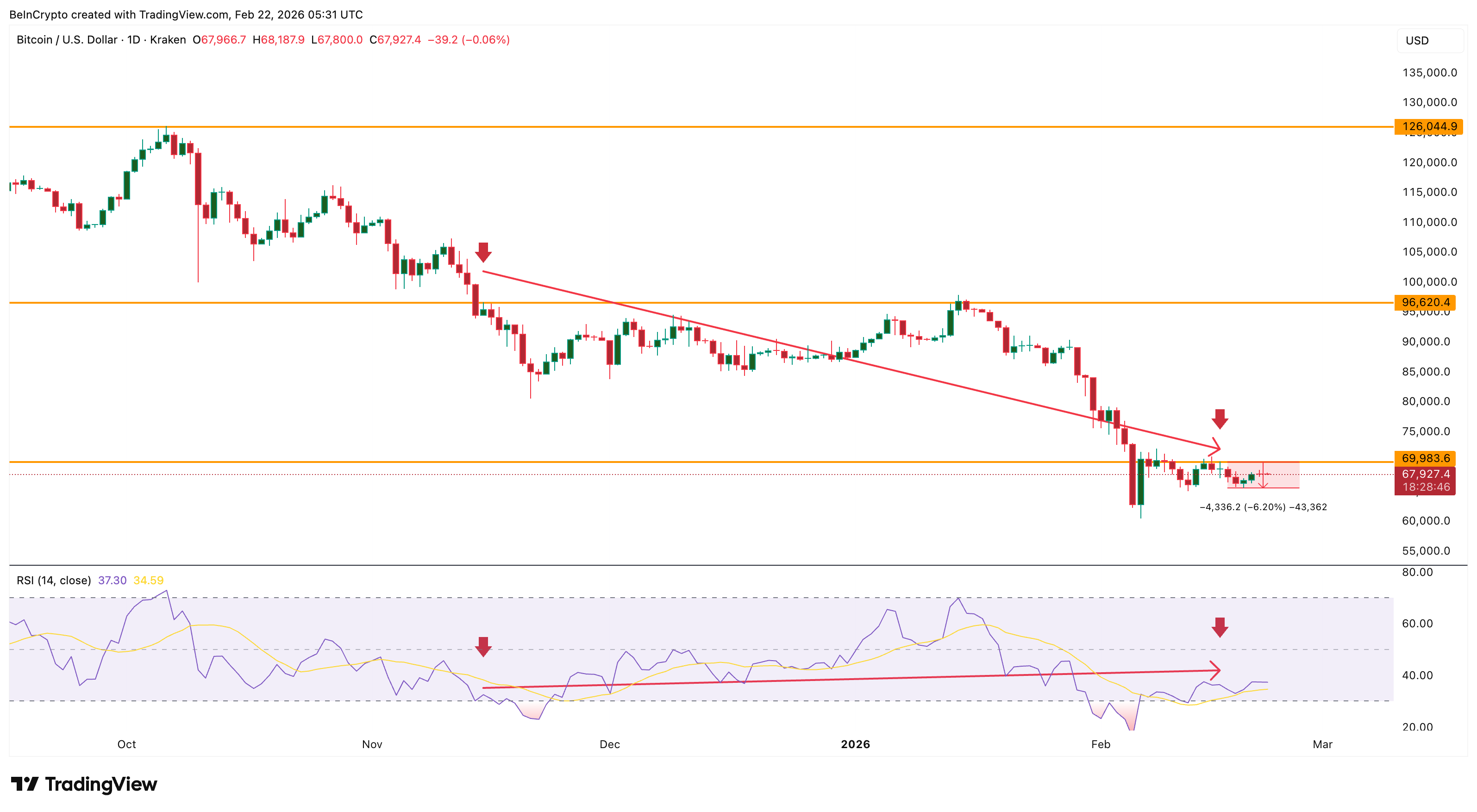
On the daily chart, Bitcoin formed a lower high between November 15 and February 16. This means price failed to fully recover during its latest rally attempt.
Meanwhile, the Relative Strength Index (RSI), which measures momentum strength, formed a higher high during the same period.
Because Bitcoin was already in a downtrend, this creates a hidden bearish divergence. This pattern usually signals continuation of the existing downtrend rather than a bullish reversal. It shows that even though momentum improved briefly, the broader selling pressure remains intact.
Since this divergence appeared, Bitcoin has already corrected nearly 6%. As long as this signal remains active, the probability of reaching the prediction market’s $75,000 target remains limited.
Long-Term Holders Have Slowed Selling, But Have Not Started Buying
Long-term holder activity helps explain why prediction markets still retain some optimism, even as risks increase. These investors may have held Bitcoin for more than 1 year. Their buying and selling patterns often determine whether Bitcoin enters a sustained rally or correction.
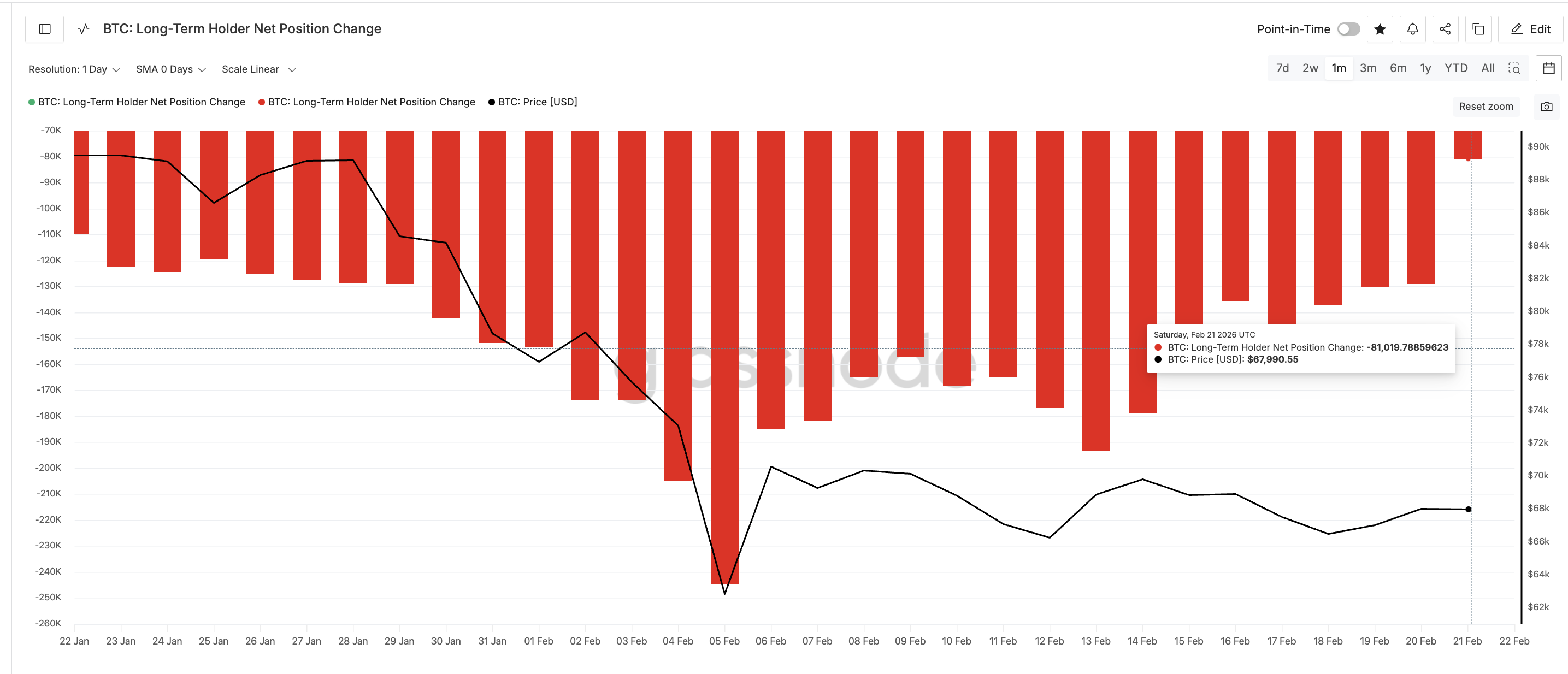
On February 5, long-term holders reduced their holdings by 244,919 BTC (30-day rolling change), a sign of extremely heavy selling. By February 21, this number improved to 81,019 BTC. This marks a roughly 67% reduction in selling pressure.
This sharp slowdown in selling helps stabilize Bitcoin’s price and explains why some traders still expect upside.
However, long-term holders are still net sellers overall. They have not yet transitioned into accumulation. Their activity has improved, but they are not yet providing the strong buying support needed to push Bitcoin toward new highs.
This creates a neutral balance. Bitcoin may avoid immediate collapse, but it also lacks the strength needed for a major breakout to push it close to $75,000.
Whale Behavior Is Split
Whale positioning further reflects uncertainty.
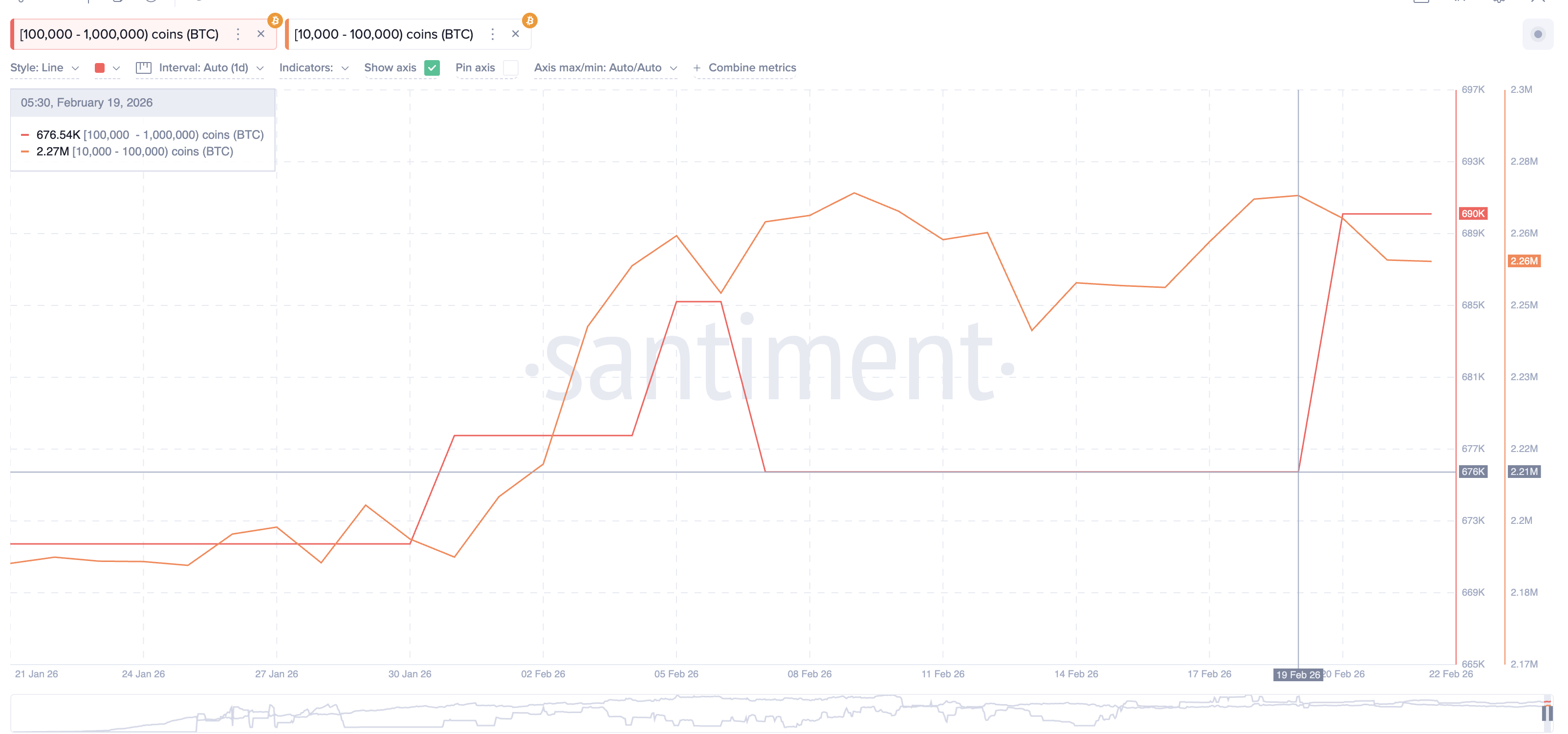
The largest Bitcoin whales, holding between 100,000 and 1 million BTC, increased their holdings from 676,540 BTC to 690,000 BTC. This represents an accumulation of about 13,460 BTC, signaling cautious buying.
However, smaller whales holding between 10,000 and 100,000 BTC reduced their holdings from 2.27 million BTC to 2.26 million BTC. This means roughly 10,000 BTC were sold during the same period.
This opposing behavior shows a lack of unified conviction, even though the net balance slightly tilts towards accumulation. Some whales are preparing for a rebound, while others remain defensive.
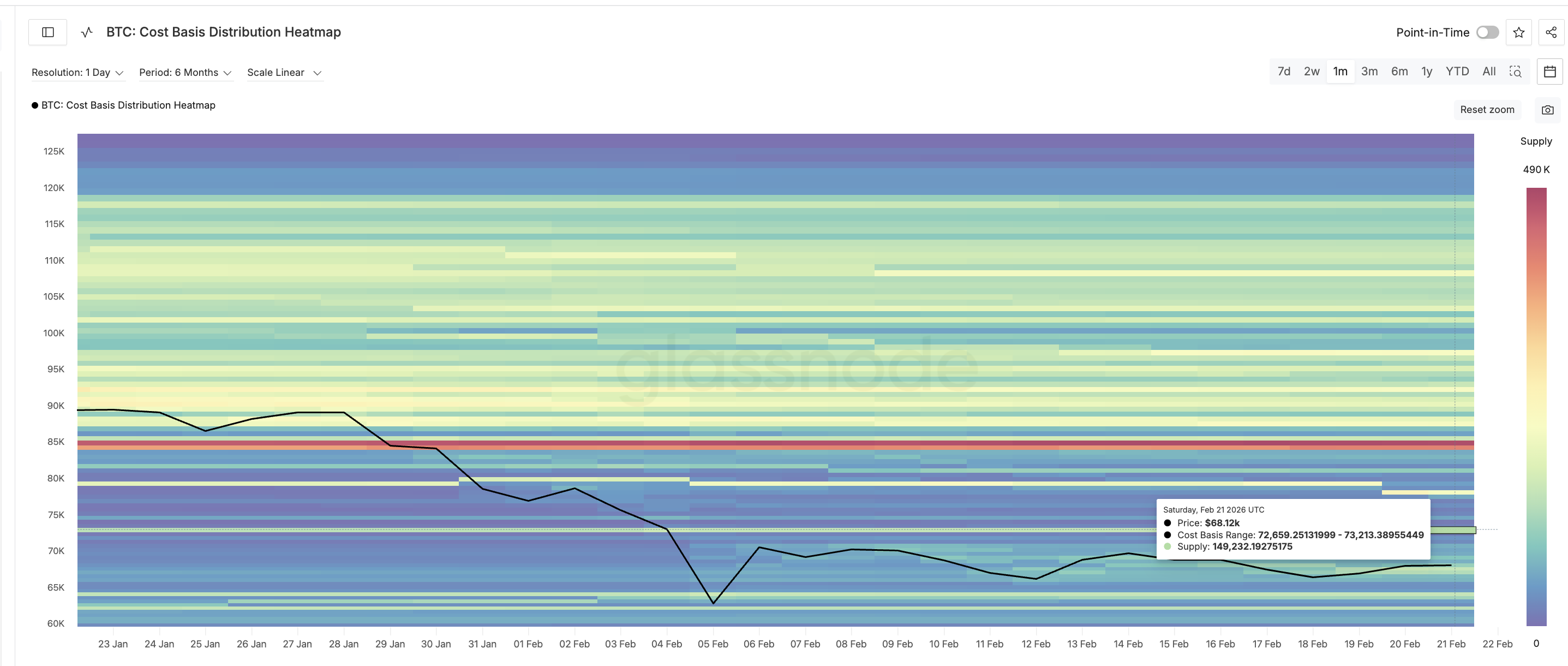
At the same time, cost basis distribution data reveals a major resistance cluster between $72,600 and $73,200. Around 149,000 BTC were accumulated in this range. These levels also appear clearly on the price chart as a major resistance zone just below $75,000.
When Bitcoin approaches this area, many holders may sell to exit at breakeven. And the whale accumulation strength, as seen, isn’t strong enough to absorb the supply yet. This selling pressure creates a strong barrier that prediction markets may be underestimating.
Bitcoin Price Structure Shows BTC May Remain Trapped Between Key Levels
Bitcoin’s price structure closely aligns with these on-chain cost basis clusters.
To reach the $75,000 prediction target, Bitcoin must first break above $72,200. This level represents both technical resistance and is close to one of the largest cost basis clusters on the chart. Breaking this zone would require a rally of more than 6% from current levels.
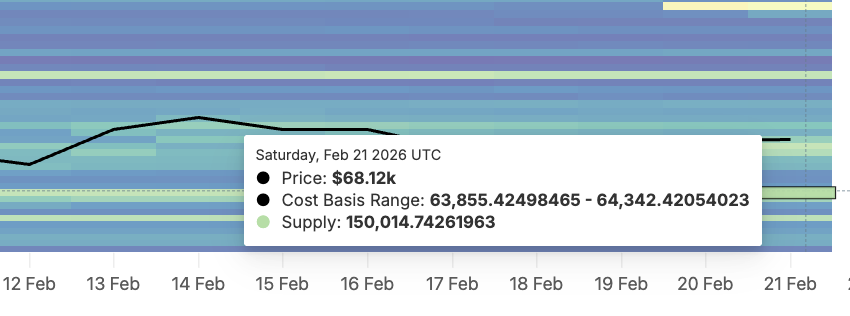
However, failure to break this resistance increases the likelihood of continued range-bound movement. On the downside, strong support exists between $64,300 and $63,800, where approximately 150,000 BTC were accumulated.
On the Bitcoin price chart, the key support level resembling the zone is $63,300, breaking which would also mean the supply cluster break. Breaking under $63,300 can make the $60,000 zone, the 12% probability bet on Polymarket, come to fruition.
As a result, Bitcoin is currently trapped between two major cost basis zones. Resistance near $72,200 limits upside, while support near $63,300 prevents immediate collapse.
This range-bound structure suggests that prediction markets may be overestimating the probability of a breakout toward $75,000 while underestimating the growing risk of continued consolidation or a correction.
A fully automated trading bot executed 8,894 trades on short-term crypto prediction contracts and reportedly generated nearly $150,000 without human intervention.
The strategy, described in a recent post circulating on X, exploited brief moments when the combined price of “Yes” and “No” contracts on five-minute bitcoin and ether markets dipped below $1. In theory, those two outcomes should always add up to $1. If they don’t, say they trade at a combined $0.97, a trader can buy both sides and lock in a three-cent profit when the market settles.
That works out to roughly $16.80 in profit per trade — thin enough to be invisible on any single execution, but meaningful at scale. If the bot was deploying around $1,000 per round-trip and clipping a 1.5-to-3% edge each time, it becomes the kind of return profile that looks boring on a per-trade basis but impressive in aggregate. Machines don't need excitement. They need repeatability.
It sounds like free money. In practice, such gaps tend to be fleeting, often lasting milliseconds. But the episode highlights something bigger than a single glitch: crypto’s prediction markets are increasingly becoming arenas for automated, algorithmic trading strategies, and an emerging AI-driven arms race.
As such, typical five-minute bitcoin prediction contracts on Polymarket carry order-book depth of roughly $5,000 to $15,000 per side during active sessions, data shows. That's several orders of magnitude thinner than a BTC perpetual swap book on major exchanges such as Binance or Bybit.
A desk trying to deploy even $100,000 per trade would blow through available liquidity and wipe out whatever edge existed in the spread. The game, for now, belongs to traders comfortable sizing in the low four figures.
When $1 isn’t $1
Prediction markets like Polymarket allow users to trade contracts tied to real-world outcomes, from election results to the price of bitcoin in the next five minutes. Each contract typically settles at either $1 (if the event happens) or $0 (if it doesn’t).
In a perfectly efficient market, the price of “Yes” plus the price of “No” should equal exactly $1 at all times. If “Yes” trades at 48 cents, “No” should trade at 52 cents.
But markets are rarely perfect. Thin liquidity, fast-moving prices in the underlying asset and order-book imbalances can create temporary dislocations. Market makers may pull quotes during volatility. Retail traders may aggressively hit one side of the book. For a split second, the combined price might fall below $1.
For a sufficiently fast system, that’s enough.
These kinds of micro-inefficiencies are not new. Similar short-duration “up/down” contracts were popular on derivatives exchange BitMEX in the late 2010s, before the venue eventually pulled some of them after traders found ways to systematically extract small edges. What’s changed is the tooling.
Early on, retail traders treated these BitMEX contracts as directional punts. But a small cohort of quantitative traders quickly realized the contracts were systematically mispriced relative to the options market — and began extracting edge with automated strategies that the venue's infrastructure wasn't built to defend against.
BitMEX eventually delisted several of the products. The official reasoning was low demand, but traders at the time widely attributed it to the contracts becoming uneconomical for the house once the arb crowd moved in.
Today, much of that activity can be automated and increasingly optimized by AI systems.
Beyond glitches: Extracting probability
The sub-$1 arbitrage is the simplest example. More sophisticated strategies go further, comparing pricing across different markets to identify inconsistencies.
Options markets, for instance, effectively encode traders’ collective expectations about where an asset might trade in the future. The prices of call and put options at various strike prices can be used to derive an implied probability distribution, a market-based estimate of the likelihood of different outcomes.
In simple terms, options markets act as giant probability machines.
If options pricing implies, say, a 62% probability that bitcoin will close above a certain level over a short time window, but a prediction market contract tied to the same outcome suggests only a 55% probability, a discrepancy emerges. One of the markets may be underpricing risk.
Automated traders can monitor both venues simultaneously, compare implied probabilities and buy whichever side appears mispriced.
Such gaps are rarely dramatic. They may amount to a few percentage points, sometimes less. But for algorithmic traders operating at high frequency, small edges can compound over thousands of trades.
The process doesn’t require human intuition once it’s built. Systems can continuously ingest price feeds, recalculate implied probabilities and adjust positions in real time.
Enter the AI agents
What distinguishes today’s trading environment from prior crypto cycles is the growing accessibility of AI tools.
Traders no longer need to hand-code every rule or manually refine parameters. Machine learning systems can be tasked with testing variations of strategies, optimizing thresholds and adjusting to changing volatility regimes. Some setups involve multiple agents that monitor different markets, rebalance exposure and shut down automatically if performance deteriorates.
In theory, a trader might allocate $10,000 to an automated strategy, allowing AI-driven systems to scan exchanges, compare prediction market prices with derivatives data, and execute trades when statistical discrepancies exceed a predefined threshold.
In practice, profitability depends heavily on market conditions and on speed.
Once an inefficiency becomes widely known, competition intensifies. More bots chase the same edge. Spreads tighten. Latency becomes decisive. Eventually, the opportunity shrinks or disappears.
The larger question isn't whether bots can make money on prediction markets. They clearly can, at least until competition erodes the edge. But what happens to the markets themselves is the point.
If a growing share of volume comes from systems that don't hold a view on the outcome — that are simply arbitraging one venue against another — prediction markets risk becoming mirrors of the derivatives market rather than independent signals.
Why big firms aren’t swarming
If prediction markets contain exploitable inefficiencies, why aren’t major trading firms dominating them?
Liquidity is one constraint. Many short-duration prediction contracts remain relatively shallow compared with large crypto derivatives venues. Attempting to deploy significant capital can move prices against the trader, eroding theoretical profits through slippage.
There is also operational complexity. Prediction markets often run on blockchain infrastructure, introducing transaction costs and settlement mechanisms that differ from those of centralized exchanges. For high-frequency strategies, even small frictions matter.
As a result, some of the activity appears concentrated among smaller, nimble traders who can deploy modest size, perhaps $10,000 per trade, without materially moving the market.
That dynamic may not last. If liquidity deepens and venues mature, larger firms could become more active. For now, prediction markets occupy an in-between state: sophisticated enough to attract quant-style strategies, but thin enough to prevent large-scale deployment.
A structural shift
At their core, prediction markets are designed to aggregate beliefs to produce crowd-sourced probabilities about future events.
But as automation increases, a growing share of trading volume may be driven less by human conviction and more by cross-market arbitrage and statistical models.
That doesn’t necessarily undermine their usefulness. Arbitrageurs can improve pricing efficiency by closing gaps and aligning odds across venues. Yet it does change the market's character.
What begins as a venue for expressing views on an election or a price move can evolve into a battleground for latency and microstructure advantages.
In crypto, such evolution tends to be rapid. Inefficiencies are discovered, exploited and competed away. Edges that once yielded consistent returns fade as faster systems emerge.
The reported $150,000 bot haul may represent a clever exploitation of a temporary pricing flaw. It may also signal something broader: prediction markets are no longer just digital betting parlors. They are becoming another frontier for algorithmic finance.
And in an environment where milliseconds matter, the fastest machine usually wins.
Substack has updated its partnership with Polymarket, “introducing native tools that make it easier to share, discuss, and debate prediction market data directly on Substack.” Additionally, Polymarket will effectively pay “a cohort of creators,” including Matt Yglesias, to use its data though the newsletter platform’s pilot sponsorships program.
“If you get the news before it happens, that should be even more economically valuable.”
This looks like a concerted effort to confuse people about what news is and does. Here’s Robinhood’s CEO Vlad Tenev, one of the leading profiteers from America’s financial nihilism: “I like to think about prediction markets as the next generation of the news. We know the news is economically valuable. People pay for getting the newspaper; they pay indirectly for shows like this [Squawk on the Street on CNBC] through advertising, and so if you get the news before it happens, that should be even more economically valuable.”
Let’s stop for a moment and think about what news is, since the slippage in Tenev’s quote (“if you get the news before it happens”) highlights the problem with his line of thought. It kind of seems like people have recently become confused about the difference between information, journalism, and “content.” The earliest known predecessor to journalism is Rome’s Acta Diurna, which was in circulation more than two millennia ago — basically an official record of events, such as births, new laws, and financial data. (A similar publication circulated in China starting in the Tang dynasty.) In 15th-century Europe, businessmen began disseminating written accounts of important events to their contacts; this is essentially the predecessor to the modern newspaper.
Do you notice anything here? That’s right: News is a record of things that have happened. Weather forecasts and horoscopes aside, newspapers do not traffic in predictions. They tell you, instead, about the very recent past — what happened yesterday. An online news site, not constrained by a printing press, can even tell you what happened 20 minutes ago. But no news organization exists to predict the future. By definition, you cannot know the news before it happens.
The actual function of news, however, can sometimes be obscured by what Daniel J. Boorstin calls “pseudo-events,” which are planned events that can be repeated, such as awards shows, press conferences, political conventions, and earnings calls. Unlike true events — natural disasters, a vote at the city council meeting, an assassination — the outcome of a pseudo-event can be known in advance because it is planned. Its contents can be distributed to reporters “under embargo,” so that when the pseudo-event occurs, reporters can instantaneously run a story.
The conflation of betting markets and news began with political coverage
Lots of publications, including this one, include coverage of pseudo-events — an Apple event is a great example — alongside the accounting of real events. In Boorstin’s The Image: A Guide to Pseudo-Events in America, he suggests that news outlets cover pseudo-events in part because there are not enough actual events to fill out the news cycle. There is also tremendous consumer demand for pseudo-events; celebrities, which are pseudo-events made flesh, are so significantly popular that an entire ecosystem of publications exists for them.
Pseudo-events have overtaken actual events in Hollywood, where they have long been generated to create marketing for movies. The other place where pseudo-events dominate real events is politics. Speeches are pseudo-events, which is why journalists often receive the drafted remarks in advance; so are press conferences, social media beefs, ribbon-cuttings, and the Presidential pardoning of a turkey. I bring this up because I believe the conflation of betting markets and news began with political coverage.
In 2024, no one was sure how reliable presidential polling was — since people were increasingly using mobile phones rather than landlines, and often not picking up because of a deluge of spam calls. Polls, of course, look more like pseudo-events (press releases) than actual ones (six-car pileups), and exist in part to drive conversation. They are not the same thing as news; polls are, at best, a snapshot of a specific group at a specific time asked specifically -worded questions and, at worst, political horoscopes. I’m not convinced newspapers should be in the business of reporting on polls, much less running them.
Still, people — at least editors and reporters, and maybe the audience too — wanted some indication of what might happen in a presidential election. Prediction markets were so confident that Trump would beat Harris that they made traditional newspapers, which saw the race as a toss up, look like they were waffling. (And if you don’t really understand how probability works, you too probably think Polymarket was more correct than “tossup.”) So betting markets were suggested as a viable alternative to polls; the idea was that people were so confident in a specific outcome that they were willing to wager on it. And that’s how odds on Polymarket and Kalshi started to creep into stories.
“These markets have changed the way people consume news.”
The other argument in favor of betting markets, as made by their advocates, is that they contain insider information. This is “cool,” according to Polymarket’s CEO, Shayne Coplan. It is also illegal. That doesn’t matter much to the purveyors of gambling-addiction-as-a-service; because contracts are peer-to-peer, the house isn’t getting ripped off. It’s only the punters dumb enough to enter the bet without insider information who’ll lose their shirts.
There are several examples of plausible insider trading on predictions markets: the entity who cashed out with almost half a million dollars when the US snatched Venezuela’s president, for instance — an actual event that occurred in order to create pseudo-events. (Baudrillard would be so proud!) Or the bettor who made more than $1 million by placing bets on what Google’s 2025 Year in Search rankings would be. Or the trader who made $50,000 by betting correctly on the recipient of the Nobel Peace Prize.
Obviously, as the Year in Search and Nobel Prize bets show, it’s easier to correctly bet on a pseudo-event than an actual one. But the consequences of insider information on actual information are potentially more devastating — the leakage of state secrets, and not to protect the public. As media critic Matt Pearce points out, there’s a problem of incentives: ethical journalists cannot pay sources, but prediction markets do.
Of course, for the insiders to make their money, there must be a steady supply of suckers. And there is! Only about a third of traders actually make profits, and “a large number of traders systematically lose money to a small minority of skilled participants.”
So by partnering with these betting markets, news organizations — from the legacy entities like WSJ or CNN to the burgeoning new media platforms like Substack — have undercut themselves two ways: first, by commodifying information and then by effectively endorsing competitors who can pay for that information; and second, by serving as advertising for prediction markets, making their audience vulnerable to getting ripped off by insiders. It is unclear to me how helping gambling companies rip off your audience serves the public interest, which is, or at least once was, the point of newsgathering.
A cynic might suggest that the move to embed betting markets in newsrooms is mere marketing
And the public interest is why most of us got into this business in the first place. Most journalists aim to reflect reality back to readers, without any particular interest in whether that makes said reader wealthier. The Fourth Estate, as news organizations are sometimes called, is meant to wield political power by uncovering wrongdoing, embarrassing the government into action. From Enron to Theranos, multiple frauds were first uncovered not by the SEC, but by the press. Back when corruption mattered in politics, many of those scandals — from Watergate to whatever we want to call George Santos’ whole deal — were also discovered by journalists rather than the Department of Justice.
This is not to say that reporters are always right, or that journalism always achieves its highest calling. I am, after all, old enough to remember the non-existent “weapons of mass destruction” that The New York Times reported on to justify the war in Iraq. But as suggested by my catty little remark about the WMDs, journalists are expected to be accountable for their mistakes. Any reputable newspaper or magazine runs a correction when even a word is off. (That NYTrefuses to admit to its major errors is a longstanding area of consternation among other journalists.)
Prediction markets, on the other hand, make their money through transaction fees — and thus through volume. In true nihilistic fashion, these markets care less about the outcome of a contract than an actual casino. It is possible to feel betrayed by the various failures of mainstream media, but Kalshi, Polymarket, and Robinhood are only after your money. A cynic might suggest that the move to embed betting markets in newsrooms is mere marketing: an attempt to signal that these are somehow different from, and superior to, casinos. Certainly that’s what I think.
What’s less clear to me is why newsrooms are going along for the ride. (I have my suspicions about why this makes sense to Substack.) Is Dow Jones so strapped for cash that it’s stooped to this? Or is it the case that the people running CNN, CNBC, and Dow Jones truly have gotten so confused by pseudo-events that they no longer understand the difference between concocted media circuses and actual happenings in the world?
I also wonder whether this push to legitimize gambling will undermine trust in people who are trained and accountable, who specialize in writing about reality. In the same way that many audiences prefer pseudo-events to events, we may discover that people prefer the “wisdom” of thousands of anons attempting to predict the future to actual reporting on the current conditions around us. Seems like that’s what Polymarket and Kalshi are betting on, anyway.
Onchain predictions market provider Polymarket has acquired the relatively fresh startup Dome for an undisclosed sum, according to an announcement on Thursday.
Dome, part of startup accelerator Y Combinator’s Fall 2025 cohort, offers a unified API for prediction markets. In other words, it allows developers to build apps, bots, dashboards, or trading tools that work across platforms like Polymarket, Kalshi, and other platforms.
The startup raised $500,000 from YC and a $4.7 million seed, according to the X bio of co-founder Kunal Roy, who was also a founding engineer at Alchemy. Kurush Dubash, the other listed co-founder, is also a founding engineer at Alchemy, according to his YC bio.
"We're excited to bring our focus on speed, reliability, and dev experience to the world’s largest prediction market!" Dome wrote on X.
Polymarket, last valued at $9 billion, reportedly has plans to raise fresh capital at a higher valuation, but has not made many acquisitions. Its purchase of U.S.-licensed derivatives exchange QCEX spearheaded the firm's reentrance into the United States, after previously being barred by the CFTC.
The firm has signed numerous distribution deals, including sports leagues like Major League Soccer and the National Hockey League, as well as media enterprises, most recently including Substack.