Premier info portal for prediction markets. The start point of information market.
Wall Street’s Top Cop Expects Enforcement on Prediction Markets
News
InsightPrediction Market

Wall Street’s Top Cop Expects Enforcement on Prediction Markets

Economics & Finance

Wall Street’s top cop expects regulators to take actions tied to prediction markets following a surge in trading on the platforms over the past year, saying that simply making bets outside of traditional spaces “doesn’t insulate you from fraud.”

Manhattan US Attorney Jay Clayton made the comments Thursday during a speech at the Securities Enforcement Forum in New York, telling the audience that prediction markets are “an area that I am looking at.”

“What is the applicable law? Let’s say I have a big stock position,” Clayton said. “The stock’s trading at $130, there’s a prediction market that pays if the stock goes below $100. Is that an out of the money put option? It sure looks like it. Right? You wouldn’t advise someone to sell that as a non-security.”

Later in the forum, he was asked if he expected enforcement actions tied to the markets. “Yes,” he responded bluntly.

Clayton’s remarks come as prediction markets have exploded into a multi-billion dollar industry, with users placing yes-or-no wagers on everything from Oscar winners to how much snow will fall. Trading on federally-regulated exchanges like Kalshi Inc. and the US arm of Polymarket has surged despite legal challenges from multiple state gaming regulators.

Concerns about insider trading are also ramping up. The markets for some wagers are often thin enough that a single trader can move prices, especially if they have non-public information. Those worries escalated in January when a trader on Polymarket made approximately $400,000 betting on the ouster of former Venezuelan leader Nicolás Maduro, with the biggest trades placed just before President Donald Trump publicly announced the US had captured him.

The head of the US Commodity Futures Trading Commission, which regulates derivatives exchanges, last month said the agency would craft new rules on prediction markets.

Source: https://www.bloomberg.com/news/articles/2026-02-05/wall-street-s-top-cop-expects-enforcement-on-prediction-markets

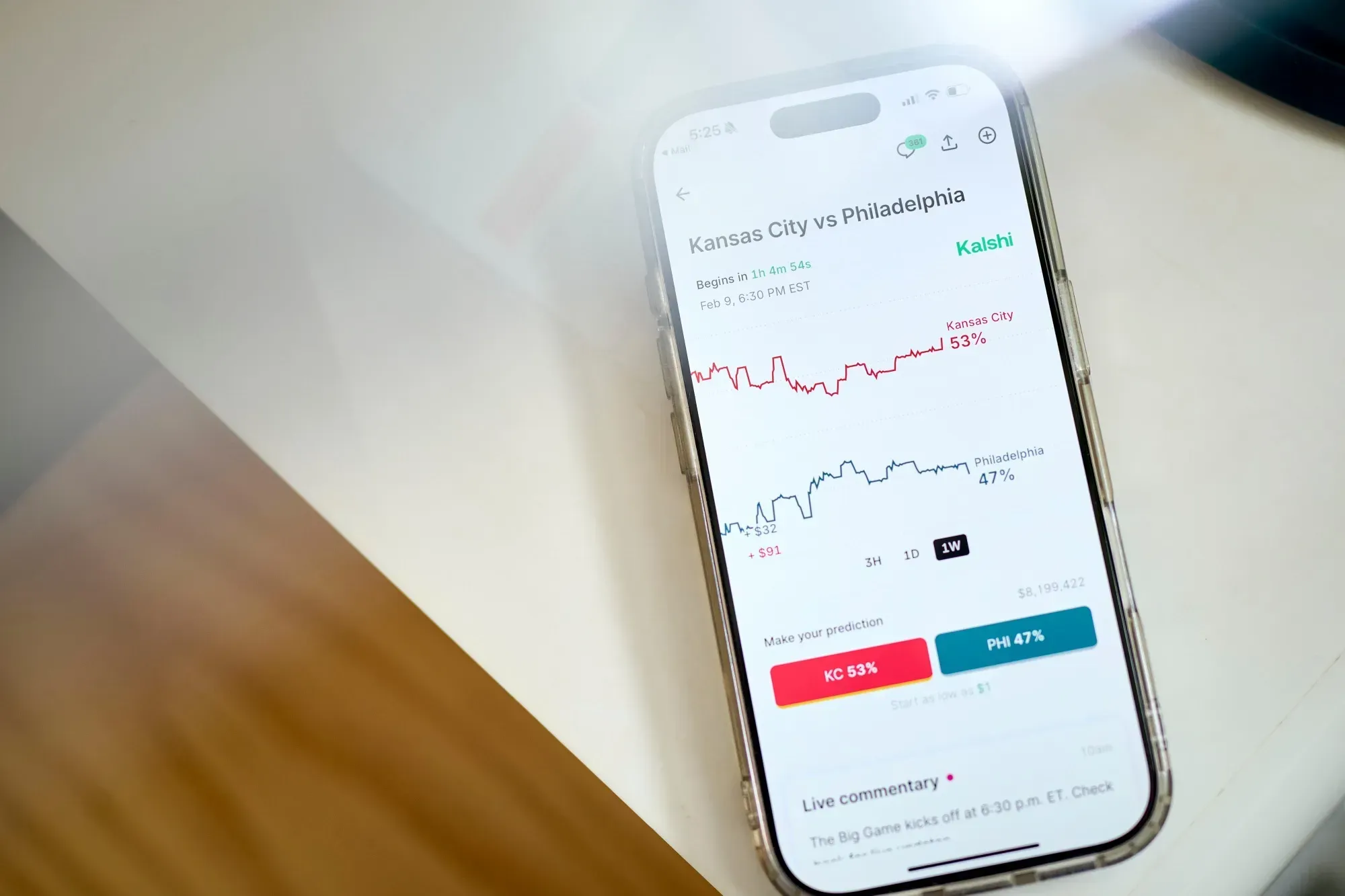
Kalshi and Polymarket Rewrite the Super Bowl Playbook for Pro Gamblers
News
Sports-NFLPrediction MarketSports Insight

Kalshi and Polymarket Rewrite the Super Bowl Playbook for Pro Gamblers

Economics & FinanceSports

The sudden rise of prediction markets has sophisticated bettors scrambling to adjust their strategies.

During his more than 15 years as a professional sports gambler, Rufus Peabody has built up an elaborate system of software tools and surrogate bettors that allow him to spot favorable odds offered by bookmakers of every variety and quickly put down millions of dollars on golf, football, basketball and other sports.

Now all that is in flux. Almost overnight, prediction markets such as Kalshi Inc. have begun snapping up large amounts of money that would likely otherwise have ended up on traditional gambling forums. Sophisticated gamblers like Peabody, often referred to either as sharps or sharks, are adjusting their operations accordingly. “It really feels like everything’s prediction markets, prediction markets, prediction markets,” says Peabody, who began trading heavily on Kalshi in September. “Maybe not for the average recreational bettor, but certainly in the sharp community.”

Kalshi and other federally regulated exchanges have opened up online betting to tens of millions of Americans who live in states where sportsbooks remain illegal, sparking a legal war with gaming regulators in states where betting is allowed and setting off a race among financial exchanges, brokerage firms and gambling companies to win market share in the nascent industry. While so-called event contracts tied to elections and geopolitics have gotten a lot of attention, sports have seen the fastest growth and attracted the most dollars.

In January, trading volume on Kalshi was nearly $10 billion, according to the data dashboard Dune, with the majority of those contracts—over $8.5 billion worth—tied to sports. While full data for the month isn’t yet available, bettors last year wagered nearly $16 billion at regulated sportsbooks during January. The volume comparison is not entirely apples-to-apples, as many prediction market traders buy and sell positions multiple times in the runup to a game, but the growth has been torrid enough to send investors flocking to exchanges and to push sportsbooks to rush out their own prediction market apps. Kalshi’s app was downloaded 3 million times in January, more than four times as much as any of the biggest traditional gambling apps, according to Apptopia. Traders on Kalshi and its chief rival, Polymarket, have swapped more than $800 million worth of contracts tied to the Super Bowl so far, compared with the $1.8 billion Americans are expected to wager on the game through regulated sportsbooks, according to the American Gaming Association.

For sharps, keeping ahead of this trend means more than moving money from one account to another. While prediction markets serve the same basic function as a sportsbook—the ability to bet on the outcome of a game—they’re structured differently. Sportsbooks take the other side of every wager they collect. Prediction markets match traders on opposite sides of “yes/no” contracts.

In practice, placing a wager looks different. A bettor who wants to put $100 on the New England Patriots to win the Super Bowl, for instance, can go to FanDuel, where, as of Feb. 4, the company was offering odds of +194, meaning a $100 wager will pay out $294 if the Patriots win. (The bettor gets their $100 wager back, plus $194.) On Kalshi, that same day, “yes” contracts for the Patriots were selling at about 35¢ each. At a payout of $1 per contract, putting down $100 would yield $289 if the Patriots win.

For sharps such as Peabody, the biggest change with prediction markets is not in how odds are displayed but in who is allowed to set them. On exchanges, traders can take a “yes” or “no” position at the price on the screen, roughly the way they’d place a wager with a sportsbook. But they can also propose their own odds by offering to buy a set number of contracts at a set price, a practice known as market making. These so-called limit orders become available to other traders on the exchange, who have the option to take the other side of the bet. These distinct mechanics create entirely different strategic considerations, and they come with new opportunities and risks.

Prediction markets have changed the face of online gambling to resemble Wall Street, forcing bettors to act more like financial traders themselves, while also drawing them into direct competition with well-heeled firms such as Susquehanna International Group and Jump Trading, which have started trading on the markets. Over the past three months Peabody and his small team of collaborators have shifted millions of dollars into Kalshi, which began offering events contracts tied to sports at the beginning of 2025. Kalshi’s leaderboard, where Peabody goes by “dogname,” shows he has already turned a profit of more than $3 million on more than 180 million contracts. “I don’t come from the financial world,” says Peabody, 40. “So it’s fun. It’s a new challenge.”

Peabody describes his strategy while sitting at his dining room table in Manhattan, where he works in front of a laptop, a pair of monitors and a phone that buzzes every few seconds. It’s a far cry from the classic vision of the bettor on the edge of his seat in a Las Vegas sportsbook, watching as games play out on walls full of flatscreens. Peabody is soft-spoken, even-keeled and not the type to get worked up about a single game. “Sharp bettors are looking for every place they can where they have an advantage,” he says. “Right now there’s a lot of alpha to be had on the prediction markets.”

One major advantage to prediction markets is that they don’t limit or exclude sharps. Exchanges pass money between winners and losers and take a small fee on each trade. It makes no difference to them if some traders win consistently. Sportsbooks, by contrast, are on the hook to pay out winners, so most take measures to identify sophisticated players and set restrictions on how much they can bet. Sharps get around these limits by building networks of surrogates who haven’t been flagged by sportsbooks. They coordinate bets in groups on the messaging app Telegram and collect profits through bank transfers or cryptocurrency transactions, or by handing over a literal “bag of cash,” according to Antonino De Rosa, a 44-year-old sharp who lives in Port Saint Lucie, Florida.

De Rosa, who’s part of a 17-person betting syndicate, works from his home office identifying promising bets and doing postmortems of the 30 or so wagers his colleagues make every day. His group focuses on tennis and the NBA, using a model it built to simulate each player or team’s odds based on factors like the latest score and who has possession. Sometimes he watches games live to make sure nothing happens that the models may have missed. (He also just likes watching sports.)

De Rosa and his colleagues put down roughly $12 million a week. Because this happens largely through surrogates, just getting the money out the door can be arduous. “For us to bet $30,000 or $40,000 on a tennis game, we have to click over 300 accounts,” De Rosa says, admitting he isn’t always able to get his money back from his surrogates. “I always say we’re sports bettors, we’re not gangsters. So we get stiffed all the time.”

Prediction markets have no such complications, but they do come with their own anxieties. When De Rosa logs in to an exchange like Kalshi, he sees a flashing order book of the prices other users are offering. At the top of the list are the best bids and offers—the highest price someone is willing to pay, or the lowest price at which someone is willing to sell. The fees also vary depending on the odds, and whether you’re a market maker or a taker. “When you go to Kalshi, first of all it looks like you need some kind of degree just to understand what’s going on,” De Rosa says.

Sometimes De Rosa operates as a taker, buying contracts at the best price he sees. But he can also act as a market maker, offering a price and setting the quantity of contracts he’s after. This is where things get more complicated, riskier and, potentially, more lucrative. Because Kalshi and other exchanges fill orders from oldest to most recent, getting to the head of the queue is the only way to get action. This means sharps have to do more than master probabilities; they have to anticipate how other traders will behave and act before other market makers do. “It’s very game theoretical,” Peabody says.

One habitual market maker is John Shilling, who runs a gambling operation called Blackbriar Technologies with two partners who were both financial traders in Chicago. Drawing on that experience, he and his partners assembled an automated trading system to place orders. The sportsbooks where Shilling used to spend his time would have quickly banned such a tool, but prediction markets allow it to operate. “When Kalshi came it changed overnight what was valuable,” Shilling says from his home office outside Charleston, South Carolina.

As they hone their new trade, Blackbriar’s operators contend with its inherent dangers. In August, their outfit was among the first makers to offer prices for each player in the upcoming PGA Tour Championship. Because the top-ranked Scottie Scheffler had won the BMW Championship the week before, bettors flocked to put down wagers on him, leaving Blackbriar exposed to steep losses if he won. “Before we could blink we were probably short more than $150,000 on Scottie,” Shilling says. In the end, Blackbriar accumulated a $329,853 position against Scheffler.

Luckily for the firm, Scheffler came up short, netting Shilling and his colleagues a $415,105 payout. But it was a reminder that market making can leave a trader with lopsided risks. Defending oneself requires constant vigilance, being ready to pull offers the minute news breaks that a star player will miss a game, or limit the amount of bets you’ll take on any single event. Like Shilling, Peabody and his team have developed software to automate much of this work, allowing them to instantly remove orders when prices change suddenly, as often happens, for instance, after the announcement of an injury.

As ever, skilled gamblers make their money by being right more often than the person on the other side, whether that is a sportsbook or, in the case of Kalshi, a fellow gambler. The good news for sharps, at least for now, is that the hype around prediction markets means there are a lot of inexperienced bettors around. Robinhood, the popular stock and cryptocurrency trading platform, and the crypto exchange Coinbase, provide their customers access to popular markets on Kalshi.

Peabody signed up for his own Robinhood account so he could monitor which markets were available to these bettors, who provide the “soft recreational flow” he needs to maximize his returns. Frequently, this means taking the side of heavy favorites against bettors who are hoping for longshot wins. Early in the men’s college basketball season, for instance, Peabody placed an order on Kalshi for 500,000 contracts, at 99¢ each, for Columbia University to lose against the University of Connecticut.

When Columbia lost (by a score of 89-62) the net profit for Peabody was just a few thousand dollars. If they’d won, he would have lost hundreds of thousands. He was willing to risk it because his model, which runs thousands of simulations of every college basketball game, told him UConn had a greater than 99% chance of winning. Peabody calls this “picking up pennies in front of a steamroller.” He can’t see who is leaving these pennies, but he assumes they’re coming from Robinhood.

Sometimes, though, the roles are reversed. That same month, Peabody noticed someone had offered to trade at a price assuming that Loyola Chicago’s men’s basketball team had a 98% chance of beating Mercyhurst, though his model showed the odds were much lower. “I was like, ‘Who’s this idiot that put up 98¢?’” he says.

Peabody bet $10,000 and ended up winning half a million dollars when Mercyhurst upset Loyola 73-65.

Sharps realize that they may not be the smartest people in the room forever. In general, markets evolve, and smart traders find their advantage narrows as other sophisticated players chase the same opportunities. This happened with electronic stock trading in the 1990s and more recently, as De Rosa recalls, with fantasy sports and online poker, when the dumb money got discouraged and started leaving. The big trading firms are already tilting the playing field.

With the increased competition, De Rosa estimates his betting group is making a profit of only about 2% on exchanges, compared with 4% or 5% on sportsbooks. Many of the sharps are keeping much of their money in sportsbooks, and where they go in the future will depend on whether prediction markets manage to lure and keep the minnows. “Eventually the casual players will lose their money, and eventually there will only be sharks left,” he says. “I want to just tell people, ‘Please be careful, because these places are infested by smart people.’”

Source: https://www.bloomberg.com/news/articles/2026-02-05/super-bowl-lx-is-bringing-professional-gamblers-to-prediction-markets
Kalshi expands surveillance, enforcement efforts ahead of Super Bowl 60
News
Prediction MarketSports-NFLSports Insight

Kalshi expands surveillance, enforcement efforts ahead of Super Bowl 60

Economics & FinanceSports

Kalshi on Thursday announced efforts to expand its surveillance and enforcement frameworks as skepticism builds around the booming prediction market industry.

The announcement comes days before Super Bowl 60, which has already drawn more than $160 million in prediction market trading volume, according to Kalshi. The platform and its peers allow users to buy event contracts for outcomes in politics, pop culture, financial markets and sports.

Prediction trades on predetermined outcomes — for example, on which companies will air Super Bowl ads on Sunday — have prompted questions of possible insider trading. New York Attorney General Letitia James on Monday issued a warning about what she called “unregulated prediction markets.”

“Being federally regulated means that Kalshi bans market manipulation, insider trading, has limits on the types of markets it lists, runs Know-Your-Customer (KYC) and Anti-Money Laundering (AML) checks on every user before they can trade, and publicly reports all trades to the CFTC daily,” the company said in a release. “Kalshi also spent years building custom prediction market trade surveillance and enforcement systems that are similar to those used in the stock market.”

Kalshi said Thursday it has taken further steps, forming an independent surveillance advisory committee, which will provide quarterly analysis to the company’s outside counsel and publish statistics on investigations into suspicious activity on its platform. The company also announced surveillance partnerships with Solidus Labs and the director of the Wharton Forensic Analytics Lab.

The prediction market will also now work with a former undersecretary of the Treasury for terrorism and financial intelligence to advise Kalshi on “market integrity, trading surveillance and financial compliance matters.”

Kalshi lawyer Robert DeNault has been appointed to the role of head of enforcement, where he will work with the advisory committee to identify insider trading and market manipulation, the company said.

Kalshi said it has also created hubs on its website to provide resources for consumers on responsible trading and market integrity.

In a post on X, CEO Tarek Mansour said if the company finds any wrongdoing, the penalties include fines and referrals to the Commodity Futures Trading Commission — which regulates event contracts in the U.S. — and the Department of Justice for prosecution.

“In the past year, we ran over 200 investigations and froze relevant accounts,” Mansour wrote. “Of these, over a dozen have become active cases and several have been referred to law enforcement.”

Mansour said Kalshi has based its market surveillance system on those used by the New York Stock Exchange and the Nasdaq, flagging suspicious behavior by running trades through pattern recognition models.

“All industries have bad actors and no system is perfect, Kalshi’s included,” Mansour wrote. “But we are committed to improving daily. Lots of work ahead!”

Source: https://www.cnbc.com/2026/02/05/kalshi-expands-surveillance-enforcement-efforts.html

Prediction Traders Are Betting Bitcoin Will Fall Below $65,000
News
Prediction MarketInsightSignals

Prediction Traders Are Betting Bitcoin Will Fall Below $65,000

Economics & Finance

Bitcoin values have fallen to their lowest level since President Donald Trump took office. If prediction markets are to be believed, the world’s most popular cryptocurrency may have a lot further to fall.

Bitcoin has lost 40% since it hit an all-time high of over $126,000 in October, shedding momentum, narrative and its claim as a hedge all at once.

Contracts on Polymarket, a decentralized prediction platform popular with crypto-native speculators, now imply an 82% chance that Bitcoin will fall to $65,000 this year, a level roughly 13% lower than today’s $73,200.

Some are betting on even worse. The odds of a sub-$55,000 finish have climbed to roughly 60%, while the odds of a rebound sending the currency back up to $100,000 have fallen to 54% from 80% at the start of the year.

The bearish tilt is even sharper on short-dated contracts. One February market on Polymarket now assigns a 72% chance that Bitcoin trades below $70,000 by March 1 — up more than 35 percentage points from the start of the month. About $1.7 million in bets backs that outcome, reflecting real-time trader pessimism just as ETF outflows and failed macro correlations deepen doubt across the space.

“It basically reflects the bearish sentiment in markets right now,” said Marex’s Ilan Solot, citing Bitcoin’s recent inability to act as a safe haven, among other factors.

Crypto-market sentiment has been in the gutter since early October, when a surprise weekend crash liquidated billions of dollars in various positions. In hindsight, it proved a significant moment: tokens have not been able to recover since. A fresh selloff this past weekend has darkened the mood further. The value of the crypto market now stands at around $2.5 trillion, down from more than $4 trillion in October.

“These down markets are often very brutal on the people that take leverage. And the amount of money that was destroyed on October 10th is way bigger than the previous downdraft in November of 2022,” said Dan Morehead, founder of Pantera Capital. “That causes a lot of pain. And a lot of those investors don’t return to the market — and it takes a while.”

Flows into crypto ETFs had helped buoy prices last year when tens of billions of dollars flowed into Bitcoin funds alone. But that source of support has dried up: as a category, crypto ETFs trading in the US have seen outflows of nearly $4 billion over the past three months, data compiled by Bloomberg show. The average trader is now underwater on their investment, according to research from Glassnode and K33.

“We have seen a notable downshift in the flows to US spot ETFs, which is a large source of potential new money into the space,” wrote Citi’s Alex Saunders in a report. “This lack of new demand coincided with established long-time holders becoming concerned about cyclical weakness in Bitcoin”

Yet the wisdom of the crowd — when viewed through the prediction-markets lens — stands in hard contrast to what Wall Street crypto bulls have been hyping: that digital tokens are set to make a comeback. Money manager and fintech personality Tom Lee, for instance, in November predicted that Bitcoin could be back between $150,000 and $200,000, a forecast that failed to materialize. And while firms like Standard Chartered Plc and Bernstein have slashed their forecasts, they still expect a meaningful rally: both say Bitcoin could reach $150,000 by the end of the year.

Source: https://www.bloomberg.com/news/articles/2026-02-04/prediction-traders-are-betting-bitcoin-will-fall-below-65-000

Kalshi Claims ‘Extortion,’ Then Recants in Feud Over User Losses
News
Prediction MarketLegal

Kalshi Claims ‘Extortion,’ Then Recants in Feud Over User Losses

Economics & Finance

It began innocuously enough. A stock analyst pulled data on betting results to argue that users of booming prediction markets were losing money faster than on traditional gambling apps.

Then it spiraled. Kalshi Inc., the biggest US prediction market, told Bloomberg the analysis wasn’t just wrong. It was part of an “extortion” plot by the startup behind the data.

The founder of Juice Reel, the small data outfit, stood by the numbers and said Kalshi’s allegations were a “complete fabrication.” It was Kalshi that had tried to pressure him to say the data was inaccurate, he said. Kalshi changed its tone hours later and said that while it continued to dispute the findings, “after further review, we don’t believe the intention was extortion.” Kalshi denied it pressured Juice Reel to repudiate the data.

Welcome to the new wild west of online betting, with fortunes at stake for scrappy startups vying for a piece of the $200 billion American gambling market. It’s a fight for users, market share and capital — and, increasingly, for the public perception of these new financial exchanges that blur the line between investing and raw speculation, exposing users to risks that are only beginning to come into focus.

The report was always likely to touch a nerve. The analysis from Jordan Bender, an equity research analyst at Citizens, found that in their first three months, users on sites like Kalshi were losing more money than on established gambling sites like FanDuel and DraftKings, at least in proportion to the amount wagered. This cuts against Kalshi’s claims that it offers a customer-friendly way to bet on real-world events.

Prediction markets like Kalshi operate federally regulated exchanges that allow customers to bet on the outcome of a wide range of future events, from presidential elections to the Super Bowl. In their marketing, they promise a more level playing field than sportsbooks, saying they match bettors against each other rather than taking the other side of trades.

Data Dispute

Bender’s analysis showed losses on prediction markets were particularly high among the weakest performers. The bottom quarter of users lost about 28 cents of every dollar they bet on prediction markets in the first three months of adoption, compared with about 11 cents per dollar on other online gambling sites. For the bottom decile, the losses in the first 90 days climbed to 44%.

Source: Citizens; Juice Reel

Note: Traditional gambling accounts include regulated sportsbooks, bookies, offshore platforms, DFS and sweepstakes.

The source of his research: transaction-level data from Juice Reel, an app that allows gamblers to track their performance on different platforms.

Kalshi initially said, in a statement sent to Bloomberg, that the data was “flat-out wrong” and born of a conflict of interest.

Elisabeth Diana, the firm’s head of communications, said that Juice Reel had previously sought “investment support” from Kalshi. She alleged that Juice Reel’s founder offered to “defuse the situation” created by the Citizens report if he was given a meeting with Kalshi’s CEO.

“Please consider the source and its motives,” she said in an emailed statement. “This is extortion.”

Kalshi’s allegations of “extortion” came as a surprise to Ricky Gold, the 32-year-old CEO of Juice Reel, when contacted by Bloomberg. He said that it was Kalshi that reached out to him in a bid to quash the findings.

“They called and messaged us, pressuring us to tell Bloomberg that our data is inaccurate,” Gold said. “We stand for transparency, we stand for helping bettors, traders understand their activity across the platform, and we stand behind our data.”

After Gold pushed back, Kalshi continued to dispute the findings in the Citizens report — and said that it had not pressured Gold to repudiate the data. But the company’s spokesperson, Diana, backed away from the allegation of extortion.

“We are in ongoing discussions about Juice Reel’s legal ability to obtain our data, but after further review, we don’t believe the intention was extortion,” the company said in an updated statement last week.

“Every bettor and trader is entitled to access their transaction history,” Gold said about his data collection.

Bender, the gambling industry analyst at Citizens, said: “We are confident in our analysis of the available data.”

Citizens declined to comment further.

Sports Betting

Bender has used Juice Reel’s data for previous research. In 2024, he told the gaming outlet Sports Handle that the data was useful for industry experts, but not always popular with gambling companies.

The dispute comes as Kalshi continues to experience skyrocketing demand ahead of the upcoming Super Bowl, which is expected to be a busy time for both sportsbooks and prediction markets.

Weekly trading volumes on Kalshi surpassed $2 billion for the first time this January, up from $1 billion in October, according to user-compiled data on Dune Analytics. The recent growth has been driven largely by the popularity of contracts tied to sports, though users can bet on anything from geopolitics to music charts.

This growth, though, is creating a heated debate about the social consequences of the rise of prediction markets. Sports gambling is known to exact a heavy financial toll on users, and both Kalshi and its main rival, Polymarket, have been eager to distance themselves from the gambling industry. The founder of Polymarket has called sportsbooks a “scam.”

But Citizens’ analysis found that in the Juice Reel data set, the median prediction market wallet lost about 7% of the money wagered in the first 90 days of activity, compared with a 1% loss on other forms of gambling.

Kalshi did not provide any data to dispute the Citizens analysis but said the company’s “internal data directly contradicts” the report’s findings. The losses of its average user were “significantly lower than 7%,” Kalshi said.

In its statement, Kalshi said that the report “defies logic,” because a recent study from economists at the University of Chicago and Stanford found that sports gamblers lose around 7.5% for every dollar wagered.

Gold, at Juice Reel, said that he re-examined the underlying data used in the Citizens analysis and found no inaccuracies.

Professional Traders

Bender has said in the past that Juice Reel customers tend to be more experienced gamblers, but they likely do not include the Wall Street trading firms and professional gamblers that have begun to operate on prediction markets and that are positioned to be among the most profitable users.

In his recent report, Bender wrote that the presence of those sophisticated players — and the worse pricing on prediction markets — may explain why ordinary bettors are doing worse than they do on gambling sites, where the sportsbooks sit on the other side of every trade.

“Prediction markets are creating worse losses for the worst users, while more educated bettors are winning more,” he wrote.

Kalshi said its pricing is more competitive than that of gambling companies.

Kalshi has been amping up its efforts to argue that prediction markets are an improvement on previous forms of betting. The company recently hired John Bivona, a former congressional staffer, as the company’s first head of federal government relations. He wrote in a post on LinkedIn last week that “Kalshi has built a platform where there is no system: no algorithm, no house, no Wall Street. People decide the price and compete fairly against each other.”

But a growing number of state regulators have tried to stop prediction markets, arguing that they are a form of illegal gambling with inadequate protections for customers. The companies have fought back and continued operating nationwide.

Source: https://www.bloomberg.com/news/articles/2026-02-04/kalshi-claims-extortion-then-recants-in-prediction-markets-gambling-feud

Crypto.com Launches Predictions-Only Platform Before Super Bowl
News
Prediction MarketSports-NFLSports Insight

Crypto.com Launches Predictions-Only Platform Before Super Bowl

Economics & FinanceSports

Crypto.com is launching a dedicated platform, OG, for prediction markets just days before the Super Bowl, the company said Tuesday.

A pioneer of federally-regulated sports-themed prediction markets, Crypto.com co-founder and and Chief Executive Officer Kris Marszalek said a stand-alone product is warranted after 40-fold growth week-over-week in its event contracts business over the past six months.

OG will also offer leveraged and margin trading of predictions contracts, said Nick Lundgren, a Crypto.com executive who’s been named chief executive officer of OG. The back end will still be powered by its existing exchange and clearinghouse, all registered with the Commodity Futures Trading Commission.

Prediction market platforms operate exchanges that allow customers to bet on the outcome of a wide range of future events, from presidential elections to college basketball games. The CFTC said last week it would craft new rules for the multi-billion dollar industry, which has been fueled by sports contracts.

While sports is a heavy focus in the run-up to the Super Bowl and March Madness, the company also plans to offer contracts on entertainment, politics and publicly-traded companies. The company said OG will be headquartered in the US and focused on that market initially.

Source: https://www.bloomberg.com/news/articles/2026-02-03/crypto-com-launches-predictions-only-platform-before-super-bowl

Wall Street Pros See Potential, Obstacles in Prediction Markets
News
Prediction MarketInsightSignals

Wall Street Pros See Potential, Obstacles in Prediction Markets

Economics & FinancePolitics

Wall Street professionals have a broadly positive perception of prediction markets, but the nascent sector’s lack of liquidity is a key stumbling block to reaching the mainstream.

Around 43% of market structure experts view prediction markets as an innovative value-add to the overall marketplace, according to a flash survey conducted by Crisil Coalition Greenwich this month. A similar range were neutral on the space’s prospects, while around a fifth said the markets encourage gambling and introduce additional “risk noise” instead of trading signals.

The survey of 53 market specialists in the US provides a snapshot into Wall Street’s perception of prediction markets at a time when the space is booming. Major players, including CME Group Inc., Intercontinental Exchange Inc. and Cboe Global Markets Inc., are investing in the sector, while others like Susquehanna International Group Inc. are participating as market makers.

Prediction-markets platforms like Polymarket and Kalshi allow traders to wager on binary outcomes, tracking everything from economic releases to Oscar winners. The companies argue the data generated by such contracts allow traders to effectively harness the wisdom of the crowd, producing accurate forecasts that can inform risk-taking and policy decisions.

Get the Morning & Evening Briefing Americas newsletters.Start every morning with what you need to know followed by context and analysis on news of the day each evening. Plus, Bloomberg Weekend.

One of the largest concerns voiced by survey respondents, which ranged from buy-side and sell-side traders to fintech providers, was a lack of liquidity in prediction markets, with many markets too small to generate actionable insights. Some generate just tens of thousands of dollars in volume, while the largest — often tracking sports games or geopolitical events — can top hundreds of millions of dollars.

“The wisdom of the crowd only works when you have a crowd, and many of the economic and political contracts listed on the major markets remain thinly traded,” Jesse Forster, a senior analyst on Coalition Greenwich’s market structure and technology team, wrote in a report on the findings. “The market’s momentum suggests this will change over time, but we all know liquidity begets liquidity, and starting that virtuous cycle can be tough.”

Nearly three-quarters of respondents said prediction markets will give institutional investors a new vehicle for speculation on world and financial events in the coming year. Meanwhile, only a third suggested prediction markets could be used for a new approach to hedging — a key argument made by platforms like Polymarket and Kalshi as they try to expand their order books.

Source: Crisil Coalition Greenwich 2026 Prediction Markets Flash Study

Note: Other includes market sentiment data, information value only, a new source of uninformed investors for sophisticated investors to proft from. Based on 53 respondents.

“This is probably a little bit of wishful thinking,” Forster said, referring to the betting platforms’ goal. “I don’t think we’re going to see a ton of institutions going negative on Mamdani on Kalshi to hedge their real estate investments in New York City.”

About a fifth of specialists said they don’t expect prediction market data to be very valuable to institutional investors in the next one to two years, while 4% said it won’t be valuable at all.

Source: https://www.bloomberg.com/news/articles/2026-01-29/wall-street-pros-see-potential-obstacles-in-prediction-markets

Kalshi Fed Forecasts Are as Good as Wall Street’s, Study Says
News
InsightPrediction Market

Kalshi Fed Forecasts Are as Good as Wall Street’s, Study Says

Economics & Finance

Kalshi, the booming platform that churns out predictions on everything from the Super Bowl to US elections, is showing early promise as an accurate forecaster of Federal Reserve policy and economic data, a new study finds.

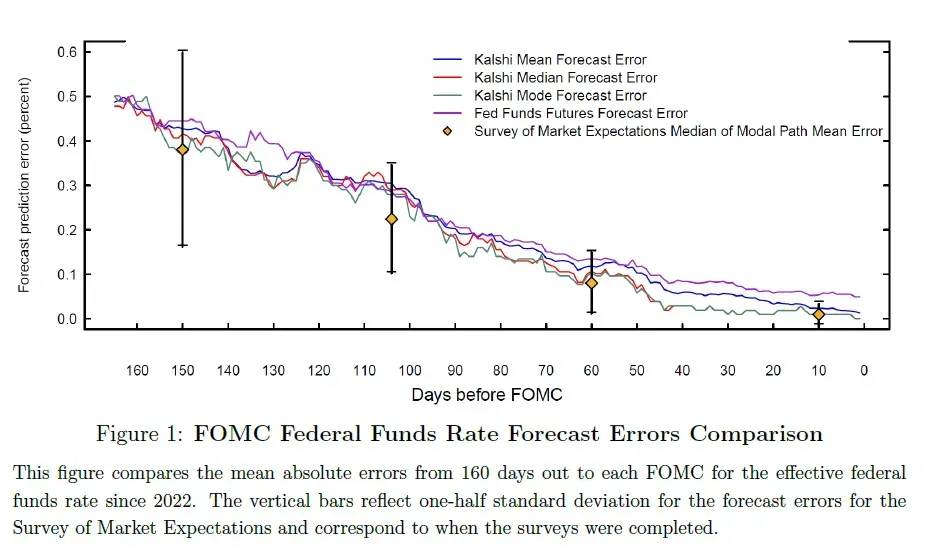
When it comes to predicting interest-rate decisions, Kalshi is “roughly consistent” with professionals such as those surveyed by the Federal Reserve Bank of New York, according to a working paper authored by three economists, including one from the Fed. In a notable case, the prediction market even outperformed the pros when the central bank delivered a surprise, jumbo-sized cut.

The paper, which has not yet been peer reviewed, arrives ahead of Wednesday’s Fed decision. There’s little daylight between the forecasts for this event, with Kalshi and its rival platform Polymarket both showing a 99% chance that policymakers will hold rates steady, compared to 97.2% odds priced into fed funds futures. All 92 economist estimates compiled by Bloomberg predict the same outcome.

The findings on past Fed events and economic data releases could bolster the argument that prediction markets effectively harness the wisdom of the crowd to produce accurate forecasts that can inform risk-taking and policy decisions. Recently, the fast-growing platforms have been scrutinized over a dramatic increase in sports betting and what critics say are systemic vulnerabilities to manipulation and insider trading.

But at least to Wall Street, Kalshi may offer advantages over traditional forecasting, the authors say. Contracts are actively traded on the site, producing real-time updates on a broader set of variables while better reflecting the full range of potential outcomes.

“The real advantages are you’ve got a distribution instead of a point estimate, and you can look at how it responds very quickly after events,” said Jared Dean Katz, a Ph.D. student at the Northwestern University Kellogg School of Management who co-wrote the paper.

“It’s even better that the forecasts are pretty accurate,” he added.

Like its competitors, Kalshi offers trading on ‘yes’ and ‘no’ contracts that pay out at $1 each. If a contract is selling for 32 cents, for example, that translates to a 32% chance of the outcome happening. For economic data, most contracts are tied to whether the final number — like the consumer price index — will be above a certain level.

According to the paper, the modal Kalshi forecast — the outcome deemed most likely by its traders — has been spot-on by the night before the Fed decision in data from 2022 through June. The central bank is generally adept at steering market expectations, but the prediction market also performed well when policymakers surprised with a 0.5 percentage point cut in September 2024.

Kalshi also did as well as economists surveyed by Bloomberg when it comes to inflation and unemployment data, the paper finds, and delivered a statistically significant improvement over professional forecasters on one particular data set, headline CPI.

“The overarching theory is the wisdom of the crowds getting information from lots of people aggregating their beliefs,” said Jonathan Wright, an economics professor at Johns Hopkins University, who co-wrote the paper with Katz and Fed economist Anthony Diercks.

The findings echo earlier research on prediction markets that shows even small experimental markets can beat forecasting alternatives. In the case of economic variables, for instance, traders are incentivized to incorporate all information, including professional projections.

Such studies bolstered Kalshi’s successful case against financial regulators in 2024 that paved the way for prediction markets to legally host bets on election outcomes. Not long after, Kalshi began also listing contracts tied to sports and entertainment.

That’s not to say that prediction markets are flawless machines, with some researchers finding evidence that bettors tend to overpay for low-probability outcomes. At one point, prediction market traders pegged the probability of Jesus returning to earth last year at almost 4%.

An analysis of trades on Kalshi, conducted by an engineer at the crypto exchange Coinbase on an independent basis, suggests that finance-related contracts on the platform show less of this kind of long-shot bias than other markets such as sports.

For the authors of the new paper, the benefits of prediction markets go far beyond accuracy.

“I and others are super fascinated by this because we’ve always wanted to get markets for the things that economists care about and those don’t really exist,” said Wright.

Source: https://www.bloomberg.com/news/articles/2026-01-28/kalshi-fed-forecasts-are-as-good-as-wall-street-s-study-says

Crypto Traders Flee to Prediction Bets After Crash
News
Prediction Market

Crypto Traders Flee to Prediction Bets After Crash

Economics & Finance

Not long ago, Nikshep Saravanan was deep in the crypto trenches — trading memecoins, reaching out to venture capitalists, and trying to launch a startup for digital creators. By January, he’d dropped it all. These days, he spends hours on prediction markets, tracking odds on everything from sports to politics.

“As I was trying to get traction without funding, the prediction-markets space started blowing up,” recalled the 27-year-old Canadian.

Saravanan is part of a fast-growing wave of crypto-native traders cooling on the token economy and gravitating toward event betting. Where the action once revolved around meme coins and protocol launches, it’s now about interest-rate decisions, NBA games, and weather forecasts. It’s not fringe anymore: weekly notional volume across platforms like Polymarket and Kalshi has surged from $500 million in June to nearly $6 billion in January, according to tracker Dune.

In the fall, Saravanan pivoted to building HumanPlane, a platform for researching and tracking prediction markets tied to everything from elections to sports. “Here I can do a lot more with no capital,” he said. “There’s so much more interest here.”

The shift reflects both opportunity and fatigue. Bitcoin is down nearly 30% since its October peak, and many altcoins have fared far worse. The crash sapped energy and attention from the crypto scene. Prediction markets, by contrast, are pulling in the same speculative crowd, offering a sharper hit: binary odds, real-world stakes, fast resolution. No multi-year roadmaps, just a dopamine loop with a yes or no verdict.

The twist: even as traders abandon crypto’s token dreams, the infrastructure they’re migrating to still runs on crypto. On platforms like Polymarket, every key part of the trade, except order-matching, happens onchain. So while belief-driven token speculation is cooling off, the underlying tech is quietly finding one of its most durable use cases yet.

That shift is playing out in the numbers. While crypto exchange app downloads fell sharply last year, prediction markets moved in the opposite direction. Polymarket’s installs climbed from 30,000 in January to more than 400,000 by December, according to market intelligence firm Sensor Tower. Kalshi’s installs ballooned from 80,000 to 1.3 million over the same time. Binance, the world’s biggest crypto exchange, saw downloads cut by more than half.

But that drop still masks a deeper existential crisis across the token economy. More than 11 million coins effectively died last year — the largest extinction event in crypto history, according to CoinGecko. Altcoins lost about $150 billion in value between the end of 2024 and the end of 2025, per TradingView. Many were wiped out during October’s crash, which also triggered auto-liquidations on major exchanges. The episode deepened a growing belief that the game is rigged: fragile coins, vanishing liquidity, and platforms that can glitch at the worst moment.

“Crypto is so ruggable,” Saravanan said. “People can remove liquidity, there’s swiping. People try to overcompete each other. People are kind of tired of the game.”

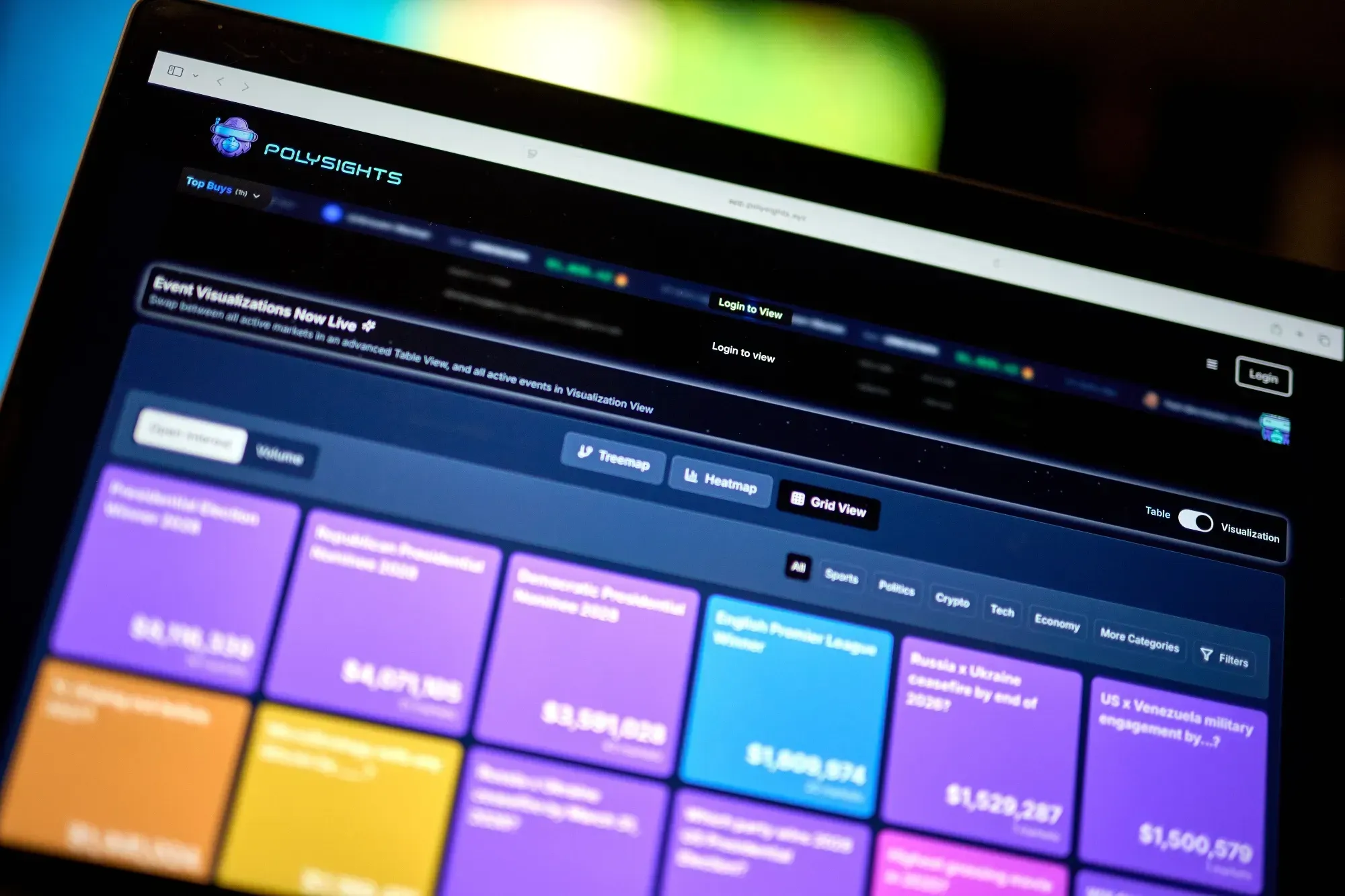
Tre Upshaw, another Canadian builder, made the same move. After losing money trading memecoins like SafeMoon, he now runs Polysights, an analytics dashboard for prediction markets. “I realized that’s just hyper gambling,” he said. “I got burned so many times on memecoins.” Of course, a slew of people are also losing money on prediction markets, with 70% of trading addresses showing realized losses, per researcher defioasis.eth.

Crypto traders haven’t left entirely — they’ve rerouted. Polymarket and Kalshi both allow traders to place bets on the future price of Bitcoin. Crypto contracts have become the second busiest trading category on Polymarket. A year ago, they ranked fourth. Notional crypto volume on both platforms has increased nearly tenfold, per Dune. Even CoinMarketCap — once the homepage of token mania — now includes a prediction markets section.

Crypto infrastructure firms are leaning in. Coinbase added prediction markets in December, with trades routed through Kalshi. Gemini and Crypto.com have their own prediction markets efforts. Crypto.com is white-labeling services for outsiders, including Trump Media. Max Branzburg, Coinbase’s head of consumer and business products, said the firm has “seen tons of excitement” from users who want a single venue to trade “everything.”

The dollars are expected to follow. Clear Street’s Owen Lau expects Coinbase to generate $700 million in prediction market revenue for 2030. Robinhood’s annual run rate from the category is already around $300 million, according to his estimates. A Mizuho survey found Coinbase and Robinhood users were nine times more likely to participate on prediction platforms than the general population.

Coinbase doesn’t see the expansion as a threat to its core business. The company recently acquired The Clearing Company and plans to push further into the space.

“As we add more instruments, they tend to complement each other,” Branzburg said.

The result is less a collapse of crypto culture than a refocusing. The speculation didn’t disappear — it just moved to fresh ground.

“A lot of people who are still in crypto are using onchain prediction markets as well,” Upshaw said.

Source: https://www.bloomberg.com/news/articles/2026-01-26/crypto-traders-flee-to-prediction-bets-after-150-billion-crash

Coinbase Acquires The Clearing Company in Prediction Market Push
News
M&APrediction Market

Coinbase Acquires The Clearing Company in Prediction Market Push

Economics & FinanceTech

Coinbase Global Inc. announced Monday that it will acquire a derivatives clearinghouse, The Clearing Company, to boost its entry into the growing prediction markets business.

The crypto trading platform said the acquisition would help it expand on its ambitions to become “the Everything Exchange.” It comes just days after Coinbase began rolling out prediction markets and equities trading.

Coinbase already has its own derivatives exchange approved by the Commodity Futures Trading Commission.

Clearinghouses operate critical market plumbing for predictions markets, despite being less visible to the public than exchanges.

The Clearing Company is not yet operational but applied in November for approval from the Commodity Futures Trading Commission to operate a registered clearinghouse.

The startup is notable for using digital ledger technology to clear and settle trades in stablecoins, which can allow for instant settlement.

Its founder, Toni Gemayel, as well as many of The Clearing Company’s executives, are veterans of both Kalshi Inc. and Polymarket, the two dominant players in predictions markets in the US.

Coinbase said the acquisition “adds the specialized talent needed to take this category further.”

Coinbase is currently routing trades through Kalshi, which runs its own clearinghouse. A Coinbase spokesperson said the acquisition doesn’t change any plans with Kalshi.

The Clearing Company recently announced a $15 million seed round led by Union Square Ventures along with Coinbase Ventures and many other investors.

Source: https://www.bloomberg.com/news/articles/2025-12-22/coinbase-acquires-the-clearing-company-in-prediction-market-push

Matchbook to Launch UK Prediction Markets Ahead of US Entry
News
RegulatoryLegalPrediction Market

Matchbook to Launch UK Prediction Markets Ahead of US Entry

Economics & FinancePolitics

Matchbook, a sports betting exchange, is launching a prediction market platform in the UK as it prepares to compete with rivals Kalshi and Polymarket in the US.

The British debut in January will be a “road test” of its technology before Matchbook — registered in Guernsey — obtains US regulatory approval, which it expects as early as March, interim chief executive officer Ronan McDonagh said in an interview.

Matchbook is majority-owned by Zeljko Ranogajec, a professional gambler originally from Australia, after Matthew Benham, the owner of Brentford FC, pared his stake to a small interest. The launch in the UK, a country with a long tradition of legal sports betting, will test how widely American enthusiasm for prediction markets has spread overseas.

Betting exchanges, like Matchbook, function by matching buyers and sellers, unlike traditional sportsbooks which take the opposite side of a customer’s bet. The key difference for a British audience is largely in the presentation. While Matchbook is already a betting exchange, its new offering changes the display of contracts from the fractional odds typical in the UK to a percentage probability for ‘yes’ or ‘no’ outcomes.

Platforms such as Kalshi and Polymarket have played a major role in elevating the profile of prediction markets, particularly since the 2024 US election. These entities function as federally regulated financial exchanges, offering event contracts that cover politics, sports, and pop culture. This regulatory status enables them to offer what are fundamentally sports wagers nationwide, thereby bypassing state-specific gambling restrictions.

Matchbook will launch the product under its existing exchange license with the UK Gambling Commission, with a focus on sports, McDonagh added. It will also introduce a prediction market as a white-label provider for easyBet, which is part of easyJet founder Stelios Haji-Ioannou’s group.

“It’s not new in the sense that it works on the same engine as an exchange,” McDonagh said from Cork, Ireland. “It should be more understandable, so I think we’re hopeful that it captures a new audience or it intrigues people to have a look.”

Matchbook, whose legal entity is Triplebet Ltd., has been operating a sports exchange for about 20 years. The company’s US partner RSBIX LLC in September filed with the US Commodity Futures Trading Commission to launch an exchange. Led by Jeff Ifrah, who is in business with one of President Donald Trump’s former defense attorneys, RSBIX had tried — and failed — five years ago to seek the agency’s approval for NFL contracts with a different partner.

While the UK has no shortage of betting platforms, Kalshi and Polymarket remain unavailable in the country. Unlike the US, new entry would likely come under the purview of gambling regulators.

Robinhood has previously said it’s exploring bringing prediction markets overseas and has spoken to the UK Financial Conduct Authority about that.

With less brand recognition in the US, Matchbook is open to partnering with another company for distribution, said McDonagh.

“We’re not sentimental about going in as Matchbook,” he said. “We’ve been in the exchange business so long and we’ve got a really strong tech platform. We’ve got strong market making partners, liquidity and a great product. We’ll be able to complete on day one in the US.”

Source: https://www.bloomberg.com/news/articles/2025-12-10/matchbook-to-launch-uk-prediction-markets-ahead-of-us-entry

Robinhood, Susquehanna Escalate Prediction-Market Arms Race
News
CompetitionPrediction Market

Robinhood, Susquehanna Escalate Prediction-Market Arms Race

Economics & FinanceTech

Robinhood Markets Inc. and Susquehanna International Group are taking over a regulated exchange that was tied to the now-defunct crypto business FTX, giving them a powerful new foothold in the fast-growing world of prediction markets.

The two firms are buying a majority stake in LedgerX, a US-based derivatives exchange once owned by FTX and now run by Miami International Holdings Inc.

The buyers already have strong ties to prediction markets. Susquehanna has said it serves as a market maker on Kalshi, the leading US prediction market exchange. Robinhood offers Kalshi’s event contracts to its retail investing clients.

The new deal will give Robinhood and Susquehanna direct control of the infrastructure needed to list and clear event contracts on their own terms, at a moment when Wall Street, sports leagues, and crypto firms are racing to shape the future of regulated speculation.

“Robinhood is seeing strong customer demand for prediction markets,” JB Mackenzie, vice president and general manager of futures and international at Robinhood, said in a statement. “Our investment in infrastructure will position us to deliver an even better experience and more innovative products for customers.”

Financial details of the transaction were not disclosed, but MIAX said it is selling 90% of the exchange to the Robinhood-led group. Robinhood said it would be the “controlling partner” in the new venture, with Susquehanna serving as a “day-one liquidity provider” so that customers have a counterparty for trading.

The move could represent a challenge for Kalshi because it has used its partnership with Robinhood to get its contracts in front of a broad audience. More than half of Kalshi’s business in recent months has come from Robinhood, according to an analysis from Bloomberg Intelligence.

In its most recent earnings release, Robinhood said that its customers traded 2.3 billion event contracts in the third quarter, more than double the quarter before.

“I’m sure Kalshi is counting the activity that we send to them, which is quite substantial,” Robinhood’s chief financial officer, Jason Warnick, said on a call with analysts this month.

Kalshi declined to comment on the MIAX deal.

Kalshi was one of the first companies to get approval from the Commodity Futures Trading Commission to open an exchange for listing financial contracts tied to the outcome of events. The business has exploded this year since Kalshi used its exchange to begin offering trading on sports games.

There is still significant legal uncertainty around the business. A federal judge in Nevada ruled this week that Kalshi is subject to gaming regulators who have told the company to stop offering sports contracts in the state.

The same judge also declined on Tuesday to grant Robinhood a temporary restraining order to prevent Nevada’s gaming regulator from taking enforcement action against the brokerage. Robinhood said it would appeal the decision.

In the meantime, several companies interested in prediction markets have acquired US-regulated derivatives exchanges to begin offering contracts to compete with Kalshi.

DraftKings, the sports gambling company, purchased its own exchange and FanDuel, a unit of Flutter Entertainment Plc, has a partnership with the CME Group Inc. to create a new platform for wagering on sports and other events. Polymarket, which has offered prediction markets overseas, said on Tuesday that it received a new approval to enter the US through QCX, a regulated exchange it recently acquired.

LedgerX, which began as a platform for crypto-related derivatives, was one of the few solvent pieces of FTX when it went bankrupt. It was an important part of Sam Bankman-Fried’s push to gain power and influence in Washington. After FTX collapsed in 2022, MIAX bought the platform for $50 million as a way to expand its presence in the crypto industry.

MIAX said on Tuesday that it is keeping a 10% stake in the new business to gain exposure to prediction markets.

Source: https://www.bloomberg.com/news/articles/2025-11-26/miax-sells-ledgerx-exchange-once-owned-by-ftx-to-susquehanna-and-robinhood