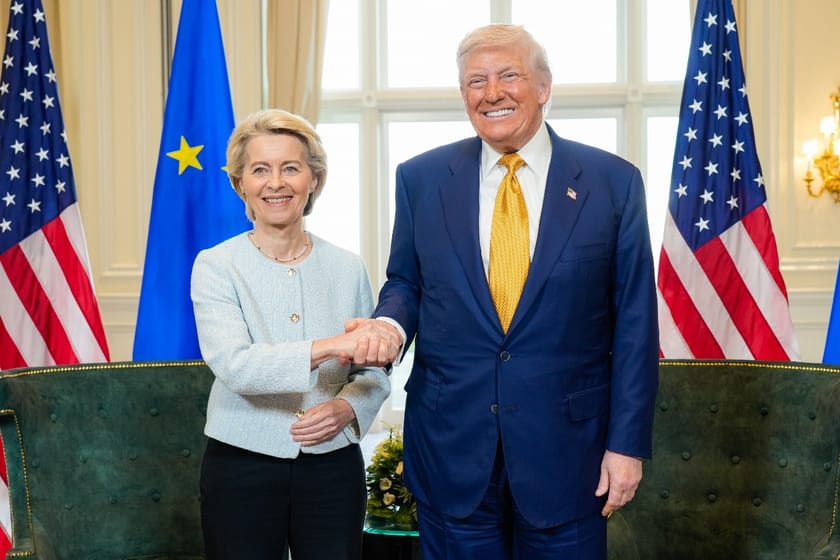
The EU beat the clock. On June 25, the Council of the EU formally adopted the regulations implementing its tariff commitments under the EU-US trade agreement, and as of July 1, the bloc has eliminated remaining duties on US industrial goods and opened preferential access for a range of US agricultural and seafood products.
The headline read is relief: deadline avoided, tariffs down, transatlantic trade stabilized.
But now the question is whether "de-escalation" is the right word for a deal that only exists because of a threat, is still full of trapdoors, and leaves the sector most likely to derail it, steel and aluminum, still bleeding.
Do you think the EU-US tariff deal is genuine de-escalation or a fragile truce?
Why the de-escalation read makes sense
Tariffs on US industrial goods are eliminated outright, and the European Commission estimates the change saves EU importers and consumers around €5 billion a year. Both sides describe it as a multi-year framework running through 2029, with a built-in review before it expires.
But the whole point of the July 4 deadline was to pressure the EU into implementing what had already been negotiated the previous August.
When Trump warned tariffs would jump to much higher levels if the EU did not act, the EU acted. This is not pure de-escalation; it is coercive leverage working as Washington intended.
Here's where the risk case gets stronger
The de-escalation read leans on treating "deal signed" as "risk resolved." But the deal's own text argues otherwise.
The agreement keeps a 15% all-inclusive tariff cap, but it also gives the European Commission explicit power to suspend tariff preferences if US tariffs on steel and aluminum derivative products stay above that cap past set checkpoints, with a Commission report due to Parliament and Council by December 1, 2026. Layered on top of that is a separate safeguard mechanism letting Brussels investigate and counter import surges that threaten serious harm to EU industry or agriculture.
Neither of those provisions is decorative, and neither is hypothetical. EU steel is still paying the full 50% US tariff, deal or no deal, because steel and aluminum were carved out of the 15% cap from the start.
Eurofer, the EU steel industry association, has published the damage: EU steel exports to the US fell 34% in the three quarters after the tariff hike to 50%, from 2.93 million tonnes to 1.94 million tonnes, and the industry has said plainly that the trade agreement is worth nothing for steel producers until this is actually fixed. It is a cost being paid today, while the "de-escalation" headline runs.
Brussels is not just waiting on Washington here, either. The EU brought in its own new steel safeguard on July 1, a tariff-free quota capped at 18.3 million tonnes a year with a 50% duty above it, applied to all trading partners.
This follows the EU's October 2025 move toward a replacement steel safeguard, aimed at preventing diverted steel from flooding Europe as US tariffs redirected trade flows. In other words, it's one side's tariffs generating spillover that the other side has had to build new defenses against.
Why this matters more for companies than for headlines
The first reason is that preferential access is not the same as permanent access, and the suspension clause doesn't stop at the disputed products. Duty-free treatment on US industrial goods and preferential terms on farm and seafood products are conditioned on a mechanism the EU can suspend, and this mechanism reaches across the broader preference package, not just steel and aluminum.
Companies budgeting multi-year input costs around July 1 pricing, or firms in the "safe" industrial lane who assume this doesn't touch them, are underwriting a policy that can change over a dispute in a completely different sector.
The second is timing. Capex decisions with multi-year payback windows now depend on two separate clocks: whether Washington resolves the metals dispute before the end-2026 checkpoint, how the Comission frames the issue in its December 1, 2026 report, and whether an EU industry group successfully invokes the safeguard clause before then. Either one moving can change the cost basis a multi-year investment was built on.
What to watch next: Three triggers to keep an eye on
The steel and aluminum clock. Watch whether US tariffs on the affected steel and aluminum derivatives come down to 15% or below before the deal's end-of-2026 checkpoint. Right now they're still at 50%, which is expected under the deal as written, but if that hasn't changed by the deadline, the EU gains a suspension option it doesn't currently have.
Next, watch whether the safeguard mechanism is actually invoked over an agricultural import surge. The mechanism existing does not prove fragility on its own, but the first attempt to use it will.
Finally, watch whether industry pushback spreads beyond steel. Eurofer has already gone on record saying the deal is worth nothing for steel producers until the tariff issue is fixed, so the real signal is whether farm groups or other sectors start making the same complaint.
The better way to read this deal
At first glance, this looks like a story about a deadline getting cleared. This is only the surface-level read.
What is actually being priced is whether “signed” means “settled.” The agreement's own design with conditional caps, suspension triggers, and an unresolved metals dispute parked on a calendar is itself evidence that both governments expect to renegotiate risk, not that risk is gone.
The de-escalation read says the truce holds. The better read says the truce has a built-in test at the end of 2026, and right now nothing suggests steel and aluminum are on track to pass it.
Which of these would most change your read on this deal?
Sources:
- APNews: EU issues new steel and e-commerce regulations to reduce trade imbalance with China
- CNBC: Tariffs: Trump threatens EU if no trade deal is signed by new deadline
- European Commission: The EU-US trade deal: Restoring stability and predictability
- Iowa Farm Bureau: U.S. farm exports gain ground in new EU trade deal
- Lexology: EU: Update on the EU-US Tariff Agreement
- NBC News: E.U. hits the brakes on U.S. trade deal after Trump threatens 15% global tariffs
- Sullivan & Cromwell: EU Implements Tariff Commitments Under the EU-U.S. Trade Deal
- The Express Tribune: European Parliament approves long-delayed EU-US trade agreement