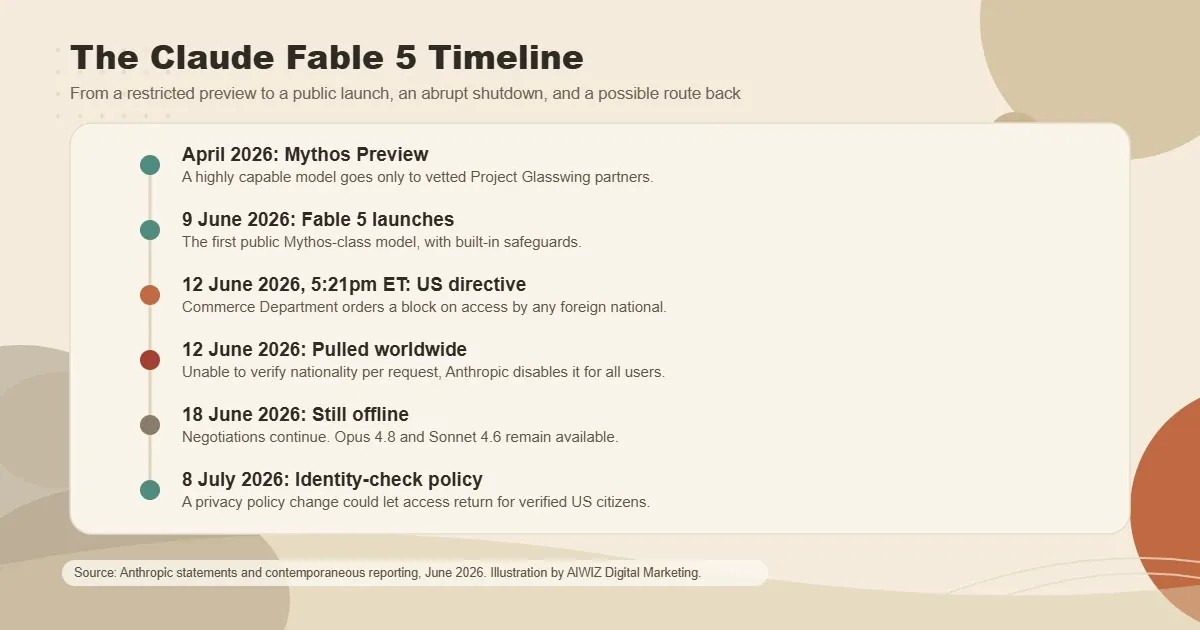
On June 9, Anthropic released Claude Fable 5, an AI model that comfortably beat OpenAI’s GPT 5.5 on agentic-coding benchmarks by more than twenty points.
However, the revolutionary model’s shelf life was only fleeting!
At around 5:21 p.m, eastern time, Friday, June 12, the US Commerce Department sent a letter.
By the evening of the same day, Fable 5 and Mythos 5, its unrestricted sibling, went dark for every customer on the planet.
An Old Law to Implement a Kill Switch
What is also equally interesting is the instrument through which the shutdown directive was carried out. It was the Export Control Reform Act of 2018 and the “deemed export” rule under 15 CFR 734.13 which treats granting a foreign national access to controlled technology, even if its inside the US, as an export.
The order, which essentially made Fable 5 a deemed export, also covered the company’s own foreign-national employees. With no way to verify citizenship in real time at API scale, Anthropic only had one compliant move in its pocket: shut the model down for everyone, on a global scale.
Calling the Fable 5 decision a restriction barely captures the entire essence of the event. When a foreign-national restriction is being implemented on a live service with millions of subscribers, it isn’t exactly a restriction, it is a kill switch. And the kill switch was the only way to enforce it on a same-day notice.
This was done without an independent technical review, court approval, prior notice or any exemption for allied nations.
The government letter arrived on a Friday evening, by nightfall, all the “problematic” models had gone dark.
Ignoring Government Access Order Framework
A more plausible reading that holds the argument beyond the jailbreak rhetoric could be the June 2 White House executive order which directed the NSA, Treasury and CISA to work on a “covered frontier model” framework. Under the framework, the government will have a 30-day access to models such as Fable 5 before they’re released to other partners or general audiences. Fable 5 launched five days after that order and never made it to government offices for testing or due diligence.
This is why, the export directive is less of an emergency response to a security finding and more of an enforcement of a voluntary framework that a leading AI lab bypassed. The jailbreak served as a legal hook, while the executive order powered the motive.
Meanwhile, the alleged letter that Commerce Secretary Howard Lutnick had sent to Anthropic’s CEO, did not spell out any specific concern. However, it does appear that the real motive behind the letter was not just about resolving a patch, but a negotiation tactic over who gets to see such frontier models before they become open for public.
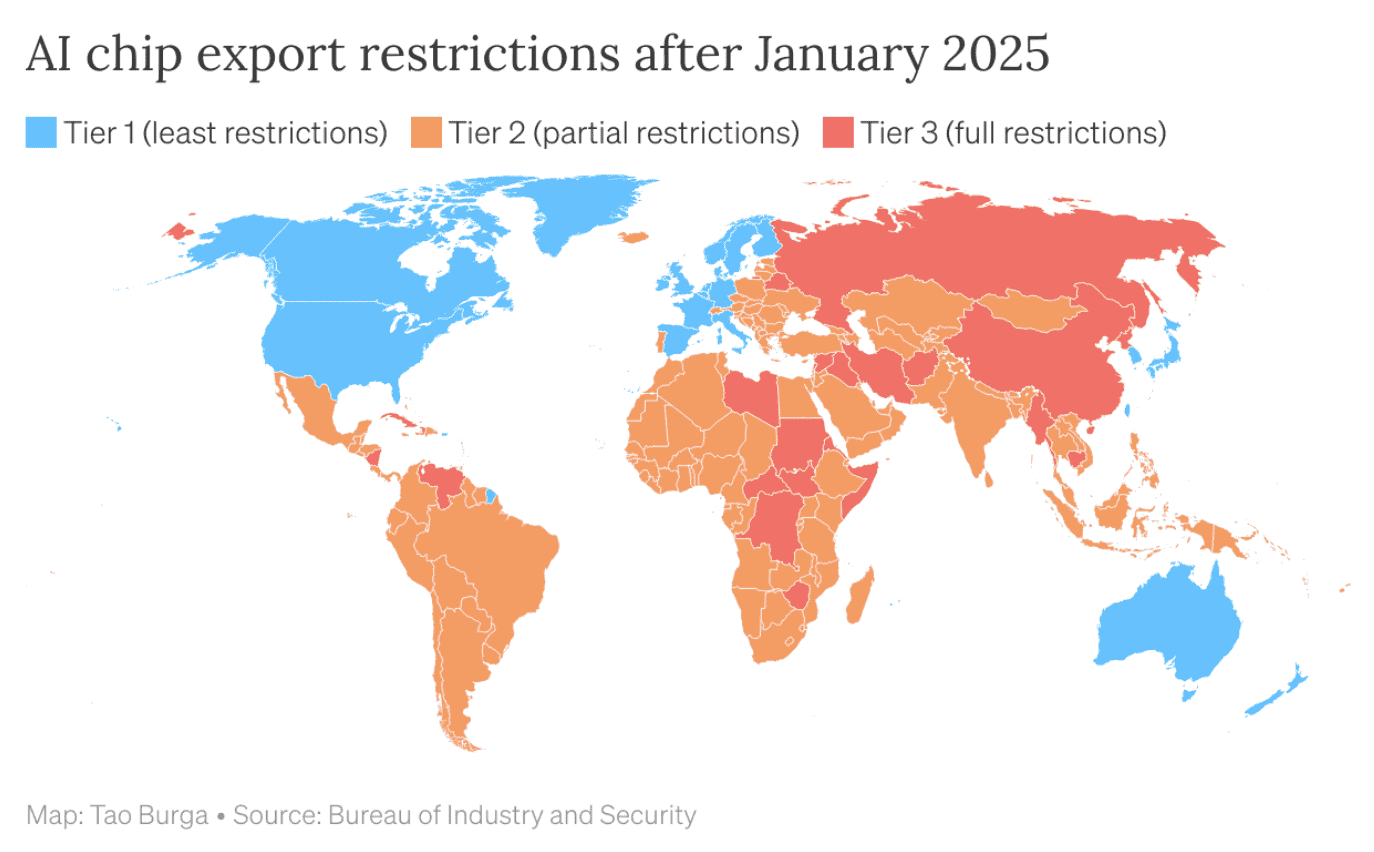
The move to completely shut down Fable 5 is an unprecedented one. Never before has a deployed commercial AI product gone through something like this. Earlier, the biggest regulatory barriers for AI were export controls targeting hardware or advanced chips to China under the January 2025 diffusion framework.
The move also sets a precedent or a blueprint for any frontier model which serves to a global user base, vulnerable to the whims of a government agency which can revoke its presence, leveraged by national security, without any verbal evidence or a committee, while also rendering it powerless to lodge an appeal against the decision.
Since the shutdown, most of the commentary has been focused on the trigger point. Was it a really dangerous jailbreak? Was the US government right about the severity of the jailbreak?
While the debate is quite an interesting one, it is essentially beside the point.
The key event isn’t really an alleged flaw. The key instrument here are the tools that were used to make a groundbreaking model go dark at its infancy.
The unprecedented shutdown was same-day, global and court-free of a deployed commercial product. It would naturally make people wonder how dangerous Fable 5’s capabilities were that the US government decided to bypass all conventional legal channels to pull the plug.
Is the Jailbreak a Distraction?
The merits of this move naturally require specific reasoning. Based on Anthropic’s own communications, government concerns are mostly around the ability of the model to read a codebase and identify software flaws. But there isn’t really anything unique about it since the same job is done by developers, cybersecurity specialists and pretty much every security engineer who runs a software before it goes live.
Based on the points made by Andrew Morris of GreyNoise Intelligence and Katie Moussouris, the capabilities in question aren't unique to Fable 5 so a simple patch doesn't necessarily fix everything.
Anthropic can patch the vulnerability and the control is lifted. However, Anthropic and other testers argue that the same capability is available from other models such as GPT 5.5 and even its own Opus 4.8. In short, there is no quick fix that would solve the problem without crippling a flagship model for a capability that its rivals retain without government oversight.
Perhaps it is safe to say that the government is asking a company to patch a property of capable models in general, not a defect unique to this one. To put simply, the entire Fable 5 is more than just a bug report – it is a critical debate about whether frontier coding ability is safe in public hands.
A Warning Cloaked as Patch Fixing?
While supporters of the act will call this event a major national security win, the action hasn’t really had the desired outcome. It hasn’t eliminated a purported dangerous capability from existence. All it has done is simmer downed Anthropic’s version of the capability that the likes of GPT 5.5, Opus 4.8 and a host of other open-weight models already provide.
What it has done so far, is that it has set a precedent for future frontier models to showcase compliance in face of a national security-linked directive.
The most logical response to this precedent is perhaps migration towards models that cannot be switched off, are self-hosted, open-weight or foreign. In light of what has happened earlier this month, the Cloud Security Alliance has suggested companies to relocate critical workloads across multiple vendors, thus containing a capability rather than allowing it to fizzle out.
Another pertinent point here is that the bypass did not come from a foreign adversary, it came from Amazon, Anthropic’s largest investor and primary cloud provider, along with its direct competitor.
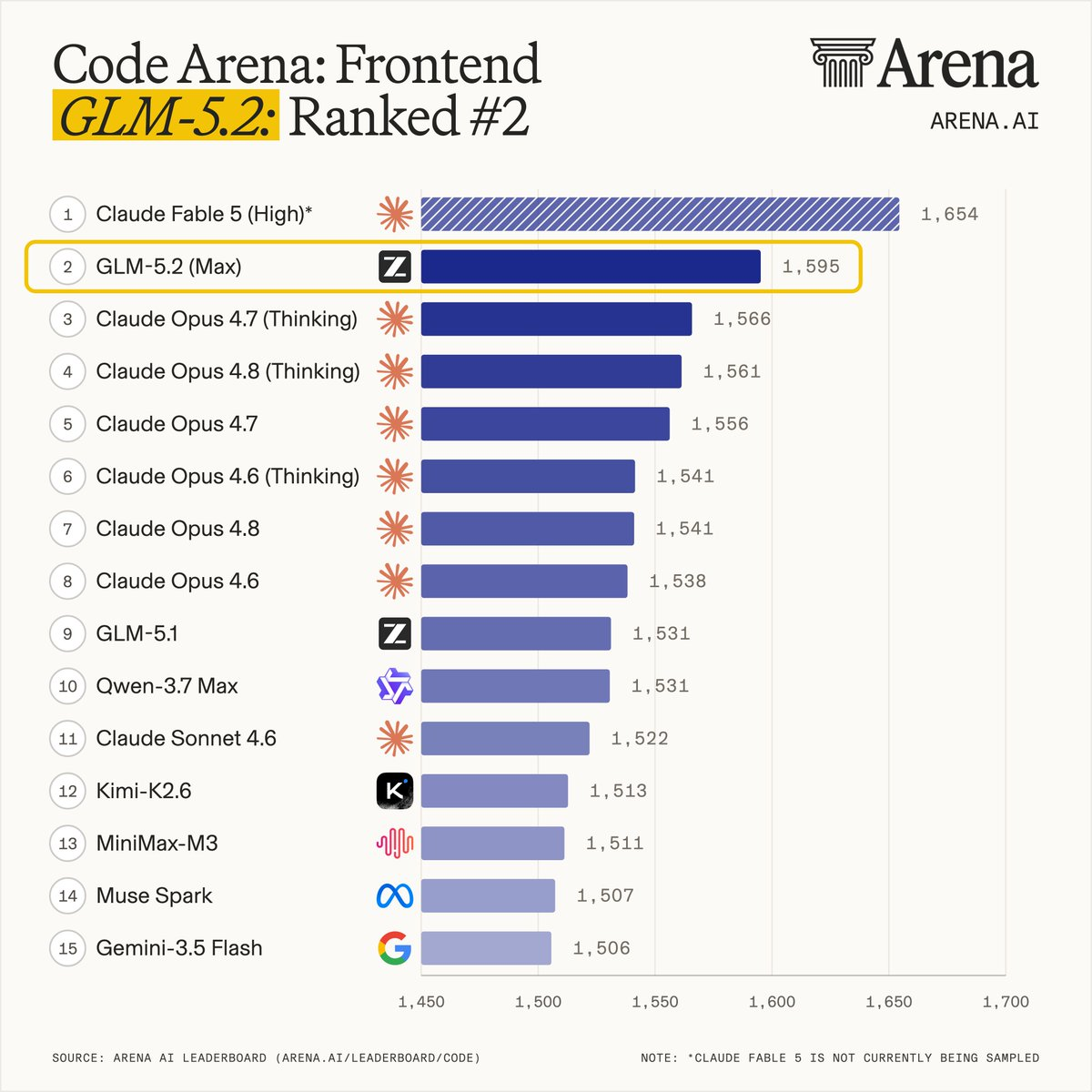
Such a move can also pave way for other models to offer something similar to Fable 5 and emerge as direct competitors. For instance, the Beijing-based Zhipu AI's GLM-5.2 model is already filling the gap Fable 5's vanishing act has created.
Will Fable 5 Return?
Presently, Anthropic is working to restore access and officially considers the executive order a misunderstanding. The model is likely to return, with no timeline in sight at the moment. However, in this case, timeline isn’t important – the terms of return are what matter more.
If access returns bundled with regulatory concessions based around the pre-briefing framework, the model will be working with a hanging noose of another shutdown if it deviates from the terms. However, if the government quietly backs down once Anthropic provides technical detail, it becomes a one-off event, thus allowing a frontier model to branch out unchecked.
The timing of this is also critical and could impact Anthropic's initial public offering plans.
Will Fable 5 return at the end of July?
Conclusion
For years, AI industry has been arguing about guardrails and what a model should and should not do. Fable 5 revealed that the real discussion was never really about safety training. It was more about an out-of-the-blue executive order that is currently a lever sitting over an entire industry, waiting to take action based on national security interests.
The model that went offline doesn’t seem to be the biggest story here. What it doesn’t come back with once the switch is turned on again, is the real discussion.