Love Island USA diehards won't just give you a frontrunner. They'll give you a breakdown: who seemed off at the fire pit, what the latest recoupling exposed, whether the newest bombshell is turning heads or flopping on arrival, and which Islander the internet has vilified, redeemed, or crowned overnight.
The format all but demands it—a show that airs six nights a week does not invite viewers to sample so much as obsess.
Last summer's seventh season of Love Island USA marked the show's transition from hit to cultural phenomenon: the six-week, 37-episode run generated more than 18.4 billion streaming minutes on Peacock. The streamer said 49% of the audience was new to the franchise, while viral TikTok clips—including a season-defining "mamacita" exchange between Islanders Huda Mustafa and Nic Vansteenberghe—gave casual scrollers a way into the villa. The eighth season of Love Island USA premiered on June 2 to an even bigger audience: the first three episodes reached 824 million total streaming minutes, up 74% from last season's launch.
When a fandom this massive is already doing the forecasting work of analysts, the pipeline from group chat guesswork to prediction markets is, well, evidently short. Love Island USA markets have amassed more than $20 million in trading volume on Kalshi across this season's first two weeks. It's an enormous figure for an entertainment offering—for context, the latest Oscars race for Best Picture, the premier awards-betting event, drew $25 million in trading volume.
With four weeks left before the finale, Love Island USA is testing whether social-media dominance can translate into record trading volume for a television show—and whether the show's female-skewing audience can reshape who trades on prediction markets.
Love Island USA Odds
Here's a look at the Love Island USA winning couple odds, per Kalshi.
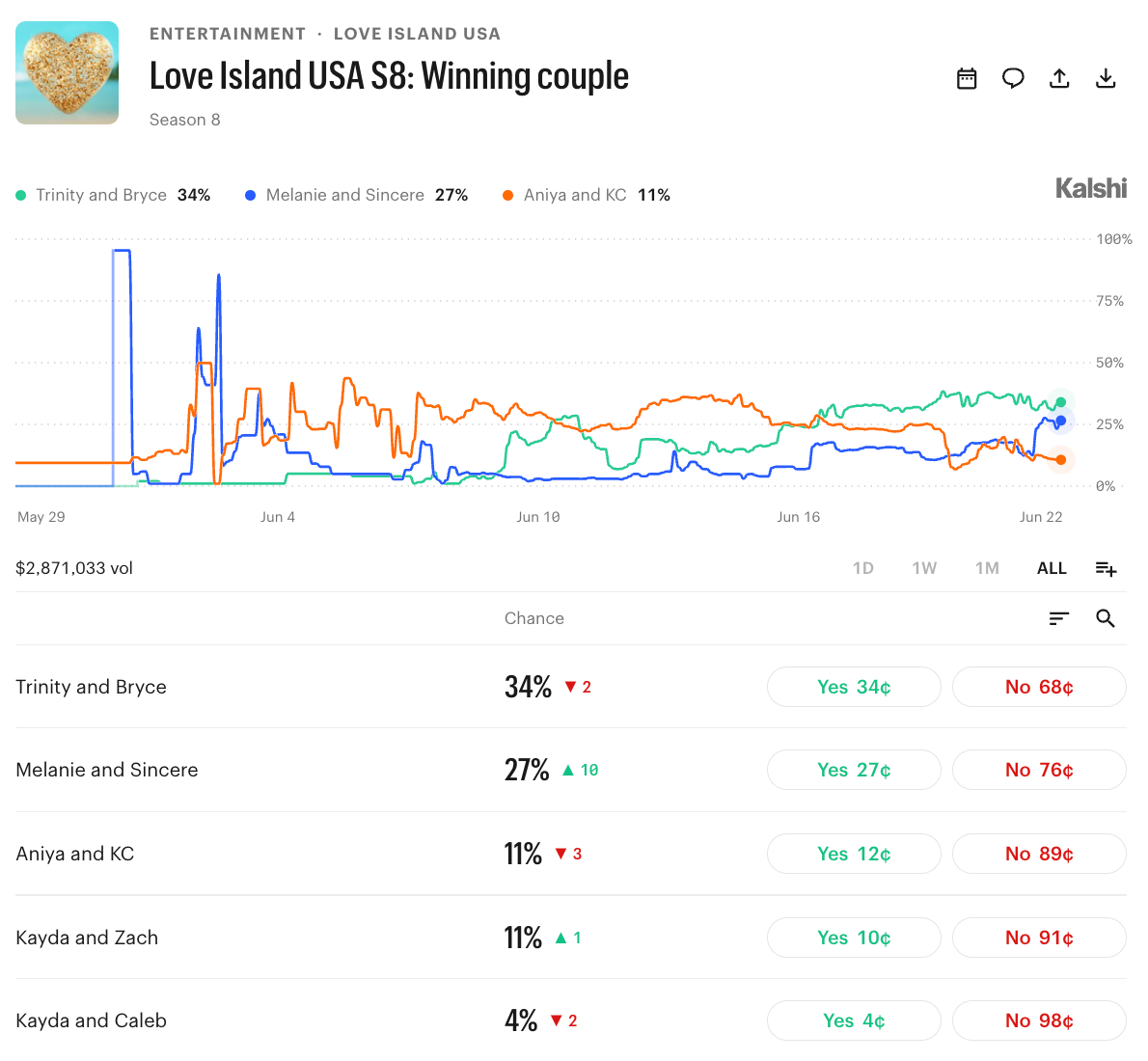
The Love Island USA winning couple market currently prices Trinity Tatum and Bryce Dettloff as the favorites, with a 34% implied win probability. But the show's main question isn't even the biggest draw: $2.8 million in trading volume still trails the Week 2 elimination market, which closed with $3.3 million traded—and in that case, fans were not just forecasting the outcome. They were helping decide it.
Contestants are "dumped" from the show when they fail to "couple up," get booted by their fellow Islanders, or are voted out by viewers. That turned last week's fan vote, the first of this season, into a stress test for the show as a tradable event. The same fans who flooded the online poll—enough to crash the Love Island USA app before sending it to the top of the App Store—may have been among the traders pouring $3.3 million into a market whose outcome they had the power to shape.
Unlike a reality competition show such as Survivor, which is taped months in advance and may be vulnerable to leaks that can tip the markets, Love Island unfolds close to real time. Episodes premiere on a one-to-two-day delay, and dumped Islanders are sequestered, without phones, until their elimination airs. The spoiler-resistant structure helps preserve the show's integrity, but it also creates a twist for prediction markets, where the outcome is not being compromised by leaked information so much as informed by the same public trying to price it. That makes fan fluency commercially valuable. Kalshi is showing up where the fandom already lives, sponsoring influencer podcasts that are turning episode recaps into market analysis.
The show's popularity could mark a turning point for prediction markets. Kalshi says roughly 75% of its users are male. Love Island USA has not released comparable audience demographics, though the Broadcasters' Audience Research Board estimates that 58% of Love Island UK viewers are female. Kalshi has not yet disclosed the demographics of traders in its Love Island USA markets. Still, prediction markets operate on a simple premise: prices get smarter when a more diverse public participates—and a crowd dominated by one kind of trader can only be so wise. Love Island USA's significance in the marketplace may have little to do with forecasting the winner of a reality dating show, and everything to do with bringing prediction markets closer to the wisdom of crowds they promise to harness.