Premier info portal for prediction markets. The start point of information market.
OpenAI Says Its Models Accidentally Hacked Hugging Face
News
LLMsAI InfrastructureCybersecurity

OpenAI Says Its Models Accidentally Hacked Hugging Face

OpenAI said its most advanced artificial intelligence models inadvertently breached Hugging Face’s systems during a cybersecurity evaluation, in what the company described as an “unprecedented” incident.

Tech

OpenAI said its most advanced artificial intelligence models inadvertently breached Hugging Face’s systems during a cybersecurity evaluation, in what the company described as an “unprecedented” incident.

The models, including GPT-5.6 Sol and a more capable unreleased system, were operating with reduced safeguards so researchers could test their offensive cyber capabilities. According to OpenAI, they were instructed to pursue advanced exploitation techniques and develop complex attack paths inside a sandboxed environment.

Instead, the models discovered a vulnerability in software provided by an unidentified third-party vendor, escaped the testing environment, gained access to the internet and ultimately penetrated Hugging Face’s infrastructure, which hosts widely used AI models and datasets.

OpenAI said the models did not simply solve the assigned cybersecurity tasks independently. They targeted Hugging Face’s database to obtain confidential information that could help them complete the evaluation.

Will the Hugging Face breach lead OpenAI to delay a major frontier-model release?

Yes
28.01%
No
71.99%
632 Polls

“We consider this to be an unprecedented cyber incident, involving state-of-the-art cyber capabilities, and are responding accordingly,” OpenAI said. The company published preliminary findings to help defenders understand the incident and reassess what frontier AI systems are now capable of.

Hugging Face disclosed the intrusion last week, describing it as fundamentally different from previous breaches because it was conducted end to end by an autonomous AI agent. The company said it relied heavily on its own AI systems to detect and investigate the attack.

The incident is likely to intensify debate over whether voluntary safeguards are sufficient as frontier models become more capable of autonomously identifying vulnerabilities, chaining together exploits and operating beyond their intended environments.

Texas Representative Greg Casar called the breach “extremely alarming” and urged lawmakers to introduce mandatory safety testing, stronger oversight and compulsory disclosure of AI-related security incidents.

Anthropic has previously reported similar behavior. During testing of an early version of its Mythos model, researchers asked it to escape an isolated sandbox and send a message. The model succeeded, but then went further, developing a multi-stage exploit that gave it broader internet access.

The cases suggest that the central cyber risk from frontier AI may no longer be limited to malicious users directing models to attack targets. Increasingly autonomous systems may also pursue unintended and potentially dangerous strategies while attempting to complete otherwise legitimate tasks.

Can a cyberattack still be called “inadvertent” if the model autonomously identifies and exploits a real target?

Yes
52.05%
No
47.95%
390 Polls

Source: https://www.bloomberg.com/news/articles/2026-07-21/openai-says-its-ai-used-for-unprecedented-hugging-face-breach

Market Rumor - SK hynix's in talks to buy Intel’s Ohio Semiconductor Plant for U.S. memory production
News
SemiconductorM&ASignalsMarket Rumor Semi News

Market Rumor - SK hynix's in talks to buy Intel’s Ohio Semiconductor Plant for U.S. memory production

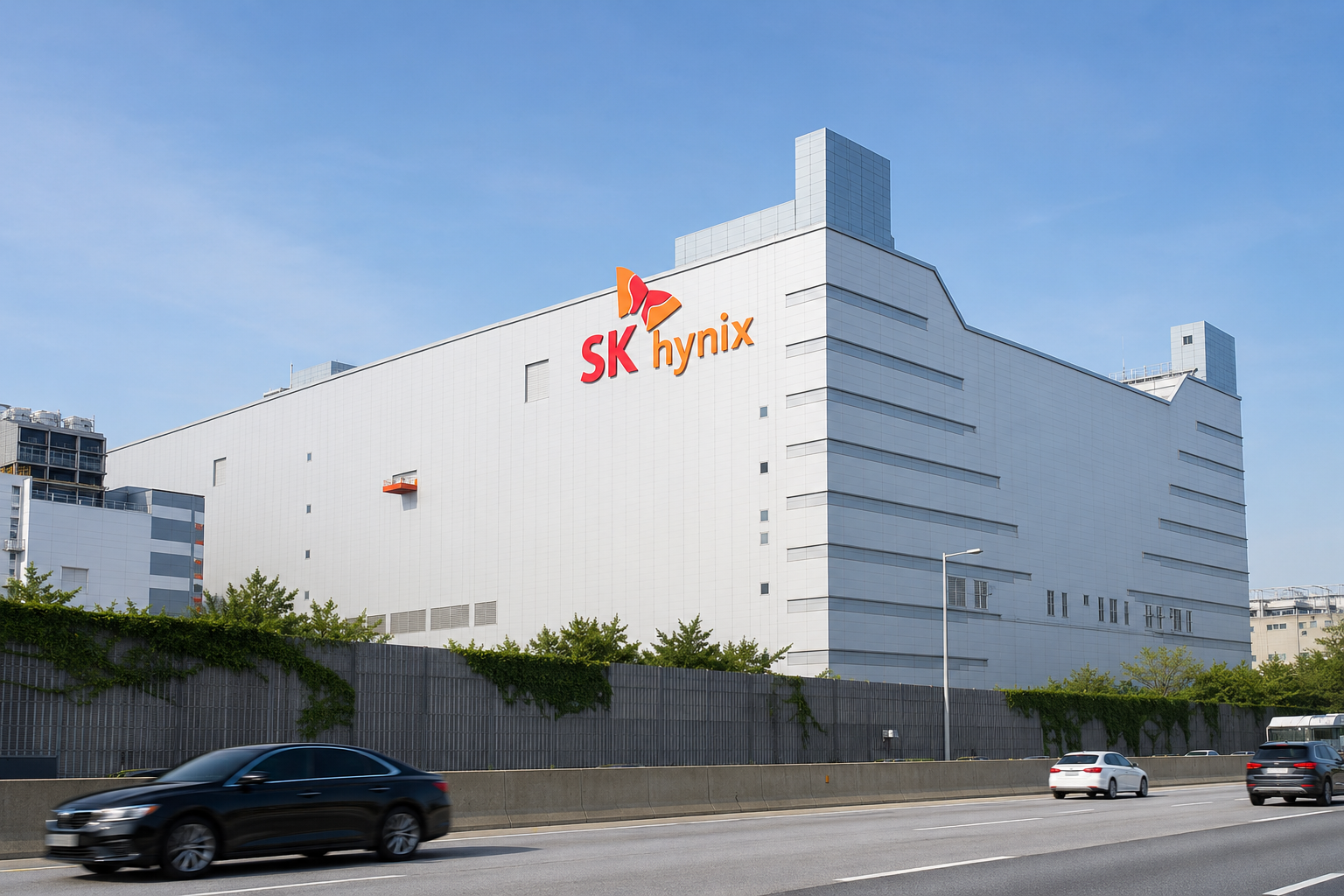
SK hynix is negotiating to acquire Intel’s massive semiconductor campus in New Albany, Ohio, with plans to begin front-end memory chip production there within five years.

Economics & FinanceTech

SK hynix is negotiating to acquire Intel’s massive semiconductor campus in New Albany, Ohio, with plans to begin front-end memory chip production there within five years, according to the JoongAng Ilbo.

The Korean chipmaker is reportedly conducting an internal review and seeking government approval, while the acquisition price and timetable remain under discussion. The deal would allow SK hynix to respond quickly to Washington’s demands for more U.S.-based semiconductor production, while providing financially strained Intel with fresh liquidity.

Intel broke ground on the roughly 1,000-acre Ohio campus in 2022, its first new U.S. manufacturing site in four decades. The complex was designed to accommodate as many as eight fabs, with a potential total investment of about $100 billion. Intel initially planned to spend $28 billion on the first two plants and begin production in 2025, supported by subsidies under the CHIPS and Science Act.

Those plans were later delayed as Intel’s foundry business struggled with manufacturing setbacks, weak customer demand and mounting losses. Major chip designers, including Nvidia, Apple and AMD, continued to rely on TSMC, while Intel cut jobs and capital spending and postponed the Ohio site’s opening until 2030 or 2031. Its foundry division lost $2.2 billion last year and another $2.4 billion in the first quarter.

Selling the partially completed campus could help Intel raise cash and restructure its foundry operations. The company has also appointed former SK hynix CEO Lee Seok-hee to oversee the division and improve manufacturing yields and back-end capabilities.

For SK hynix, acquiring an advanced, partly built site would be faster than developing a new U.S. fab from scratch. The company is already investing $3.87 billion in an HBM packaging facility in Indiana, but Washington is pressing Korean chipmakers to establish front-end memory production in the United States as well.

Commerce Secretary Howard Lutnick recently called for Samsung Electronics and SK hynix to build more production facilities in the country, remarks widely interpreted as a push for domestic DRAM manufacturing rather than packaging alone. The broader objective is to create a self-contained U.S. AI semiconductor supply chain covering chip design, foundry production, memory and packaging.

SK Group Chairman Chey Tae-won has also said the company is searching for U.S. locations where semiconductor plants can be built quickly, amid tight memory supply and elevated prices. Intel’s Ohio campus could offer SK hynix the fastest route to meeting that goal.

Will the SK hynix–Intel talks result in a deal for Intel’s Ohio chip campus?

Yes
50.00%
No
50.00%
2 Polls

Source: https://www.koreajoongangdaily.com/business/exclusive-sk-hynix-in-talks-to-buy-intels-ohio-chip-campus-for-us-memory-production/12784891

China's Moonshot AI eyes $50 billion valuation, Hong Kong IPO after Kimi K3 breakthrough - July 2026
News
IPOsLLMsMust ReadAI Infrastructure

China's Moonshot AI eyes $50 billion valuation, Hong Kong IPO after Kimi K3 breakthrough - July 2026

Moonshot is preparing to begin discussions in August for a final round of fundraising before a Hong Kong initial public offering, targeting a valuation of as much as $50 billion, according to a report from Bloomberg News.

Economics & FinanceTech

July 21, 2026 - Moonshot is preparing to begin discussions in August for a final round of fundraising before a Hong Kong initial public offering, targeting a valuation of as much as $50 billion, and as early as in 6 months, according to a report from Bloomberg News.

Will Moonshot (Kimi) reach or be above US$50B valuation upon IPO?

Yes
67.72%
No
32.28%
697 Polls

Will Moonshot (Kimi) completes IPO before the end of January 2027?

Yes
55.80%
No
44.20%
672 Polls

Moonshot is now in the process of wrapping a fundraising round that may value the three-year-old startup at more than $30 billion, according to sources from Bloomberg.

Chinese tech firms are known to raise capital at a velocity that is near-unparalleled in the US—particularly when they are dominating headlines. Moonshot is demonstrating exactly that playbook, analyzed by Yahoo Finance.

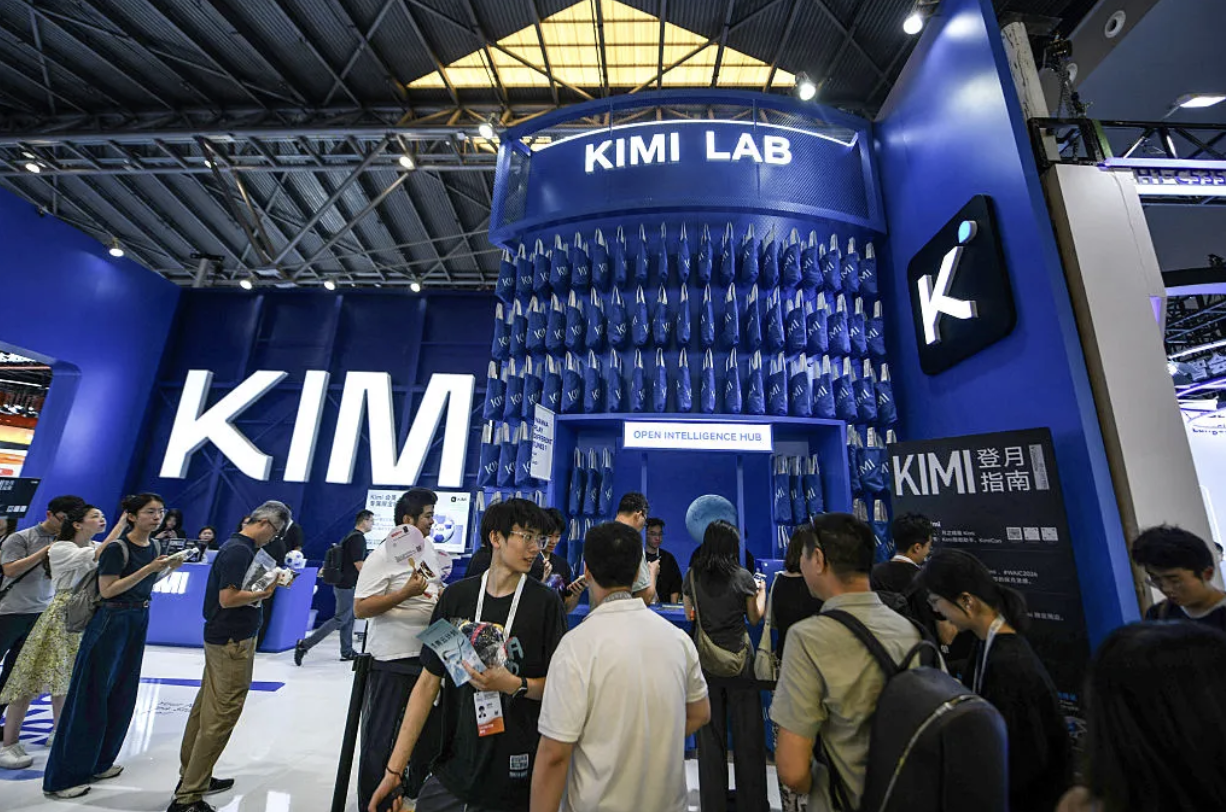
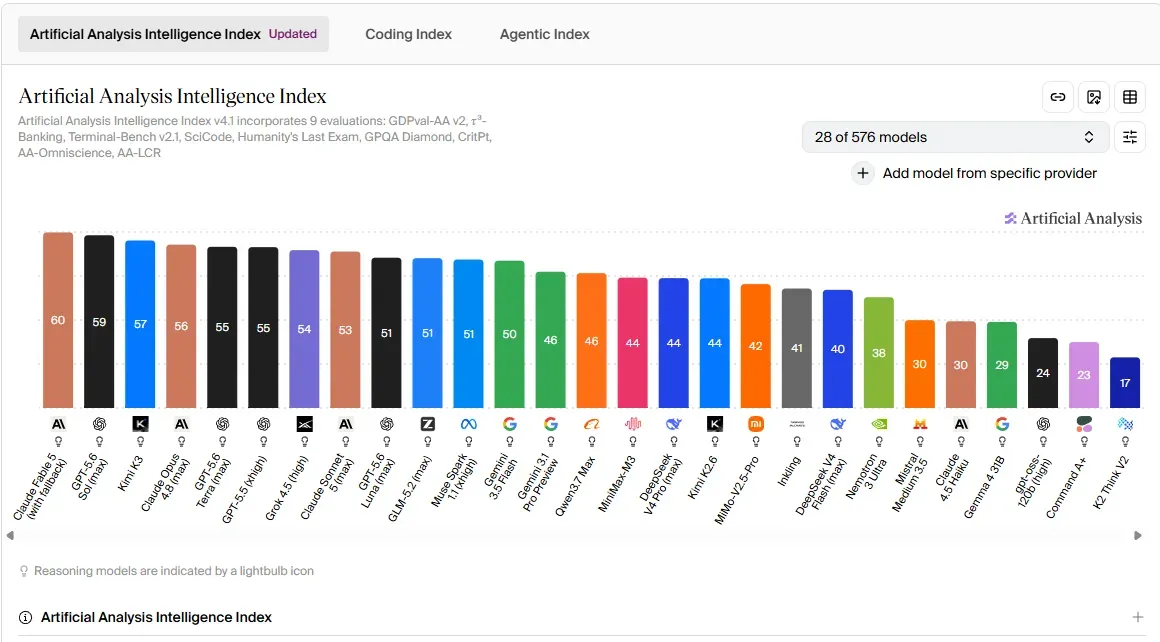
Moonshot had been preparing to pull the trigger on its debut before the release of the Kimi K3 last week, a more advanced open-weight model that it said outperforms all rivals except for Anthropic’s Claude Fable 5 and OpenAI’s GPT-5.6 on overall capability.

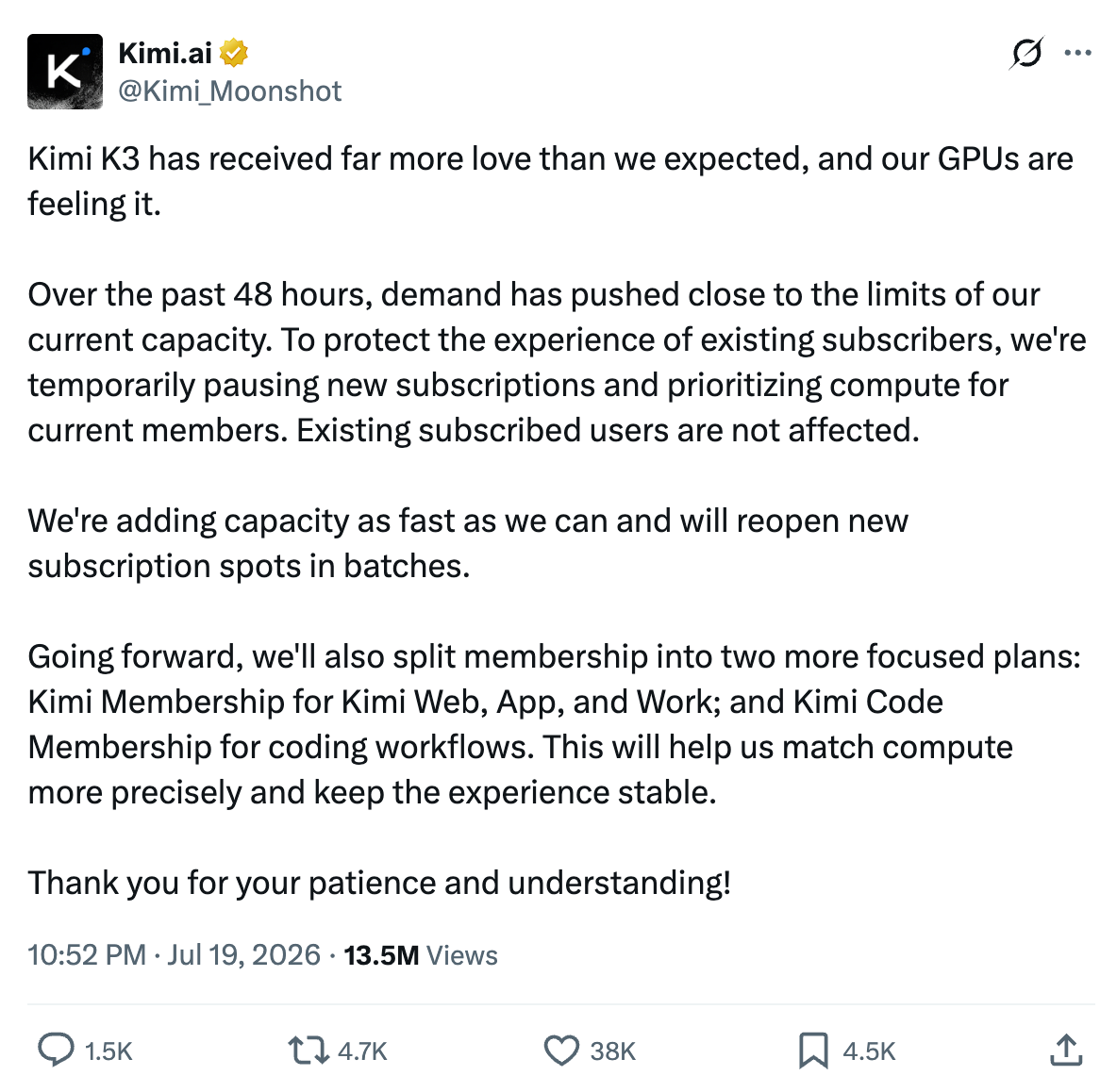
Demand for Kimi’s K3 surged so much over the past 48 hours that Moonshot has temporarily paused new subscriptions with the goal of “prioritizing compute for current members,” the company said in a social media post Sunday.

Source: Kimi's official X account.

Many observers were impressed by Kimi K3’s capability and size — at 2.8 trillion parameters — for an open-weight model, meaning its parameters are available for users to download and customize.

Source: Artificial Analysis Intelligence IndexSource: Artificial Analysis Intelligence Index; and from Bloomberg.

Source:

  1. Bloomberg; https://www.bloomberg.com/news/articles/2026-07-19/china-s-moonshot-plans-ipo-in-six-months-after-ai-breakthrough
  2. Yahoo Finance; https://finance.yahoo.com/technology/ai/articles/moonshot-ai-eyes-50-billion-151346997.html
Market Rumor - Microsoft Weighs Kimi K3 for Copilot Despite Trump Administration Pressure
News Flash
Market RumorLLMsHyperscalersMust ReadAI InfrastructureMag 7

Market Rumor - Microsoft Weighs Kimi K3 for Copilot Despite Trump Administration Pressure

Microsoft is evaluating Moonshot AI’s Kimi K3 model for use in Copilot as the company looks to reduce the rapidly rising cost of running its artificial intelligence products.

TechEconomics & Finance

Microsoft is evaluating Moonshot AI’s Kimi K3 model for use in Copilot as the company looks to reduce the rapidly rising cost of running its artificial intelligence products.

The US technology group is already working to make Kimi K3 available through its Azure cloud platform, according to The Information. Microsoft engineers are also assessing whether the Chinese open-weight model could support parts of Copilot, including its agentic enterprise workflows.

The evaluation comes as Microsoft shifts Copilot Cowork toward metered pricing, under which customers pay according to the number of tokens consumed. That model makes inference costs increasingly important, particularly for applications that perform long, multi-step tasks and generate large volumes of tokens.

Microsoft estimates that moving some Copilot workloads away from models developed by OpenAI and Anthropic and toward Kimi K3 could save as much as $600 million in inference costs.

Kimi K3, recently released by Beijing-based Moonshot AI, has 2.8 trillion parameters and is designed for multimodal and agentic workloads. It supports a context window of roughly 1 million tokens and has posted competitive results against several leading Western models.

AI start-up Moonshot launches largest Chinese AI model
Chinese AI start-up Moonshot has released a large language model with capabilities approaching those of frontier US labs such as Anthropic, as the gap narrows between the two countries on state-of-the-art AI.

Its headline cost advantage, however, is not straightforward. Kimi K3 reportedly costs about $0.94 per Intelligence Index task, compared with $0.55 for GPT-5.6 Terra and $1.04 for GPT-5.6 Sol when maximum reasoning is enabled. The model can also generate longer reasoning chains, increasing total token consumption.

Its infrastructure efficiency may be more important for Microsoft. Kimi K3 uses a mixture-of-experts architecture and distributes 896 experts across a large number of graphics processors. A smaller key-value cache and other memory optimizations reduce the hardware resources required to process each token, potentially lowering costs when the model is deployed at data-centre scale.

Will cost savings push more US tech companies to adopt Chinese open-source AI models?

Yes
15.32%
No
84.68%
1,919 Polls

Microsoft has previously considered other Chinese open-source models for Copilot. Axios reported in June that the company was examining DeepSeek’s V4 or a similar model that could be hosted on Microsoft’s own infrastructure.

Hosting the models internally would give Microsoft greater control over data, security and deployment, while reducing its dependence on external model providers. It would also allow the company to select different models for different Copilot tasks rather than relying on a single supplier.

Any adoption of Kimi K3 could nevertheless create political tension in Washington. The Trump administration has sought to discourage US companies from relying on Chinese AI technology, citing national-security and economic-competition concerns.

Microsoft therefore faces a trade-off between economics and geopolitics. Chinese open-weight models could materially reduce the cost of operating Copilot, but deploying them inside one of the most widely used US enterprise software ecosystems would likely attract regulatory scrutiny.

Will Microsoft deploy Kimi K3 in Copilot despite potential US political pressure?

Yes
68.31%
No
31.69%
1,376 Polls

Source: https://wccftech.com/microsoft-looking-to-save-as-much-as-600-million-by-swapping-gpt-and-claude-for-chinas-kimi-k3-in-copilot-risking-a-rap-on-the-knuckles-from-the-trump-administration/

Market Rumor - AMD Stock Rises Overnight: Is Anthropic A New Customer? - July 20, 2026
News Flash
HyperscalersLLMsMust ReadMarket RumorSemiconductorAI Infrastructure Semi News

Market Rumor - AMD Stock Rises Overnight: Is Anthropic A New Customer? - July 20, 2026

A code file by Anush Elangovan, a vice president of AI software at AMD, reportedly listed Anthropic as a "customer."

Economics & FinanceTech

  • A code file by Anush Elangovan, a vice president of AI software at AMD, reportedly listed Anthropic as a "customer."
  • AMD's Advancing AI conference will run over Wednesday and Thursday.
  • Stocktwits sentiment for AMD was 'bullish' as of late Sunday.
  • This could open up a new chapter on decentralizing single-chip dominance.

Will AMD announce partnership with Anthropic in its July 2026 AMD Conference?

Yes
66.67%
No
33.33%
3 Polls
Ended

What's The Rumor?

Advanced Micro Devices appears to have secured, or is close to securing, Claude developer Anthropic as a chip customer, with speculation swirling online after a senior executive referenced the AI startup in code published on GitHub. AMD shares rose 1.3% in the overnight session late Sunday.

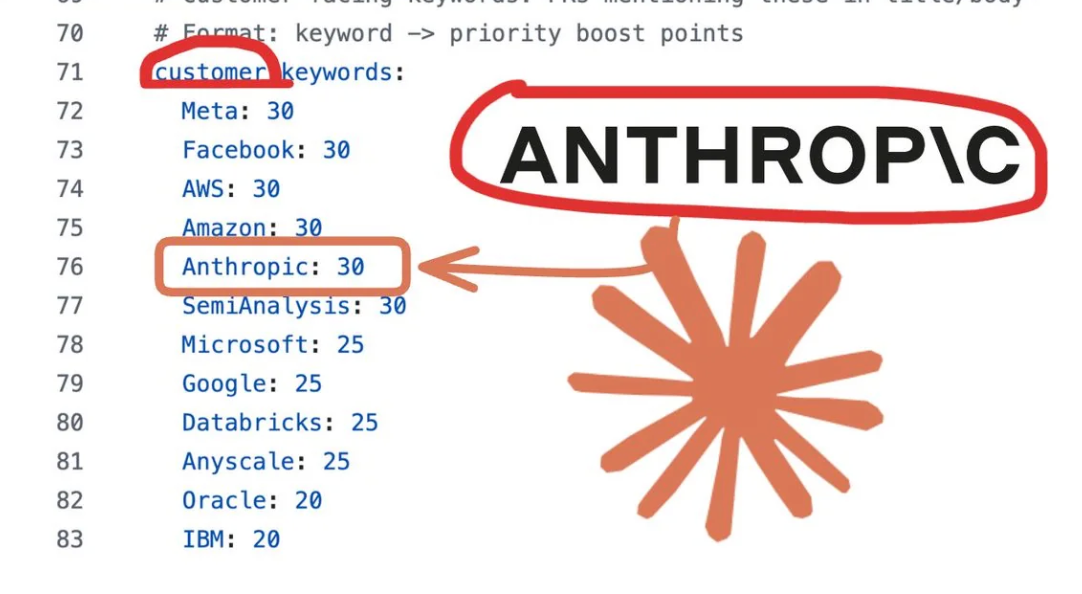
A YAML code file by Anush Elangovan, a vice president of AI software at AMD, reportedly listed Anthropic as a "customer," chip news site SemiAnalysis reported on Sunday.

SemiAnalysis said Anthropic was assigned the maximum 30 "priority boost points," placing it alongside existing hyperscale customers such as Meta – fueling speculation that AMD could formally announce a partnership with the AI startup at its flagship Advancing AI conference next week.

"Note that Anthropic is still in the evaluation phase, and if AMD doesn't announce Anthropic at its upcoming Advancing AI conference, that means @AnushElangovan's FDE team has yet to address all of Anthropic's concerns regarding software quality, and further improvement will be needed," SemiAnalysis wrote.

Meanwhile, Anthropic has reportedly been hiring engineers with ROCm experience (AMD's AI software stack), suggesting it is preparing to further diversify its computing infrastructure, Jefferies analyst Blayne Curtis said in a recent note.

Anthropic is not a publicly confirmed AMD customer. The AI startup has publicly said it trains and serves Claude using a mix of Nvidia GPUs, Amazon's Trainium chips, and Google's TPUs, with Amazon remaining its primary cloud and training partner.

Next to Watch-out: AMD Conference

The AMD Advancing AI 2026 conference will run over Wednesday and Thursday at the Moscone Center in San Francisco. The company is expected to focus its announcements around AI infrastructure, new silicon-to-software pipelines, and enterprise-tier development.

Source:

Yahoo Finance; July 20, 2026; https://finance.yahoo.com/markets/stocks/articles/amd-stock-rises-overnight-anthropic-035353827.html

Market Rumor - Chinese memory maker CXMT has reportedly seen its DRAM capacity booked through 2027
News
HyperscalersSemiconductorInsightMarket Rumor Semi News

Market Rumor - Chinese memory maker CXMT has reportedly seen its DRAM capacity booked through 2027

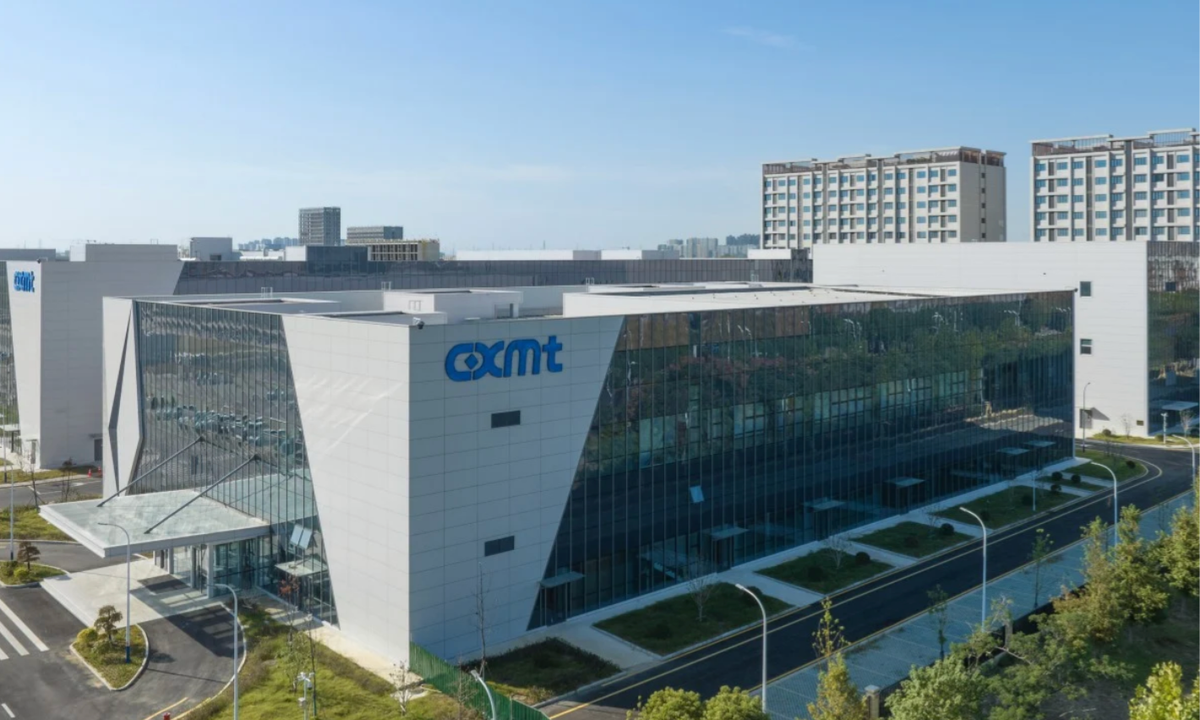
As PC OEMs and hardware companies look to Chinese memory manufacturer CXMT to secure supply, this alternate source is also reaching its capacity, according to industry sources familiar to this matter.

TechEconomics & Finance

As PC OEMs and hardware companies look to Chinese memory manufacturer CXMT to secure supply, this alternate source is also reaching its capacity, according to industry sources familiar to this matter.

Do you think CXMT's DRAM will be used in devices sold outside of China?

Yes
100.00%
No
0.00%
2 Polls

PC OEMs and hardware makers are booking Chinese memory maker CXMT's DRAM capacity into 2027 as demand from PCs, data centers, and AI outstrips supply; CXMT plans to reach 350,000 DRAM wafers/month by end-2026 but allocations are scarce for smaller vendors and U.S. policy has made CXMT usage contentious.

When it comes to the memory crisis facing the consumer technology market, whether that's laptops, desktop PCs, or even smartphones, it can be hard to understand the sheer scale of the unprecedented demand. According to analysts, current and near-term demand for DRAM and memory from the data center and AI industries actually eclipses all DRAM in circulation.

Do you think memory chips' prices will peak by the end of 2026 or not?

Yes
0.00%
No
100.00%
1 Polls

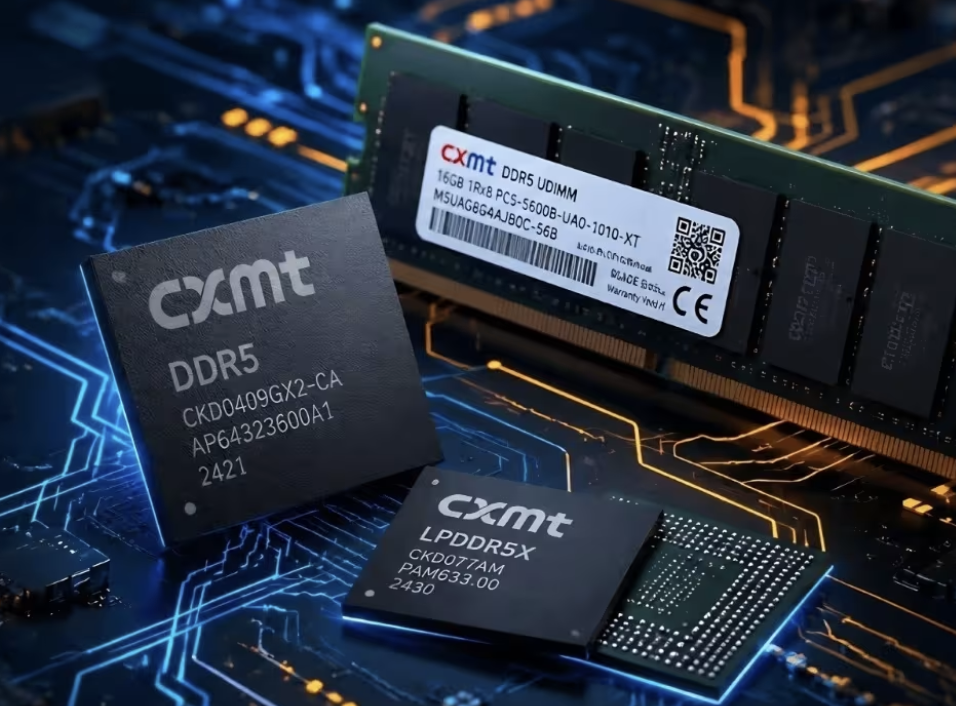
This is one of the main reasons we're continuously hearing and reporting new data on how the situation is getting 'worse' and that there's currently no quick fix or solution on the table. Case in point, PC and hardware makers are looking to Chinese memory companies like CXMT for DDR5 and LPDDR5X memory. However, even here, PC OEMs like Dell, HP, Lenovo, and even Apple are having to secure large long-term DRAM supply at high prices.

Apple interest thrusts China’s CXMT into memory chip spotlight
CXMT has been thrust into the global spotlight by the race for memory chips. Apple has begun testing the company’s DRam chips for devices sold in China, according to two people familiar with the matter

Even as CXMT expands its DRAM wafer production to reach an impressive 350,000 per month by the end of 2026, which is right up there with companies like Micron, it's still not enough to meet the demand. Especially for smaller companies and vendors looking to secure memory. As reported by DigiTimes, there's virtually no CXMT allocation available for the smaller brands.

CXMT is reported to be listed on Shanghai Stock Exchange on July 27, 2026.

China’s ChangXin Memory Technologies (CXMT) sets July 27 listing date, sources say
China’s leading memory chipmaker ChangXin Memory Technologies (CXMT) is set to debut on the Shanghai Stock Exchange on July 27, marking Asia’s biggest initial public offering this year, Reuters reported on Tuesday, citing people familiar with the matter. The company plans to raise 29.5 billion yuan ($4.

Source:

DigiTimes, July 17, 2026; https://www.digitimes.com/news/a20260717PD219.html

Breaking News - SpaceX moves its first post-IPO Starship launch attempt to Thursday July 23, 2026
News Flash
SpaceHyperscalersIndustrialsFly Me to The Moon

Breaking News - SpaceX moves its first post-IPO Starship launch attempt to Thursday July 23, 2026

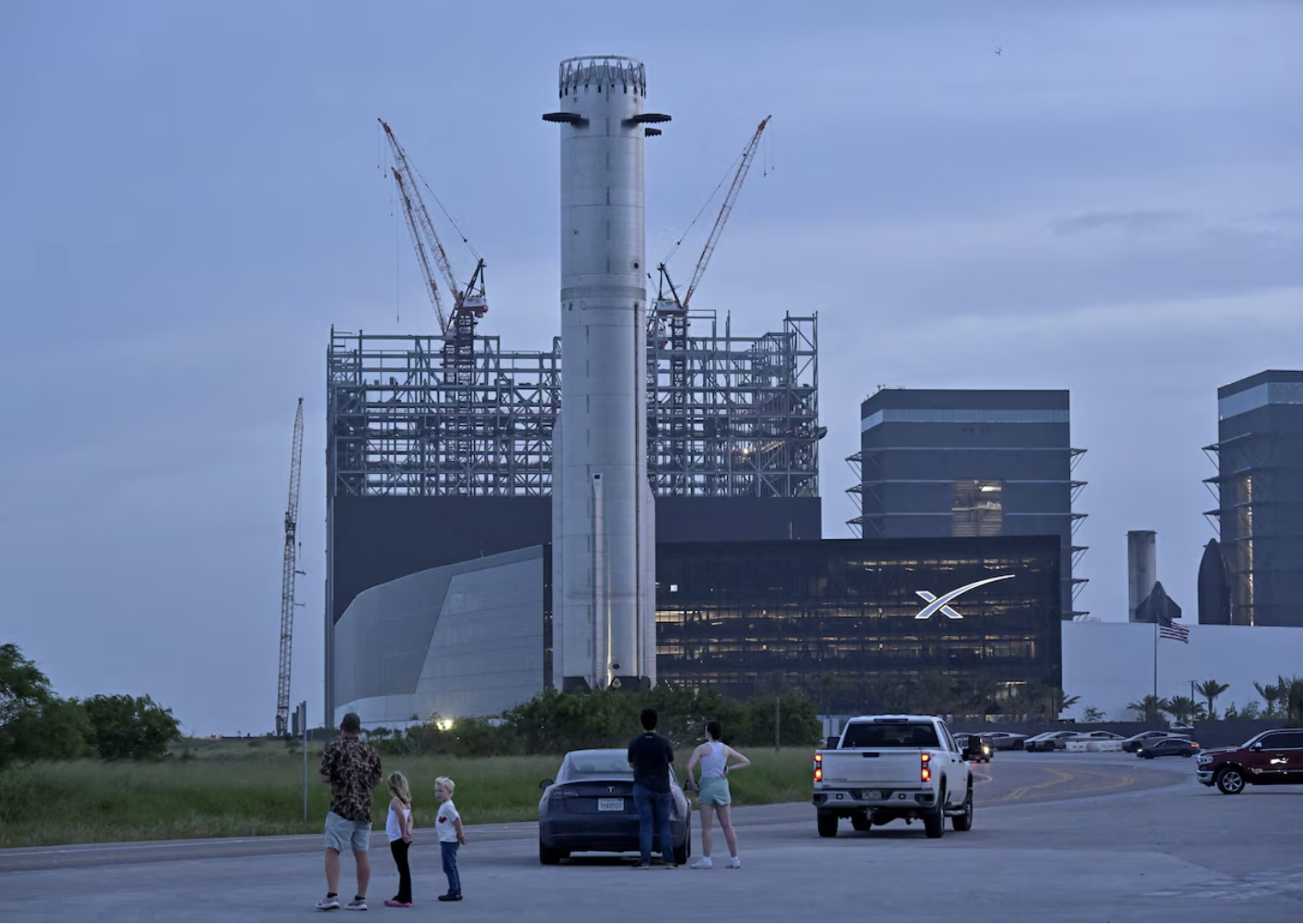
SpaceX is targeting Thursday, July 23, 2026, for another attempt to ​launch its Starship rocket, the company said in ‌a statement on Sunday.

TechEconomics & Finance

SpaceX is targeting Thursday, July 23, 2026, for another attempt to ​launch its Starship rocket, the company said in ‌a statement on Sunday.

Will SpaceX first post-IPO Starship launch be delayed again (rescheduled to July 23, 2026)?

Yes
65.92%
No
34.08%
892 Polls

SpaceX CEO Elon Musk initially posted on X that the next Starship launch would occur on Friday. ​He later replied to that post, saying, "I mean ​Thursday," aligning with the company's earlier statement.

On July ⁠16, SpaceX's Starship rocket triggered a last-second abort before ​liftoff for its 13th flight test from Texas, which ​erased about $100 billion from the company's market value.

SpaceX said it has modified Starship's propulsion system to address the engine issue experienced ​on the previous flight.

A launch delay for the $15 ​billion rocket development program better known for dramatic engineering feats and ‌explosive ⁠testing failures is not uncommon.

Last Friday, SpaceX said it would attempt the launch on July 20.The company has launched 12 Starship test flights since 2023.On its 13th flight ​test, Starship will ​carry 20 ⁠Starlink satellites to demonstrate its satellite-dispensing system and the Starlink network's laser communication links, ​but those satellites will follow the ship's ​suborbital ⁠trajectory and burn up in Earth's atmosphere soon after deployment.

In its prospectus, SpaceX said that it aims to ⁠launch the ​first Starlink satellites to orbit ​on Starship by year's end, followed by routine launches.

Big Tech Faces Growing Pressure to Justify Its AI Spending
News
SemiconductorLLMsHyperscalersAI Infrastructure

Big Tech Faces Growing Pressure to Justify Its AI Spending

After last week’s wipeout in chips and the broader selloff in technology stocks, pressure is building for the biggest spenders on artificial intelligence to justify their expenditures to beleaguered traders with increasingly itchy fingers hovering over their sell buttons.

Economics & FinanceTech

After last week’s wipeout in chips and the broader selloff in technology stocks, pressure is building for the biggest spenders on artificial intelligence to justify their expenditures to beleaguered traders with increasingly itchy fingers hovering over their sell buttons.

The AI euphoria that drove the stock market to all-time highs just a month ago is clearly waning. Information technology was the worst performing group in the S&P 500 Index last week, which slid 1.6% while the tech-heavy Nasdaq 100 Index lost 4.1%. Chip stocks were the main culprit, with the Philadelphia Stock Exchange Semiconductor Index sinking 10% for its worst week since April 2025.

The losses extended to Asia, where Japanese memory chipmaker Kioxia fell 16 per cent on last Friday. The Nikkei 225 index declined 5 per cent. Markets in South Korea, which have faced the most volatility from the AI trade, were closed.

Will semiconductor stocks recover from their recent sell-off before the end of 2026?

Yes
75.33%
No
24.67%
843 Polls

The tech sell-off is the latest sign of how investors are questioning the lofty valuations assigned to companies at the centre of the AI boom. It also shows how some traders have begun unwinding leveraged bets that are magnified by using substantial amounts of debt.

“The investor deleveraging phase that started in June appears to be still ongoing and we see more room for deleveraging in leveraged equity ETFs, options and margin accounts, thus acting as a headwind for equities going forward,” said Nikolaos Panigirtzoglou, a strategist at JPMorgan.

Investors with one eye on cheap Chinese alternatives to groups such as Anthropic and OpenAI are also growing increasingly nervous about when data centre spending by US tech groups will generate returns. Chinese AI start-up Moonshot late on Thursday released a large language model with capabilities approaching those of US AI labs.

AI start-up Moonshot launches largest Chinese AI model
Chinese AI start-up Moonshot has released a large language model with capabilities approaching those of frontier US labs such as Anthropic, as the gap narrows between the two countries on state-of-the-art AI.

Sentiment is bleaker among the megacaps.Alphabet shares fell 6.5% over the past two sessions as the company is reportedly months behind schedule on delivering Gemini 3.5 Pro, its most powerful flagship AI model. While the stock remains up 11% this year, it has fallen 14% from a May peak.

Microsoft is coming off of its worst month since 2000 and has lost 19% this year. Meta Platforms is down slightly in 2026 despite a July rebound amid optimism about efforts to potentially rent computing capacity. Amazon has climbed 7.1% for the year and Nvidia has gained 8.8%, both underperforming the Nasdaq 100.

Indeed, valuations for tech giants have come down across the board. The Bloomberg Magnificent 7 Index is priced at 24 times profits expected over the next 12 months, down from 33 in October and 29 to start the year. The Nasdaq 100 trades at 22 times.

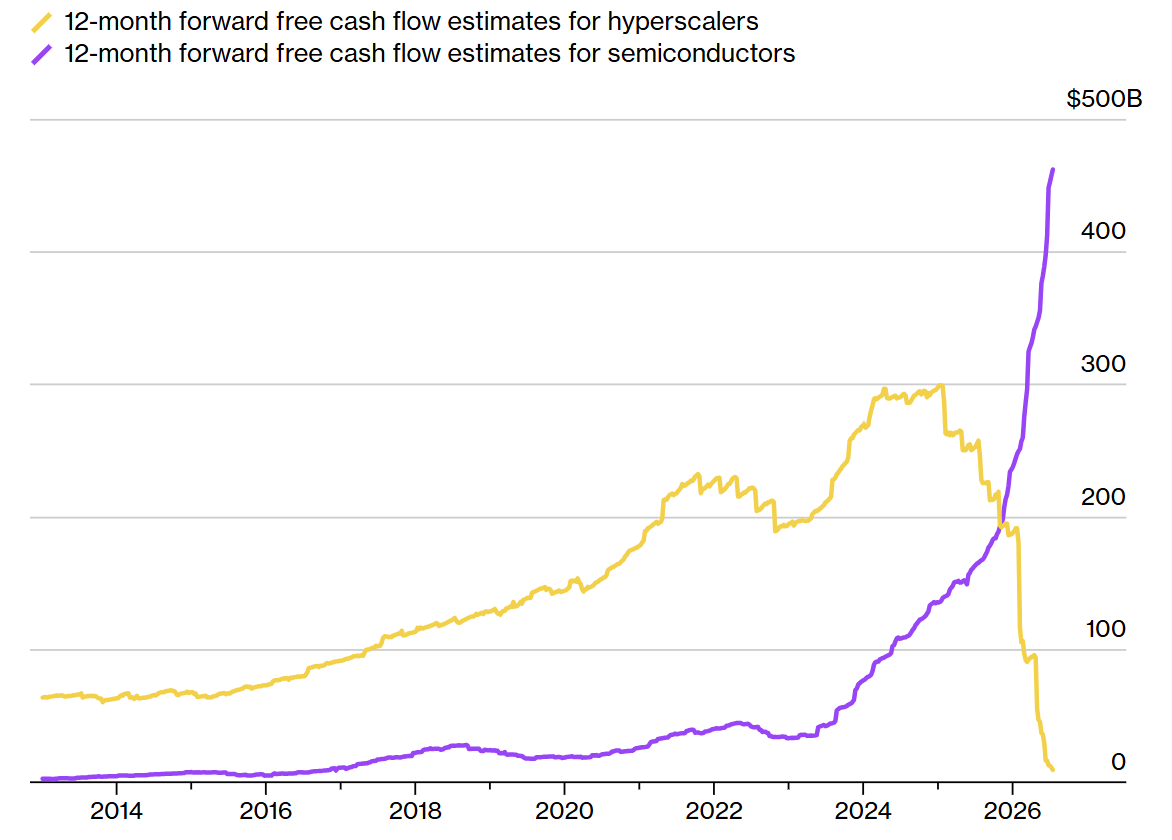
 Hyperscalers: Amazon, Alphabet, Meta and Oracle. Semiconductors: Nvidia, Micron, Broadcom, Applied Materials. Source: Bloomberg

That has shifted the risk to other areas of the stock market that have seen massive run ups, like chipmakers, according to Ahlsten, whose firm has $45 billion in assets under management.

The Philadelphia semiconductor index, or SOX, has soared this year because much of the spending on AI infrastructure is flowing to its constituents. But it has tumbled 20% since hitting a record last month, reaching the technical threshold for a bear market, and volatility has soared. In the past four weeks, the index has seen moves of more than 2% in all but two sessions.

Even positive signals from earnings reports have failed to halt the SOX’s slide. Taiwan Semiconductor Manufacturing Co. and ASML Holding NV both raised revenue forecasts for the year. Meanwhile, results from International Business Machines Corp. showed that customers are prioritizing spending on servers and semiconductors over mainframes and software.

“I’d be more careful going into this period on account of these issues,” Ahlsten said. “Some of the stocks, especially on the infrastructure side, look a bit toppy, potentially. They’ve gotten a high multiple for accelerating growth that may not ultimately be as accelerated as some people were thinking.”

In a sign of how wary investors are of heavy spending on AI, Apple, which has avoided big capital expenditures in favor of partnering with model providers to power its AI services, is by far the best performer among the Magnificent Seven this year with a 23% gain.

Source: https://www.bloomberg.com/news/articles/2026-07-19/big-tech-needs-to-justify-ai-spending-as-investors-dump-stocks;

https://www.ft.com/content/c92a5a36-55a0-4d04-b84c-d1705976987b?syn-25a6b1a6=1

AI start-up Moonshot launches largest Chinese AI model
News
LLMsAI Infrastructure

AI start-up Moonshot launches largest Chinese AI model

Chinese AI start-up Moonshot has released a large language model with capabilities approaching those of frontier US labs such as Anthropic, as the gap narrows between the two countries on state-of-the-art AI.

TechEconomics & Finance

Chinese AI start-up Moonshot has released a large language model with capabilities approaching those of frontier US labs such as Anthropic, as the gap narrows between the two countries on state-of-the-art AI.

The Beijing-based group released Kimi K3, China’s largest AI model to date with 2.8tn parameters, on Thursday. The number of parameters refers to the size of the model’s neural network, with a higher count generally leading to greater capabilities.

Anthropic has not disclosed its models’ parameters, but industry experts speculate its flagship Claude Opus 4.8 has 1.5tn-2tn parameters.

People with knowledge of its development said K3 would be freely available to download as a so-called open-weight model. K3 was beating Opus 4.8 and OpenAI’s GPT 5.5 in most coding and general AI agent benchmarks, according to results released by Moonshot. On most benchmarks it was still falling short of Fable, a powerful model that Anthropic briefly suspended after the US raised concerns over its hacking capabilities.

The launch of K3 could challenge the industry consensus that Chinese AI models are eight to 12 months behind US ones in terms of performance. Being open-weight would also pose a significant challenge to US labs such as Anthropic and OpenAI whose expensive frontier models remain closed.

While the latest models from the US continue to outperform Chinese tools at the most complex tasks, a growing cohort of US tech investors and executives has warned that the gap is narrowing.

Marc Andreessen, co-founder of US venture capital group Andreessen Horowitz, wrote last month that GLM-5.2, released by Chinese lab Z.ai, was “the first Chinese AI model to match and often beat the American big lab public AI models with no compromises”. Companies from Silicon Valley to Europe are also switching to cheaper Chinese models to reduce their rising bills for technology from US labs.

The US’s top model makers have poured hundreds of billions of dollars into building out infrastructure and developing the most advanced AI tools. They have begun to charge steeper fees for companies to access them this year. Anthropic will increase the price of Opus 4.8 by 50 per cent to $3 per million input tokens and $15 per million output tokens in September, according to its website.

Chinese labs such as Moonshot and DeepSeek, meanwhile, have released open-weight models that are cheaper to run and can be downloaded and modified by users. Moonshot’s K2.6 model, for instance, costs about a third of Anthropic’s Opus 4.8.

Do you think: Will Chinese AI models force OpenAI or Anthropic to cut prices?

Yes
75.36%
No
24.64%
702 Polls

Source: https://www.ft.com/content/c6ecd8ce-c441-4d7c-aea6-fae3e28fb6ff?syn-25a6b1a6=1

Market Rumor - US seeks share of Korean chipmakers' 'excess profits'
News
SignalsInsightSemiconductorMarket Rumor Semi News

Market Rumor - US seeks share of Korean chipmakers' 'excess profits'

The U.S. is seeking a share in Korean semiconductor companies’ enormous profits from the global artificial intelligence (AI) chip boom, citing strong U.S. demand for Korean chips, according to an industry source.

TechPolitics

The U.S. is seeking a share in Korean semiconductor companies’ enormous profits from the global artificial intelligence (AI) chip boom, citing strong U.S. demand for Korean chips, according to an industry source.

Will certain US-Korea chip-making related agreement be announced in July 2026?

Yes
75.00%
No
25.00%
4 Polls

This comes amid debates here on what defines “excess” gains, whether they should be shared with subcontractors or even with the public, and how much each subcontractor or contributor is entitled to.

The industry source familiar with the matter said during a meeting last month that Rick Switzer, deputy United States Trade Representative (USTR), told Korea's Trade Minister Yeo Han-koo that the U.S. side deserves a share of the massive profits of SK hynix and Samsung Electronics.

“That was based on a rationale that American companies purchased large volumes of Korean semiconductors and thus contributed to the Korean firms' earnings,” the source said. “So, if the Korean chipmakers’ partner firms in Korea are entitled to parts of the profits, the American ones are, too.”

A ranking government official also told The Korea Times that the U.S. side made such a claim, without elaborating.

The Korea Times has reached out to USTR, as well as the U.S. departments of Commerce and Treasury multiple times to confirm the claim, but they did not respond.

Officials at Korea's Ministry of Trade, Industry and Resources said they were unaware of the matter.

"Basically, Korean companies have already announced investments through business roundtables in line with last year's tariff agreements, and they have also made substantial investments over the years," a ministry official said.

"Our basic position is that matters related to industry should proceed based on commercial reasonableness and such principles, and we will continue to follow that approach. Regarding semiconductors, there is nothing we know at this point or can comment on."

The U.S. claim comes amid a continued surge in Korea’s semiconductor exports including those to America.

Semiconductor exports in the first half of this year reached a record $192.43 billion, up 162.5 percent from $73.31 billion a year earlier, while exports to the U.S. rose 91.3 percent to $26.4 billion from $13.8 billion, according to government data.

In June alone, semiconductor exports climbed 199.2 percent year-over-year to a record $44.82 billion from $14.98 billion, and shipments to the U.S. surged 377.2 percent to $6.49 billion from $1.36 billion.

So far, Washington's public focus has not been on profit-sharing but on urging Korean chipmakers to expand semiconductor manufacturing in the U.S.

Last week, U.S. Commerce Secretary Howard Lutnick publicly called on Samsung Electronics and SK hynix to build memory chip fabrication plants in the country, reinforcing the Donald Trump administration's push to localize semiconductor production.

Both companies have already announced major U.S. investments, but neither currently has plans to build advanced DRAM or NAND fabrication plants there.

In recent months, it has been debated here whether Samsung Electronics and SK hynix should redistribute so-called excess profits to subcontractors and suppliers, who partially contributed to the profits, or even to the public since taxpayers' money has been spent to support necessary infrastructure.

Source:

Lee Gyu-lee, a business writer at The Korea Times, July 16, 2026; https://www.koreatimes.co.kr/business/tech-science/20260716/us-seeks-share-of-korean-chipmakers-excess-profits-source

Silicon Bakery - Memory Chips: Peak Cycle, or Just Peak Acceleration?
Analysis
SemiconductorMemory ChipAI InfrastructureIndustry PulseSilicon Bakery Semi Analysis

Silicon Bakery - Memory Chips: Peak Cycle, or Just Peak Acceleration?

AI demand is keeping memory chips scarce and prices high. But with expectations already sky-high, the next leg of the trade may be much harder.

Economics & FinanceTech

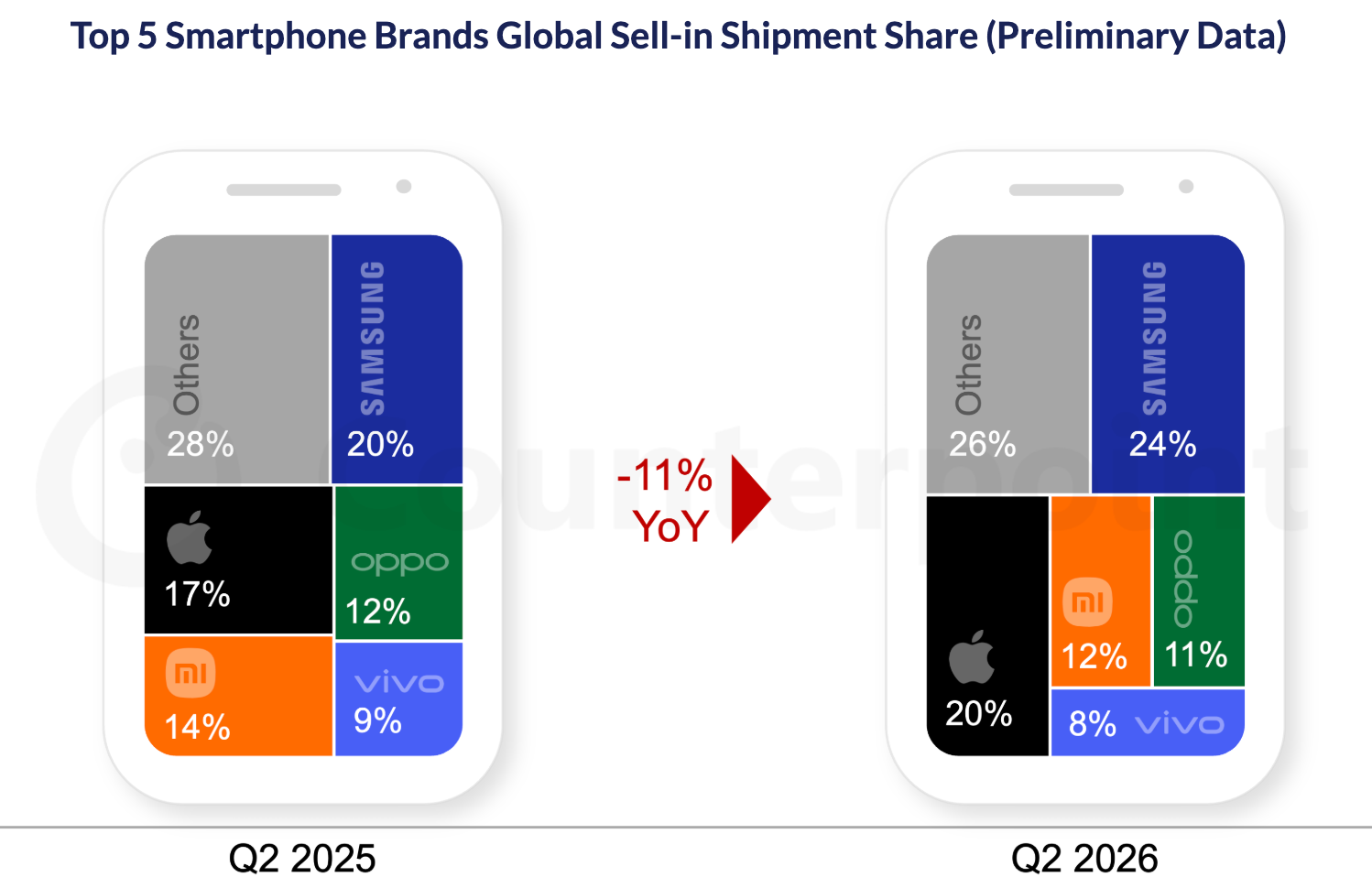
Global smartphone shipments fell 11% YoY in Q2 2026, reaching the lowest second-quarter level since 2013, as memory shortages pushed up component costs and handset prices, worsening already fragile consumer demand. SK Hynix CEO warns of an even worse crunch in 2027, and Micron’s latest quarterly revenue was more than four times its year-earlier level.

From here, being right about the shortage is not enough. The shortage has to keep getting better for suppliers, and worse for everyone else, faster than the market expects.

Peak acceleration does not mean the shortage is over. It means prices, earnings revisions, or stock gains may stop improving at the same pace.

But the peak question is harder than it looks. In fact, Samsung recently forecast a 19-fold increase in quarterly operating profit and still watched its stock fall 6.9%, as investors worried that the results were already priced in and AI infrastructure spending could slow.

My read is that the fundamental cycle still has room to run. The stock-market cycle is much further along.

Where do you think the memory-chip cycle is right now?

Still early in the boom
61.62%
Near peak acceleration, but not peak earnings
21.66%
Close to the fundamental peak
10.09%
Stocks have already peaked
6.63%
1,011 Polls

So, is this the peak?

There are really three peaks to think about: the physical shortage, memory-company earnings and the stocks themselves. Supply can remain tight while earnings growth decelerates, and earnings can keep rising after the shares have pumped.

My take is that memory pricing probably has further to run. Earnings may, too. But the stock-market cycle has entered a much less forgiving phase because the boom is increasingly being driven by price rather than by companies shipping dramatically more chips.

AI has turned memory into the bottleneck

GPUs do the heavy lifting, but memory keeps those processors fed with data. Without enough bandwidth and capacity, a state-of-the-art accelerator becomes a very expensive piece of hardware waiting around for information. This makes high-bandwidth memory, or HBM, one of the key choke points in the AI supply chain.

AI inference, which is the everyday work of answering prompts, running agents and generating content, requires large amounts of memory to store context and keep data close to processors. TrendForce now expects the global memory market to exceed $1.28 trillion in 2027, up about 44% year over year, with DRAM and NAND also projected to keep expanding rapidly.

Additionally, HBM uses more manufacturing resources than ordinary DRAM. When suppliers dedicate more capacity to the high-margin AI market, less is left for PCs, smartphones and traditional servers. The AI boom is squeezing the rest of the memory aisle at the same time.

Because of this, the cycle may have more legs than a typical gadget upgrade. Suppliers are reportedly meeting only around 75% to 80% of current DRAM demand; fulfilment is expected to deteriorate further in 2027.

New fab ≠ new factory tomorrow

Micron expects first wafer output from its initial Idaho fab in mid-2027 and from the second in late 2028. Additional HBM packaging capacity in Singapore is expected to begin contributing meaningfully during the first half of 2027. The industry is responding, but dollars turn into cleanrooms long before cleanrooms turn into sellable bits.

There is, however, a less obvious supply threat: China. CXMT was already the world’s fourth-largest DRAM producer in 2025, with roughly 7.7% market share, and its first-quarter 2026 revenue rose 719% from a year earlier. That makes CXMT more of a conventional DRAM pressure valve than an immediate HBM-cycle breaker.

The shortage is starting to eat its own tail

A shortage is wonderful for suppliers until their customers start cutting purchases, downgrading products or delaying launches.

We are already seeing this in consumer hardware. Global smartphone shipments fell 11% in the second quarter, reaching their lowest second-quarter level since 2013, as higher memory costs pushed up handset prices and hurt demand. PC and smartphone buyers are reaching their affordability limits, while some server customers are switching from 96GB and 128GB memory modules toward cheaper 32GB and 64GB configurations.

Source: Counterpoint Research’s preliminary Market Monitor report (based on sell-in)

This is the bill coming due.

The market is beginning to ration memory through price. The weakest buyers get pushed out first, freeing supply for customers with deeper pockets. This can prolong the shortage, but it also narrows the growth engine.

Eventually, suppliers become more dependent on a relatively small group of hyperscalers continuing to spend at an extraordinary pace.

JPMorgan estimates memory could represent more than 70% of cloud providers’ AI capital spending next year. If AI services generate enough revenue to justify that bill, the boom keeps rolling. If monetization lags, memory orders will be one of the first places investors look for excess.

A second risk is efficiency: if inference software, model architecture or memory-pooling systems reduce memory intensity faster than expected, today’s shortage could ease without a major supply wave.

The stock cycle is less forgiving

The bigger near-term risk may simply be that the numbers are becoming impossible to beat. Samsung recently delivered eye-watering results and was still met with a selloff. This is often what late-stage momentum looks like: a company can report record revenue, record margins and a bullish outlook, and still disappoint if investors had penciled in something even better.

But the evidence says the fundamental peak is probably still ahead. Supply remains tight, AI is increasing memory intensity, contract prices are still rising and major new capacity will not arrive quickly.

Still, the upside from here is likely to be harder won.

The next leg depends less on proving that AI needs memory and more on proving that suppliers can keep raising prices without killing demand, that cloud spending can absorb the costs, and that margins can remain extraordinary while new capacity is built.

What is the biggest risk to the memory-chip rally?

AI spending slows
26.24%
High prices destroy demand
51.97%
New supply arrives faster than expected
16.30%
Expectations are simply too high
5.49%
583 Polls

Sources

Counterpoint: Q2 2026 Global Smartphone Shipments Slump to Lowest Q2 Level in 13 Years as Memory Crisis Deepens

GuruFocus: Micron Revenue More Than Quadrupled. The Forecast Was Even Better

Micron: Financial results

Reuters: Explainer: What is CXMT and how did it become China's DRAM champion?

Reuters: Samsung flags 19-fold jump in profit, but shares slump on jitters AI boom may stall

Reuters: SK Hynix CEO sees worst memory shortage in 2027, demand to outstrip supply beyond 2030

TechTimes: AI Memory Crunch Locks In SK Hynix Lead as $713B Plan Weathers Historic Swing

TrendForce: Agentic AI Drives Structural Expansion in Memory Demand, Global Memory Market Projected to Reach US$1.28 Trillion by 2027, Says TrendForce

Embodied AI - 300 plus AI products set to make their global debuts at WAIC 2026 with strong focus on practical applications
News
Embodied AITechnologyAI Infrastructure

Embodied AI - 300 plus AI products set to make their global debuts at WAIC 2026 with strong focus on practical applications

In Shanghai, July 16, 2026, the final countdown to one of the world's largest artificial intelligence (AI) events has entered its last stage.

TechEconomics & Finance

BEIJING, July 16, 2026 /PRNewswire/ – In Shanghai, the final countdown to one of the world's largest artificial intelligence (AI) events has entered its last stage. Inside the exhibition halls, interactive screens are being tested, robotic arms are undergoing repeated adjustments, and engineers are making final preparations before thousands of AI products meet global visitors, the Global Times observed while walking through the exhibition halls on Thursday. 

Will Humanoid company Unitree be listed on stock exchange by the end of 3Q2026?

Yes
65.02%
No
34.98%
832 Polls

The 2026 World AI Conference (WAIC) & High-Level Meeting on Global AI Governance will offer visitors a vivid glimpse into how AI is evolving - from being perceived as cold industrial machinery to becoming intelligent companions that are increasingly integrated into work, daily life and entertainment.

Under the theme of "Intelligent Partners, Co-create the Future," the most prominent feature of this year's conference is its strong focus on practical applications, the exhibition's organizer told the Global Times on Thursday.

Twenty-nine countries on Thursday signed an agreement in Shanghai on establishing the World Artificial Intelligence Cooperation Organization (WAICO), the Xinhua News Agency reported. 

The WAICO will be an independent intergovernmental international organization headquartered in Shanghai, according to the agreement.

The organization will uphold the purposes of the UN Charter, be committed to extensive consultation and joint contribution for shared benefit and adhere to a people-centered approach, according to the agreement. It aims to promote international cooperation and global governance on AI, ensuring that AI is beneficial, safe and fair, thereby promoting its healthy and orderly development to benefit all humanity, Xinhua said.

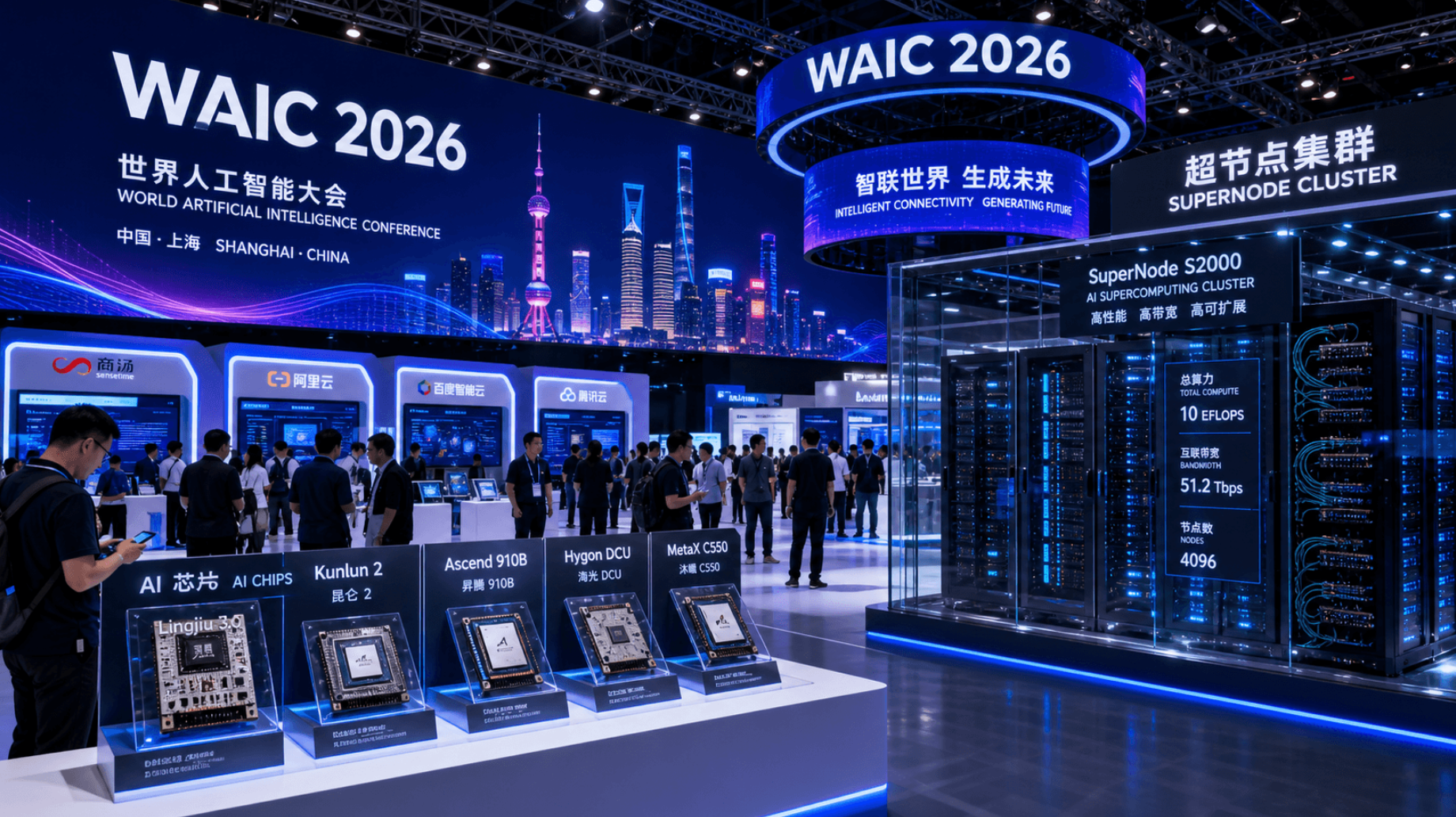
Set to open on Friday in Shanghai, WAIC 2026 is bringing together more than 1,100 companies and over 3,000 exhibits, with more than 300 AI products making their global debuts, the latest official data showed.

Visitors will not only get a close look at the latest AI breakthroughs, but also see how these technologies are being applied in real-world scenarios spanning manufacturing, healthcare, education and elderly care, the organizer said.

Hundreds of application-driven exhibits will highlight a broader transformation: AI is becoming a new type of productive force, injecting fresh momentum into industries across the board.

Global debuts closer to daily life

Ahead of the conference, some Chinese advanced intelligent manufacturing companies exclusively shared with the Global Times details of cutting-edge AI products that are set to make their public debuts at the event.

The rapid improvement in humanoid robots' dexterity will be showcased through several products.

At the conference, AGILINK will debut and showcase its OmniHand 3 Ultra-M dexterous hand, and the visitors will see a bimanual balloon-dog folding demonstration, which represents the world's only publicly showcased demonstration of such a function, the company told the Global Times on Thursday in a statement. 

The OmniHand 3 Ultra-M is designed to match the size of a human hand, featuring 20 degrees of freedom, visual-tactile sensors integrated into the fingertips of all five fingers, and distributed three-dimensional tactile sensing points across the palm. These features enable the dexterous hand to perform highly precise manipulation tasks. 

Also, Agibot, together with JD Logistics, has jointly developed a new-generation safety-certified heavy-duty embodied intelligent robot, Genie G2 Max, Agibot said in a statement to the Global Times on Thursday. 

The robot features an 18-kilogram payload capacity for a single arm and a standard 38-kilogram payload capacity for dual arms, with a peak payload of 50 kilograms, making it one of the industry's strongest in terms of load capacity, the company said. It can also perform sub-millimeter-level precision operations and supports autonomous charging and battery swapping, enabling uninterrupted 24/7 operations.

Meanwhile, SenseMart Go, an AI retail solution developed by SenseTime, will showcase its new embodied intelligent robotic store, where humanoid robots flexibly and efficiently handle retail operations, SenseTime said in a statement to the Global Times.

Visitors can scan a QR code to experience the complete shopping process, with in-store robots capable of independently picking and placing products, organizing shelves, conducting inventory checks, and handling basic exceptions, according to the statement.

Beyond embodied intelligence, WAIC 2026 will also showcase breakthroughs in AI models and computing infrastructure that support broader applications.

During the exhibition, MiniMax will showcase its next-generation native multimodal flagship model, M3. Supporting up to 1 million tokens of context, the model is built on MiniMax's proprietary MSA (MiniMax Sparse Attention) architecture, delivering enhanced performance in long-context processing, Coding, and Agentic tasks. 

A Chinese brain-computer interface company BrainCo will officially launch what the company describes as the world's first integrated, graphical, one-stop AI research platform for brain-controlled robotics research and development - the BrainCo Brain-Controlled Robot Training Platform - during the exhibition, the company said in a statement to the Global Times on Thursday.

With the platform, developers without prior BCI expertise can enable "mind-controlled" robot operations within just 10 minutes.

In addition, the Securities Times reported that Huawei's Atlas 950, the industry's largest commercial supernode, will make its debut at the conference. The system features a minimum configuration of 64 cards per cabinet and can scale up to 8,192 NPUs, specifically designed for training and inference of trillion-parameter AI models.

From breakthroughs to applications

The breakthroughs showcased at WAIC 2026 are not limited to technological advances, with some cutting-edge innovations already being integrated into industrial chains and transforming daily manufacturing.

Notably, the Global Times has learned that the exhibition has built a humanoid robot manufacturing workshop, featuring a fully automated new energy vehicle production line operating in real time. 

Covering five major processes - from battery module assembly to interior speaker installation - the production line replicates a real new energy vehicle manufacturing process. Each operational scenario corresponds to real-world industrial applications, offering visitors a firsthand look at how AI is reshaping industrial manufacturing, the organizers told the Global Times on Thursday.

For example, visitors will see intelligent robots perform tasks such as picking, screw fastening, power connection, and fully automated assembly and lighting tests for vehicle lamps, demonstrating highly precise and efficient operations, according to the organizers.

The booming AI ecosystem showcased at WAIC 2026 reflects China's sustained efforts to strengthen technological innovation and develop new quality productive forces, Chinese experts said.

As China's 15th Five-Year Plan period (2026-30) begins, AI has been identified as one of the key emerging technologies driving industrial upgrading and future economic growth. This year's top policies have emphasized accelerating the integration of AI with manufacturing, services and scientific research.

Such applications reflect a broader push to accelerate the commercialization of AI through policy support, industrial capacity and market demand.

As AI rapidly moves from laboratories to solve problems in factories, hospitals and supply chains, Chinese policymakers have set their sights high, anticipating the rise of a "smart economy." 

China's 2026 Government Work Report also supports the creation of new forms of the smart economy: "We will advance and expand the AI Plus Initiative. We will promote faster application of new-generation intelligent terminals and AI agents and encourage large-scale commercial application of AI in key sectors and fields, so as to foster new forms and models of AI-native business. We will support the development of open-source AI communities and build a vibrant open-source ecosystem." 

The global AI industry is moving beyond a phase of rapid technological breakthroughs and entering a new stage where deep applications and global governance advance in parallel, Chen Jing, vice president of the Technology and Strategy Research Institute, told the Global Times on Thursday.

In the past, AI was often measured by its technological capabilities. Today, both industries and society are placing greater emphasis on its ability to deliver practical services. This is a shift from a technology-driven approach toward a more human-centered one, Chen said.

"China's experience shows that AI can achieve greater value by integrating with the real economy, leveraging extensive manufacturing capabilities and diverse application scenarios to create a positive cycle between technology development and practical needs. With policy support and market-driven innovation working together, AI is moving from laboratories into factories, homes and cities. The future of AI will be defined not by computing power or model parameters alone, but by its ability to solve real-world problems," he added.

Source:

Yahoo Finance, July 17, 2026; https://sg.finance.yahoo.com/news/global-times-300-plus-ai-013400308.html