After last week’s wipeout in chips and the broader selloff in technology stocks, pressure is building for the biggest spenders on artificial intelligence to justify their expenditures to beleaguered traders with increasingly itchy fingers hovering over their sell buttons.
The AI euphoria that drove the stock market to all-time highs just a month ago is clearly waning. Information technology was the worst performing group in the S&P 500 Index last week, which slid 1.6% while the tech-heavy Nasdaq 100 Index lost 4.1%. Chip stocks were the main culprit, with the Philadelphia Stock Exchange Semiconductor Index sinking 10% for its worst week since April 2025.
The losses extended to Asia, where Japanese memory chipmaker Kioxia fell 16 per cent on last Friday. The Nikkei 225 index declined 5 per cent. Markets in South Korea, which have faced the most volatility from the AI trade, were closed.
Will semiconductor stocks recover from their recent sell-off before the end of 2026?
The tech sell-off is the latest sign of how investors are questioning the lofty valuations assigned to companies at the centre of the AI boom. It also shows how some traders have begun unwinding leveraged bets that are magnified by using substantial amounts of debt.
“The investor deleveraging phase that started in June appears to be still ongoing and we see more room for deleveraging in leveraged equity ETFs, options and margin accounts, thus acting as a headwind for equities going forward,” said Nikolaos Panigirtzoglou, a strategist at JPMorgan.
Investors with one eye on cheap Chinese alternatives to groups such as Anthropic and OpenAI are also growing increasingly nervous about when data centre spending by US tech groups will generate returns. Chinese AI start-up Moonshot late on Thursday released a large language model with capabilities approaching those of US AI labs.
 The Financial Times
Sentiment is bleaker among the megacaps.Alphabet shares fell 6.5% over the past two sessions as the company is reportedly months behind schedule on delivering Gemini 3.5 Pro, its most powerful flagship AI model. While the stock remains up 11% this year, it has fallen 14% from a May peak.
Microsoft is coming off of its worst month since 2000 and has lost 19% this year. Meta Platforms is down slightly in 2026 despite a July rebound amid optimism about efforts to potentially rent computing capacity. Amazon has climbed 7.1% for the year and Nvidia has gained 8.8%, both underperforming the Nasdaq 100.
Indeed, valuations for tech giants have come down across the board. The Bloomberg Magnificent 7 Index is priced at 24 times profits expected over the next 12 months, down from 33 in October and 29 to start the year. The Nasdaq 100 trades at 22 times.
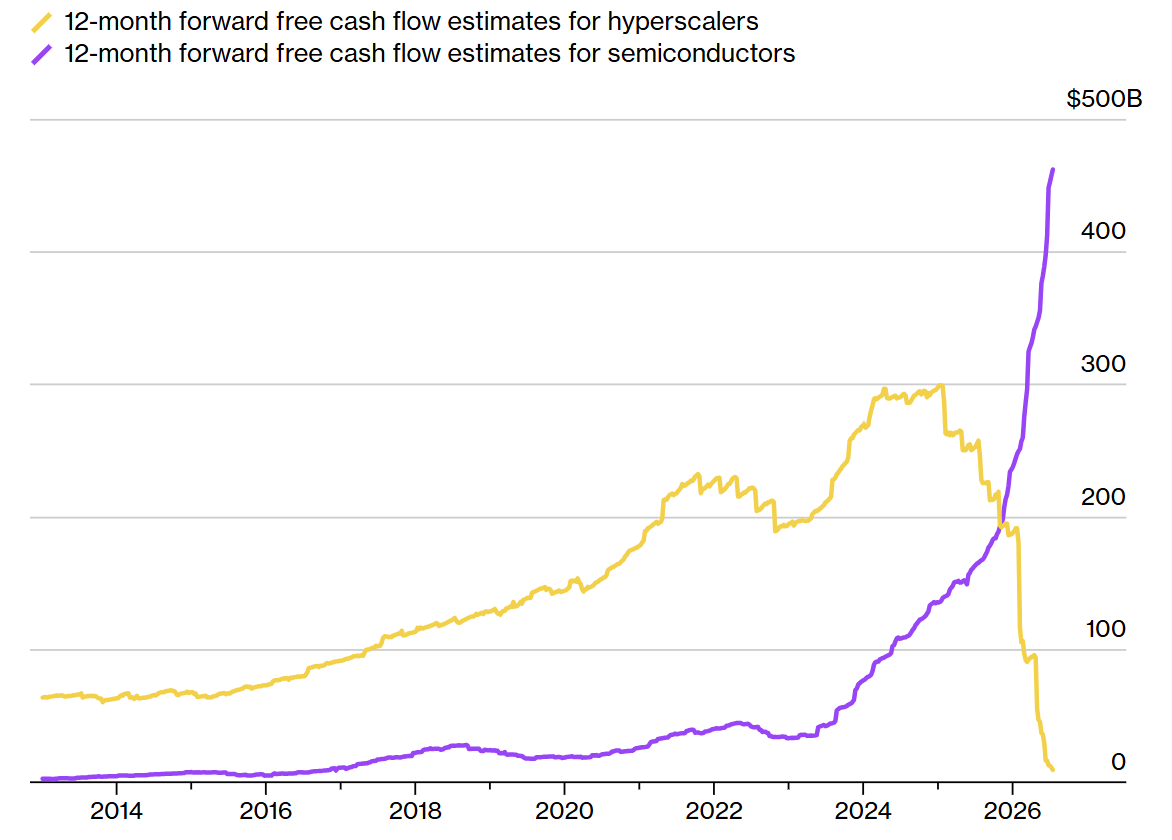
That has shifted the risk to other areas of the stock market that have seen massive run ups, like chipmakers, according to Ahlsten, whose firm has $45 billion in assets under management.
The Philadelphia semiconductor index, or SOX, has soared this year because much of the spending on AI infrastructure is flowing to its constituents. But it has tumbled 20% since hitting a record last month, reaching the technical threshold for a bear market, and volatility has soared. In the past four weeks, the index has seen moves of more than 2% in all but two sessions.
Even positive signals from earnings reports have failed to halt the SOX’s slide. Taiwan Semiconductor Manufacturing Co. and ASML Holding NV both raised revenue forecasts for the year. Meanwhile, results from International Business Machines Corp. showed that customers are prioritizing spending on servers and semiconductors over mainframes and software.
“I’d be more careful going into this period on account of these issues,” Ahlsten said. “Some of the stocks, especially on the infrastructure side, look a bit toppy, potentially. They’ve gotten a high multiple for accelerating growth that may not ultimately be as accelerated as some people were thinking.”
In a sign of how wary investors are of heavy spending on AI, Apple, which has avoided big capital expenditures in favor of partnering with model providers to power its AI services, is by far the best performer among the Magnificent Seven this year with a 23% gain.
https://www.ft.com/content/c92a5a36-55a0-4d04-b84c-d1705976987b?syn-25a6b1a6=1