Global smartphone shipments fell 11% YoY in Q2 2026, reaching the lowest second-quarter level since 2013, as memory shortages pushed up component costs and handset prices, worsening already fragile consumer demand. SK Hynix CEO warns of an even worse crunch in 2027, and Micron’s latest quarterly revenue was more than four times its year-earlier level.
From here, being right about the shortage is not enough. The shortage has to keep getting better for suppliers, and worse for everyone else, faster than the market expects.
Peak acceleration does not mean the shortage is over. It means prices, earnings revisions, or stock gains may stop improving at the same pace.
But the peak question is harder than it looks. In fact, Samsung recently forecast a 19-fold increase in quarterly operating profit and still watched its stock fall 6.9%, as investors worried that the results were already priced in and AI infrastructure spending could slow.
My read is that the fundamental cycle still has room to run. The stock-market cycle is much further along.
Where do you think the memory-chip cycle is right now?
So, is this the peak?
There are really three peaks to think about: the physical shortage, memory-company earnings and the stocks themselves. Supply can remain tight while earnings growth decelerates, and earnings can keep rising after the shares have pumped.
My take is that memory pricing probably has further to run. Earnings may, too. But the stock-market cycle has entered a much less forgiving phase because the boom is increasingly being driven by price rather than by companies shipping dramatically more chips.
AI has turned memory into the bottleneck
GPUs do the heavy lifting, but memory keeps those processors fed with data. Without enough bandwidth and capacity, a state-of-the-art accelerator becomes a very expensive piece of hardware waiting around for information. This makes high-bandwidth memory, or HBM, one of the key choke points in the AI supply chain.
AI inference, which is the everyday work of answering prompts, running agents and generating content, requires large amounts of memory to store context and keep data close to processors. TrendForce now expects the global memory market to exceed $1.28 trillion in 2027, up about 44% year over year, with DRAM and NAND also projected to keep expanding rapidly.
Additionally, HBM uses more manufacturing resources than ordinary DRAM. When suppliers dedicate more capacity to the high-margin AI market, less is left for PCs, smartphones and traditional servers. The AI boom is squeezing the rest of the memory aisle at the same time.
Because of this, the cycle may have more legs than a typical gadget upgrade. Suppliers are reportedly meeting only around 75% to 80% of current DRAM demand; fulfilment is expected to deteriorate further in 2027.
New fab ≠ new factory tomorrow
Micron expects first wafer output from its initial Idaho fab in mid-2027 and from the second in late 2028. Additional HBM packaging capacity in Singapore is expected to begin contributing meaningfully during the first half of 2027. The industry is responding, but dollars turn into cleanrooms long before cleanrooms turn into sellable bits.
There is, however, a less obvious supply threat: China. CXMT was already the world’s fourth-largest DRAM producer in 2025, with roughly 7.7% market share, and its first-quarter 2026 revenue rose 719% from a year earlier. That makes CXMT more of a conventional DRAM pressure valve than an immediate HBM-cycle breaker.
The shortage is starting to eat its own tail
A shortage is wonderful for suppliers until their customers start cutting purchases, downgrading products or delaying launches.
We are already seeing this in consumer hardware. Global smartphone shipments fell 11% in the second quarter, reaching their lowest second-quarter level since 2013, as higher memory costs pushed up handset prices and hurt demand. PC and smartphone buyers are reaching their affordability limits, while some server customers are switching from 96GB and 128GB memory modules toward cheaper 32GB and 64GB configurations.
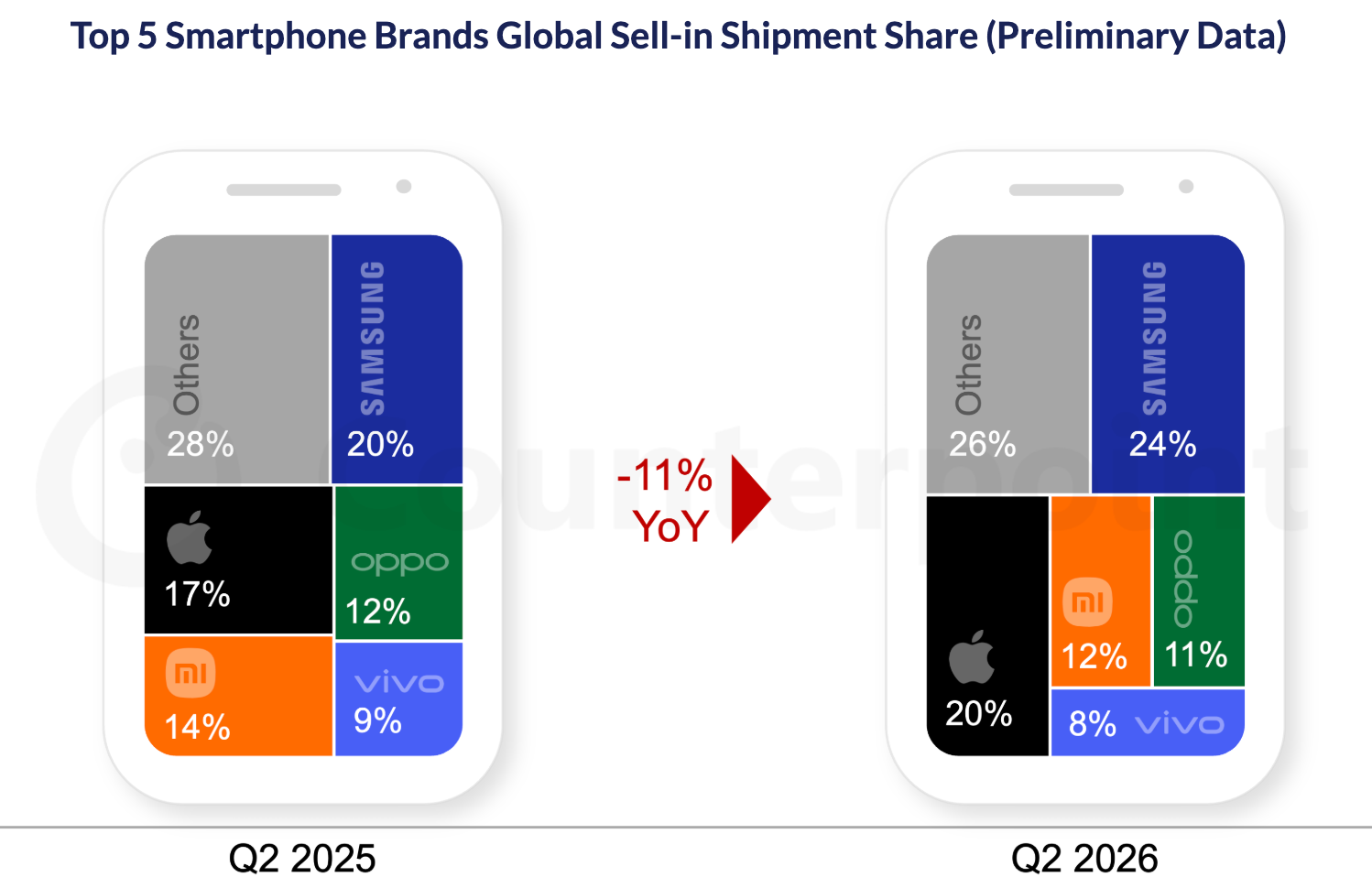
This is the bill coming due.
The market is beginning to ration memory through price. The weakest buyers get pushed out first, freeing supply for customers with deeper pockets. This can prolong the shortage, but it also narrows the growth engine.
Eventually, suppliers become more dependent on a relatively small group of hyperscalers continuing to spend at an extraordinary pace.
JPMorgan estimates memory could represent more than 70% of cloud providers’ AI capital spending next year. If AI services generate enough revenue to justify that bill, the boom keeps rolling. If monetization lags, memory orders will be one of the first places investors look for excess.
A second risk is efficiency: if inference software, model architecture or memory-pooling systems reduce memory intensity faster than expected, today’s shortage could ease without a major supply wave.
The stock cycle is less forgiving
The bigger near-term risk may simply be that the numbers are becoming impossible to beat. Samsung recently delivered eye-watering results and was still met with a selloff. This is often what late-stage momentum looks like: a company can report record revenue, record margins and a bullish outlook, and still disappoint if investors had penciled in something even better.
But the evidence says the fundamental peak is probably still ahead. Supply remains tight, AI is increasing memory intensity, contract prices are still rising and major new capacity will not arrive quickly.
Still, the upside from here is likely to be harder won.
The next leg depends less on proving that AI needs memory and more on proving that suppliers can keep raising prices without killing demand, that cloud spending can absorb the costs, and that margins can remain extraordinary while new capacity is built.
What is the biggest risk to the memory-chip rally?
Sources
Counterpoint: Q2 2026 Global Smartphone Shipments Slump to Lowest Q2 Level in 13 Years as Memory Crisis Deepens
GuruFocus: Micron Revenue More Than Quadrupled. The Forecast Was Even Better
Micron: Financial results
Reuters: Explainer: What is CXMT and how did it become China's DRAM champion?
Reuters: Samsung flags 19-fold jump in profit, but shares slump on jitters AI boom may stall
Reuters: SK Hynix CEO sees worst memory shortage in 2027, demand to outstrip supply beyond 2030
TechTimes: AI Memory Crunch Locks In SK Hynix Lead as $713B Plan Weathers Historic Swing
TrendForce: Agentic AI Drives Structural Expansion in Memory Demand, Global Memory Market Projected to Reach US$1.28 Trillion by 2027, Says TrendForce