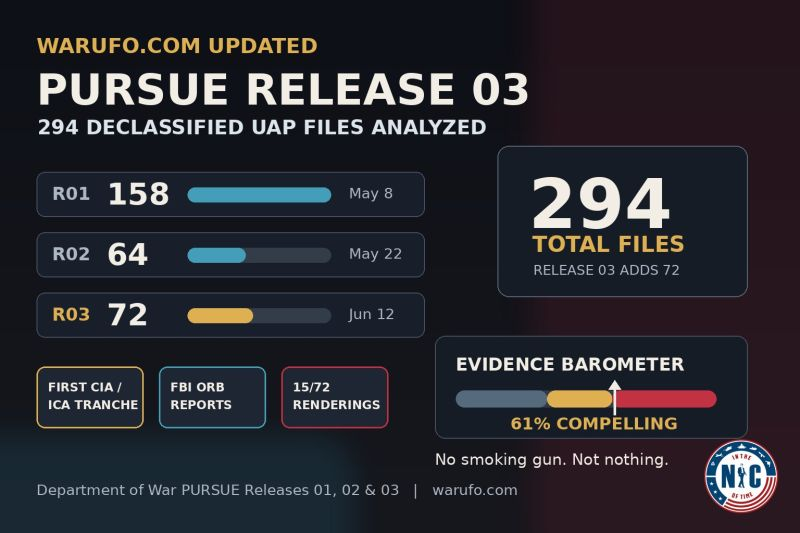
The year 2026 has been perhaps the most transparent year in the history of the US government’s willingness to talk about the unexplained. Since May 8, the Pentagon has been declassifying records through PURSUE, the Presidential Unsealing and Reporting System for UAP Encounters. PURSUE is a product of a February order from President Donald Trump, who directed agencies to find and release everything linked to UFOs, UAP and extraterrestrial life.
The first tranche of the order included around 160 files and loads of videos, dating back from 1944, a year before the conclusion of the Second World War.
Naturally, there is hope that we could be getting close to the US government finally admitting about the existence of extraterrestrial lifeforms and associated technology - thus answering the question of whether we're alone for good.
Prediction markets are already running contracts on whether that admission will come this year — a bet on what would be one of the most consequential announcements in human history.
Putting a Price on Aliens
It's a question that now trades as a live contract on Polymarket, where volume has climbed to nearly $50 million. But the condition is demanding: the market resolves to 'Yes' only if Trump, a cabinet member, a member of the Joint Chiefs of Staff, or any US federal agency confirms that extraterrestrial life or technology exists before year's end.
On June 12, the Department of War published the third release of declassified and historical UAP files as part of the PURSUE move, thus reinforcing hope that at some point this year, the government might admit to the existence of aliens and alien tech.
And this is the angle worth looking into. The alien market isn't really betting on whether extraterrestrials exist — it's betting on whether the US bureaucracy will drop its cloak-and-dagger secrecy and say so on the record.
Look closely at the contract and you see what it actually demands. Not a file, not a video, not a transcript of an astronaut recounting strange lights — but an official statement. Which is precisely the one thing the entire disclosure apparatus seems built never to produce.
Government Disclaimer to Avoid Official Admission
On top of that, every PURSUE document is stamped with a disclaimer telling readers not to treat it as an analytical judgment or a factual determination. And while AARO exists to adjudicate these cases, it keeps filing them in the 'unresolved' column — its own reporting points to a lack of data that would indicate the recovery or reverse-engineering of any UAP.
The irony is that transparency actually lowers the odds of a contract like this resolving 'Yes.' Each case logged as unresolved nudges the story away from 'they're hiding something' and toward a pile of low-context files no one can draw a conclusion from.
This is the distinction that matters: disclosure and confirmation are two separate events, and the market has been pricing the gap between them in real time. It's also why the 'when' in the market's headline isn't really a date — it's a condition. Confirmation arrives only if an official steps past that disclaimer and says the words out loud: forced by a congressional subpoena, delivered under sworn testimony, or issued when AARO finally attributes one of its uncharacterized cases to something non-human.
Reviving A Critical Act
Witness testimony could move the market, too. David Grusch, a former intelligence official, told the House Oversight Committee in 2023 that the US runs a program to retrieve and reverse-engineer craft of non-human origin, and that the government holds nonhuman biological material. Grusch conceded, however, that he had never personally seen any of it and was relying on accounts from credible sources — which may not clear the bar this market sets.
A more bipartisan development worth watching is Senator Mike Rounds' pledge to revive the UAP Disclosure Act, which would include protections for whistleblowers.
SIGN UP FOR NEWSLETTER
Exploring the Russia-China Connection
The market could also be mispricing one path. The contract is built around an official confirmation of extraterrestrial life or technology, but it says nothing about the form such a statement might take — and the form is everything. If anomalous hardware were ever attributed to Russia or China, or unveiled as reverse-engineered American craft flaunted as a deterrent, the government could acknowledge something extraordinary while carefully never using the word 'extraterrestrial.' The confirmation, in other words, might arrive wrapped in threat rather than wonder — and slip right past the condition this market is waiting on.
Closing
Even the most casual brush with confirmation gets pulled back fast. Asked point-blank on a podcast this February whether aliens are real, Barack Obama said 'They're real, but I haven't seen them' — then clarified within a day that he'd seen no evidence, during his presidency, that extraterrestrials had ever made contact. A former president can muse; the on-the-record correction follows almost immediately.
Public belief, meanwhile, settled long ago. One in five Americans (21%) say they've seen something they thought was a UFO, and roughly three-quarters assume the government would hide any real evidence — the public's confirmation threshold was crossed years back. The market is really measuring the other one: the government's. And so far, every released file shows the state tiptoeing toward the line without any conviction to cross it.