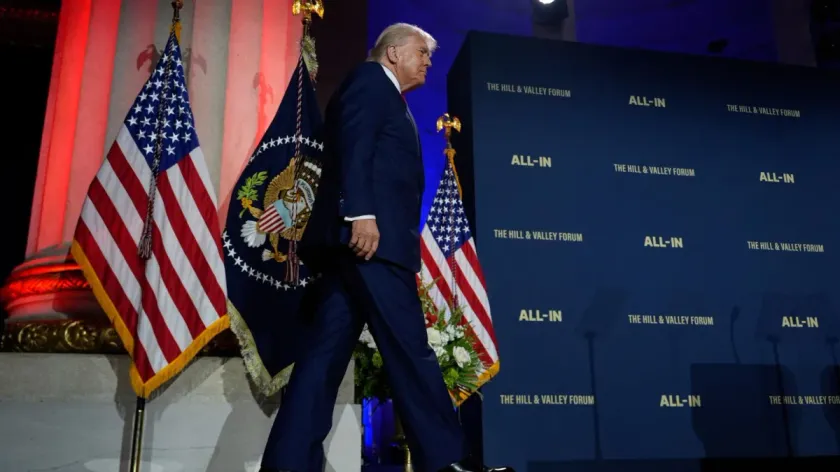
The next fight over the Federal Reserve is no longer just about inflation, jobs, or the timing of the next rate move. It is also becoming a test of how much political pressure markets believe the Fed can absorb.
Will Trump materially reshape the Fed before his current term?
Bloomberg(July 3) reported that President Donald Trump’s allies are renewing efforts to reshape the Federal Reserve, including ways to exert more pressure on the institution rather than just fire top officials in Washington. The report lands at a sensitive moment: the June employment report weakened the case for another near-term rate hike, while inflation remains high enough to keep the Fed away from a smoothly rate cutting.
 predictionmarkets
That makes the political perspective relevant to the market. Thus the rate cycle can be read in two different interpretations.
From economic angle, the Fed should wait for more data. Hiring has slowed sharply, labor-force participation has fallen, and the June payroll miss weakened the argument for another immediate hike. But inflation remains high enough to complicate any rapid turn toward easing.
From political angle, Trump has repeatedly pushed for lower interest rates, while the latest Bloomberg report suggests his allies are continuing to explore ways to reshape the institution. More recently, Trump publicly criticized the Fed board as “a little bit hostile,” underscoring that pressure on monetary policy has not disappeared under the new leadership.
The institutional problem for any president is that the Fed is not designed to be easy to control.
The Board of Governors has seven members nominated by the president and confirmed by the Senate. Governors serve staggered 14-year terms, while the chair and vice chairs serve separate four-year leadership terms.
Interest rate policy is also broader than the chair alone. The Federal Open Market Committee (FOMC) includes the members of the Board of Governors, the president of the New York Fed, and four other regional Reserve Bank presidents who vote on a rotating basis.
Regional Fed presidents add another layer of insulation. They are not directly appointed by the White House, they are selected through their respective Reserve Banks and require approval from the Board of Governors.
That means Trump’s influence is real, but constrained. A president can nominate governors when vacancies arise and select the Fed chair from among sitting governors, but the structure of the system makes a rapid takeover difficult. The policy setting process is deliberately distributed across long serving governors and regional institutions.
The Supreme Court has made that boundary even more important.
In one landmark decision, the Court expanded presidential authority to remove leaders of other federal regulatory agencies, strengthening the legal theory of a more powerful “unitary executive.” But the Court also preserved a distinct boundary around the Federal Reserve and separately refused to let Trump remove Governor Lisa Cook while her case proceeds.
So it is to hasty to say Trump controls the Fed. More suitable is that he is testing the boundaries of Fed independence.
If investors believe monetary policy remains primarily data driven, then payroll momentum, inflation, labor force participation, and upcoming CPI reports should dominate the rate cycle debate.
But if investors begin to believe political pressure can alter the Fed’s reaction function, a different risk enters the market. Traders would no longer be pricing only where inflation and unemployment are heading. They would also have to judge whether the central bank will respond to those indicators in the same way as in the past.
For now, Fed Chair Kevin Warsh is publicly pushing back against concerns over political influence. Speaking at the ECB’s central-banking forum in Sintra, Warsh said the Fed would remain independent and reaffirmed its commitment to price stability and the 2% inflation objective. He also avoided providing clear forward guidance on future rate decisions.
However, Trump continued to exert pressure in public. After the June jobs report, he described the Fed board as “a little bit hostile” and said Warsh “has to do what he has to do” on interest rates.
What will matter more for the Fed’s next major rate move?
According to all of these, there are two competing explanations for the next move in rates.
The first is the economic explanation: softer payrolls, falling labor force participation, persistent inflation, and the next CPI report will determine whether the Fed will suspend, hike, or eventually turn toward decrease.
The second is the political explanation: Trump may not need to formally control the Fed to become a market variable. Persistent pressure can affect expectations around future appointments, institutional governance, and how investors perceive the durability of central bank independence.
Is the U.S. rate cycle still being driven mainly by economic fundamentals, or is Trump’s political leverage becoming a market variable in its own right?
Source:
- Trump Allies Double Down on Efforts to Reshape Federal Reserve, July 2, 2026 https://www.bloomberg.com/news/articles/2026-07-02/trump-allies-double-down-on-efforts-to-reshape-federal-reserve?srnd=homepage-asia
- US job growth slows sharply in June; labor force participation rate at more than 5-year low, July 2, 2026 https://www.reuters.com/world/us/us-job-growth-misses-expectations-june-unemployment-rate-falls-42-2026-07-02/
- Supreme Court strengthens Trump's hold on key levers of government power, June 30, 2026 https://www.reuters.com/legal/government/supreme-court-strengthens-trumps-hold-key-levers-government-power-2026-06-30/
- Trump blasts ‘hostile’ Fed and says Warsh ‘has to do what he has to do’ on interest rates, July 2, 2026 https://www.marketwatch.com/story/trump-blasts-hostile-fed-and-says-warsh-has-to-do-what-he-has-to-do-on-interest-rates-60b5d16b
- Federal Reserve Chair Warsh emphasizes political independence, signals focus on inflation, July 1, 2026 https://apnews.com/article/warsh-federal-reserve-inflation-interest-rate-18c005515444abd2043ad113c9849407