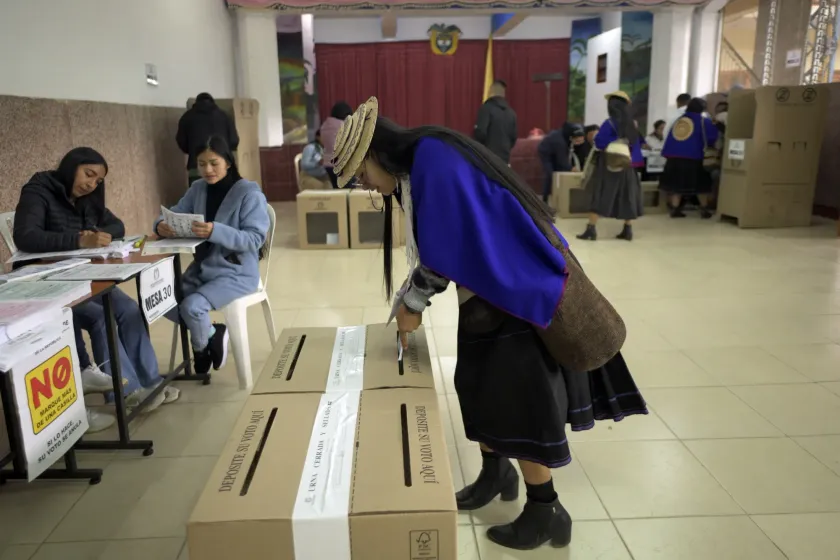
Colombia’s primary elections left political junkies in ecstasy and economists uneasy.
The better-than-expected performance of center-right senator Paloma Valencia has effectively turned the May 31 presidential vote into a three-way race, with leftist Iván Cepeda and hardliner Abelardo de la Espriella also vying for the two spots in an eventual runoff. Valencia’s emergence adds spark to a contest that now looks wide open: the successor to Gustavo Petro could be one of his close ideological allies, a protégé of his nemesis former president Álvaro Uribe or a cartoonish outsider with no experience in office. For any Nordic political scientist fascinated by complex electoral dynamics, this is irresistible; it guarantees a gripping campaign through the likely June 21 second round.
At the same time, Colombia’s fractured politics, reflected in a new congress where no party holds more than a quarter of either chamber, suggest that no matter the ideological leaning of the next government, it will have to build consensus if it hopes to pass legislation and implement reforms. That should worry investors and policymakers, because Colombia faces a looming fiscal crisis that so far no candidate has been willing to address. With meaningful budget cuts largely absent from a campaign focused on insecurity, corruption and health care, the next president won’t arrive in office with a popular mandate to impose the austerity that the Andean nation may soon require.
The numbers are grim: Colombia ended 2025 with a primary deficit of 3.5% of GDP, the largest budget gap in three decades outside periods of crisis. Once interest payments are included, the deficit rises to 6.4% of GDP; it could have surpassed 8% were it not for debt-management maneuvering by the Petro administration. CARF, the country’s fiscal watchdog, has estimated that returning to compliance with Colombia’s debt rule — suspended by Petro last year as he sought to free himself from spending constraints — will require a fiscal adjustment of 4.5% of GDP through 2028. That means the next government will have to spend substantial political capital sustaining a credible budget-tightening of more than one percentage point of GDP per year. The alternative is flirting with an investor confidence crisis.
Already trading at higher sovereign spreads than regional peers such as Chile, Peru, Mexico or even Brazil, Colombia’s five-year credit default swaps hit a 10-month high of 241 basis points on March 6, right before the primary, but eased slightly as investors cheered the election results.
While the finance ministry said last week it aims to reduce the deficit to 5.1% of GDP in 2026 through lower spending and debt service costs, it offered little detail on how it would achieve such an ambitious goal. The notion that the spendthrift Petro might deliver a sharp fiscal contraction during his final five months in office also defies credulity. He appears, instead, to be passing the problem to whoever comes next.
True, Colombia’s fiscal problems didn’t start with its flamboyant and garrulous president. The country has run structurally higher deficits since the pandemic and lost its investment-grade status in 2021 under former president Iván Duque. But Petro has made matters worse, accelerating spending amid persistent inflationary pressures. His administration relied on optimistic revenue projections, underestimated spending pressures and adopted questionable policies, including raising the minimum wage far above inflation and trying to undermine the central bank’s inflation-fighting credibility. The decision in October to cancel the two-year flexible credit line approved by the International Monetary Fund removed an additional financial safeguard.
To be sure, the possibility of a centrist or right-wing victory increases the odds of more orthodox economic policies, helping to explain why investors cheered on the primary’s results. But that shift toward pro-market policy still looks like a leap of faith. According to Polymarket, Cepeda continues to lead the odds of winning the election with 43%. And even if a pro-business government is inaugurated, it’s politically treacherous for any president in Colombia, limited to a single four-year term with no reelection, to devote a large share of the mandate to delivering austerity.
There was a time when Colombia’s fiscal rectitude was a matter of national pride. Unlike most of its neighbors, it has not defaulted on its sovereign debt in nearly a century. Preserving that impressive record will now fall to the next president, who may soon discover that fixing Colombia’s finances is far harder than winning ultra-competitive elections.
Source: https://www.bloomberg.com/opinion/articles/2026-03-16/colombia-s-real-threat-is-not-political