A top Wall Street regulator is considering changes to a weekly report covering the position of traders just as prediction market exchanges and offshore venues start to offer more contracts in the oldest corner of the derivatives market.
The Commodity Futures Trading Commission is asking for public input on its Commitments of Traders reports, which is widely relied on by hedge funds and other traders to help craft their strategies.
“After significant outreach and communication with the agricultural community and commercial end users, the Commission is examining the current structure and publication of our COT Reports,” CFTC Chairman Michael Selig said in a statement Thursday.
That review comes after Kalshi Inc., a leading prediction markets platform, announced in mid-April the exchange would be offering a new commodities trading hub. But unlike industry stalwarts like CME Group Inc. and Intercontinental Exchange Inc. that support trading of grain, energy and numerous other derivatives, prediction markets don’t have to furnish information that is compiled into COT reports.
Kalshi agreed to limit its trading hours on new financial contracts tied to crops like corn to the same hours as traditional exchanges, Bloomberg reported earlier Thursday, following agriculture industry concerns about the products.
The CFTC said Thursday it is considering whether the one-of-a-kind data set should be published more frequently, and if doing so would risk revealing which companies or trading firms were taking large positions in a given market.
The agency also asked whether binary options, which can include the types of contracts traded on CFTC-licensed prediction markets, should be included in the reports.
Minji absent from Copenhagen sessions as comeback preparations begin
NewJeans has begun preparations for a comeback, but without member Minji, raising questions about the group’s future lineup.
Ador confirmed Tuesday that members Hyein, Haerin and Hanni recently traveled to Copenhagen for music production. Minji, however, was not part of the trip, fueling speculation that the group could return as a trio.
The five-member group has been largely inactive following a prolonged legal dispute with its agency. In November 2024, the members notified Ador of contract termination, citing alleged breaches of management obligations. A subsequent lawsuit filed by Ador to confirm the validity of the contracts resulted in a first-instance ruling against the members, effectively halting group activities for an extended period.
In November last year, Ador confirmed the return of Hyein, Haerin and Hanni, while terminating its contract with Danielle and signaling plans to pursue legal action. Minji’s status remains unresolved, with the agency’s most recent position described only as “under discussion.”
Speculation over a comeback gained traction after Hyein and Haerin were spotted at a store in Copenhagen with staff on April 15, in footage shared by a Chinese tourist. Hanni was later also confirmed to have been in Denmark. At the time, Ador told The Korea Herald it was difficult to confirm specific schedules or whether filming was taking place.
Further rumors emerged when an alleged studio booking document surfaced online Monday, showing a Copenhagen recording studio reserved under Ador’s name from April 13 to 16. The detail drew attention, given that NewJeans is the label’s only artist.
Responding to the reports, Ador said Monday that the visit was part of “a pre-production process to build NewJeans’ new musical narrative.”
“The members are currently preparing for activities based on their individual conditions and optimized schedules. We will share official updates on their future plans at the appropriate time,” the agency added.
While Ador did not mention Minji directly, the statement appeared to leave open the possibility of her eventual participation.
Industry insiders cautioned against assuming the group will return as a trio, noting that recording can begin with partial participation and be completed later.
“Song production can start without all members present,” an industry official said. “It would actually be more unusual for Minji to suddenly appear in overseas sessions when her return has not been finalized. But the concern is that continued activity by three members could raise speculation that she may also step away, as Danielle did.”
Minji has yet to formally confirm her return more than six months after the others signaled their comeback. Some observers suggest ongoing disagreements over revised contract terms could be delaying her decision.
Another industry source added that the window for a smooth full-group return may be narrowing, making her eventual participation increasingly uncertain.
How many members will be in NewJeans' next comeback lineup?
As Demon Slayer: Kimetsu no Yaiba enters its final arc, the first installment of the Infinity Castle saga is beginning to provide a new benchmark for the franchise's commercial performance. According to data from Kogyo Tsushin and Box Office Mojo, the film continues to demonstrate strong global demand. Within 266 days of release, it drew approximately 98.5 million admissions worldwide and generated a total global box office revenue of ¥117.9 billion.
These figures suggest that the Demon Slayer IP retains a highly efficient ability to convert audience attention into commercial performance, reinforcing its position as a top-tier global franchise.
However, this performance raises a more important question: does it simply reflect the continuation of existing momentum, or does it signal an expanded ceiling for what the franchise can achieve? Will the second installment continue to surpass it?
Why It Could Surpass
On the bullish side, there are strong structural reasons to believe that the second installment could outperform the first. First, global anime consumption continues to rise. According to Netflix's anime report, more than 50 percent of its global members have watched anime, indicating that the addressable audience has expanded significantly since 2020, The summary of the 2025 Animation Industry Report also confirms this. This matters, because Demon Slayer is no longer just a domestic phenomenon — it is now a globally distributed IP with synchronized release strategies.
At the same time, Demon Slayer has consistently maintained a rating of 8.4 or higher on MyAnimeList, the Infinity Castle arc represents the narrative climax of the series. Historically, final installments tend to outperform earlier entries due to accumulated emotional investment. A comparable case can be seen in franchise films like Avengers: Endgame, where long-term narrative buildup translated into record-breaking box office performance. If audience engagement follows a similar pattern, Part 2 could benefit from stronger repeat viewing and higher conversion rates.
Distribution infrastructure and production quality further reinforces this advantage. Sony's Crunchyroll has established a comprehensive global distribution network, the studio ufotable continues to deliver industry-leading visuals, creating a cinematic experience that strongly incentivizes theater attendance. When visual spectacle becomes a core selling point, audiences are more likely to choose theaters over waiting for streaming releases.
Why It Likely Won't
Market competition has intensified with Hollywood blockbusters and multiple IP-driven releases competing for the same time slots. At the same time, the anime space itself has become more crowded, with titles like Jujutsu Kaisen and Attack on Titan capturing significant audience attention. Data from Box Office Mojo and AJA shows that while anime films have become more frequent in global markets, the gap between top-performing titles and mid-tier releases remains wide. This suggests that increased supply does not necessarily translate into proportional demand growth, and may instead dilute urgency among audiences.
There is also the issue of IP lifecycle. While Demon Slayer remains highly popular, the original manga has concluded, which places a natural cap on future narrative expansion. Meanwhile, newer IPs such as Chainsaw Man are actively capturing younger audiences, contributing to a gradual redistribution of attention. Google Trends data further indicates that while Demon Slayer maintains high baseline interest, peak search intensity has become more episodic rather than continuously rising.
From a market perspective, these opposing forces suggest that the second installment is unlikely to represent a simple linear continuation of growth. Instead, it sits within a probabilistic range shaped by both structural tailwinds and headwinds. But that doesn’t mean future releases have no chance to reach similar heights. The real question is whether the underlying conditions have fundamentally changed.
Data Sources:
[1] kogyotsushin: Top 100 All-Time Box Office Hits
Pop culture is undergoing a radical evolution. It’s shifting from a side-hustle category on betting platforms into a sophisticated engine of social data where value is being completely restructured.
From Discrete Events to Liquid Assets: The Financialization of Anne Hathaway’s 2026
As we cruise through 2026, the financialization of the "Culture" vertical has moved entirely beyond the fringe. Over on Kalshi, trading volume for Oscar nomination contracts has already cleared $3.4 million. These "Yes/No" binary contracts aren't just bets; they’re a real-time crystal ball for film critics. Simultaneously, Polymarket—leveraging its crypto-native user base—has demonstrated superior efficiency in pricing continuous variables, such as opening weekend totals and exact box office multipliers, providing a level of market depth typically reserved for traditional equities.In this landscape, Anne Hathaway’s 2026 slate represents more than a career resurgence; it is a masterclass in how a superstar's personal impact is being "assetized." Every glimmer of her career has become a rung on the ladder of her elite status, allowing the market to capture her "vibe" and turn it into a legitimate investment perspective.
The Portfolio Strategy: Analyzing the Anne Hathaway Hedge
If we look at Hathaway’s 2026 slate as an investment portfolio, we can redefine her market impact through three financial lenses: Liquidity, Expectation Gaps, and Hedging Value.To traders, she is currently balancing two highly distinct assets:
The High-Yield Prestige Asset (Mother Mary): Releasing in mid-April, this is Hathaway’s Oscar bait.() She is tasked with playing the paradox—the blinding charisma of a superstar versus the fragile, mental shattering of a woman in private. It’s the kind of "emotional wreckage" that prediction traders love to price into early awards-season contracts. Acting chops are the ultimate KPI here, driving sentiment and volatility.
The Blue-Chip Core Asset (The Devil Wears Prada 2): Arriving on May 1st, our girl Andy Sachs is no longer fetching lattes for Miranda; she’s a seasoned power player. The actress who was once "too perfect" for the public has matured into a cinematic legend, making this sequel a formidable anchor asset.
Prada 2 and the "Expectation Gap"
In the prediction world, the metric to watch for a legacy sequel is "Expectation Gap Pricing" on the Domestic Opening Weekend.Back in 2006, the original film was just a chic workplace comedy. Two decades later, the IP has seasoned like fine Bordeaux. When the full trailer dropped in February and racked up 222 million views in 24 hours, it didn't just break 20th Century Studios' records—it turned baseline "hype" into a statistical probability of a massive debut.
Metric
2006 (Original)
2026 (Sequel Consensus)
Market Shift
Opening Weekend
$27.5 Million
$80M – $95 Million
~3x Leap in Commercial Value
Asset Class
Mid-Budget Sleeper Hit
Tentpole Blockbuster
Narrative Maturity
Macro Hedging: The "Mother’s Day" Defense
Release dates are the ultimate form of risk management. By slotting Prada 2 for May 1st, the studio strategically ensured its crucial second weekend lands exactly on Mother’s Day (May 10).In prediction markets, betting on the "Second-Weekend Drop" is fiercely competitive. While your average summer blockbuster tanks by 50-60% in week two, the demographic alignment here acts as a built-in hedge. Traders are currently pricing in a mere 30-35% dip. That kind of algorithmic market resilience elevates the film to "defensive stock" status.
The New Bottom Line: Certainty is the Ultimate Premium
Back in the old days, a celebrity's market impact was simply about "attention." In the prediction market era, it’s redefined as The Premium of Certainty.The biggest risk for any legacy sequel is ruining the original. But a cast of this caliber essentially sets a valuation floor. Traders view Hathaway's track record as a form of default protection—her credibility minimizes the downside risk. Stars are the narrative anchors of the screen; without that celestial glow, a film finds it incredibly difficult to drum up market consensus in a short period.Over the years, the name ‘Anne Hathaway’ has become a gold standard. It turns messy box-office math into a simple vote of confidence, tempting retail and institutional traders alike to jump into the game.Our obsession with Prada 2 is proof that pop culture is being rationalized by prediction markets. When a performance can be deconstructed into opening-day data, decay curves, and award probabilities, it becomes quantifiable social data. Prediction markets have taken "Star Power" beyond social media volume and turned it into a real-time, high-stakes vote on a brand’s ability to create value across time. Trends may flicker, but the ability to bank on a sure thing is a classic that never fades.
Data Sources:
[1] Kalshi Official Markets: Oscars 2026 Forecasts.
Coachella kicks off today, and Katseye has a prime-time slot. The girl group is set to perform at 8 p.m. on Friday night just before headliner, Sabrina Carpenter. Earlier this week, they released a new single they’ll perform live for the first time at the festival. This should be a huge moment for Katseye and their fans, but one question is hanging over the whole affair: Will Manon be there?
Back in February, Katseye’s label, HYBE x Geffen, announced Manon Bannerman, the group’s oldest member, would be taking a “temporary hiatus” from their schedule. In her own statement, the singer said, “Sometimes things unfold in ways we don’t fully control, but I’m trusting the bigger picture.” This week, she released another statement, saying she’d been having “positive conversations” with the label.
Based on everything coming out of Coachella, those positive conversations do not seem to be leading her back to the group. On Thursday, HYBE apparently told the Korea Herald that Manon would not be performing at Coachella and that she “remains on hiatus.” If that wasn’t enough of a confirmation, a video from a fan who witnessed the group’s sound check showed only five women onstage instead of six.
Manon was also absent from the group’s video for their new single, “PINKY UP,” which premiered on Thursday. This was perhaps expected, considering her ongoing hiatus, but that doesn’t mean fans are happy about it. Under every post promoting the video on Instagram, the comments are flooded with messages about Manon. “My pinky is down until I see Manon back in the group,” one representative comment reads. “NO MANON = NO KATSEYE,” reads another. Well, maybe Katseye could bring out Carpenter a little early to even out the choreo.
At first glance, weekly Elon tweet markets look unserious.
Then you watch them trade.
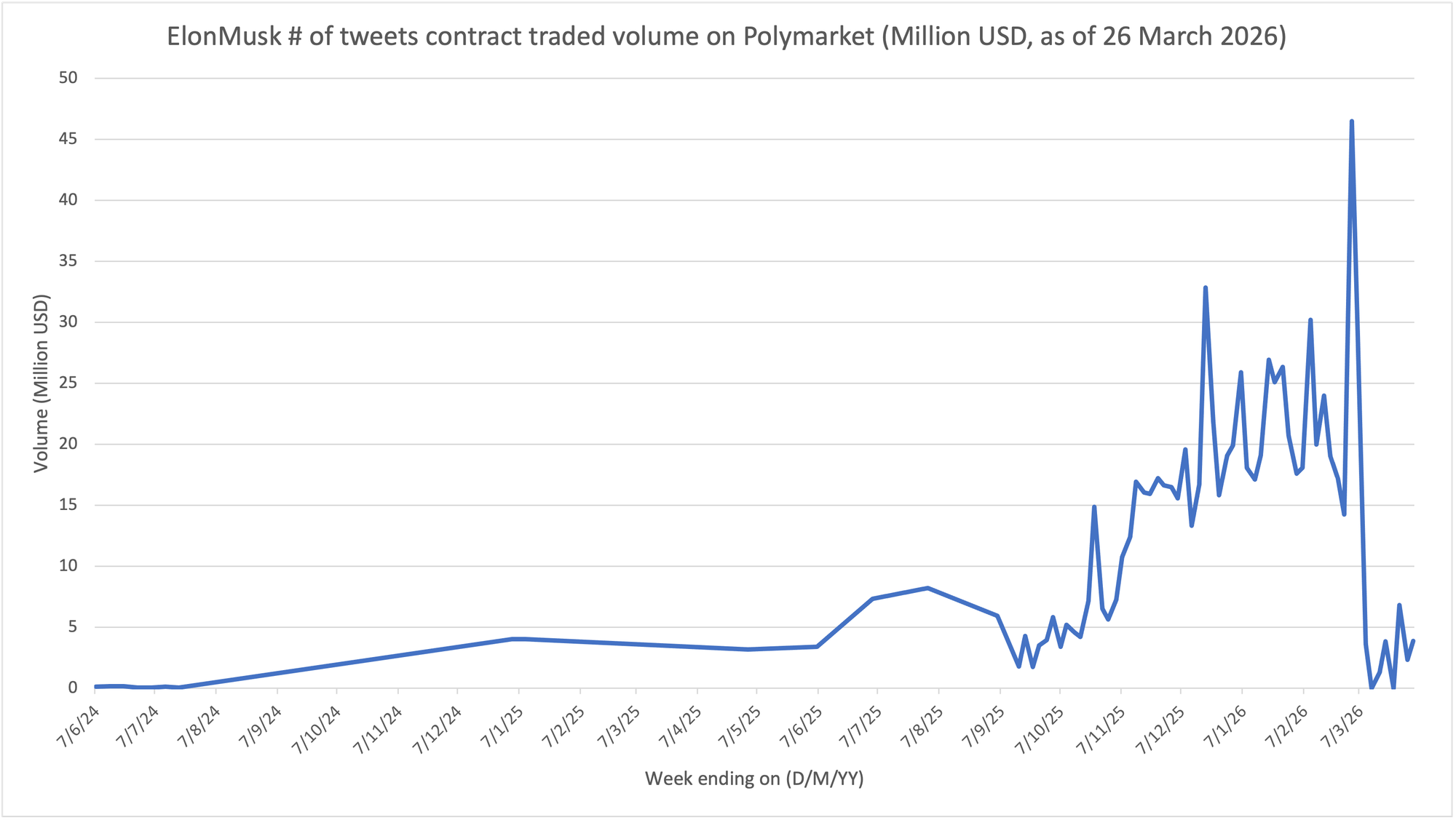
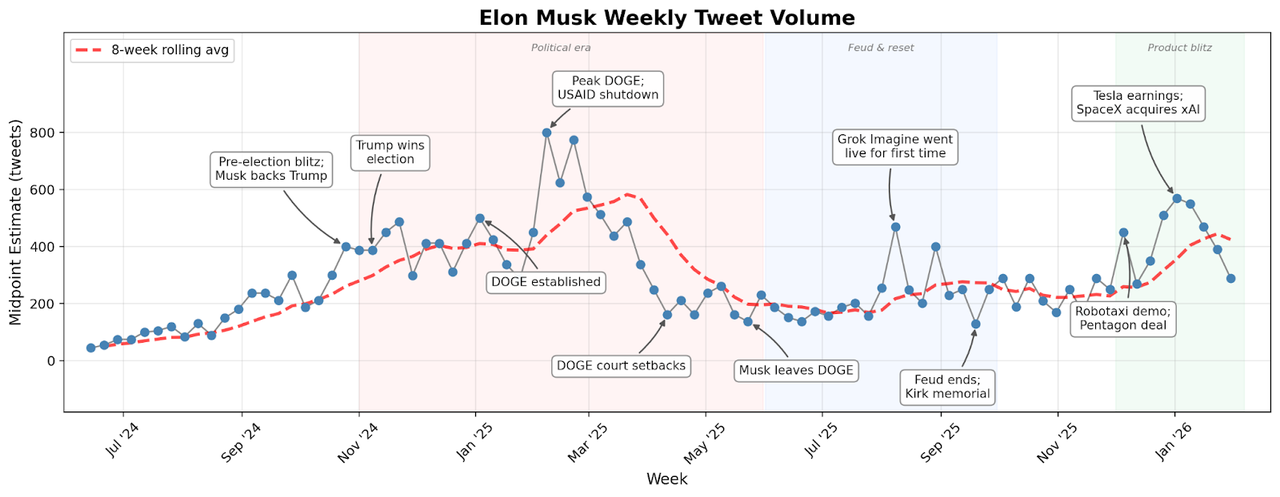
Polymarket launched weekly markets on Elon Musk’s X posting volume in June 2024, and by the last week of February 2026 those markets had grown from about $136,000 to $46.5 million in weekly volume. That is no longer a novelty market. It is a live event contract with real money, real repricing, and real demand for better analysis.
The spike in market volume near late February 2026 sat inside a dense Musk news cycle as Musk-related headlines around SpaceX and xAI increased (data fetched from Polymarket API)
They do not eliminate uncertainty. Elon is still Elon. They try to do something specific: impose statistical regularity on a subject who may not cooperate.
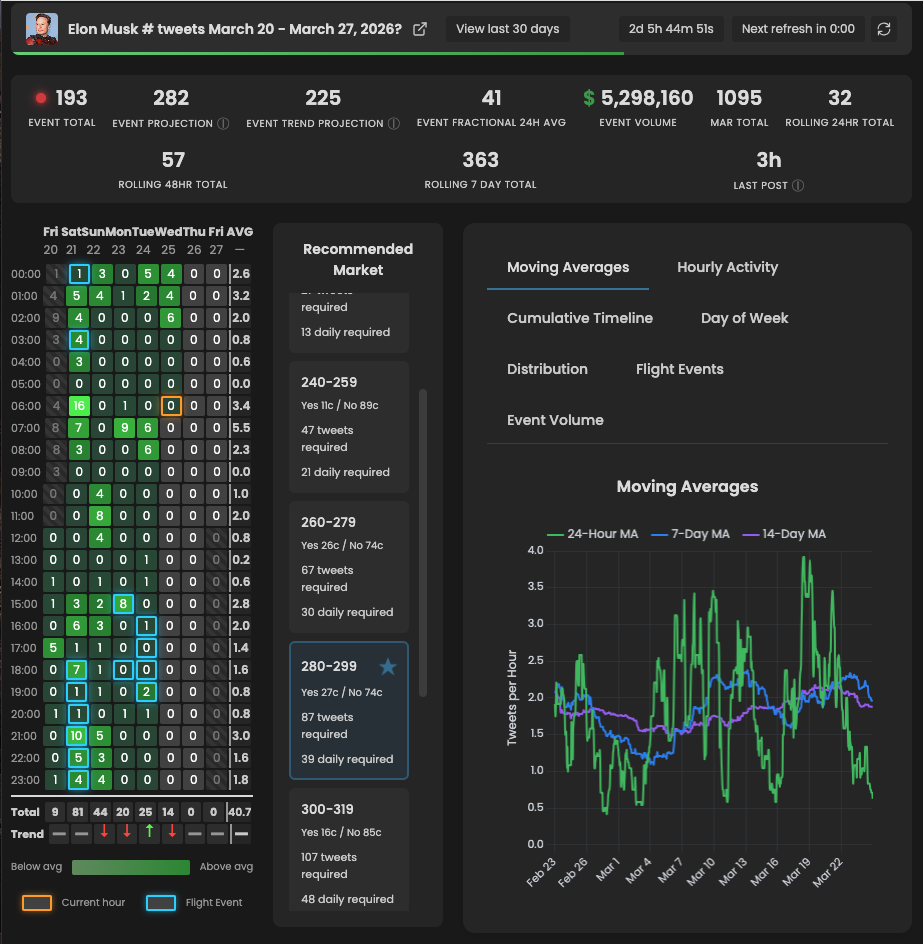
MuskMeter is the live tape. Its site surfaces real-time tweet tracking and organizes the flow into usable views, including moving averages, hourly activity, cumulative timeline, day-of-week distribution, event volume, a tweet activity score based on the last three-hour average, recent posts, the site also tracks flight activity and SpaceX schedules, on the theory that travel days correlate with quieter posting. In other words, MuskMeter is where you go to see what is actually happening right now at a more granular level.
MuskMeter provides metrics and visualizations at the hourly level (MuskMeter.live webpage screenshot as of 25 March, 2026)Elon Musk's flight activity + SpaceX launch schedule remind us to watch out for surges/declines in tweet activity; while tweet activity score gives an live overview (MuskMeter.live webpage screenshot as of 25 March, 2026)
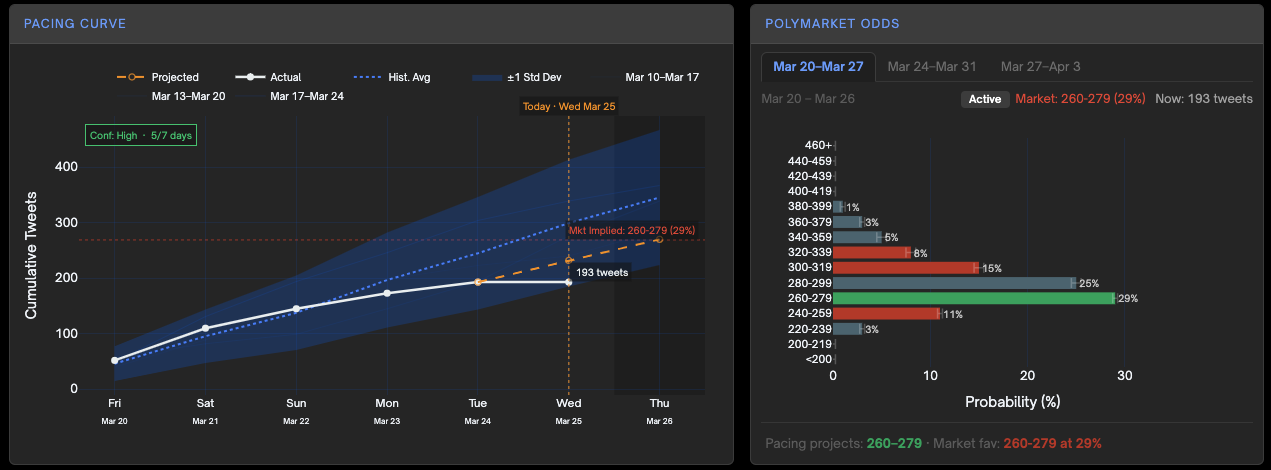
Elon X Forecast is the market lens. The tool claims 86 weeks of historical data as its foundation, built around two hypothesized drivers: momentum and mid-week pacing. The site combines a live pacing curve with current Polymarket tweet-market data, turning it into a dashboard for checking whether the contract price actually matches the observed pace of posting.
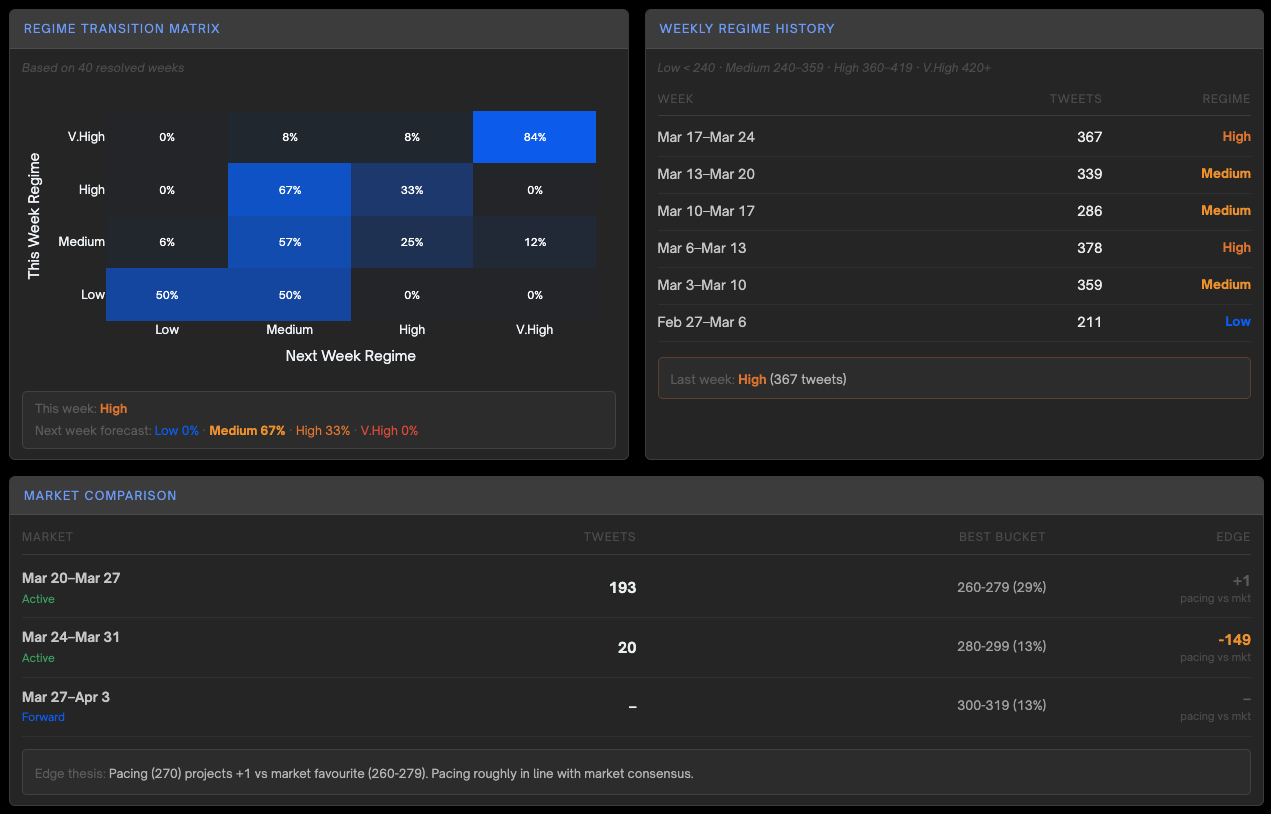
The pacing curve shows mid-week progress against historical baselines and spot market price lags (elonxforecast.com webpage screenshot as of 25 March, 2026)Elon's tweet volume exhibits momentum to some extent as the diagonal entries generally have higher values (elonxforecast.com webpage screenshot as of 25 March, 2026)
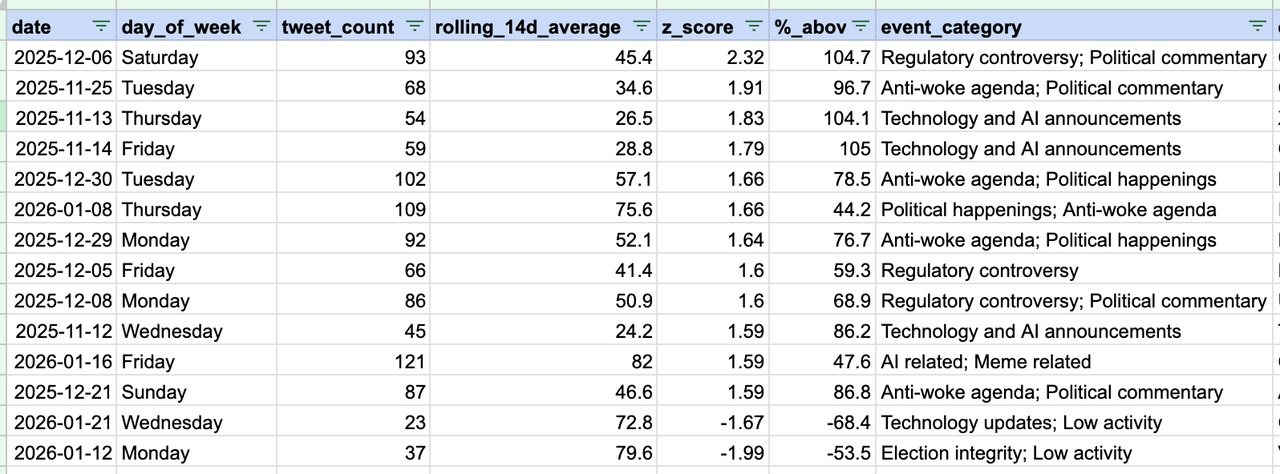
Speaking of the tweet volume outliers at some points in time, the tool creator also notes the following:
"Most of these departures (from the averages), 85% to be exact, are positive outliers (volume spikes). Looking at the categories, we see some trends:
(1) “Woke Mind Virus” and other political commentaries tend to spark extended threads that can balloon the weekly total.
(2) Tech updates and election integrity topics are normally associated with lower tweet levels."
Days classified as outliers by event category (Source: 🔮 TWEET QUANT)
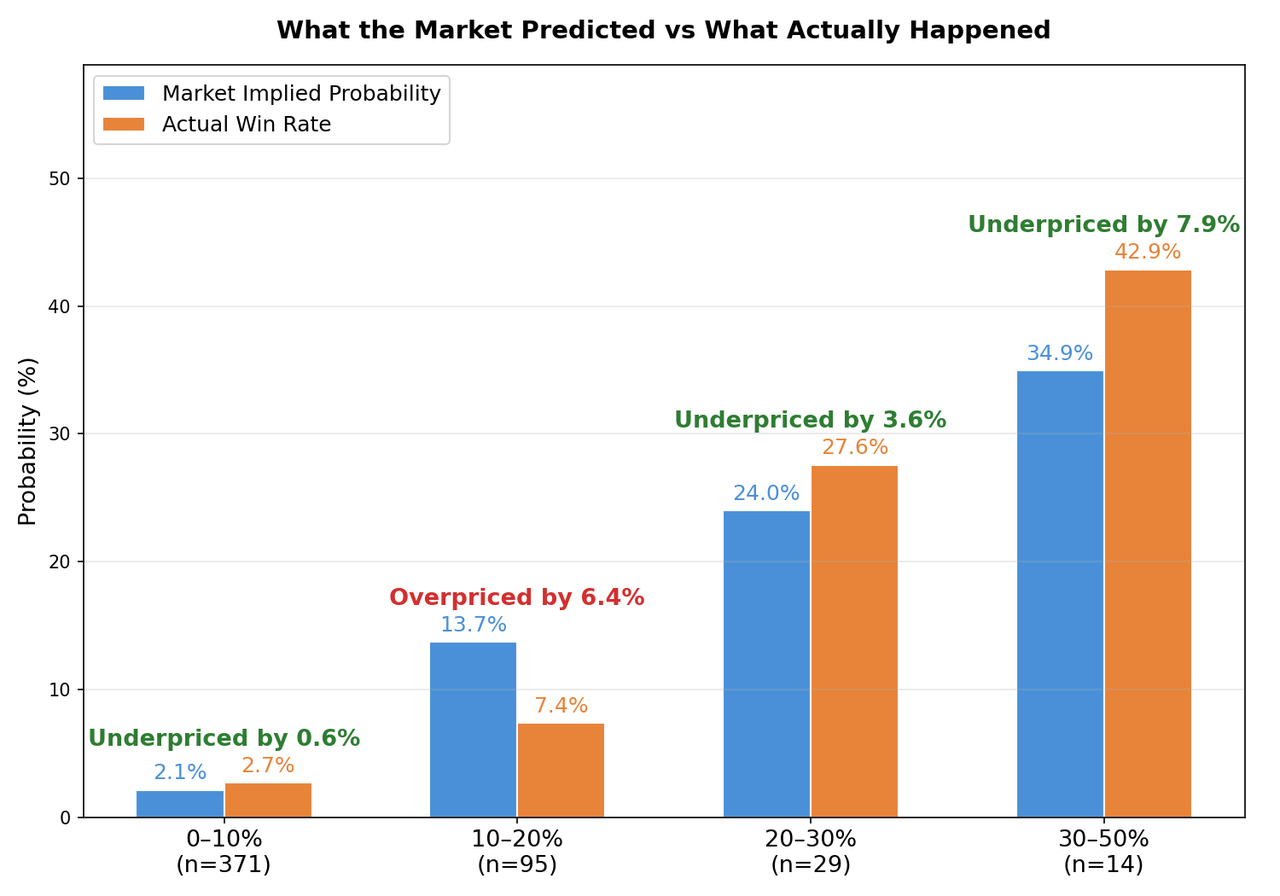
On the other hand, by comparing historical market-implied probabilities and realized win rates (i.e., the actual outcomes), we can see significant market mispricings. The 10-20% bucket appears overpriced, with markets assigning 13.7% odds to outcomes that materialize only 7.4% of the time. Meanwhile, the 30-50% bucket looks underpriced: contracts imply 34.9% odds, yet end up winning about 43% of the time.
This is consistent with the psychological bias called favorite-longshot bias, which describes that people tend to overweight small probabilities and sometimes underweight relatively high probabilities, which can lead them to overpay for longshots and underprice favorites.
Historical calibration against actual realized win rate (Source: 🔮 TWEET QUANT)
If you do decide to trade this market, the most disciplined approach would be to use them in sequence.
Start with MuskMeter, not the odds. Look at the recent-post flow. Check whether activity is clustering in bursts or spreading steadily through the day. Look at the short-run activity score and the moving-average context. This stops you from making the classic mistake of reacting to price before checking the underlying tape.
Then move to Elon X Forecast. Here the goal is not just to count tweets. It is to interpret them. There is some evidence supporting that tweet volume exhibits momentum from week to week, that pacing becomes more informative as the week develops, and that outlier event days can push totals far above normal. For example, by Tuesday, about 69% of a typical week’s total tweets had usually already been posted in the last-14-week pacing sample. That means mid-week counts are not just trivia. Instead, they are a basis for projecting the final weekly total and checking whether market odds have lagged reality.
This is why the tools are strongest in combination.
On its own, MuskMeter can make a user too reactive. You see a burst of posting and immediately assume the high bucket is live. On its own, Elon X Forecast can make a user too abstract. You start staring at modeled ranges and forget that markets can reprice violently when a real-world catalyst hits. But together they create a disciplined workflow: MuskMeter for observation, Elon X Forecast for valuation.
A practical routine looks like this.
Before the week starts, use Elon X Forecast to understand the baseline: what range is realistic given prior-week momentum and historical behavior? During the week, use MuskMeter to monitor whether the live flow is confirming or breaking that baseline. Then return to Elon X Forecast to see whether Polymarket prices have adjusted enough. If live activity is running ahead of normal pace and the contract still looks anchored to an older, quieter expectation, that is the point of analysis.
Elon Musk loves the letter X. (Image credit: Emin Sansar/Anadolu Agency via Getty Images)
From curious to confident. Join the sharpest forecasters online, get top contracts, platform updates & market signals - free.
These tools are useful, but people should be clear about the bet they are really making. Every model in this space ultimately leans on the same hidden premise that Musk’s future posting behavior will rhyme with his past. Most of the time, that is a fair assumption. The 86-week sample behind Elon X Forecast does show some momentum and pacing effects. But this is not payrolls, CPI, or an election cycle. It is the discretionary behavior of one man, and one who can plainly see that the market is watching his output in real time. That creates a regime-change risk no backtest can diversify away as Elon can abruptly change his behavior at any time.
Musk's X names Polymarket as its official prediction market partner and his xAI integrates data from major prediction markets like Polymarket and Kalshi. (Source: Bloomberg)
And the venue mix says something too. Kalshi currently appears to lean toward broader Musk-themed markets rather than a rolling tweet-count franchise, while Polymarket is still listing weekly Elon tweet contracts. That alone hints at the market-integrity discomfort around an underlying so close to being self-aware.
For traders, the takeaway is not to ignore these tools. It is to understand their limit: your edge is only as durable as the underlying is ungameable.
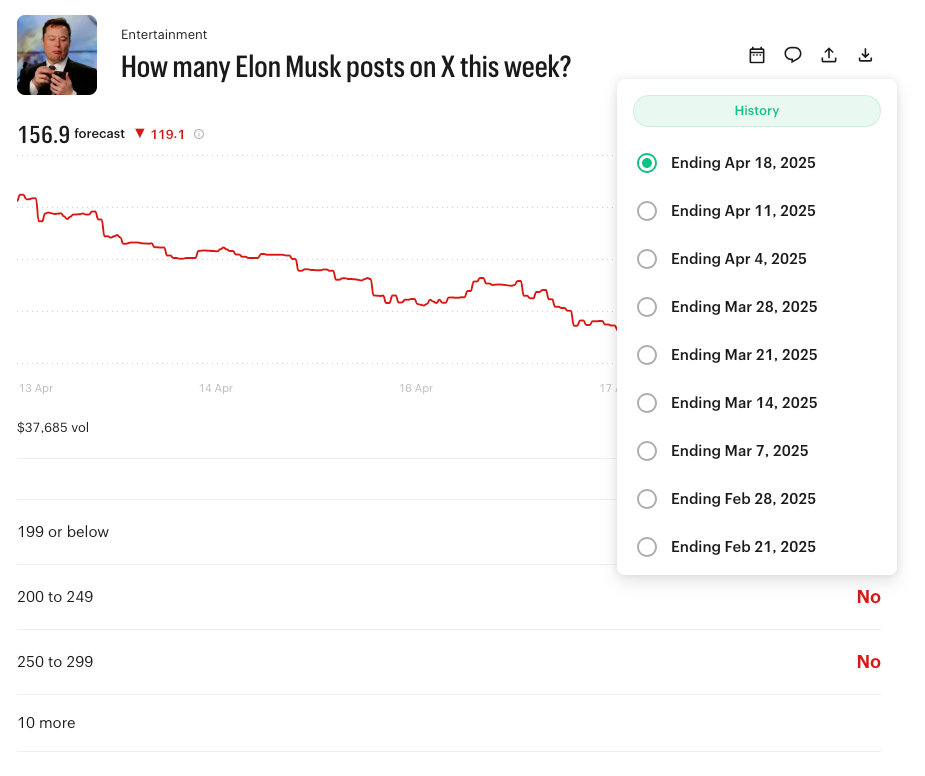
There is no recent active market for a similar contract on Kalshi (Kalshi webpage screenshot as of 26 March, 2026)
In a nutshell, for the general public, the big takeaway is simple: stop treating the contract like a meme and start treating it like a sequence of signals.
One tool shows the behavior. The other helps translate that behavior into market context.
And that is the real value of MuskMeter and Elon X Forecast: they do not tell you the future with certainty. These tools give you a real informational edge over pure guessing. The question is whether that edge survives contact with a subject who can see you watching.
Disclaimer: The content is for informational purposes only. You should not construe any such information or other material as legal, tax, investment, financial, or other advice. Nothing contained in this article constitutes a solicitation, recommendation, endorsement, or offer by the author(s) or any third party service provider to buy or sell any securities or other financial instruments in your or in any other jurisdiction in which such solicitation or offer would be unlawful under the securities laws of such jurisdiction. The author(s) report(s) no conflict of interest.
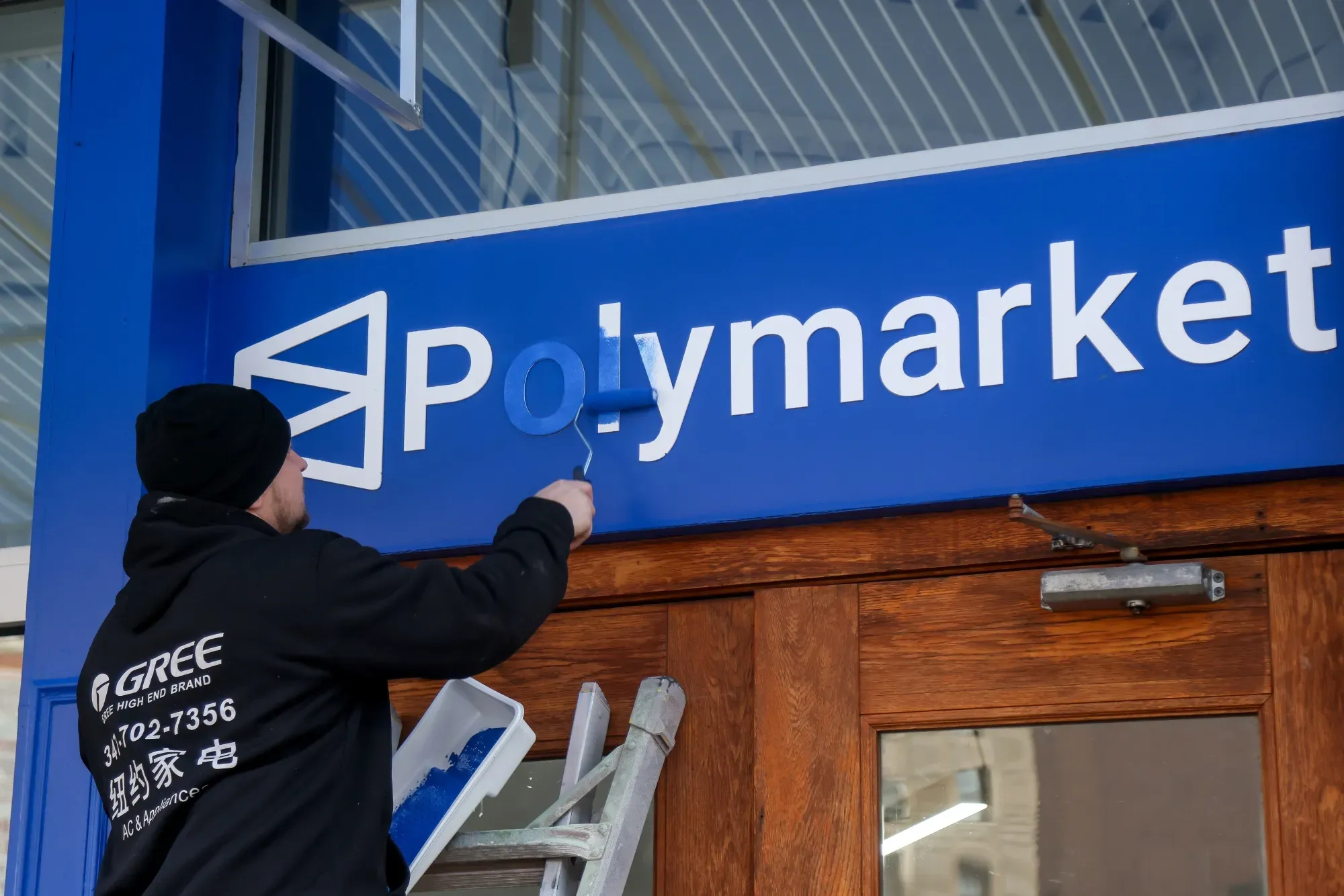
Polymarket took over a bar near the White House, for a promotional event showcasing the prediction market’s vision of betting on current events as a new form of entertainment.
The Situation Room, as Polymarket is calling it, will be open for a single weekend, with rows of TVs on the walls and above the bar, showing newscasts and financial tickers. A human-sized globe covered in screens displayed the odds from Polymarket’s exchange, where users bet on the outcomes of elections, sports and military conflict.
“We want to be a part of the conversation in DC, and where better to have a conversation than in a bar,” the company’s chief legal officer, Neil Kumar, said at an event for reporters outside the venue.
The event is the company’s latest promotion focused more on grabbing attention than winning business. In February, Polymarket opened a pop-up grocery store in Manhattan where it gave away free food for four days before packing up.
Polymarket and its rivals have come under growing scrutiny in recent weeks from lawmakers and regulators, who have expressed concern about the vulnerability of prediction markets to insider trading and manipulation.
Democrats in Congress have introduced several pieces of legislation looking to rein in the nascent industry, and several states have taken the exchanges to court, accusing them of violating state gambling laws.
Polymarket, in particular, has faced questions about its decision to offer wagers on military conflict. One contract tied to missile attacks on Israel led to threats against a reporter covering the attacks.
US prediction markets are overseen by the Commodity Futures Trading Commission, which has generally prohibited exchanges from listing financial contracts related to war. Polymarket’s main exchange operates offshore and does not answer to US regulators.
Kumar acknowledged on Friday that most US customers who visit the company’s bar won’t be able to place bets on Polymarket’s app, which is only operating in beta mode in the US.
“I think you’re going to start to see, in the near future, a Polymarket in the US that looks like the Polymarket platform that most people know,” he said.
The event was held at Proper 21 K, an upscale bar and restaurant just a few blocks from both the White House and CFTC headquarters. Polymarket transformed the venue with the company’s blue branding after announcing the event a few days ago in a post that promised the “world’s first bar dedicated to monitoring the situation.”
The company said that the bar would only be open by invitation on Friday night, followed by two nights for the broader public, with the same menu as the existing bar.
A Polymarket contract on whether Iran would strike Israel on March 10 was designed to forecast the future. Instead, more than 90% of the betting volume on the prediction market came after the fact, as users attempted to profit from a dispute that hinged on the source of a single blast.
The stakes turned personal. Emanuel Fabian, a Times of Israel military correspondent, received death threats after reporting that a missile had struck outside Jerusalem, making him an obstacle to one side of the trade. The people behind the messages demanded he change the story to say that an intercepted projectile was responsible, which wouldn’t count as a strike.
“It’s such an irrelevant, inconsequential detail,” Fabian said in an interview. “It doesn’t matter to the average person.”
The episode exposed a vulnerability in how prediction markets resolve contested outcomes — a process that, on Polymarket, relies on holders of a third-party cryptocurrency voting in a public chatroom rather than any centralized authority. It also showed how contracts designed to aggregate information can create financial incentives to distort it.
The dispute over a single word — missile or fragment — is only the most recent controversy to hit the fast-growing prediction market platforms in recent weeks. In the opening days of the war in the Middle East, there was intense debate about how to resolve contracts on Polymarket and its chief rival Kalshi on whether Ayatollah Ali Khamenei would be out as Iran’s leader.
These episodes undercut the central promise of prediction markets: that by offering yes-or-no bets they can harness the wisdom of the crowd to produce accurate forecasts on everything from politics to the economy and sports. One example of their potential came in 2024, when they gave Donald Trump higher odds of winning the presidential election than traditional polls.
Some of the controversy stems from how the contracts are designed. Polymarket, which hosted the bets on its main platform outside the US, allows anyone to propose how a market should resolve by posting a small amount of collateral. If there’s a disagreement, another user can dispute the outcome. The matter is then put to a vote among holders of a cryptocurrency called UMA, with traders debating the evidence in a public Discord chatroom. Polymarket itself rarely intervenes to decide a market’s resolution.
More than 90% of all shares traded on the Israel strike market were swapped after March 10, while the outcome was being disputed, according to a Bloomberg analysis of trading data from Dune Analytics. This process is called “bonding,” where traders see a possibility to make money on the market resolving after the event in question takes place. Total trading volume eventually climbed to $23 million.
That looks a lot like the earlier Khamenei contract. Much of those wagers were placed after the military strikes on his offices were first reported, which quickly pushed up the odds. Many large wallets also continued to wager on the supreme leader’s removal even after the probability hit 99%, earning a quick but small profit before the market was resolved.
In the end, Fabian did not change his story about the missile strike, despite receiving threats like this one: After “you make us lose $900,000 we will invest no less than that to finish you,” a message said, according to Fabian’s account.
Polymarket condemned the incident in a social media post on Monday, adding that it had banned several accounts and will pass on the information to the relevant authorities, without elaborating on how it had identified the accounts involved. The platform’s main venue is not overseen by US regulators and does not conduct identity checks on its users. The company did not respond to a request for additional comment.
The contract has since been settled to say a missile did strike on March 10, in line with Fabian’s reporting.
There is something deeply funny about using the Oscars to advertise the power of prediction markets.
To be clear, the Academy does not deal in corn futures. It is a vote conducted by 10,000 members of the global entertainment elite, scattered across the world, and influenced by taste, status, relationships, fashion, momentum, and mood. And yet the fintech guys would like us to believe this was a triumph of price discovery.
About $120 million was wagered on the 2026 Oscars as prediction markets went mainstream. Supporters of platforms like Polymarket and Kalshiargue that when markets reach enough activity, their collective wisdom becomes a kind of crystal ball — faster than experts, smarter than pundits, and better at identifying outcomes before the rest of the culture catches up. Their evidence: prediction markets correctly called 19 of the 24 Oscar categories.
The sales pitch
Prediction markets insist they are not gambling. They describe themselves in the language of finance, not sportsbooks. Users buy and sell “event contracts” with one another rather than betting against the house — a casino, FanDuel, or a bookie — that takes the other side of the wager.
That distinction matters because, positioned as financial instruments, these companies can sidestep some of the scrutiny applied to gambling businesses. Kalshi board member Alfred Lin, a Sequoia Capital partner whose firm was an early investor, has argued that these markets serve a legitimate economic purpose by allowing investors to hedge against uncertainty — fluctuating interest rates, for example, or a geopolitical crisis that disrupts oil supply.
How that logic extends to multimillion-dollar Oscar markets on which celebrities would appear at the Oscars is less clear. It also may not matter. In January, guidance from the U.S. Commodity Futures Trading Commission helped open the floodgates, and Kalshi’s valuation reportedly jumped from $1 billion to $11 billion in three months.
The idea that these companies are meaningfully different from gambling sites — or, more to the point, that their growth is not being driven by young men gambling on their phones — is hard to take seriously. Fortune reported that 90 percent of recent volume in these markets appears to stem from traditional gambling behavior.
What began as an “experiment” in sports and entertainment has quickly become central to the business. This year’s Super Bowl alone generated $1 billion in event contracts, and Kalshi’s reported revenue jumped from $1.8 million in 2023 to $24 million in 2024, with estimates of $260 million in 2025.
The intellectual case for prediction markets was always more ambitious. Academics, investors, and data journalists like Nate Silver argued that highly liquid markets — where contracts can be bought and sold continuously, like securities — might produce powerful new predictive signals. In theory, they should react faster than pundits or pollsters and emerge as early indicators of cultural, political, and financial shifts.
Lin called prediction markets “truth machines.” Kalshi cofounder Tarek Mansour put it this way: “They’re a market-based mechanism, so you get the wisdom of the crowds… when people have real money on the line, they don’t lie.”
President Trump’s 2024 election victory was widely framed as the breakthrough moment for prediction markets, with roughly $3 billion placed on the outcome. But that election was also a prime example of how overstated their predictive power can be.
Between October 29 and November 3, 2024, Trump’s odds of winning on Kalshi fell from 64.2 percent to 50.8 percent. Then, between 8 p.m. on November 4 and Election Day on November 5, they surged to 66.7 percent. That is not a market acting as an early-warning system. It is a gambling market absorbing the latest polls, punditry, and momentum narratives as last-minute money pours in.
Following the pundits
The same dynamic played out with the 2026 Oscars. You may have seen headlines claiming prediction markets had a banner night, with Kalshi performing about as well as top Oscar pundits like IndieWire’s Anne Thompson, the Next Best Picture team, and The Hollywood Reporter’s Scott Feinberg. It correctly picked 18 of the 21 non-shorts categories.
That framing is misleading. The market’s confidence only emerged in the final 72 hours, after dramatic swings that closely tracked the experts’ final calls. The notion that the market somehow got an early read on the tastes of Academy voters is absurd. This is one of the most socially coded and insular electorates in public life. There is no clean predictive model for it because there is no real equivalent.
What these late-moving markets were actually following was the collective judgment of the reporters and analysts covering the Oscar race. That reporting helps decode one of the most closed systems in Hollywood, which makes it all the more ridiculous for a fintech company to use the Oscars as proof of its disruptive power.
An unhealthy market
I monitored Kalshi during the final six weeks of the Oscar race, and what I found was not a healthy predictive market. It was an unhealthy gambling market.
To see the difference, consider a normal sportsbook. Say Vegas sets the point spread for the New York Giants at -3.5, meaning the Giants must win by four points for that bet to cash. If the Giants are coming off a dominant performance, retail gamblers may overreact and push the line to -6.5.
That movement creates opportunity. A sportsbook wants balanced action on both sides, so distorted odds attract bettors in the other direction. Sharp money steps in when the public has overreacted. Professional gamblers look for those moments because, over time, consistently exploiting pricing errors is how they make money.
And if the line later corrects, those same bettors may place a hedge in the opposite direction. A healthy gambling market keeps self-correcting this way, balancing herd behavior against professional skepticism.
Kalshi during Oscar season behaved nothing like that.
Historically, Oscar favorites win about 70 percent of the time, though that fluctuates from year to year across a very small sample of 24 categories. And not all favorites are alike: in competitive races, the leader often remains unclear until precursor awards like SAG, PGA, and DGA.
This year’s Best Actress and Best Actor races show how badly Kalshi handled both a relatively settled contest and a volatile one.
In Best Actress, eventual winner Jessie Buckley was about as close to a lock as the race offered. But on Kalshi she rose to an absurd 98.6 percent favorite. The problem is not simply that the odds looked silly. It is that no Oscar race contains enough information to justify that level of certainty.
Precursor awards are less predictive than they appear. Buckley won SAG, yes, but we do not know by how many votes. Without underlying vote totals, it is difficult to build a robust model or even assess how much signal the result contains. And the overlap between SAG’s 160,000-member union and the Academy’s much smaller acting branch is tiny.
So yes, Buckley was the favorite. But 98.6 percent implies a level of certainty the underlying data simply cannot support. And Buckley was not an isolated case. Olympic figure skater Ilia Malinin reached a 99.1 percent chance of winning on Kalshi — a bizarre number for a sport where one athlete, under immense pressure, performs a three-minute routine on ice against the best skaters in the world. Who is taking that risk to make a penny on the dollar?
That question matters because it suggests these markets are not being disciplined by rational price discovery. They are being distorted by users treating them as gamified betting apps, often in combination with parlays and other high-risk wagers.
The Best Actor race made the distortion even clearer.
Before the SAG Awards on March 1, Timothée Chalamet was about a 72 percent favorite on Kalsia. In practical terms, that meant you could buy a 28-cent contract on any one of the other four nominees winning. Didn’t matter if it was Michael B. Jordan, Ethan Hawke, Wagner Moura, or Leonardo DiCaprio; anyone but Chalamet wins, and you collect a dollar on your 28-cent bet.
But the data never justified Chalamet as such a strong favorite in a race pundits repeatedly described as unusually open. Jordan and DiCaprio were beloved stars from the two biggest films positioned to dominate the Oscars. Ethan Hawke’s one-man showcase in “Blue Moon,” combined with a strong campaign trail charm offensive, made him a legitimate contender. And Wagner Moura, already a Golden Globe and Cannes winner, was earning raves for “The Secret Agent,” making him a viable favorite amongst the Academy’s increasingly international membership.
Then, less than two weeks later, after Jordan won the SAG awaard, Chalamet contracts were trading at 33 cents on the dollar.
Put differently, within less than two weeks, Kalshi offered both of these bets:
$100 on Chalamet losing: payout $357.14 $100 on Chalamet winning: payout $303.03
Yes, close races move. But this kind of swing is nearly impossible to replicate in a healthy, high-volume sportsbook market. What we are seeing here is not the wisdom of crowds. It is the gamification of every news event, turning terminally online behavior into the illusion of edge and channeling that impulse into a flood of money.
Worse, prediction markets are increasingly adopting the same predatory mechanics as casinos and sportsbooks.
In early February, Bank of America estimated that nearly one-fifth of activity on Kalshi and Polymarket came from parlays, wagers that bundle multiple bets together. For example: A single bet that Buckley, Chalamet, and “Golden” all win Oscars. If all three hit, the payout is larger. But the larger payout never fully compensates for the added risk; the math always favors the house. Anyone who has struggled with gambling, or known someone who has, understands how predatory parlays can be.
Prediction markets justify this by wrapping parlays in the language of derivatives and trading, as Fortune noted. That may also explain the irrational appetite for extremely short-money bets like Buckley at 98.6 percent. On their own, those bets make little sense. Bundled into multileg combinations, they begin to look much more like casino products dressed up as financial instruments.
Call it gambling, call it prediction markets, call it derivatives trading — increasingly, it looks like Wall Street’s newest way of monetizing what it lovingly calls dumb money.
The 98th Academy Awards, to be held at Hollywood's Dolby Theatre on Sunday, could shape up to be a landmark night for Korean cinema and Korean-rooted filmmaking.
Two films with direct ties to Korea are in the running: one an overwhelming awards-season favorite and the other a dark-horse entry that gives one of the most eccentric works in Korean cinema its due.
'KPop Demon Hunters' – the undisputed frontrunner
The night's headline act for fans of Korean content will be Netflix's animated sensation "KPop Demon Hunters," which goes into Sunday's ceremony as perhaps the closest thing to a sure bet on the night. As of Saturday night local time, prediction market Polymarket gives it a 93 percent chance of taking home Best Animated Feature and an 87 percent shot at Best Original Song for "Golden."
Directed by Korean Canadian Maggie Kang and Chris Appelhans, the Sony Pictures Animation production has swept virtually every major precursor, including the Golden Globes, Critics' Choice Awards, Annie Awards (all 10 nominations), and the Producers Guild Award for Best Animated Feature.
Technically, "KPop Demon Hunters" is a US production from Netflix and Sony Pictures Animation, but by most meaningful measures, it is about as Korean as a film gets. Kang, who left Seoul at age five and grew up in Canada, has spoken openly about how her experience as an immigrant shaped the project – and the results show.
The film is packed with precisely observed details of everyday Korean life: the mix of puffer coats and T-shirts on Seoul streets when the weather turns, napkins tucked under chopsticks at a restaurant table, narrow alleys lined with illegally parked cars despite no-parking markings painted on the ground.
For K-pop fans watching at home, the main event may well be the live performance of "Golden." Ejae, Audrey Nuna, and Rei Ami – the voices behind Huntrix, the fictional K-pop trio at the center of the film – will take the Oscar stage, opening with a fusion of traditional Korean instrumentalists and dance. It will mark the first time a K-pop song has ever been performed live at the ceremony.
Ahn Hyo-seop on the red carpet
K-drama fans will also want to tune in early for the red carpet. Actor Ahn Hyo-seop, who voices Jinu, leader of the demon boy band Saja Boys in the film, will attend the ceremony, the actor's agency confirmed Friday.
While the Korean Canadian actor is a familiar face to viewers through hits like "Dr. Romantic 2" and the Netflix romantic comedy "Business Proposal," the animated film's global run has added considerably to his international profile.
His appearance reflects a broader shift in how the Academy has approached its guest list in recent years. Looking to connect with younger, globally engaged viewers, the organization has grown more receptive to television and streaming talent who have no direct stake in the nominations.
Last year's red carpet included Rowoon, a former SF9 member who had recently wrapped Disney+'s "The Murky Stream," alongside "XO, Kitty" co-stars Lee Sang-heon and Gia Kim.
The crossover logic is straightforward: Korean stars bring with them some of the most active and digitally engaged fanbases in the world, and their presence on the red carpet may help deliver the kind of social media buzz that an awards show with declining youth viewership needs.
A cult classic remake gets an unlikely nod
Korean film buffs will find something else worth watching in the Best Picture race. "Bugonia," the English-language remake of Jang Joon-hwan's "Save the Green Planet!," picked up four nominations this year: best picture, best actress for Emma Stone, best original score, and best adapted screenplay.
A win in any category would almost certainly direct audiences back to the 2003 original, which was not a commercial success on release but built a devoted cult following over the two decades since.
Directed by Yorgos Lanthimos, the film follows two conspiracy theorists who kidnap the CEO of a major pharmaceutical company, convinced she is an alien bent on destroying the Earth.
Jang was originally set to direct the remake himself but stepped back due to health issues, remaining on as an executive producer. The adapted screenplay credit -- and any potential Oscar that comes with it -- goes to Will Tracy, the former editor-in-chief of "The Onion" and a writer on "Succession."
The film's chances in any of its nominated categories are slim; Polymarket puts each well under one percent. Still, it means something that a remake of one of Korean cinema's most genuinely strange and original works has landed on the best picture ballot – a sign of how far the industry's appetite for Korean source material has traveled in recent years.
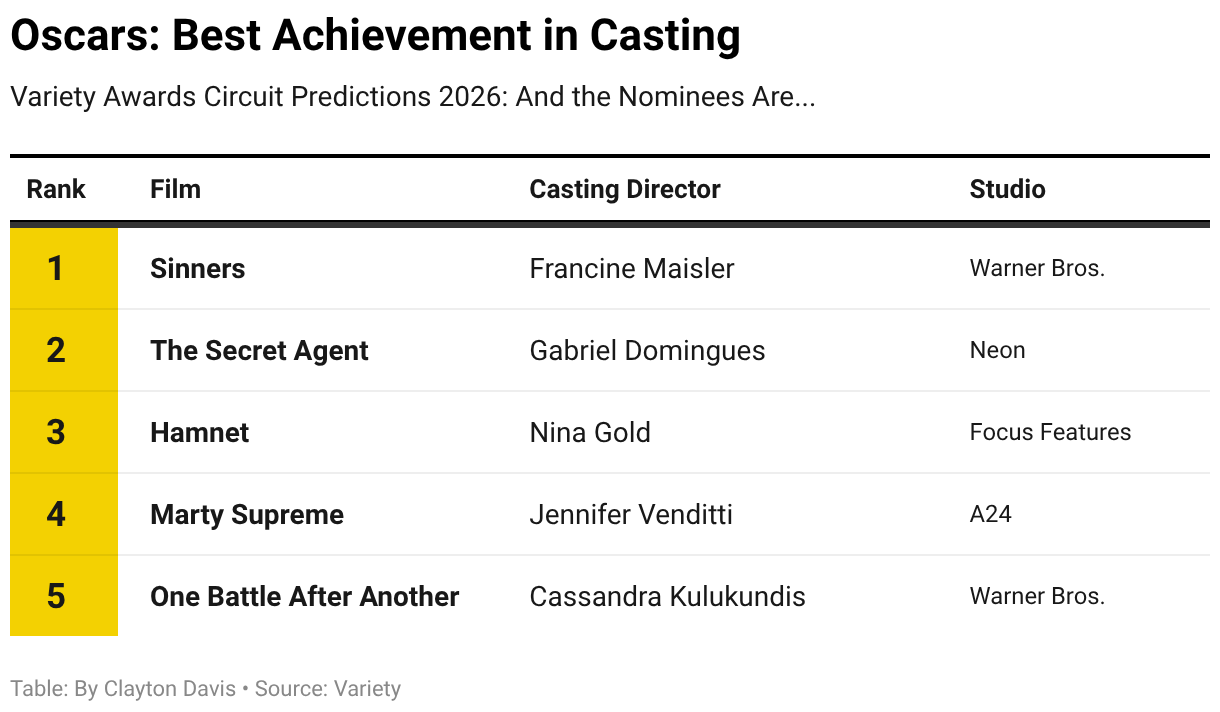
Variety Awards Circuit section is the home for all awards news and related content throughout the year, featuring the following: the official predictions for the upcoming Oscars, Emmys, Grammys and Tony Awards ceremonies, curated by Variety chief awards editor Clayton Davis. The prediction pages reflect the current standings in the race and do not reflect personal preferences for any individual contender. As other formal (and informal) polls suggest, competitions are fluid and subject to change based on buzz and events. Predictions are updated every Thursday.
Oscars Best Casting Commentary (Updated March 12, 2026):Francine Maisler on track to become the first-ever winner for Ryan Coogler’s “Sinners”
The Academy Awards are introducing the Oscar for best casting this year, which means there’s no historical precedent to guide predictions.
One of the only indicators we have so far is the 41st annual Casting Society Artios Awards, where Francine Maisler took home the prize for Ryan Coogler’s “Sinners.” Maisler shared the evening’s spotlight with Nina Gold and Douglas Aibel, who won for their work on “Jay Kelly” from the comedy category.
The Artios Awards are far from a perfect predictor, but in the absence of historical trends, they offer one of the few tangible signals for where the industry may be leaning.
Interestingly, Paul Thomas Anderson’s “One Battle After Another,” widely seen as the frontrunning-awards-season contender, missed out at the Artios — the only guild recognition the film failed to secure during the season.
With limited data points to analyze, the category remains largely speculative. Still, Maisler’s early win suggests she could be well positioned to make history as the first casting director to take home the Oscar in the category’s inaugural year.
Final predictions are below. Each category will be updated throughout the week leading up to the 98th Oscars, set for Sunday, March 15, and hosted by Conan O’Brien.
At the University of Miami, inside the columned fraternity house of Sigma Alpha Epsilon, one brother had some valuable information.
The fraternity attracts the children of the very wealthy, including Evan Whitesell, the stepson of Amazon founder Jeff Bezos. In February, the online prediction market Kalshi was offering wagers on which celebrities would show up at the Super Bowl. The odds of Bezos attending were high—a potential jackpot for anyone who actually knew his weekend plans, which didn’t involve a trip to Levi’s Stadium.
Some fraternity brothers soon began placing bets that Bezos would not attend. Two people who bet said the original source of the information was Whitesell, though neither heard it directly from him. The information spread fast through the house and the alumni network. Within days, it had spread by text message to at least one other college campus.
On Kalshi, the odds of Bezos appearing plummeted from around 70% to less than 30%.
“We know this shouldn’t be allowed,” said one brother involved. “People are like, is this insider information? Is this regulated? You feel like you’re doing something you’re not supposed to. It feels like someone should stop you.”
No one did.
One bet was on whether Jeff Bezos would attend the Super Bowl. He didn’t. STEFANO RELLANDINI/AGENCE FRANCE-PRESSE/GETTY IMAGES
Bezos didn’t attend the game on Feb. 8. Bets among the fraternity brothers and their friends ran as high as $10,000 per person, with returns hitting more than 30%. Whitesell didn’t place a trade and doesn’t have a Kalshi account, according to a person familiar with the matter. One fraternity brother said in an interview his winnings would help pay for spring break.
Prediction markets, led by Kalshi and its chief competitor, Polymarket, are in the midst of an all-out sprint to turn almost every happening—from the world-moving to the mundane—into an online bet that can be won or lost.
Their surging popularity has sparked waves of concern over allegations of insider trading—and how speculators have hit it big on macabre wagers over war, death and crime.
Crypto-analytics firm Bubblemaps identified what it called “six suspected insiders” who made $1.2 million wagering that the U.S. would strike Iran last month. On Thursday, two Democratic senators, Amy Klobuchar and Jeff Merkley, introduced legislation to restrict federal officials from trading on prediction markets.
Proponents say the markets don’t count as gambling, and that they harness the wisdom of crowds to accurately predict future events. Polymarket and Kalshi have recruited allies in high places, including Donald Trump Jr., who is an adviser to Kalshi and an investor in Polymarket.
As they attempt to build market share, both Kalshi and Polymarket have aimed marketing at an eager group of users that isn’t known for financial discretion: college students.
Both companies have begun splashing cash on campuses. Polymarket has offered to pay fraternities, in exchange for signing up users, money that can be spent on throwing “epic parties”—one frat raised $30,510 over a two-week period.
Both platforms have been paying student influencers to promote them as ways to raise fun money, enlisting student athletes as brand representatives and supporting student clubs.
The campus of the University of Miami. EVA MARIE UZCATEGUI/BLOOMBERG NEWS
It’s going about as well as you might expect: Students are losing hundreds of dollars on false rumors. The National Collegiate Athletic Association is raising alarms about betting on college games, and a student athletic department employee was fired for betting on Kalshi. Meanwhile, student groups are hosting parties with Polymarket-branded beer pong sets.
Kalshi spokeswoman Elisabeth Diana said Kalshi is “fairer and more transparent than casinos and sportsbooks.” She said 18- to 21-year-olds represent 3% of overall trading volume on the platform, and that the average user on Kalshi is 33 years old. The platform has “age gating requirements,” she said, and its marketing isn’t focused specifically on college students.
Polymarket said it has collaborations with blockchain and emerging-technology clubs at universities nationwide to “gain insights about its platform and products.” The company said it has clear terms of use for its participants and “was built to help people make sense of the world through transparent, market-based probabilities.”
The 18-to-21 window
On TikTok and Instagram, Kalshi and Polymarket have paid creators including college students to produce a tsunami of content featuring the prediction markets. The content often doesn’t disclose that the video has been sponsored. On X, Kalshi has highlighted the success of young bettors. At one point, both companies attempted to recruit a 15-year-old videogame streamer as a marketing affiliate—before dropping efforts because he was too young.
Federal Trade Commission rules require creators to disclose if they are being paid by a company to promote their products.
Kalshi gives creators guidelines for disclosing they are paid by the company, “but not all creators choose to abide by those guidelines,” Diana, the company’s spokeswoman, said in a statement. Polymarket didn’t address questions about the disclosures.
States regulate Kalshi and Polymarket’s prime competitors, online sportsbooks such as DraftKings and FanDuel, and most require them to bar bettors younger than 21. But because Polymarket and Kalshi’s trades are regulated as financial derivatives contracts by the Commodity Futures Trading Commission, people as young as 18 can wager. That creates a three-year window for prediction markets to become ingrained among young users.
In December, FanDuel and DraftKings rolled out their own prediction markets, but they haven’t captured the same level of usership, according to their quarterly reports.
Kalshi’s former head of operations, Noah Zingler-Sternig. NOAH ZINGLER-STERNIG
Kalshi’s former head of operations, Noah Zingler-Sternig, was still in high school when he started trading on prediction markets. He said he ultimately made more than $100,000 on investments and prediction markets, which he used to pay tuition at the University of Wisconsin-Madison.
“The college kids love it because it’s easy to understand,” he said. “If you want an outlet to gamble…an outlet to make money…[or] an outlet to learn more about whatever discipline you’re studying, you can get it from prediction markets.”
Users on the platforms bet on the likelihood of an event taking place. The prediction markets say that unlike gambling, users bet against each other, not the house.
Polymarket’s platform is off-limits to U.S. users but can be accessed by anyone with a VPN, which can disguise location. It plans to launch an app for U.S. users soon. The company has a data partnership with Dow Jones, the publisher of The Wall Street Journal.
Kalshi’s platform is available nationwide, though courts are examining the legality of the platform in nearly a dozen states.
The increasing popularity of prediction markets comes amid alarm bells from experts who have noted an explosion in problem gambling among teens and young adults in recent years. Half of boys ages 16 and 17 have gambled in the past year, according to a survey of over 1,000 teen boys published in January by the nonprofit Common Sense Media.
“We’re still in an era where cigarettes were in the ’40s and alcohol was in the ’50s, when everyone had a bar in their office,” said Lia Nower, director of the Center for Gambling Studies at Rutgers University. “It’s going to get much worse.”
Serving pizza and wings
Polymarket invited a delegation of fraternity brothers from Columbia University’s Sigma Phi Epsilon chapter to visit the company’s Manhattan headquarters on Nov. 16. The office had a very “SoHo loft feeling, everything’s very white,” said Conor Parks, a 21-year-old Columbia junior and member of the fraternity.
About 20 of the students went, and they were given pizza and wings, as well as $10 each to use on Polymarket. Shayne Coplan, Polymarket’s CEO, sat with them while they watched football games over several hours, asking them how well Polymarket’s soon-to-launch U.S. app worked and what features they would like to see. At least one student made about $60 that day, Parks said.
Later, Polymarket mailed SigEp a wooden plaque recognizing them as “the first Polymarket Pledge Class.”
Polymarket also pitched the chapter on becoming a partner: For each person who signed up for an account with the fraternity referral code, $10 in cash would go to SigEp, and the same amount would be deposited in the new user’s account to bet with.
The chapter’s revenue, $30,510 in two weeks, made it a “top earner,” according to a Polymarket slide deck reviewed by the Journal.
Some of the money went to an “epic end-of-the-semester party,” according to a quote attributed to the fraternity’s president included in the deck. Parks confirmed that some of that money went to a party, as well as paying for furniture. One student familiar with the party, who isn’t a member, said it was held off-campus in lower Manhattan.
SigEp’s national organization confirmed the Polymarket meeting but questioned the chapter’s appearance in marketing materials. “The two most recent chapter presidents tell us they do not recognize the quote attributed to the chapter president,” said Brian Ford, a spokesman. “It’s unclear to us whether the chapter agreed to be used as a case study in Polymarket’s marketing,” he said.
The Columbia University campus. CHARLY TRIBALLEAU/AGENCE FRANCE-PRESSE/GETTY IMAGES
Polymarket declined to comment on SigEp’s statement.
A Columbia University spokeswoman said, “We are looking into this.”
Polymarket also reached out to fraternities and social clubs across the University of California, Berkeley, last fall, according to students there, offering company-branded beer pong cups and up to $1,000 for parties.
At least one club took the company up on its offer, said Oleg Viatkin, a member of Blockchain at Berkeley, a club for crypto enthusiasts, which accepted Polymarket merchandise. The company also sponsored one of the club’s hackathons, during which students built a financial product related to Polymarket contracts. Still, Viatkin said, he has some reservations about the prediction market’s efforts on college campuses.
“I’m interested in whether 10 years ago, a gambling platform would’ve been allowed to do this on campus,” the 21-year-old junior said.
Polymarket seeded the account of the University of Chicago’s prediction markets club with $20,000, said the club’s founder, Oliver Wilson, 19, who interned for Polymarket before starting college there last fall.
In exchange, Polymarket asked the club to undertake research on its platform. “The idea is to get Polymarket’s name out into the academic sphere and kind of demonstrate how interesting the way the platform works is,” Wilson said.
Oliver Wilson, left, with a friend, interned with Polymarket before founding the University of Chicago’s prediction markets club. OLIVER WILSON
In September, Kalshi announced a nationwide push to sponsor campus clubs. “College campuses are the best place to spark new financial movements and will play a key role in bringing the next 100M users to prediction markets,” the company posted on X.
The company deleted the post after some observers questioned the effort. “You can never start those kids too early on sports betting,” Nigel Eccles, the co-founder and former CEO of online sportsbook FanDuel, mockingly wrote.
Kalshi offered to fund the tournament prize pools of the Duke Poker Club, according to an email reviewed by the Journal, and sponsored an October competition held by the Yale Undergraduate Hedge Fund Association, according to a LinkedIn post.
The company no longer has active partnerships with student groups, Diana, Kalshi’s spokeswoman said. “The thinking was to engage finance clubs and quant traders, but we decided to shelve this program to focus on broader brand efforts,” she said.
In January, Polymarket hired an 18-year-old college dropout to help run its social-media marketing strategy. The new hire, Ian Masangkay, posted on LinkedIn that it was one of the “most pivotal and generational companies of this century.”
When Jay Liang, 19, a sophomore at the University of Waterloo in Ontario, started working with Kalshi to recruit new users, he hired his classmate to make a social-media post. The TikTok—which didn’t mention the sponsorship—received more than 50 million views, one of Kalshi’s most-viewed pieces of social-media marketing.
Liang said he was told by a supervisor to target students because they “spend money recklessly.”
Kalshi’s spokeswoman said the company never told him that. “That is outrageous and made up,” she said.
Paid influencers
Kalshi and Polymarket have focused most of their outreach on social-media influencers, which company employees see as a relatively inexpensive way to win over potential new teen and college-age users, according to people who work with the companies.
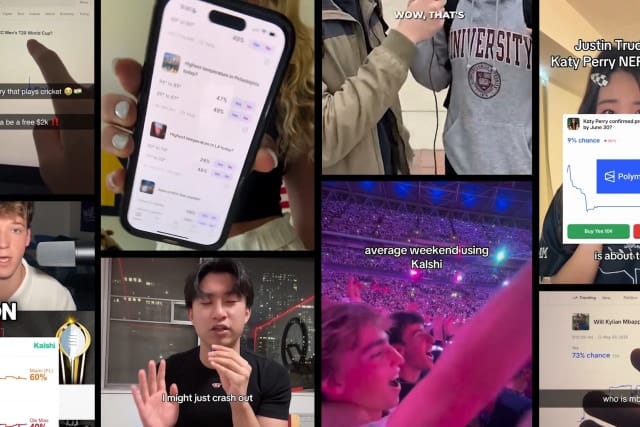
The content is usually students talking directly to the camera about the trading odds on sports or news events, according to a Journal review of hundreds of TikTok and Instagram videos made by Kalshi and Polymarket partners.
Sophia Panossian, a water polo player at the University of Michigan, urged viewers to help her “get ready with me” by checking Kalshi’s weather odds. Ethan Dang, a Vanderbilt University freshman, joked that a fellow student bet $4,000 on Polymarket on somebody farting during a speech by President Trump. Another showed Dylan Gold, a Southern Methodist University junior, partying at a concert and a game, all under text saying “average weekend using Kalshi.”
Panossian and Gold disclosed Kalshi’s support, but Dang didn’t note he was paid by Polymarket. Panossian declined to comment, and Gold and Dang didn’t respond to requests for comment.
“It’s more relatable, advertising-wise, when someone your age or in your situation talks about something,” said Norton Yang, 19, a sophomore at NYU who said he was paid by Kalshi to create TikTok content promoting the company. “Betting my life savings on @Kalshi,” Yang’s TikTok bio read. His videos didn’t disclose his relationship with Kalshi.
Kalshi’s spokeswoman said it no longer works with the creators named in this article.
The companies also tie up with affiliate users, who can get money paid into their accounts for each new person they sign up through referral codes.
Kalshi employees “kind of understand that without the tweets and the streamers and all of the social-media stuff that the traders do for them, usually just for free, their marketing would be a lot harder,” said Jack Campion, 20, a junior at the University of Wisconsin-Madison and a Kalshi affiliate.
In September, Kalshi briefly signed up a 15-year-old videogame streamer who goes by vert1d online to promote its brand on X as an affiliate.
A week later, Kalshi ended the partnership. “Yo brother, legal team confirmed that we can’t work with minors rn,” a Kalshi employee wrote to the user in messages reviewed by the Journal. “Kinda sad tbh.”
Polymarket, too, was interested in recruiting the user to promote their company, according to messages to the user from a Polymarket employee reviewed by the Journal.
Campus fallout
While University of Miami students placed a successful bet on Bezos’ Super Bowl absence, a much larger group of college students across the country bet incorrectly that Mark Wahlberg would show up, based on false rumors that spread through group chats and social media.
The rumor began at fraternities at Clemson University, where Wahlberg’s daughter Ella is a student. It spread nationwide and sparked more than $24 million in trading. William Clowney, a member of the Clemson chapter of Delta Chi who claimed in text messages reviewed by the Journal that Ella had confirmed the information, boasted that the bet was “literally free money.”
In an interview, Clowney said he doesn’t know Ella and heard the rumor from someone else.
In a post on TikTok, Ella called fraternity members who made that bet idiots and said they deserved to lose money.
More money was wagered on Wahlberg’s attendance than on the 32 other celebrities listed in Kalshi’s Super Bowl attendance market combined—including Trump, Vice President JD Vance and Bezos.
The tip rapidly bounced around the country, shared in group chats and on a corner of X known as the “burnerverse,” populated by fraternity members who use pseudonymous accounts to post crude content. Students at colleges as far-flung as Rhode Island, Louisiana, Arizona and Wisconsin were alerted to the bet, they said in interviews.
Kalshi is investigating the bets on whether Wahlberg and Bezos attended the Super Bowl for possible insider trading and market manipulation, the company’s spokeswoman said.
UFC CEO Dana White with Polymarket CEO Shayne Coplan in November. SETH WENIG/ASSOCIATED PRESS
The NCAA has raised alarms about how prevalent prediction markets are on college campuses. In January, the association urged the CFTC to bar prediction markets from hosting bets related to college sports. It also bars student athletes from betting or providing information on sports the NCAA sponsors at any level, including through prediction markets.
“The NCAA vehemently opposes prediction markets on college sports in their current form,” the organization’s risk management lead Clint Hangebrauck said in an interview. “I think from our vantage point, and just from a societal standpoint, anything that blurs the line between financial investing and gambling, especially for a young and vulnerable population, is really dangerous.”
In November, a student worker in the University of Tennessee’s athletics program was fired for placing wagers on Kalshi, according to school records and reporting by the Knoxville News Sentinel. The student had bet on NFL, NBA and college football games on Kalshi, including the University of Tennessee’s football game that week, in violation of NCAA policy, according to a copy of self-reported NCAA violations shared by the university.
At the University of Miami, students are thinking about their next bet. “Dana White’s daughter goes here,” said one of the people involved in the Bezos bet, referring to the CEO of Ultimate Fighting Championship—which Polymarket and Kalshi offer bets on. “We haven’t done anything with that, but maybe she knows things.”
When told that some students might try to use the younger White for information, the UFC executive provided a statement suitable for a cage match. “My daughter gambled one time and lost $20 and was depressed for two months,” he said, “and as far as what I do for a living, I don’t even know if my daughter knows that I work for the f—ing UFC.”