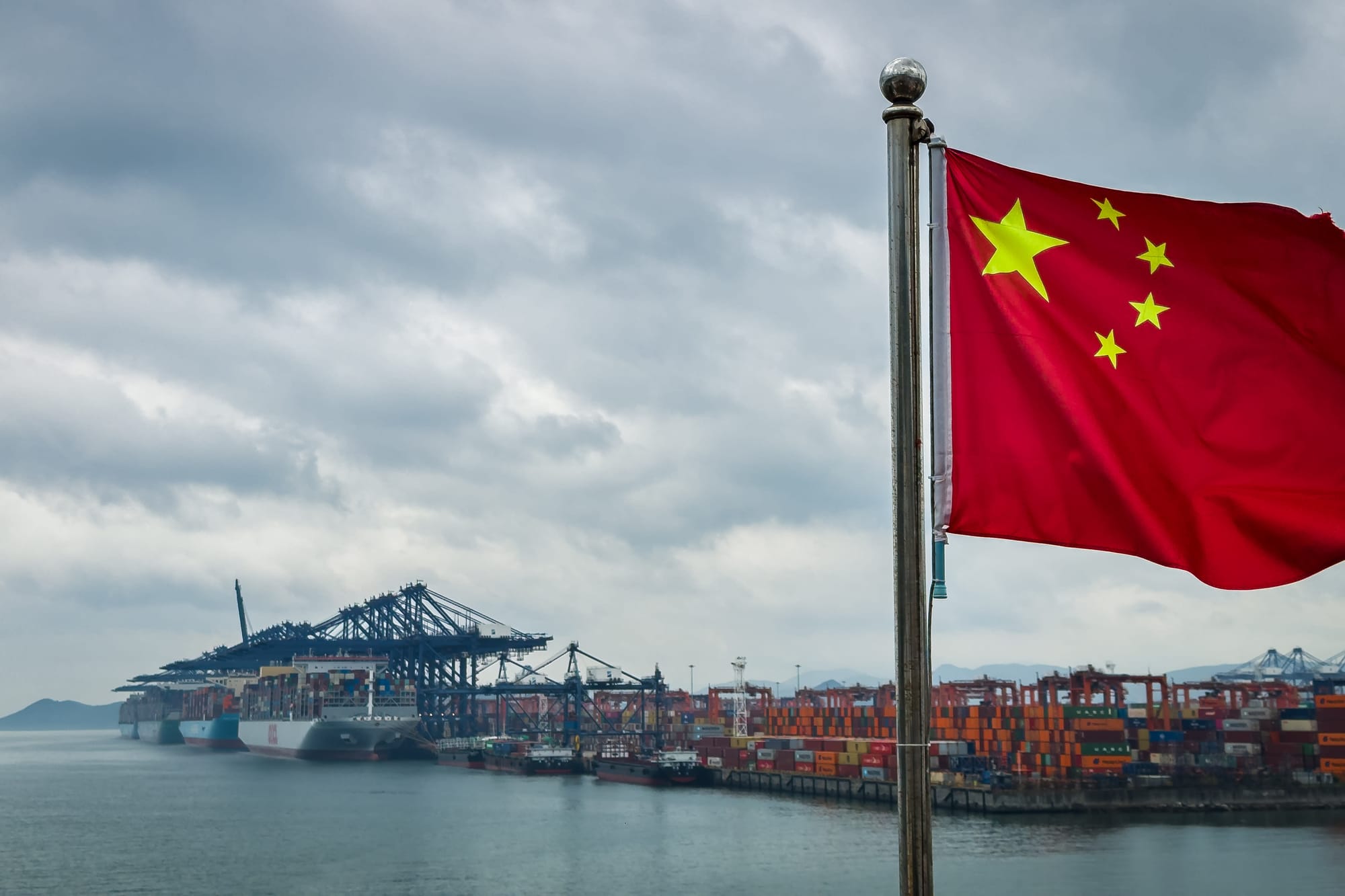
A rapid reduction in Chinese crude imports has helped stop oil from trading even higher since the outbreak of the U.S.-Iran war — but analysts warn that price rises will be needed as market balance is gradually restored.
The Middle East conflict has entered its 100th day — but fears of a $200-per-barrel spike have failed to materialize, despite global crude supplies tumbling 14% since hostilities began on Feb. 28.
Market strategists say China is acting as a key pressure valve on energy markets, with Beijing's move to cut crude imports from 11.7 million barrels a day in February to just under 9 million a day by late May helping to ease the Strait of Hormuz supply shock.
China's cut represents about 74% of the decline in global crude imports, a "disproportionate" share of the adjustment, according to J.P. Morgan analysts, who said this has helped prices remain "remarkably calm" four months into the conflict.
However, Societe Generale warns that the market will ultimately require higher oil prices moving forward as global inventories are depleted and strategic reserves require rebuilding.
In a note, SocGen commodity analysts said the 14% loss in global crude supply, largely driven by the closure of the Strait of Hormuz, has pushed prices about 30% higher. In contrast, the 1973 OPEC oil embargo cut off about 7% of supply — but sent prices soaring some 134%.
SocGen analysts said multiple factors — including strategic inventory releases, reassuring signals from Washington, and increased output from countries including Brazil and Venezuela — have offset the Hormuz supply squeeze and helped avoid a repeat of the 1973 crisis.
But they pinpointed China's "enormous" reduction of imports, at almost 3 million barrels a day, and lower refining activity, as a critical rebalancing force in markets.
"It represents one of the largest offsets to the shock, second only to Saudi rerouting flows and larger than coordinated SPR releases from the U.S., Europe, and Japan," SocGen analysts led by Mike Haigh, head of FIC and commodity research, noted.
Roughly one-fifth of the world's seaborne oil supply passes through the Strait, a narrow shipping lane between Iran and Oman.
Renewed tensions
Rory Green, head of emerging markets macro and strategy at GlobalData TS Lombard, said China's large-scale, rapid electrification of energy production and transportation since 2022 has helped shift China from an energy balance toward a "substantial surplus."
In a note published at the end of May, Green said crude oil prices have not exceeded $200 per barrel, "contrary to the predictions of many energy analysts at the outset of the Iran conflict", adding that China's "official and quasi-official" crude stockpiles have also played a role in cushioning prices.
Brent crude prices surged 4.9% on Monday to $97.67 per barrel after Israel and Iran exchanged missile strikes, the first time the two countries targeted each other directly since the April ceasefire. The re-escalation also sent U.S. West Texas Intermediate futures higher, up 4.9% to $94.93.
Analysts are now split on oil's price trajectory.
J.P. Morgan analysts said their base case scenario of a June reopening of the Strait would keep Brent crude at around $100 for the rest of 2026. They estimated that a longer-lasting closure would add about $5 in the third quarter and $15 in the fourth quarter as stocks deplete faster.
Fitch analysts, meanwhile, said a late July reopening would cause Brent prices to "fall sharply", reaching an average of $70 per barrel from September, adding that the current spike reflects a "temporary logistical supply shock" rather than a lasting loss of production capacity.
However, SocGen said strategic reserves will need to be rebuilt, adding that existing stockpiles will need incremental supply, and new oil production "requires stronger returns to move forward."
"Taken together, the longer-term equilibrium price for oil is likely higher than what the current forward curve implies," SocGen's commodity analysts added.
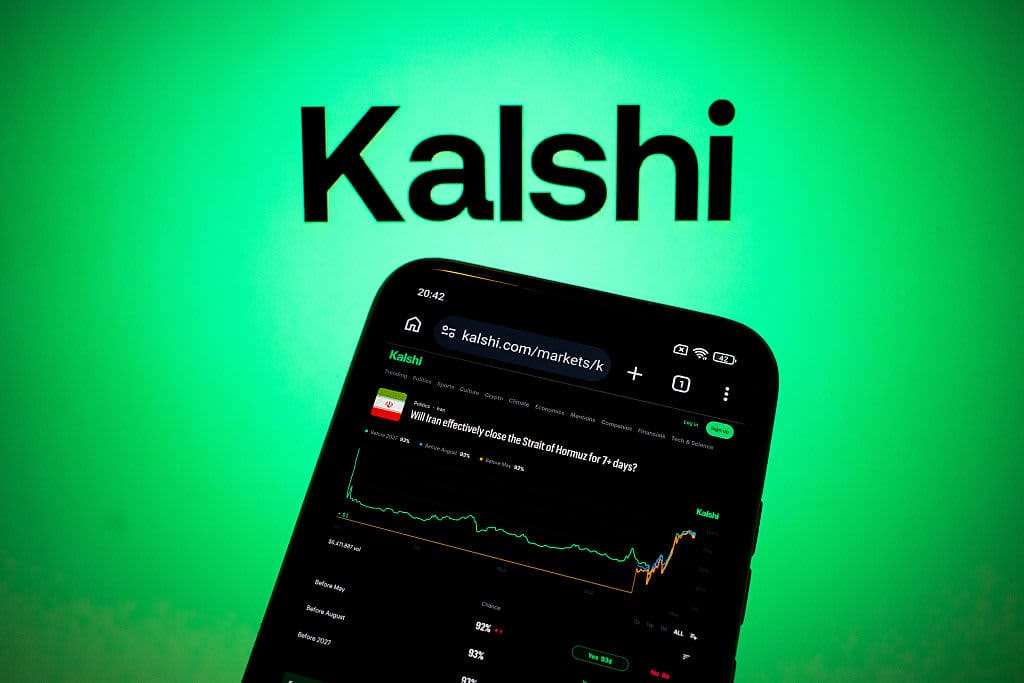
Prediction market platform Kalshi is developing a new interface for its highly engaged traders to track the company's prediction markets, according to a source familiar with the plans.
The product, which the source compared to the "Bloomberg Terminal" for traditional equities and derivatives, is currently in alpha testing with a select group of traders on the platform and has been in development for about a month.
Some of the features of the interface, which were shown to CNBC, include tracking popular contracts by 24-hour volumes across various categories, the ability to see all trades as they're actively placed and also to view individual contracts' order books. Users can customize their interfaces to see event contracts related to their own portfolios and are able to manage multiple positions in varying markets at the same time. Traders also can enable an option to reduce the friction to place trades.
Kalshi declined a request to comment.
The source said the company is creating the software to establish a singular product for its highest engaged retail traders, colloquially known as "sharps," who typically use custom workflows to enhance their trades and gain an edge. The source didn't know if Kalshi plans to monetize the platform, either at a potential launch or in the future.
In April, Fortune reported that venture capital firm Paradigm, a major Kalshi investor, was building its own prediction markets data platform. However, the report said that platform was in development for market makers and professional traders.
Long-term, the Kalshi source said the company's platform may include research and other external information, similar to that of Bloomberg's popular product serving Wall Street traders and investors. Kalshi's market data is currently accessible on Bloomberg's platform.
Bloomberg's system is still referred to as a "terminal" even though it switched from a closed computer system to a software package long ago.
While the Kalshi product will focus on its prediction markets, the source added that a goal is to extend it to the company's other asset classes. On Friday, Kalshi announced it received approval to offer perpetual futures on cryptocurrencies.
That announcement came one day after the company launched another product, its American Power Index, which it calls a real-time measure of political power using Kalshi's data.
The source did not include a timeline for an official launch of the new terminal product.
Strategy (NASDAQ: MSTR), formerly MicroStrategy, disclosed on June 1 that it had sold 32 BTC during the period from May 26 to May 31. If the company sold Bitcoin before May 31, then a market asking whether MicroStrategy sold any Bitcoin by May 31 sounds like it should resolve Yes.
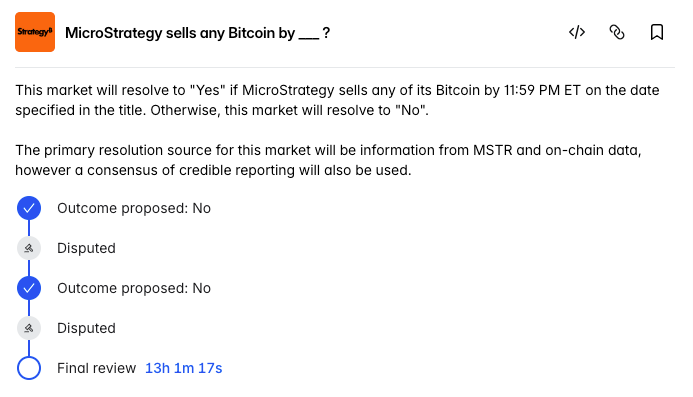
And yet, the market was proposed to resolve No, then disputed twice.
That sounds absurd at first. But the deeper issue is not whether Strategy sold Bitcoin. The deeper issue is whether a prediction market should resolve based on the historical facts of an event, or based only on evidence that was publicly available before the market deadline.
The one-day gap between the sale window and the public filing exposed a major design problem in event contracts: when the event happens before the deadline but proof arrives after the deadline, who should get paid?
What happened
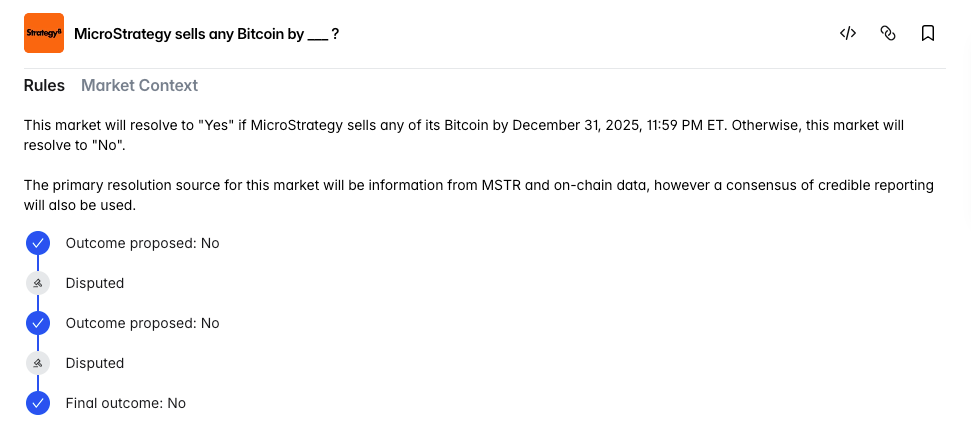
The market said it would resolve Yes if MicroStrategy sold any of its Bitcoin by 11:59 PM ET on the date specified in the title. Otherwise, it would resolve No. The primary resolution source would be information from MSTR and on-chain data, with credible reporting also usable.
For the May 31 market, the key deadline was therefore May 31 at 11:59 PM ET.
Before that deadline, there was no clear public confirmation that Strategy had sold Bitcoin. Traders did not have an official announcement from the company, a confirmed filing, or a broad consensus of credible reporting proving that a sale had occurred.
Screenshot of market rules from Polymarket
Then, on June 1, Strategy disclosed that it had sold 32 BTC during the May 26 to May 31 period. The sale was small relative to Strategy’s massive Bitcoin holdings, but symbolically important because Strategy had long been associated with a “never sell” Bitcoin narrative. The sale also mattered enormously for the Polymarket contract, because it seemed to confirm that the underlying event had happened before the market deadline.
The Yes case: the market was about the event
The strongest Yes argument starts from the plain wording of the market rules.
The rule did not say “MicroStrategy announces a Bitcoin sale by May 31.” It did not say “MicroStrategy publicly confirms a Bitcoin sale by May 31.” It said the market resolves Yes if MicroStrategy sells any of its Bitcoin by the specified deadline.
That sounds like an occurrence-based condition. The decisive question should be whether a sale happened before the deadline, not whether the sale was announced before the deadline.
From this perspective, the June 1 filing is not a new event. It is later evidence of an earlier event. The filing did not cause the sale to happen. It merely revealed that the sale had already happened.
In many real-world contexts, evidence often arrives after the underlying event. If prediction markets always ignored later evidence about earlier events, some markets would resolve against the truth simply because the relevant confirmation arrived too late.
Under this interpretation, the purpose of the market was to determine whether Strategy sold Bitcoin. Since Strategy later confirmed that it did, the market should resolve Yes.
That is a clean and intuitive argument.
The No case: the market was about verifiable evidence by the deadline
The strongest No argument starts from a different principle: prediction markets require finality.
A deadline is not just decorative. It defines the end of the market’s factual observation window. Traders need to know what universe of evidence counts. If evidence published after the deadline can determine the result, then the deadline becomes less meaningful.
This is especially important in markets involving corporate disclosures. A company may conduct an action before the deadline but disclose it later. If post-deadline evidence is always admissible, traders are effectively betting on hidden corporate records, not publicly observable events.
That creates several problems.
First, it creates information asymmetry. Insiders or people with better private information may know that an event occurred before public traders do. If public confirmation can arrive later and still decide the market, then ordinary traders are exposed to hidden-information risk.
Second, it creates hindsight resolution. A market that appeared unresolved at the deadline can flip days, weeks, or even months later because new evidence emerges. That turns resolution into a retrospective investigation rather than a clean settlement process.
Third, it creates manipulation risk. If an event can happen before a deadline but be disclosed after it, then the timing of disclosure can affect market outcomes. Companies, governments, campaigns, or other relevant actors may not be trying to manipulate a prediction market directly, but their disclosure timing can still determine who gets paid.
Fourth, it creates a slippery boundary. If evidence released one day later counts, what about one week later? What about one month later? What if a later lawsuit, audit, memoir, or government report proves that something happened before the deadline? At some point, the market stops being a prediction contract and becomes a historical research project.
Under this interpretation, the June 1 filing may prove that the event happened, but it should not matter for a market that closed on May 31. The relevant question is not “what do we know now?” It is “what could be established by the stated deadline?”
That is also a clean and defensible argument.
The real problem: the natural-language rules & the evidence universe
The most important point is that this dispute was caused by a mismatch between the market’s natural-language question and its evidence universe.
The phrase “sells any Bitcoin by May 31” sounds event-based. It asks whether a corporate action occurred before a time cutoff.
But the resolution mechanism relies on sources: information from MSTR, on-chain data, and credible reporting. Once a contract depends on sources, the timing of source availability becomes crucial.
The market did not clearly state whether post-deadline evidence could be used if it confirmed a pre-deadline sale. That missing sentence created the whole dispute.
The problem is that the actual market language left room for both an event-based interpretation and a confirmation-based interpretation. Yes traders were trading occurrence. No traders were trading confirmation. Once the June 1 filing arrived, the dispute became inevitable.
Why “on-chain data” does not fully solve the issue
One might argue that Bitcoin is on-chain, so this should have been easy. If Strategy sold Bitcoin before May 31, surely the blockchain would show it.
In practice, it is more complicated.
On-chain data is public, but corporate wallet attribution is not always complete or universally agreed. Even if a wallet moves BTC, traders still need to know whether the wallet belongs to Strategy, whether the transfer represents a sale, whether it is a custody movement, whether it is an internal reorganization, or whether it is connected to a broker or exchange transaction.
A blockchain transaction is objective. The interpretation of that transaction is not always objective.
This matters because the market did not simply ask whether any Strategy-linked wallet moved Bitcoin. It asked whether MicroStrategy sold Bitcoin. A sale is an economic transaction, not just a blockchain movement. Without official confirmation, credible reporting, or highly reliable wallet attribution, on-chain evidence may not be enough for ordinary traders to verify the event before the deadline.
So while “on-chain data” sounds like a clean resolution source, in this context it may still require judgment. That judgment becomes even harder when the relevant company disclosure arrives after the deadline.
The dispute process should not become a deadline extension
Another important issue is the role of the dispute process.
A dispute window exists so participants can challenge whether the proposed resolution follows the rules. It should not automatically extend the market’s factual deadline.
If new evidence released during the dispute period can determine the outcome, then the effective deadline is no longer the date written in the market. The real deadline becomes the end of the dispute process. That is dangerous because traders are no longer betting only on what happens by 11:59 PM ET. They are also betting on what evidence might emerge while the market is under review.
That creates a moving target.
However, there is also a cost to an extremely strict cutoff. If the market refuses to consider any post-deadline evidence, it may resolve against the true event. In the MicroStrategy case, this is exactly why the dispute feels uncomfortable. Strategy’s own filing appears to confirm that the sale occurred during the market window. Ignoring that fact may feel like choosing procedural finality over reality.
But that trade-off needs to be decided before the market opens. It cannot be improvised after money is already on the line.
The platform should not let traders discover the true resolution philosophy only after a dispute begins.
The platform’s lesson: technical correctness is not enough
Polymarket may have a defensible argument for No if it applies a hard deadline rule. But even if that resolution is technically defensible, the broader user-experience problem remains.
Many ordinary users would naturally read the market as “Did Strategy sell Bitcoin by May 31?” If the answer is historically yes, but the payout is No because confirmation arrived one day later, those users will feel trapped by a technicality.
That feeling matters as prediction markets depend on trust. Traders need to believe that the contract they are trading means what it appears to mean. If the natural reading of the rules points one way while the resolution convention points another way, the platform may win the dispute but lose user confidence.
The solution is not to eliminate edge cases. That is impossible. The solution is to standardize market types more clearly.
In my opinion, Polymarket and similar platforms should explicitly distinguish between at least two categories:
Event-occurrence markets: the question is whether an event indeed happened by the deadline, and later authoritative evidence can be used to verify it.
Public-confirmation markets: the question is whether credible public evidence exists by the deadline.Evidence emerged after the deadline will not be taken into consideration.
Each category should have standard language about evidence timing. Especially for corporate actions, government decisions, and private meetings, the admissibility of post-deadline evidence should not be left implicit.
Prediction markets are not courts
This case also highlights a philosophical difference between prediction markets and courts.
Courts often try to reconstruct historical truth. They can subpoena records, wait for discovery, hear testimony, and spend years determining what really happened.
Prediction markets cannot operate like that. They need fast, predictable, and scalable resolution. A market with millions of dollars in volume cannot wait indefinitely for perfect evidence. Finality is part of the product.
But prediction markets also cannot completely ignore truth. If markets frequently resolve against what obviously happened, users will stop treating them as credible information mechanisms.
So the goal is not simply “truth at all costs” or “deadline finality at all costs.” The goal is rule clarity.
If a market is designed to trade public confirmation, say so. If it is designed to trade historical occurrence, say so. If post-deadline evidence counts, say so. If it does not count, say so.
The market is resovled to "No".
Disclaimer: The content is for informational purposes only. You should not construe any such information or other material as legal, tax, investment, financial, or other advice. Nothing contained in this article constitutes a solicitation, recommendation, endorsement, or offer by the author(s) or any third party service provider to buy or sell any securities or other financial instruments in your or in any other jurisdiction in which such solicitation or offer would be unlawful under the securities laws of such jurisdiction. The author(s) report(s) no conflict of interest.
Crypto finance conglomerate Galaxy Digital Inc. has launched a trading desk to offer large investors better access to prediction markets via over-the-counter derivatives similar to those used in markets from interest rates to commodities.
Galaxy Derivatives, the company’s swap dealer arm, entered into a $10 million wager in May with crypto hedge fund Arca on whether or not the Digital Asset Market Clarity Act of 2025 will pass through Congress, executives at the company confirmed in an interview. The parties used an over-the-counter (OTC) event swap, a bilateral version of contracts that are already common on prediction markets like Kalshi or Polymarket.
Arca sought to hedge the risk that the act won’t become law, which would likely deal a blow to the firm’s crypto holdings. Under the terms of the swap, Galaxy gets paid by Arca if the bill passes before 2027, while Arca collects if it doesn’t.
One advantage of using an OTC swap in this case was the ability to trade larger size. The most liquid contracts on these exchanges relate to sports, with contracts on political or economic events typically less liquid. A similar Kalshi-listed contract on when the crypto market structure bill will become law has only seen $2.2 million in volume during its existence, just a fifth of the value of the Galaxy-Arca OTC contract.
“This isn’t a gambling thing - this is a hedging mechanism,” Jason Urban, global co-head of Digital Assets at Galaxy, said in a phone interview.
Galaxy is betting that thin liquidity and wide bid-ask spreads on political and economic event contracts will make doing business over the counter more enticing for hedge funds, family offices and other institutional investors. Another concern for investors is that they might not want the trade seen by other market participants, even anonymously.
“The benefits of OTC trading include discretion,” said Gilbert Wassermann, head of prediction markets at Galaxy. “If a client has a block trade on Polymarket, there is the possibility that that wallet address could be doxxed,” he said, using internet slang for the identity behind an online pseudonym being unveiled.
ISDA Agreements
Existing legal pathways can be used to structure the swap agreement, explained Wassermann. Galaxy Derivatives’ core business already involves entering into crypto swap contracts with clients, such as bets on the price of a cryptocurrency in the future. Some investors prefer to interact with known quantities like Galaxy and its competitor FalconX rather than trading directly on crypto exchanges replete with asset custody and credit risk concerns.
Over the counter swaps rely terms laid out in a boilerplate agreement created by the International Swaps and Derivatives Association (ISDA), known as the ISDA Master Agreement. By using existing ISDA agreements, Galaxy’s clients don’t have to deal with the logistical and legal headaches around connecting to a prediction market exchange. There could also be credit concerns if the exchange is situated in an unfamiliar jurisdiction. They will, however, have credit exposure to Galaxy itself.
“Prediction markets are currently not a sophisticated institutional market with enough liquidity for a fund of our size,” Jeff Dorman, chief investment officer at Arca, said in a press release. “By utilizing the OTC market with Galaxy, we were able to execute a trade that best suits our fund strategy.”
To start with, Galaxy is only writing swaps on markets that are already listed on Kalshi or Polymarket. But in the future Urban said it would contemplate being a swap counterparty on more esoteric risks.
Swap dealers tend to offset their risk using other assets. In theory, Galaxy expects to hedge using exchange traded contracts on Kalshi or Polymarket, or a proxy in traditional financial markets, and hold on its books the risk of a misalignment between financial markets and the underlying event.
“We can warehouse this risk,” said Urban, meaning the Galaxy can enter into a contract, without necessary having a way to immediately offload it.
Traders on Kalshi expect that job creation in May will see a slowdown but still surpass Dow Jones consensus.
Dow Jones estimates that May's nonfarm payrolls report — due Friday from the Bureau of Labor Statistics — will show a gain of 90,000 jobs. The consensus reflects an anticipated decline from April's recorded 115,000 nonfarm payrolls and March's 185,000, the highest this year has seen so far.
Kalshi traders on Monday were assigning a 56% probability that the report would beat the Wall Street forecast.
Odds that over 100,00 new jobs would be added jumped after April's job report was released and currently stand at 49%. Traders on Monday also put a 40% chance that new jobs will surpass 110,000.
RBC Economics had a more hopeful outlook compared to Dow Jones.
"We expect 99K jobs were added to payrolls with the unemployment rate holding steady at 4.3%," the firm reported last Friday. "So far in 2026, the labor market appears to be on solid footing. Still, on aggregate, new job creation has been quite limited with monthly payroll gains averaging 55K over the past six months."
The job report is set to come out ahead of the Federal Reserve's first meeting with new Chair Kevin Warsh on June 16-17. Markets are expecting the Federal Open Market Committee to stay on hold at the meeting, though the jobs report could influence that decision.
Dow Jones also expects hourly earnings to increase by 3.4% annually, a slight dip from last month's 3.6%. Economists also put average hourly earnings to increase by 0.3% month-over-month, slightly higher than last month's 0.2%.
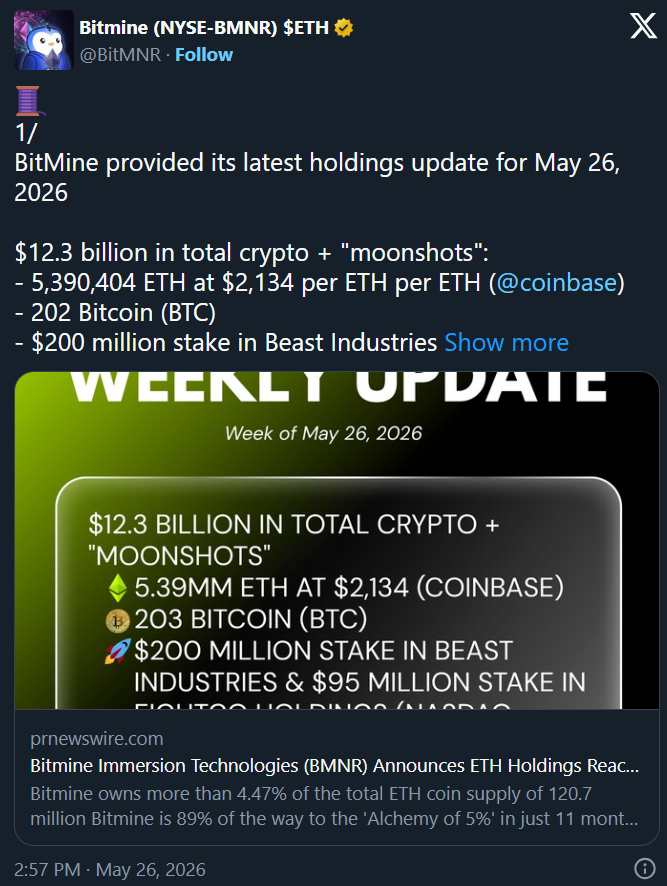
Ethereum’s recent dip below the $2,200 mark seems to have had no impact on large scale accumulation from institutions. And even more so, it encouraged aggressive buying from some of the largest players in the market. For instance, Bitmine took the opportunity to significantly increase their Ethereum holdings as they have now reached 5.4M ETH.
Bitmine Continues Its Aggressive Ethereum Strategy
Recently, Bitmine revealed that it has added 111,942 ETH in the past week. That makes it one of the biggest corporate holders of Ethereum in the world as the company now holds nearly 5.4 million ETH.
Chairman Tom Lee claims that this was done as a result of the ETH price going below the $2,200 mark. He said that Bitmine views this pullback as an attractive buying opportunity.
Lee also claims that a supercycle could be ahead for Ethereum and the crypto market as a whole. He bases this prediction on two factors: Wall Street tokenizing on the blockchain which means turning real-world assets like real estate into blockchain tokens and agentic artificial intelligence needing public and neutral blockchains.
Ethereum Price Continues Dropping
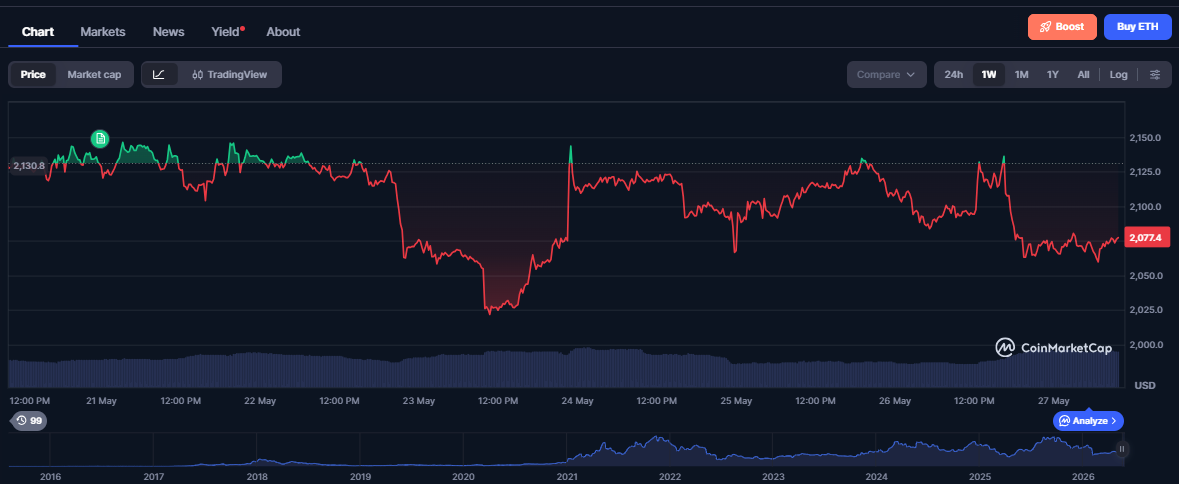
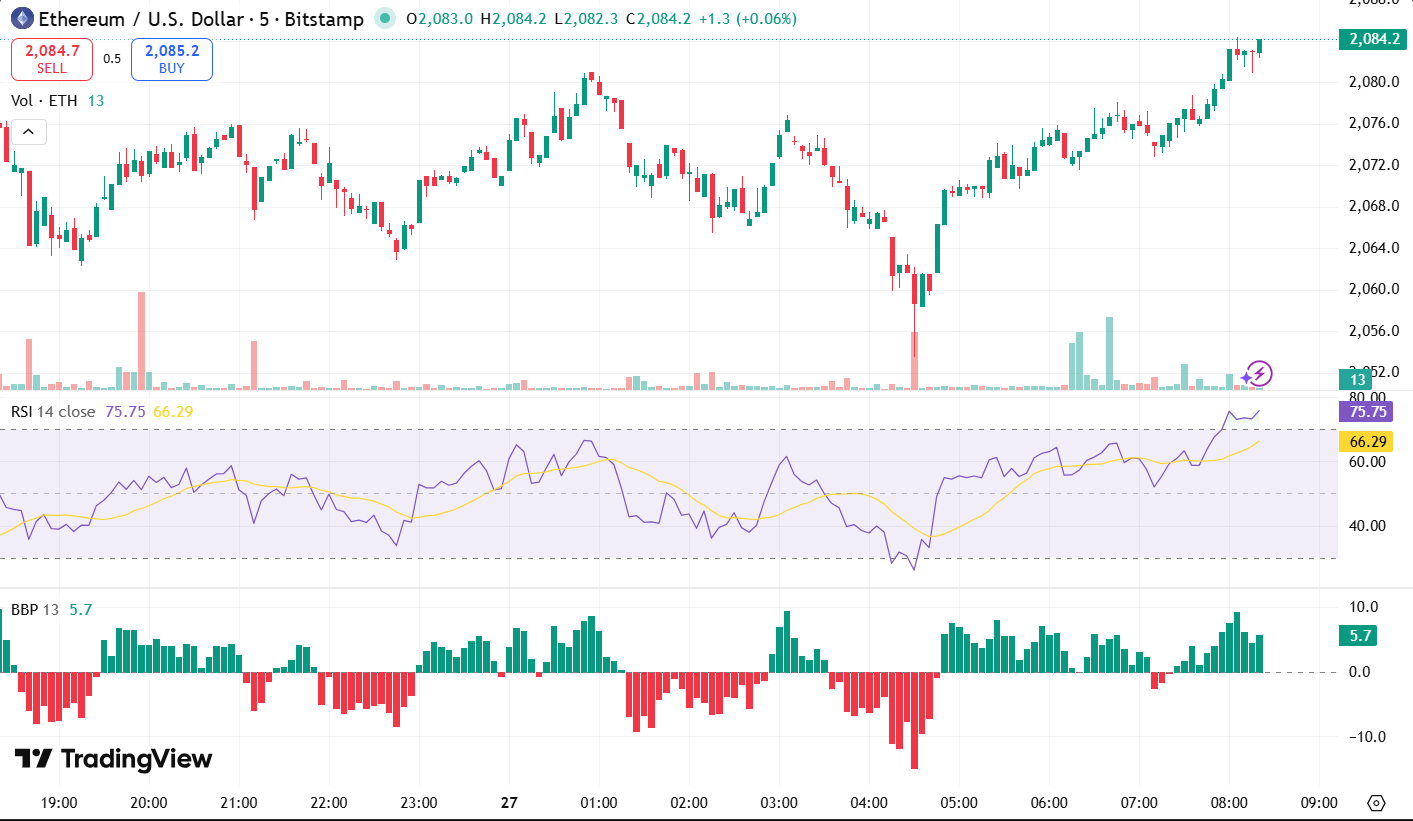
When it comes to the ETH price, it has been bleeding on the charts. CoinMarketCap shows that the value of Ethereum dipped from around $2,130 to $2,080 in the past seven days. This is just a continuation of the monthly downtrend which saw the ETH price drop over 10%.
Its immediate support level sits at $2,075 which is the level the ETH price closed at in the previous trading session. If that fails, ETH could see a dip to the $2,052 level which is the low for the current session. The long-term support level sits at $2,006 and if it drops below that it could signal a big bearish shift.
On the other hand, the immediate resistance level is $2,103 for the ETH price. A jump above this level could lead to a pump to $2,125 which is a stronger resistance barrier. In the long term, the resistance level that needs to be broken is the zone between $2,138 - $2,212 where multiple MACD signals converge.
Technical Indicators Paint a Mixed Picture
The technical indicators for Ethereum are also showing some mixed signals. For example, the 14-day RSI indicator now has a value of 75 as per TradingView. This suggests that ETH may be overbought. In other words, the price of ETH could see more pullback soon which is bearish in the short term.
Meanwhile, bulls are still in control as the 13-day bull/bear power indicator has a value of 5.7. The green bars rising paint a picture of bulls controlling the market momentum at the moment.
Keep in mind that the RSI indicator looks at the momentum of a crypto while the bull/bear power indicator focuses on its value relative to a moving average. This means the longer-term price trend and strength is in the hands of buyers despite the bearish short-term potential.
A Potential Ethereum Supercycle?
Ethereum's market structure looks quite different from the previous cycles which was made of retail speculation. Today, more corporations like Bitmine and ETF issuers want to take advantage of it. Alongside that, the broader crypto market is seeing benefits as Wall Street tokenization and agentic-AI take off according to Tom Lee.
He believes these ongoing trends are beginning to create an environment that can initiate a new broader crypto supercycle. Granted, this is long-term speculation. For now, the immediate concern for ETH should be a recovery above the $2,200 mark and potentially reaching the 1-month high of $2,424 before any supercycle starts. It has failed to do that in the last few days.
Can ‘tokenization + AI’ really drive the next supercycle, or is it just another hype narrative? If interested, feel free to vote on this poll and tell us how you came to that conclusion in the comments.
A Google software engineer was charged with insider trading on Polymarket, where he allegedly made more than $1 million betting on one of last year’s most popular Internet searches.
Michele Spagnuolo was charged in a complaint unsealed Wednesday in federal court in New York. Spagnuolo, 36, appeared before a federal magistrate and was released on a $2.25 million bond.
A lawyer for Spagnuolo didn’t immediately respond to messages seeking comment on the charges.
The case comes amid growing concern about insider trading on prediction markets. The charges against Spagnuolo come just a little more than a month after a US Army Special Forces master sergeant was charged with using classified information about the operation to capture then-Venezuelan president Nicolas Maduro to make $400,000 betting on Polymarket.
According to the complaint, Spagnuolo, an Italian citizen who joined Alphabet Inc.’s Google in 2014, had access to company data that tracked user searches when he bet that Google’s most-searched person in 2025 would be the singer D4vd. Last month, D4vd, whose real name is David Anthony Burke, was charged with murdering a 14-year-old girl. He has pleaded not guilty.
At the time, Polymarket assigned a “near-zero probability” that D4vd would be the top-ranked search over figures like Pope Leo XIV and Kendrick Lamar, prosecutors said. When D4vd was publicly announced as the top-searched person in December, Spagnuolo allegedly made around $1.2 million.
“We’re working with law enforcement on their investigation,” a Google spokesperson said in a statement. “The employee accessed our marketing material using a tool available to all employees, but using such confidential information to place bets is a serious breach of our policies. We’ve placed the employee on leave and will take the appropriate action.”
Prosecutors said Spagnuolo, who traded on Polymarket under the username “AlphaRaccoon,” also sought to cover up his bets with a service that adds privacy protection to cryptocurrency transactions, according to the complaint.
Gannon Ken Van Dyke, the Army sergeant charged with insider trading on the Maduro ouster, has pleaded not guilty.
The case is is US v. Spagnuolo, US District Court, Southern District of New York.
A series of suspicious oil trades earlier this year, during the US-Israeli conflict with Iran, prompted the White House to go so far as to send a staff-wide email warning against insider trading. Remarkably prescient trades had become such a regular occurrence that President Donald Trump’s government had grown concerned with the optics — and that’s saying something for an administration that has flaunted its conflicts of interest!
Well-founded concerns persist that the government is doing too little to police insider dealing in both new and traditional markets. Prediction markets, in particular, have become an invitation to anyone with a nugget of information to place bets using hyper-specific event contracts concerning policy decisions and other government actions.
A New York Times report detailed dozens of dubious and previously unscrutinized trades on the prediction platform Polymarket. CBS News reported on nine connected Polymarket accounts that have made more than $2.4 million betting almost entirely on US military actions. The company has said that “insider trading has no place on Polymarket,”1 and that it refers cases involving classified government information to the Justice Department. But it goes beyond the new event contract markets. Oil futures again suspiciously sold off this month before an Axios scoop that suggested progress toward ending the Iran war.
It’s the type of behavior that harks back to the anything-goes stock market of the 1920s when a regulatory vacuum allowed an informed elite to profit off the backs of the masses. Long after the financial anarchy culminated in the 1929 crash and the Great Depression, the loss of trust lingered, crimping stock market participation and forestalling any kind of rebound. Congress eventually created the Securities and Exchange Commission to protect investors and guard against fraud. An epidemic of dodgy transactions once again tested public faith in markets in the 1980s, especially after the prosecutions of junk-bond king Michael Milken and the late insider-trader Ivan Boesky, an inspiration for the Gordon Gekko character in the film Wall Street.
The actual prevalence of insider trading and other unethical behavior today is hard to quantify in real time because it happens in the shadows. But as the perception of bad behavior grows, it is incumbent on regulators and policymakers to send clear signals to the American public and international investors that they’re addressing the problem.
Under Chair Paul Atkins, the SEC claims it’s doing more with less, and that it can remain tough on the crimes that matter most without creating burdensome compliance hoops for companies to jump through. “Our goal should be to increase the cost of fraud and manipulation, not the cost of compliance itself,” Atkins said in remarks earlier this year.
Retail investors are counting on the protection. The proportion of families that directly hold stocks is near a record, and retail traders’ daily net turnover of individual US equities soared to around $750 million a day in 2025, from less than $60 million in 2019. That level of participation won’t be sustainable if our market integrity is allowed to deteriorate. Traders surveyed by Bloomberg News already report declining confidence in the workings of the oil market. Investors will ultimately retrench and the cost of capital will increase.
These effects can be especially catastrophic for the working class, who might be scared away from investing for retirement or their children’s educations. This at a time when Americans’ trust in their institutions is already extraordinarily low.
The authorities are catching some of the naughty behavior. A US Army soldier was charged with using classified information about the capture of Venezuela’s Nicolás Maduro to make more than $400,000 on Polymarket. And indictments unsealed this month describe an alleged insider-trading ring involving attorneys from some of the top mergers and acquisitions firms in the country.
But we only learned of a Commodity Futures Trading Commission probe into suspicious oil trades after a letter from Democratic Senators Elizabeth Warren of Massachusetts and Sheldon Whitehouse of Rhode Island encouraged the agency to open such a probe. For all the insider trading cases that have made headlines, the real risk is that they’re just the tip of a much larger iceberg that our downsized regulatory authorities aren’t fully addressing.
The SEC took the fewest enforcement actions in a decade during the last fiscal year, and it recently saw enforcement director Margaret Ryan quit after just six months. It dismissed or paused at least a dozen cases against crypto companies, and it dropped civil enforcement actions against three businessmen who received pardons or commuted sentences from the president.
The CFTC, which generally has responsibility over the new prediction markets, also saw less enforcement activity versus the prior year. The New York Times reported over the weekend that the CFTC’s then-acting chair Caroline Pham and her senior counsel helped prediction markets get their way with regulators, and that some officials who raised concerns were put on leave.
Less active regulators send a signal to bad actors that the odds of crime paying off are improving. History has shown that individuals consumed by worry about getting cheated are less willing to invest. In one study of the record-breaking Bernard Madoff Ponzi scheme, the authors found that investors more exposed to the fraud were more likely to pull their money from investment advisers and put it in cash. Another study found the larger the staff and budget that the SEC throws at the problem of enforcement, the less brazen the pre-event price run-ups ahead of major corporate news announcements such as earnings and M&A.
Questions about how government officials conduct themselves have also grown. Trump’s investment advisers placed more than 3,700 trades in the first quarter, including many that involved companies that have dealings with the administration. And although the US Senate has banned itself from prediction market participation, the House has been . Efforts to bar members of Congress from stock trading have languished for years.
It’s still far from clear when an event contract trade rises to the level of illegal insider trading under existing law — to prosecute successfully, you sometimes need something as egregious as the misappropriation of classified military intelligence, as in the Venezuela case. And while the trading volumes in prediction markets are still small compared to stocks and bonds, the markets are growing by leaps and bounds, and the signals they generate are exerting vast influence on traditional markets.
Let Political Candidates Bet on Themselves: Stephen L. Carter
Investors Benefit From More Financial Data, Not Less: Editorial
High Bond Yields Are What US Needs in the AI Era: Jonathan Levin
Nine anonymous cryptocurrency wallets have effectively gained control over who wins and loses on Polymarket’s most contested prediction market bets, giving a tiny group of unappointed people outsized power over billions of dollars of wagers.
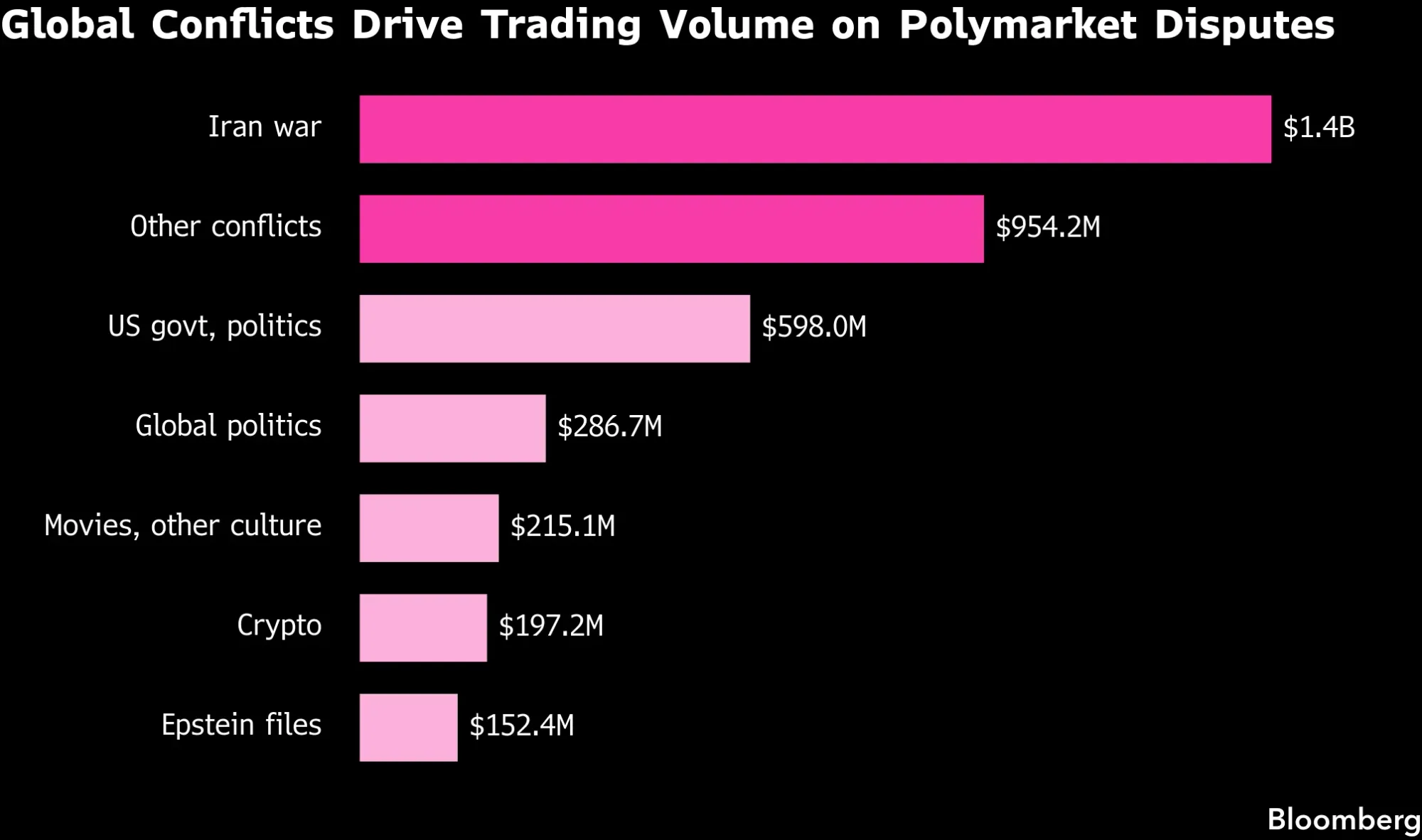
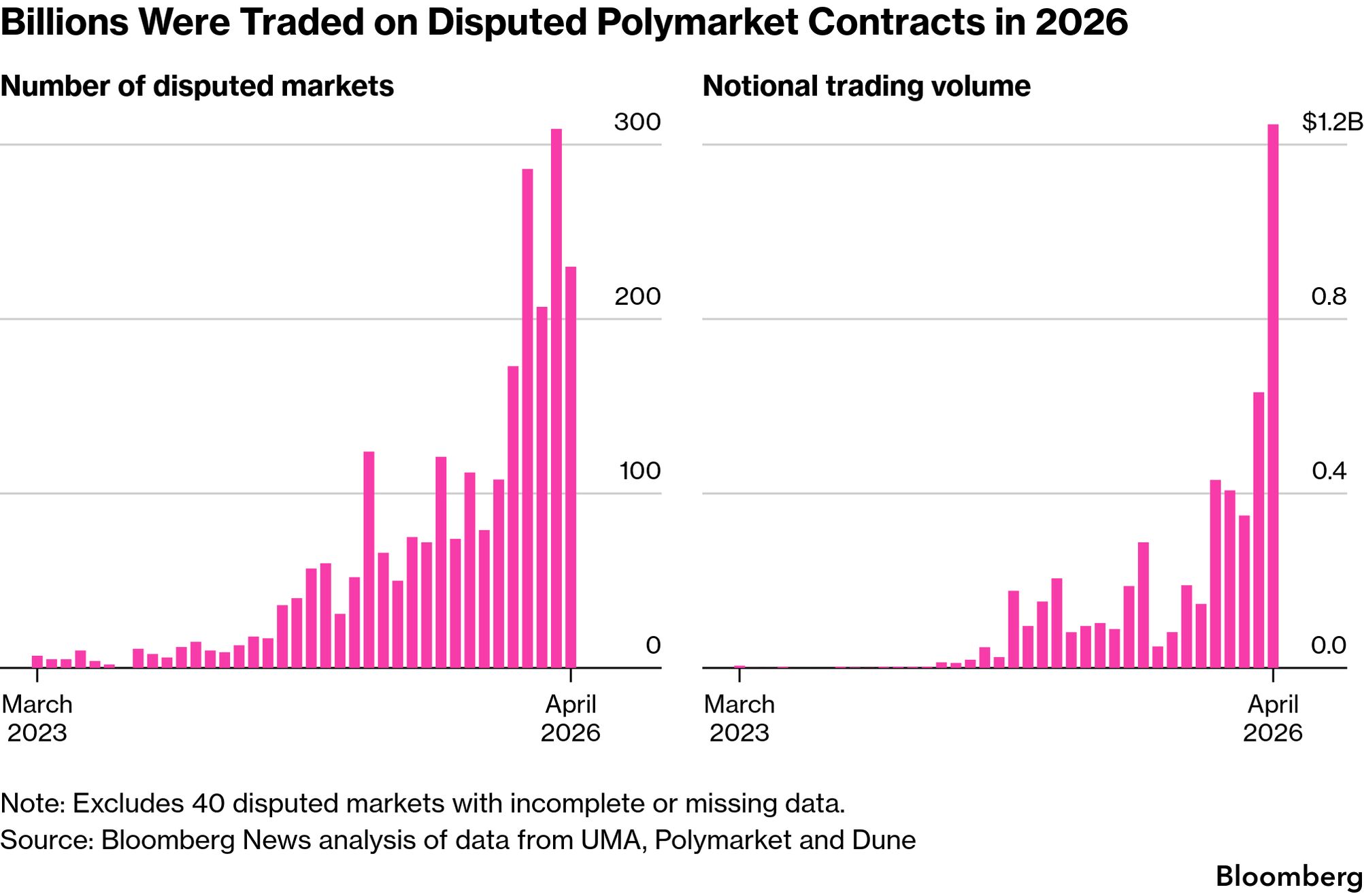
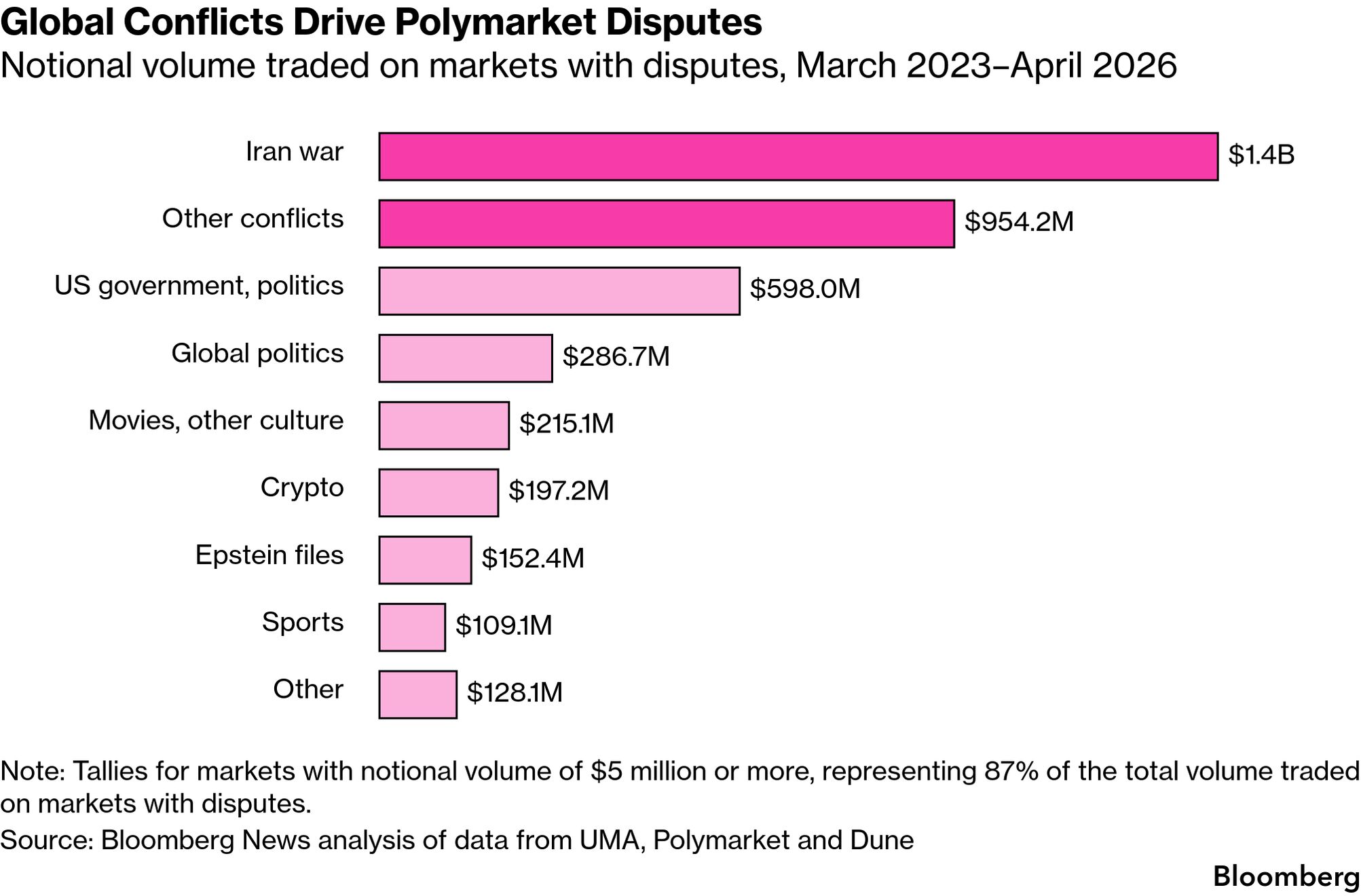
Over the past year, nearly 2,000 Polymarket financial contracts have been disputed and adjudicated by the company’s complicated third-party resolution mechanism — including bets on war, elections and geopolitical conflict. In April alone, 230 contracts that attracted more than $1 billion in trading ended up being decided through the process, up from 79 contracts six months earlier, according to a Bloomberg News analysis of blockchain records and past votes.
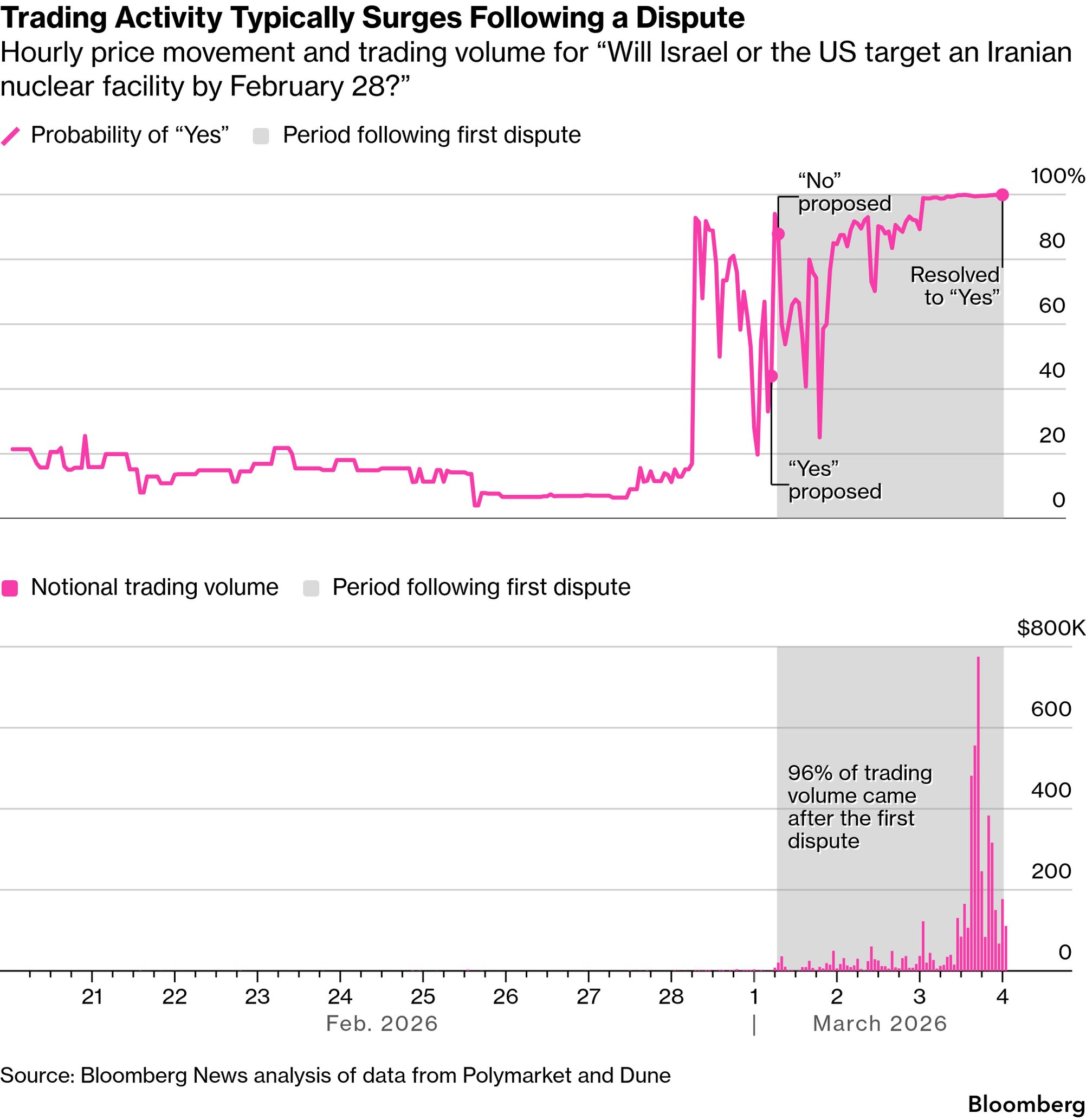
Under Polymarket’s rules, whenever the outcome of one of its financial contracts faces an official challenge, the dispute goes to a vote among holders of UMA, an independent cryptocurrency. In one recent case, UMA owners voted on how to resolve a contract tied to whether the US and Israel had struck Iranian facilities in February, with the odds bouncing around as traders tried to guess how the UMA holders would vote.
The process was designed to give bettors an open, crowd-sourced path to the truth — central to Polymarket’s identity as a decentralized “global truth machine.” It has, though, ended up concentrating power in the hands of whoever bought the most UMA tokens, even if they make decisions that defy logic and are motivated by pure economic self-interest, rather than any adherence to the real answer to the question being wagered on.
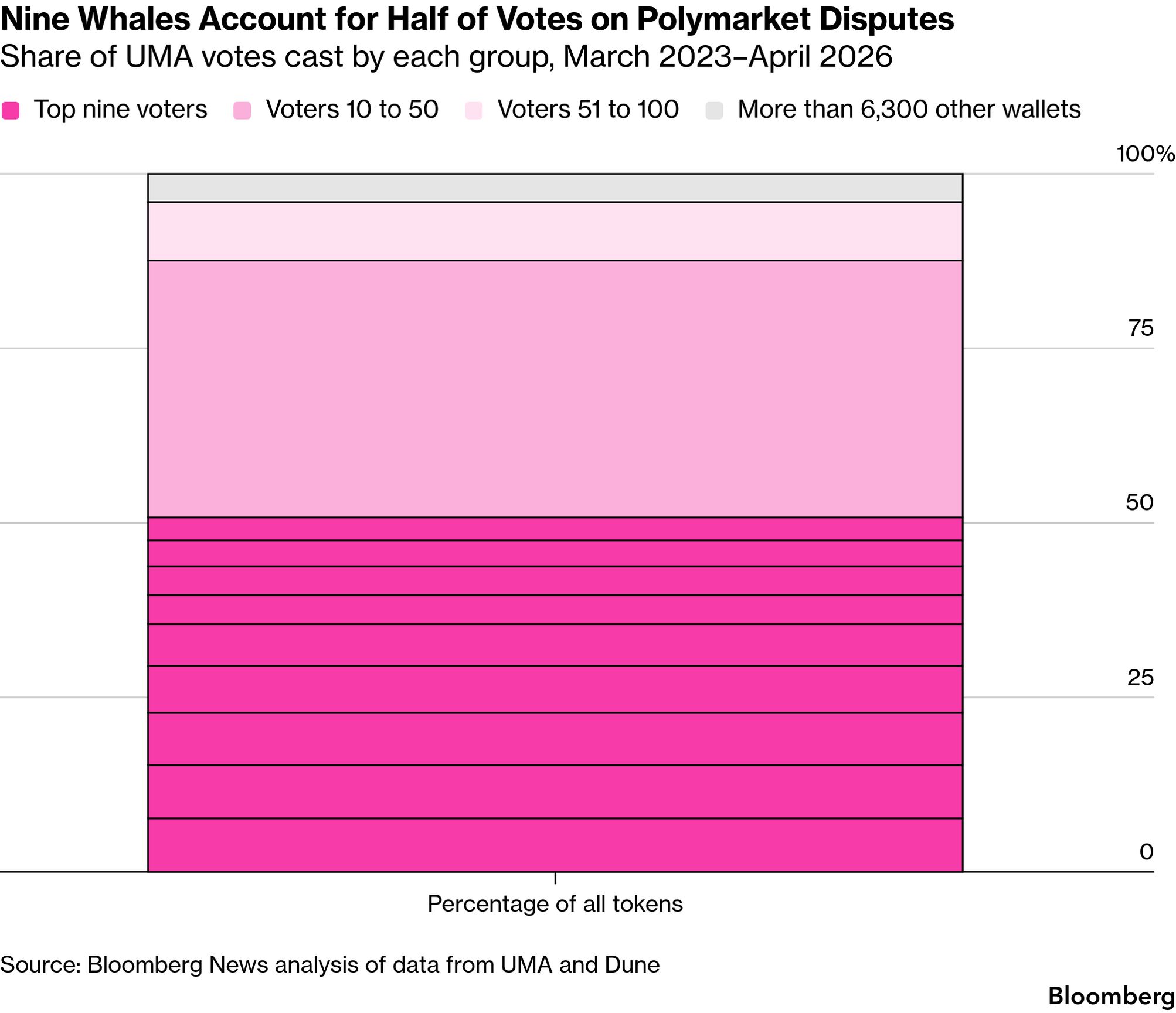
Just nine wallets accounted for roughly half of all UMA tokens that have voted on a Polymarket resolution over the past three years, the Bloomberg analysis found. That’s out of more than 6,400 accounts that have participated in at least one dispute. The nine wallets have essentially always voted together and for the winning position.
The concentration of voting power has drawn blowback from a growing number of unhappy traders who say the system has given the biggest holders the ability to tip votes in ways that serve their own financial interests, even if it leaves others holding the bag.
“No serious investor will put money there as long as there’s no transparency regarding the resolution criteria,” said Jan Czarnocki, general counsel at prediction markets startup Elastics. Czarnocki lost money on an UMA dispute about US forces entering Iran earlier this year. “Here it’s just a discretionary use of power basically.”
Polymarket declined to answer questions about changes to the UMA process. Risk Labs did not respond to requests for comment.
The UMA controversies are the latest signs of Polymarket’s struggles to move away from its scrappy crypto roots as it grows and becomes more intertwined with the traditional financial system. The company has attracted investment from Intercontinental Exchange Inc. and hosted $9 billion in bets on its primary exchange last month. But it has struggled with technical problems, and fallen behind its main rival, Kalshi Inc., in trading volume.
When contracts on Kalshi are disputed, the company’s employees are the final authority on which side wins. That has drawn complaints from customers after unpopular outcomes, in part because of the lack of transparency around Kalshi’s decisions. On Polymarket, the company can step in and reverse decisions made by UMA voters, but it has rarely done so.
Disputes have particularly wide ramifications on Polymarket because the exchange offers more bets on geopolitical events, and it has become a new and widely-cited source of forecasts and information on fast-developing situations. Bets tied to global conflicts have been the source of many recent disputes as traders try to see through the fog of war to figure out the specifics of what happened on the ground.
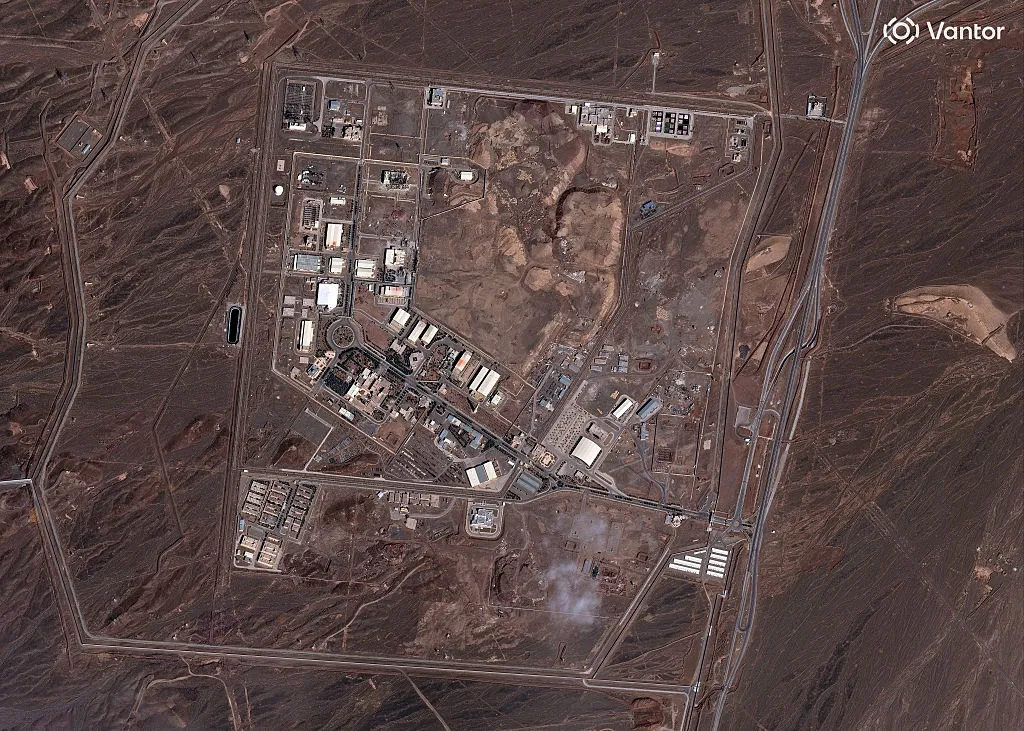
In the dispute over the alleged US and Israeli attacks on Iranian nuclear facilities in February, Polymarket traders argued over whether the first military strikes in Iran met the exact conditions laid out in the financial contract.
In UMA’s official Discord server, potential voters discussed news reports indicating that a targeted nuclear facility had been left unscathed, and satellite imagery suggesting the first known strike on a different building came after the month was over.
As often happens during these disputes, trading remained open as the deliberations went on, allowing people to put millions of dollars down in response to where the UMA debate seemed to be trending on the Discord server. Risk Labs has warned investors on UMA’s Discord that “some commenters may attempt to influence vote outcomes for their own profit.” In the end, there was far more trading after the voting process began, than before it.
The nine biggest wallets were all involved in the vote and backed the winning side, as they almost always do. The similar voting patterns are, to some degree, a product of UMA’s design. The mechanism offers a financial reward to any voter who ends up on the winning side — and a penalty for those who lose — encouraging users to choose the position that appears most likely to carry the day. The Discord conversation often ends up being an exercise in people trying to figure out which way the biggest holders — the whales — are leaning.
The criticism of this process is reminiscent of more momentous controversies in the traditional financial world, where small groups of traders had the power to swing much bigger markets. Several global banks paid huge fines between 2012 and 2015, after it was discovered that traders had colluded to manipulate the benchmark London Interbank Offered Rate that influenced the cost of borrowing money around the world.
The stakes for Polymarket bettors are much smaller. Less than 1% of all contracts traded on the exchange have faced disputes that led to an UMA vote. But the frequency with which market outcomes are challenged is rising as trading continues to grow.
A number of smaller users have banded together to create a group called UMA.rocks, aimed at taking on the power of the biggest whales. But as UMA.rocks has gained more voting power, accounting for 8% of all votes last month, it has been accused of becoming a new kind of whale, and another part of the same problem. In an attempt to tackle that criticism, its founder recently overhauled the way users’ funds are automatically allocated to votes.
One of the most prominent prediction market traders, who goes by the screen name Domer, has been complaining about the problems with UMA for the last year. He recently wrote a social media post expressing frustration with UMA.rocks, but also with Polymarket, for not fixing the problem.
“We were assured that things would change,” he wrote. “Unfortunately nothing has changed, and it has gotten far, far, far worse.”
Bitcoin has been going through some troubles in the past few days. First, its value sank nearly 5% in just one week. Next, Truth Social revealed it has abandoned its Bitcoin ETF plans. This could have been because of the competitive ETF landscape according to one ETF analyst. Despite all this, the technical analysis for BTC is still positive.
Truth Social Withdraws Proposed Bitcoin ETF Filings
According to a recent statement, Truth Social's proposed Bitcoin ETF filings which were done in June 2025 to the U.S. SEC were officially abandoned. The proposed funds' sponsor and investment adviser Yorkville America claims that this decision is strategic and does not mean it will be the end of the company's crypto offerings.
One reason for this decision could be the fact that the Bitcoin ETF landscape has become more competitive. Most investor inflows are now going to top companies with strong reputations. Plus, asset managers have started lowering their fees as they go after institutional capital.
In fact, Bloomberg ETF analyst James Seyffart claims that this intensifying competition is likely connected to why Truth Social backed out of its ETF launch. He specifically pointed to Morgan Stanley’s MSBT which only has 14 basis points (a 0.14% management fee).
The BTC Price Pulls Back
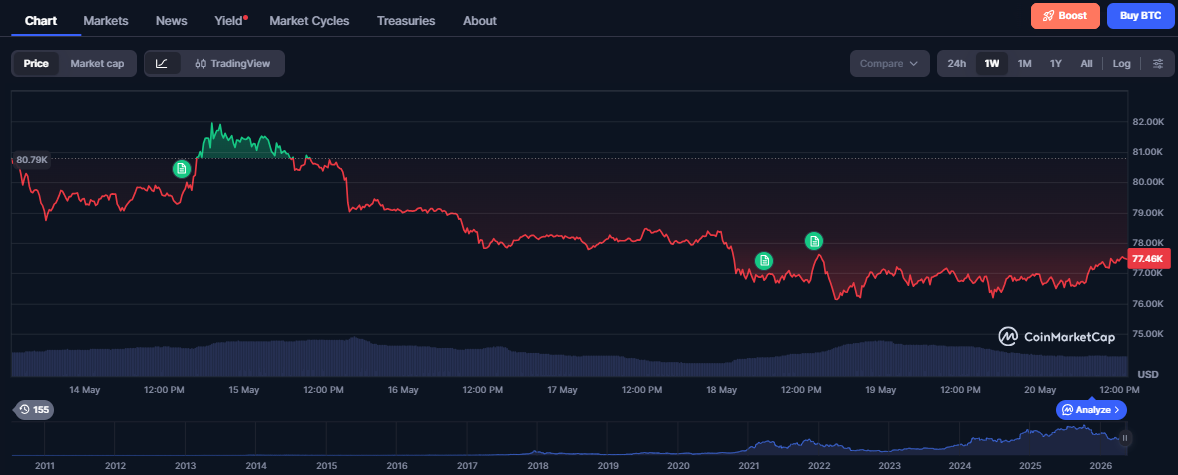
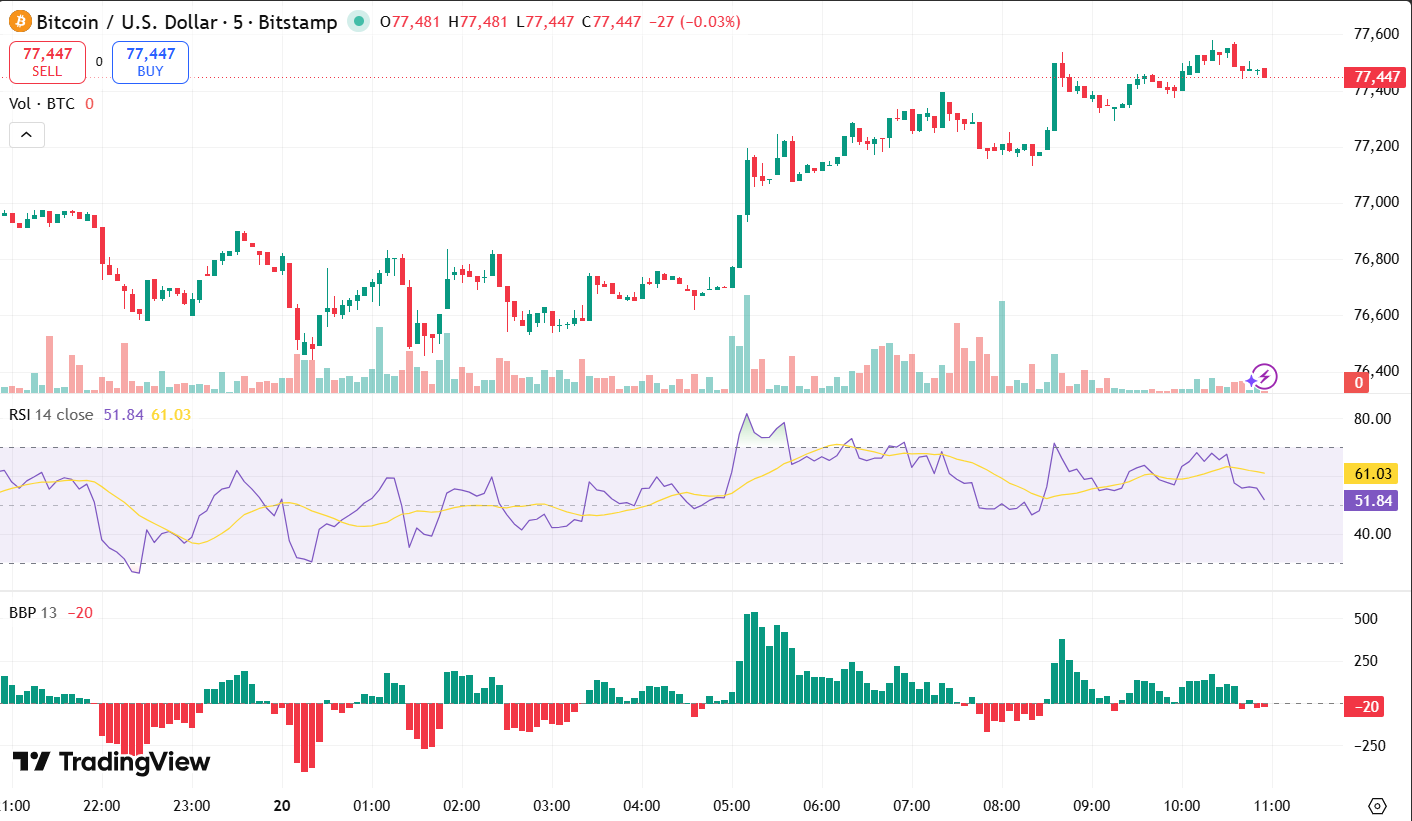
At the same time, the Bitcoin price action has been a little weak on the weekly price charts. CoinMarketCap shows that the price of BTC fell from around $81,120 to nearly $77,400 in the past seven days. This can be seen as a correction since the value of BTC increased from $74,740 on the monthly chart.
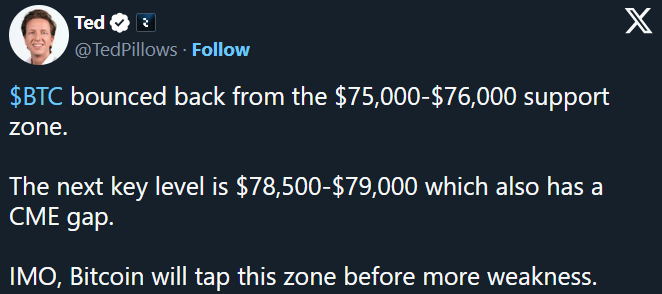
However, there is still bullish market sentiment for BTC in the crypto community. For instance, one prominent trader Ted said that the price of BTC could go on a gap-fill rally to $78,500-$79,000. To clarify, the CME Bitcoin futures market shuts down during the weekends. Because of this, a gap fill tends to happen after that. Therefore, some traders expect the Bitcoin price to go up soon.
But, these are just guesses. What matters is the facts. Currently, the immediate resistance for BTC sits at $78,258 - $81,500. Traders see this range as a key short-term test around the 200-day EMA. If this level gets broken, the BTC price could go to its 13-week high of $82,814. On the other hand, its immediate support levels sit at $76,220. The price could dip as low as $75,500 if this support level fails.
Technical Analysis Shows a Mixed Bitcoin Picture
The technical analysis shows some bullish and negative signs for Bitcoin right now. For instance, TradingView data shows that the 14-day RSI indicator now has a value of 51 which is a positive sign. This suggests that the BTC price is moving with slight upward momentum. It is sitting comfortably in the middle, not overbought or oversold.
Meanwhile, the 13-day bull/bear power indicator is more bearish. Notably, the last two bars are red and below the zero line at -20. This shows that the sellers are gaining more control since the indicator compares a price to a 13-day moving average. Bars below the zero line show that the BTC price is trading under that average. In other words, a bearish sign.
What Could Come Next for Bitcoin?
Currently, there is some negativity surrounding the short-term impact of the Bitcoin ETF withdrawal by Truth Social. The biggest question right now is if Bitcoin's most important support levels can hold as its ETF space goes through changes.
If bulls manage to take control of BTC again and flip the resistance level of $81,500 soon, a jump to its 13-week peak of $82,814 may follow. However, the key is holding above the $76,220 support level. Looking at the bigger picture, what is your opinion? Is this price dip a buying opportunity or the start of a larger correction for BTC? Feel free to vote on this poll and also explain why you came to that conclusion in the comments.
High volume and short-term markets that ask simple questions with clear resolution rules — that's the formula Evercore ISI strategists say make prediction markets helpful for forecasting.
Led by Julian Emanuel, they found contracts with higher volume produce more reliable probabilities than shallow markets. Similarly, contracts closer to their termination date showed stronger probability versus a long-term contract.
Despite the growth, they avoided calling prediction markets a north star.
"Their limitation is that they do not discover the future so much as reveal what the crowd believes," the strategists wrote in a May 17 report.
There's also another issue: Most contracts have low volume. Evercore found that only about 8% of events on Kalshi and Polymarket clear $1 million in volume.
A similar pattern was found with only live markets as well. As of Friday afternoon, nearly 60% of live markets on Kalshi and Polymarket have less than a $1,000 in trading volume. Only a sliver, roughly 5.3%, have markets with at least $100,000 in trading volume.
Evercore did note, however, that prediction markets thrive in chaotic macro events since it responds to headlines or real life moments compared to traditional forecasting tools that can face "polling errors, expert bias or subjective judgement." It also helps that a market can penalize participants and can have a mix of macro traders, industry experts and regional participants.
"The resulting price is not a perfect forecast, but it is often a useful expression of the live consensus probability," the analysts wrote.
But this diversity of traders can also be a hinderance. Everyone's reasoning to trade stretches from entertainment to hedging, which can "contaminate" the market price, the analysts cautioned. For example, a geopolitical market may be less about forecasting and more so representing a political view or fear.
The strategists also warned a thin market, suddenly being moved by a large trader, can deceive the market's outcome.
Having markets with an objective outcome rather than an ambiguous one can impact how good prediction markets are at detecting the probability of the event. The strategists said this is especially true for geopolitical reasons.
For example, "will a ceasefire hold?" may be up to interpretation, the analysts shared. When ambiguous contracts resolve, it can focus less on the actual event happening but more on that it fulfills the language.
Markets with simple questions also have their downsides, they said. Since simplified contracts can fail to get the full picture of an actual real life event.
"A binary contract can capture one slice of that uncertainty while leaving out the parts investors actually need," Evercore wrote.
The strategists said prediction markets skyrocketed because of institutional attention, its infrastructure, contract breadth and the 2024 CFTC decision to approve election-related contracts on Kalshi. Leading prediction market platforms Kalshi and Polymarket saw trading volume growth during the 2024 presidential elections but trading volume skyrocketed in fall 2025.
Hedge fund short sellers have made at least $2.3bn this year betting against online gambling companies, which are under pressure from both the rapid rise of prediction markets in the US and steep tax increases in the UK.
Traders positioned to make money from falls in the share price of betting groups Flutter, DraftKings and Entain have accumulated estimated paper profits of $2bn, $351mn and $35mn, respectively, since the beginning of 2026, according to data provider S3 Partners. Some of this profit has been realised as funds have closed their short positions.
Shares in the world’s largest publicly traded gambling company Flutter, which is dual-listed in London and New York, have dropped more than 50 per cent so far in 2026. DraftKings, which is the closest competitor to Flutter’s US sportsbook FanDuel, is also down about 30 per cent, as investors fret that prediction markets are eating into the $17bn US sports betting market.
Across the Atlantic, London-listed Entain, which owns British betting chains Ladbrokes and Coral and runs US sportsbook and casino brand BetMGM in a joint venture with MGM Resorts, has fallen 30 per cent.
The declines come as investor sentiment towards US-focused sports betting companies has “reached extreme levels of pessimism” amid the rise of prediction markets, according to Barclays analyst Brandt Montour. Analysts at Citi last month downgraded Flutter’s shares from buy to sell, citing concerns about the company’s ability to hit its US profit targets.
Prediction markets, which allow customers to bet on binary outcomes of future events, are currently regulated as derivatives by the Commodity Futures Trading Commission, enabling them to bypass states’ sports-gambling bans and taxes. They have surged in popularity and now attract billions of dollars in sports wagers every month, sparking fears that they will erode gambling companies’ profits.
UK-focused betting brands have also struggled after chancellor Rachel Reeves raised taxes on online casino games and online betting in her November Budget. Entain in March reported that it had taken an unexpectedly large £488mn impairment charge as a result of the new levies, while Flutter — which owns chains such as Paddy Power, Sky Bet and Betfair — in February warned that the new levies were slowing growth.
Hedge funds that have increased bets against Flutter include DE Shaw, which started increasing its position last October and was shorting 1.49 per cent of Flutter’s London-listed stock, according to the latest disclosures filed with the UK Financial Conduct Authority. Two Sigma Investments has also built a short position in 2.17 per cent of Flutter’s total London-listed shares — now the largest short position — up from 0.61 per cent at the end of 2025.
Other funds that have taken short positions against Flutter so far this year include AQR Capital Management, Marshall Wace and Balyasny Asset Management.
Marshall Wace, Millennium International Management, and Capital Fund Management have all shorted Entain. Marshall Wace has held the largest net short position so far in 2026, as much as 1.7 per cent of Entain’s shares in April, but has since partly cashed in the bet.
Marshall Wace, Capital Fund Management, AQR Capital Management, Two Sigma, Balyasny Asset Management and Millennium declined to comment. DE Shaw did not respond to a request for comment.
Not all short bets have come good, however. Funds holding positions this year against Evoke, owner of William Hill and 888, have lost about $3.5mn, according to S3 Partners, after the company — one of the hardest hit by UK tax rises — rebounded more than 50 per cent from its December lows amid reports of takeover talks with gaming operator Bally’s Intralot.
In the US, Barclays’ Montour anticipates a possible “relief rally” for both Flutter and DraftKings, as prediction markets also face rising scrutiny, legal disputes over whether they should be treated as gambling and fears that they could be facilitating a new wave of insider trading.