For most of the last decade, "how are EV sales doing" was a decent enough proxy for "how is lithium demand doing."
But lithium carbonate prices have risen 130% since June 2025. Over roughly the same stretch, EV sales weakened sharply in the US, Canada, and China at key moments.
Those two facts look like they should point in opposite directions. They don't, because EV sales stopped being the whole story for lithium demand a while ago, and the market's own forecasters are already saying so.
The clearest evidence sits inside one report. BloombergNEF's June 2026 outlook showed slowing EV growth in major markets while raising its 2025-2035 stationary storage battery demand outlook by 27%.
Traders still pricing lithium off EV sales alone are reading half of this report, so let’s give the EV side of this story its due before explaining why it’s the wrong lens.
Do you think lithium's rally reflects real fundamentals, or is it getting ahead of itself?
EV demand fell hard in its largest markets
EV demand genuinely fell off a cliff in several key markets, and it fell for a reason that should spook anyone using it as a demand signal: policy got pulled.
The IEA's Global EV Outlook, published May 20, found US EV sales fell 45% in the fourth quarter of 2025 versus a year earlier, timed almost exactly to the federal tax credit's expiration. The IEA links the drop directly to the end of US EV tax credits and broader policy shifts.
It’s not a one-off American policy accident either, because Canada ran the same experiment and got the same result. Its EV rebate program ended, and EV share of new car sales fell from nearly 17% in 2024 to 11% in 2025.
Two governments, two different countries, same experiment, same result, which is a pretty strong hint that marginal EV demand remained highly policy-sensitive, rather than fully organic.
This weakness is concentrated, but large enough to affect global numbers. Global EV sales fell 3% year over year in the first quarter of 2026, with North America down 27% and China, still the largest EV market, down 21% year to date despite a partial recovery in March.
BloombergNEF cut its long-term EV adoption outlook for the second year running, citing the US and China slowdowns directly.
Storage becomes the new trade
BloombergNEF's June 2026 report, the same one that cut the EV forecast, also raised its 2025-2035 stationary storage demand outlook by 27% over its prior estimate. Both changes came from the same team, in the same report.
Reuters, using UBS figures, put 2026 lithium demand growth from energy storage at 55%, following 71% growth in 2025. Guotai Junan estimates storage's share of total lithium demand rose from 23% in 2025 to a projected 31% in 2026.
Put simply, a trader reading lithium demand off EV sales alone is missing close to a third of total demand, and that third is growing faster than the EV share is shrinking.
Is this just one good sector covering for one bad sector?
Averaging a weak sector against a strong one only works if the two move for the same reasons. They don't here. EV sales are consumer decisions, and consumer decisions bend hard around tax credits and interest rates, which is exactly why the end of US tax credits coincided with a 45% year-over-year drop in Q4 2025 US electric car sales.
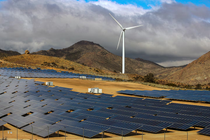
Grid-scale storage runs on utility buildouts and the power appetite of AI data centers, decisions made on multi-year infrastructure timelines that don't care what happens to a tax credit in Washington.
This gap is how storage becomes the blind spot.
Chinese lithium carbonate spot prices bottomed at roughly 58,400 yuan per tonne in June 2025 and rose to about 134,500 yuan per tonne by December, a 130% increase. Most happened before Reuters published its June 2026 report on producers shifting toward storage, so the price moved ahead of the mainstream coverage, which means the trade was not built entirely on new information becoming public.
Morgan Stanley projects an 80,000-tonne lithium carbonate deficit for 2026. UBS projects a smaller 22,000-tonne deficit. Both are a reversal from the roughly 61,000-tonne surplus estimated for 2025.
Albemarle, the world's largest lithium producer, reported its energy storage segment growing 117% year to date. This is a current-year number, not a forecast.
But even the forecasts are still catching up. Fastmarkets raised its own 2026 average lithium carbonate price forecast to $23.80 per kilogram in a report published this June, up from $17.40 per kilogram just months earlier, roughly a 37% upward revision to its own number.
When the agency that prices industry contracts is revising its 2026 call upward mid-year, it’s a direct sign the deficit wasn't fully reflected in prices even a few months ago, and the catch-up may not be finished.
Does this change who captures the upside?
This does not automatically change who captures the upside. Processing is still dominated by low-cost Chinese producers, so G7 leaders agreed last month to coordinate on Western lithium and nickel supply. Rising demand does not automatically help a Western producer if the margin still sits downstream, in processing capacity mostly outside the West.
Producers with less exposure to this bottleneck are in a different position. Australian hard-rock miners like Pilbara may benefit more directly from higher spodumene demand, but they still depend on downstream processing economics.
The question industry executives keep putting to Western governments is the uncomfortable one: what are they actually willing to pay for supply security, because so far, nobody's paid the bill.
Here’s what to watch next
Watch whether 2026 storage demand growth actually lands near UBS's 55% estimate, since the whole re-rating case rests on that number showing up in reality, not just in a forecast.
Next trigger is whether the Morgan Stanley and UBS deficit calls survive restarting supply, since higher prices are already coaxing idled Australian and Chinese capacity back online. If this capacity returns quickly, the Morgan Stanley and UBS deficit figures could narrow before they show up in price, taking pressure off the rally.
It’s interesting to see if G7 coordination on Western processing turns into anything concrete. A joint statement without follow-through would leave them exposed to Chinese processing costs regardless of what happens to demand, with even the price forecasters still adjusting upward to catch up to it.
The bottom line
At first glance, lithium still looks like an EV story running out of road, but this only holds if you think demand is still one number.
It isn't. It's two curves that stopped moving together, one shrinking for policy reasons, one accelerating for infrastructure reasons, sitting in the same forecast from the same analysts.
Traders still pricing lithium off the EV number alone are reading half the spreadsheet, and the other half has already started moving.
Which of these would most change your view on lithium from here?
Sources:
- IEA: Global EV Outlook 2026
- BloombergNEF: Electric Vehicle Outlook 2026
- Reuters: Lithium producers bet on battery storage as demand shifts beyond EVs
- Reuters: Energy storage boom strengthens demand outlook for beaten-down lithium
- Electrek: Global EV sales data, Q1 2026
- Seeking Alpha: Albemarle energy storage segment growth data
- Panorama Minero: Fastmarkets interview on price forecast revisions