
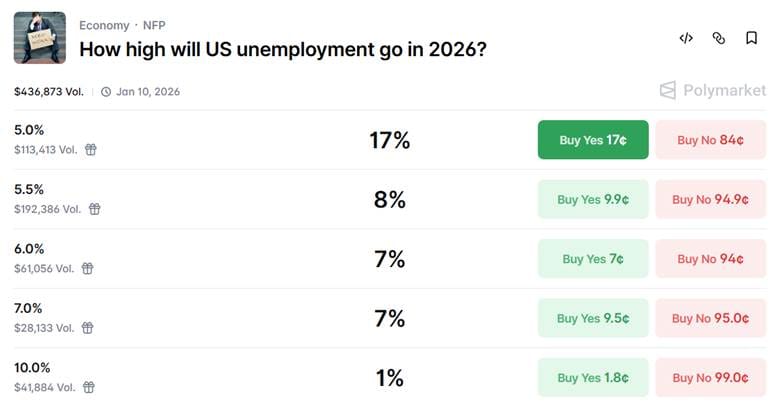
As of this writing, Polymarket traders are giving the 5.0% US unemployment line around 17% odds for 2026.
On the latest headline data, this price is easy to defend. Unemployment is still 4.3%, payrolls are still growing, and the labor market has not cracked. But the contract is broader than a snapshot of today’s economy: it resolves “Yes” if any seasonally adjusted U-3 unemployment rate in a 2026 BLS Employment Situation report comes in at 5.0% or higher.
This means one monthly print is enough, unemployment does not have to finish the year at 5.0%.
This is where the price gets more interesting. At 17%, the market is technically saying the jump from 4.3% to 5.0% is unlikely to happen in any of the remaining Employment Situation reports for a 2026 reference month.
The market has the headline data on its side
The latest jobs report gave traders no obvious reason to panic. The economy still added 172,000 jobs in May, and unemployment did not move from 4.3%. Revisions helped the picture too, with March and April now showing 93,000 more jobs than first reported.
This is a solid defense of the 17% price. The unemployment rate has been stuck in a narrow 4.3% to 4.5% range since July 2025, so 5.0% is still a meaningful move from here. It is close enough to monitor, but far enough that traders can fade it without sounding reckless.
Source: DOL
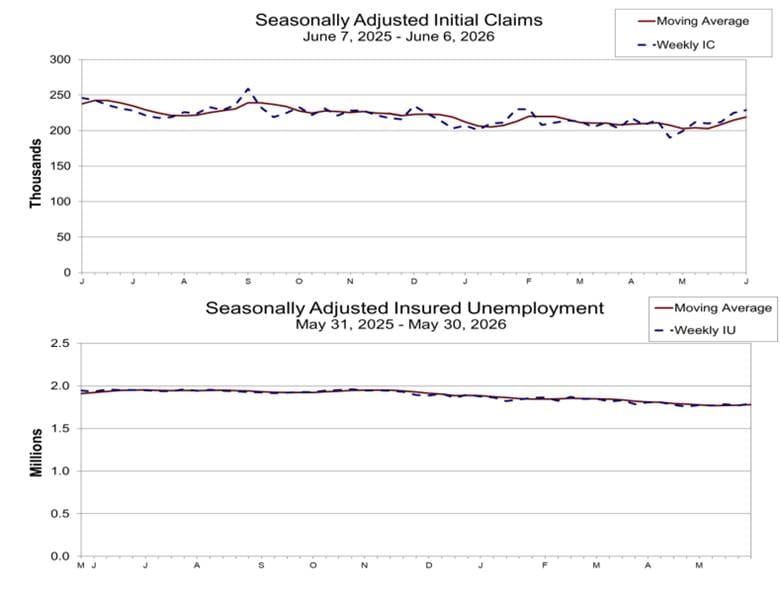
Claims are not giving the 5.0% camp much help yet. Initial claims were 229,000 in early June, with the four-week average at 219,000, so the direction is not alarming. Continued claims have also moved up, which is worth watching, but this still looks more like a labor market losing speed than one already breaking toward 5%.
This is the middle ground behind the 17% price: enough weakness to keep the threshold on the radar, not enough to make a 5.0% print the base case.
The better question is how unemployment gets there
A move to 5.0% can come from fewer companies adding workers, job searches stretching out, and unemployed workers taking longer to get pulled back into payrolls.
Source: BLS
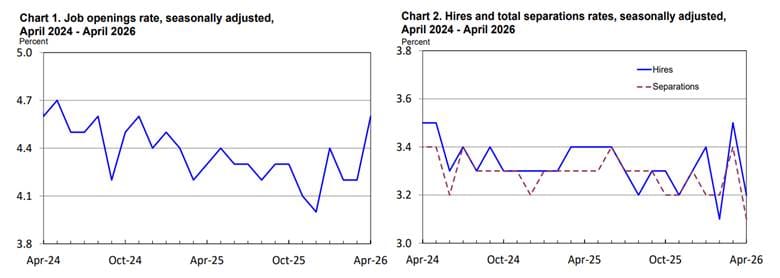
April’s JOLTS report had a split message: openings climbed to 7.6 million, while hires slipped to 5.1 million and separations fell to 5.0 million. For this market, this mix matters more than the headline openings figure. Employers can keep vacancies online while moving more slowly on actual hiring, which is how labor slack can build before the unemployment rate fully shows it.
If hiring stays weak while unemployment edges up to 4.4% or 4.5%, the 5.0% line will look more and more plausible.
The duration data makes the calm look less clean
May also showed more strain in unemployment duration. The long-term unemployed reached 2.0 million, up 524,000 from a year earlier, and workers out of work for at least 27 weeks accounted for 27.5% of all unemployed people. This makes the stable 4.3% headline rate look less settled, because longer job searches can push unemployment higher without one dramatic layoff wave.
Continued claims are a cleaner check on re-employment than initial claims, which can be noisy week to week. A few more readings moving higher would put pressure on the idea that labor softness is staying neatly contained.
This is the narrow challenge to the 17% price, because the market may be right about the current labor picture and still too relaxed about what comes next.
What would make 17% look too low?
The June jobs report is the next major checkpoint, but the contract stays live through every remaining 2026 Employment Situation report. Still, a rise to 4.4% or 4.5% would already change the trade, especially if it comes with softer payroll growth, weaker revisions, or another increase in long-term unemployment.
A payroll print below roughly 100,000 would also carry more weight if prior months are marked down. One soft report can be dismissed, but a soft report that drags the recent trend lower is harder to wave away.
The JOLTS follow-through matters too. If openings stay elevated but hires keep falling, the labor market is telling traders that posted demand is not translating into actual jobs.
The countercase is simple enough. Polymarket’s price holds up if unemployment stays in the low-to-mid 4% range, payrolls remain positive, continued claims stop rising, and wage growth cools without a bigger hit to employment.
For now, traders are treating 5.0% unemployment as a long shot. And it may be right. But because this contract only needs one 2026 print to get there, the real test is whether the next few reports keep the drift from becoming a trend.
Sources:
1. BLS: Employment Situation Summary
2. BLS: Job Openings and Labor Turnover April 2026
3. DOL: Unemployment Insurance Weekly Claims