Nvidia’s latest quarter strengthened the broader AI-compute demand case, though not the custom-silicon thesis by itself. Nvidia reported $89 billion of quarterly data-center revenue, up 117% YoY, while maintaining a company-wide gross margin of 75%. Meanwhile, Broadcom reported 221% growth in AI semiconductor revenue. Together, the results show that demand for AI compute remains enormous—but only Broadcom’s print directly tests whether custom accelerators can scale economically.
The adoption question is no longer whether hyperscalers will use custom silicon; Google’s TPUs and other in-house programs have already established that. The remaining question for Broadcom is whether it can scale those programs while preserving enough margin and cash flow to support the investment case.
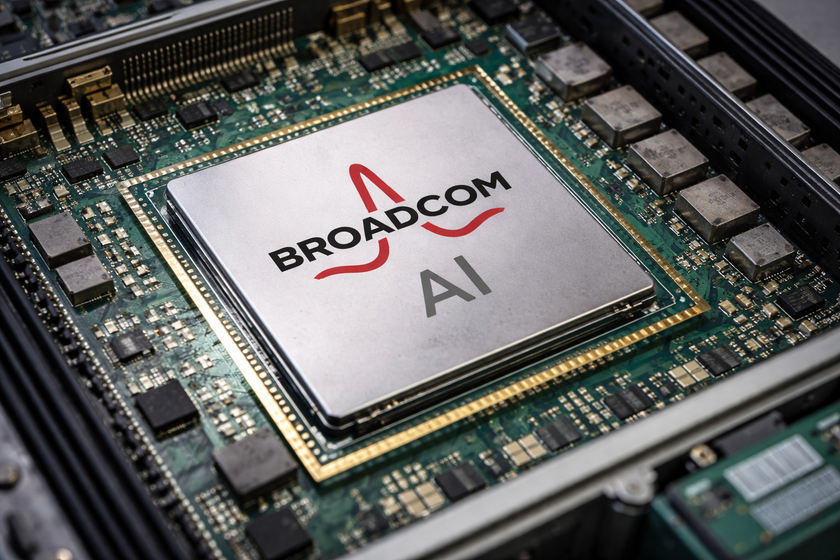
On the first question, the latest print was pretty convincing. Broadcom’s AI semiconductor revenue reached $16.7 billion last quarter, up 221% year over year and 54% sequentially.
Custom accelerators, or XPUs, accounted for 73% of this business. Management sees AI revenue rising again to $21.7 billion this quarter and now expects roughly $115 billion of AI semiconductor sales in fiscal 2027 and $230 billion in 2028.
This is enough to establish demand. But not margins.
Where do you think custom AI chips pose the biggest threat to Nvidia?
Custom AI chips have passed the demand test
My take on this is pretty simple: custom silicon does not need to “beat Nvidia” to generate alpha. This bar is way too high.
Hock Tan says an XPU tuned for a customer’s specific model can perform as well as, or better than, a GPU on that workload for less than half the cost. Take the performance claim with the usual management-guidance grain of salt, but customers are voting with real dollars. Broadcom now has six XPU customers, and it is shipping Google’s latest TPUs, OpenAI’s first custom accelerator and it expects production shipments of Meta’s MTIA silicon in Q4.
This doesn’t mean Nvidia is getting displaced, but it does mean that Nvidia no longer owns every economically attractive path to AI compute. Granted, Nvidia’s quarterly AI semiconductor revenue data-center print is still over 5x Broadcom’s total AI semiconductor run-rate.
Yet, for hyperscalers managing continuous, massive-scale inference workloads, custom silicon has officially transitioned from an R&D sandbox to core infrastructure.
The margin line is where the thesis gets harder
The bull case faces stronger headwinds further down the P&L.
|
Metric |
Q2 FY26 |
Q3 FY26 |
Q4 FY26
guide |
|
AI
semiconductor revenue |
$10.7B |
$16.7B |
$21.7B |
|
Sequential AI
growth |
- |
54% |
30% |
|
Consolidated
gross margin |
77.1% |
75.0% |
~73% |
|
Semiconductor
gross margin |
- |
~67% |
- |
|
Infrastructure-software
gross margin |
- |
~94% |
- |
|
Operating
margin |
~67.3% |
67.9% |
~66% |
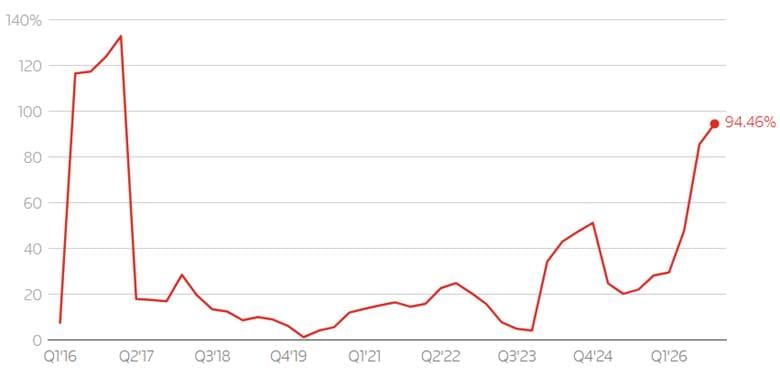
Broadcom’s consolidated gross margin contracted 210 bps sequentially to 75% in Q3. Management expects roughly 73% in Q4, down from 78% a year earlier, because AI is becoming a bigger piece of the business and XPUs carry more expensive memory content.
More importantly, there’s the rub: management estimated Q3 non-GAAP semiconductor gross margin at approximately 67%, versus 94% for infrastructure software.
Source: Reuters
AI is becoming a larger share of the revenue mix, XPUs are becoming a larger share of AI, and those XPUs increasingly carry expensive memory content. So, put simply, Broadcom is growing fastest in a business that carries much lower gross margins than its software operations and drags down the company mix as it gets bigger.
In other words, the fastest-growing part of Broadcom is diluting gross margin.
Hock Tan’s response is that you should focus lower down the income statement. Revenue is scaling much faster than operating expenses, allowing Broadcom to absorb gross-margin pressure through operating leverage. And so far, he has the numbers on his side.
Non-GAAP operating income rose 92% last quarter, the operating margin reached 67.9%, and free cash flow came in at $13.7 billion, or 46% of revenue. Broadcom expects operating margin to remain around 66% this quarter even as gross margin falls again.
Those figures need one qualification. The 67.9% operating margin is consolidated and non-GAAP; Broadcom does not disclose a separate XPU operating margin. Between Q2 and Q3, consolidated revenue rose 33.4%, non-GAAP gross profit rose 29.7%, and non-GAAP operating income rose 34.6%. That shows company-wide operating leverage is currently offsetting gross-margin dilution. It does not prove that the XPU business itself is preserving operating margin.
This is the bull case in one line: gross margin can come down if operating leverage makes up the difference. And so far, it is.
But if you’re trading the name, operating margin is the number I’d keep front and center. If AI revenue keeps ripping while operating margin stays somewhere around the mid-60s, the model is working. If operating margin starts chasing gross margin downhill, then all that XPU growth starts looking a lot less appetizing.
Broadcom’s best customers are also its biggest risk
There is another reason not to extrapolate today’s economics in a straight line, and the wrinkle is that Broadcom’s custom-chip customers are exactly the companies with enough scale and engineering talent to squeeze their suppliers.
Its top five end customers accounted for roughly 45% of total revenue in the first half of fiscal 2026. The company itself says that concentration is likely to stick around.
This is great when Google, Meta and the AI labs are throwing money around, but it introduces severe pricing pressure once procurement departments optimize for cost.
The risk is that “custom” does not mean “exclusive.”
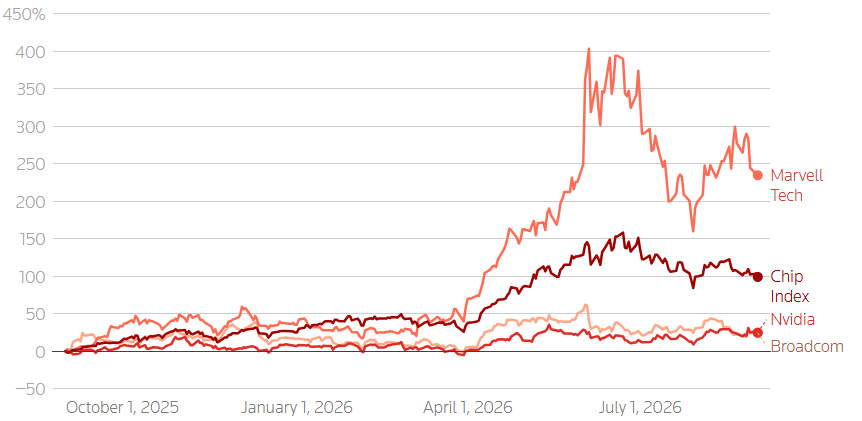
Google is the clearest example. Broadcom has historically been its main custom-chip partner, but Google has now expanded its relationship with Marvell. The agreement could generate as much as $120 billion of qualifying revenue through fiscal 2033. But that figure is a ceiling tied to discretionary purchases, not a committed order. Reuters characterized the arrangement as an expansion of Google’s supplier pool rather than a displacement of Broadcom, which is precisely the point.
Hyperscalers learned they don’t want to be locked into Nvidia. Why would they turn around and lock themselves into Broadcom?
The custom-chip boom is absolutely an opportunity for Broadcom. But as the market gets bigger, Marvell, MediaTek and others get more incentive to pile in. This can be great for Broadcom’s top line while still putting a lid on how much profit it gets to keep.
Source: Reuters - Broadcom shares lag as rivals ride AI surge
$230 billion is the real stress test
Broadcom expects AI revenue of about $58 billion this year, $115 billion in fiscal 2027 and $230 billion in 2028. Management says demand is actually running above the $115 billion outlook and that supply has already been secured against those targets.
Those numbers are huge. I’m not sure revenue is the part traders should sweat most anymore.
Here is what I’d watch instead:
First, Q4 AI revenue needs to land around or above the $21.7 billion guide. A miss there would be the first crack in the “demand is basically unlimited” narrative.
Second, watch the 73% Q4 gross-margin guide versus the 66% operating-margin guide. Gross margin probably keeps drifting lower as XPUs grow. If operating margin holds around the mid-60s, Broadcom is proving Tan’s operating-leverage argument. If it starts slipping materially below that zone, I’d get more cautious.
Third, watch customer diversification. Six XPU customers are better than three, but the company-wide top-five concentration near 45% means one program slipping, dual-sourcing, or moving to a rival can still move the needle.
And finally, keep score against that $115 billion/$230 billion AI revenue path. Broadcom says it won’t formally update those targets every quarter, so shipment growth, supply commitments and hyperscaler capex plans become the breadcrumbs.
Nvidia proved there’s a ridiculous amount of money chasing AI compute, and Broadcom has now made a pretty good case that custom chips can grab a meaningful slice of it.
The next leg of the trade depends on proving Broadcom can keep enough of this money for itself.
 Ana Frincu
What will matter most for Broadcom’s AI thesis from here?
Sources
Benzinga: Broadcom Q3 2026 Earnings Call Transcript
Broadcom Investor Relations: Broadcom Inc. Announces Third Quarter Fiscal Year 2026 Financial Results and Quarterly Dividend
Investing.com: Earnings Call Transcript: Broadcom Tops Q3 2026 Estimates as AI Sales Surge
NVIDIA Investor Relations: NVIDIA Announces Financial Results for Second Quarter Fiscal 2027
Reuters: Broadcom Forecasts Quarterly Revenue Below Estimates
Reuters: Financiers Are Set to Turn Nvidia Into an AI Baron
Reuters: Marvell Grants Google $12.2 Billion Stock Warrant in Custom Chip Deal
U.S. Securities and Exchange Commission: Broadcom Inc. Form 10-Q for the Quarter Ended May 3, 2026