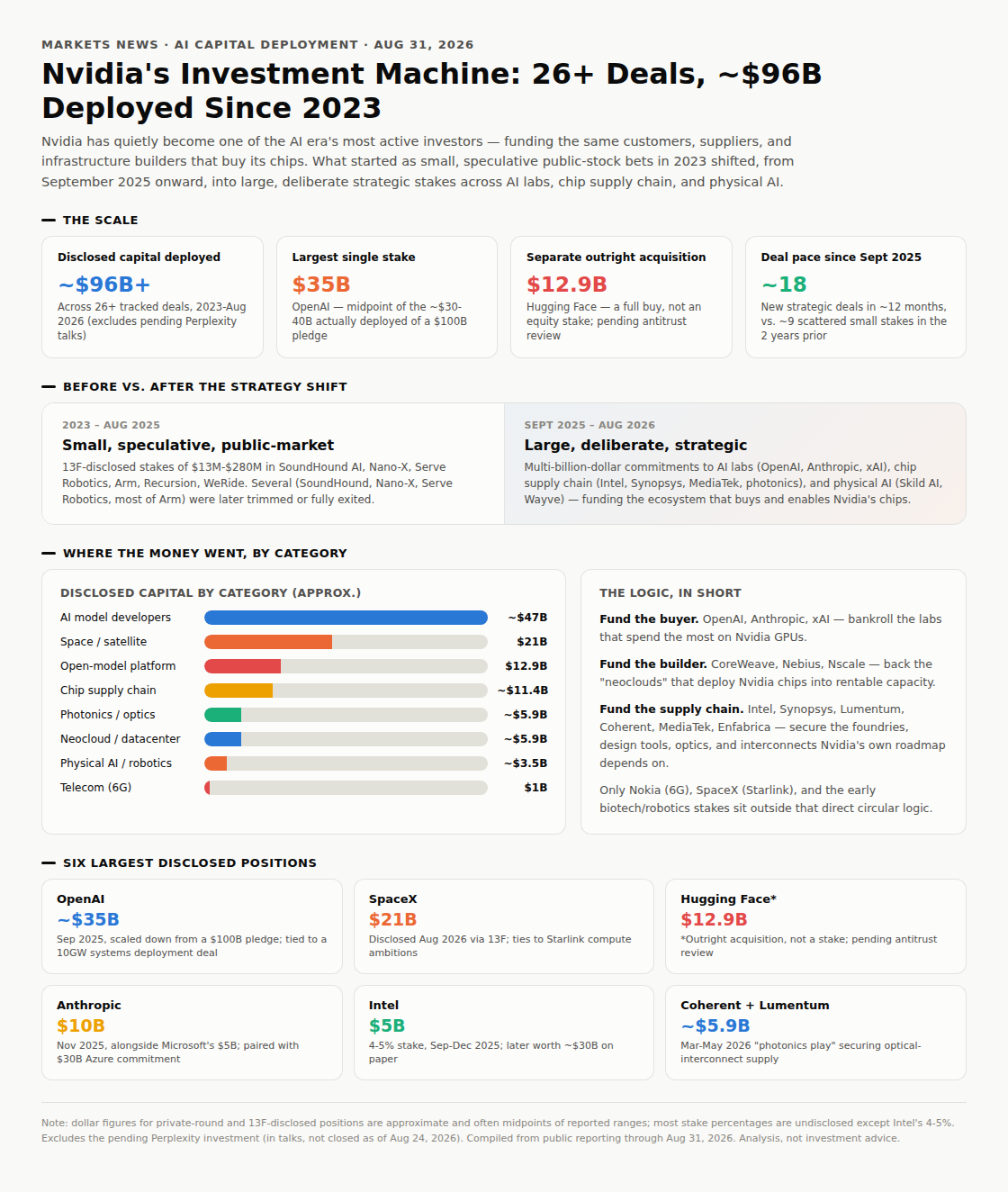
A clear strategic roadmap emerges — Nvidia isn't behaving like a chipmaker with spare cash sitting in index funds. It's running a deliberate, vertically-integrated capital strategy.
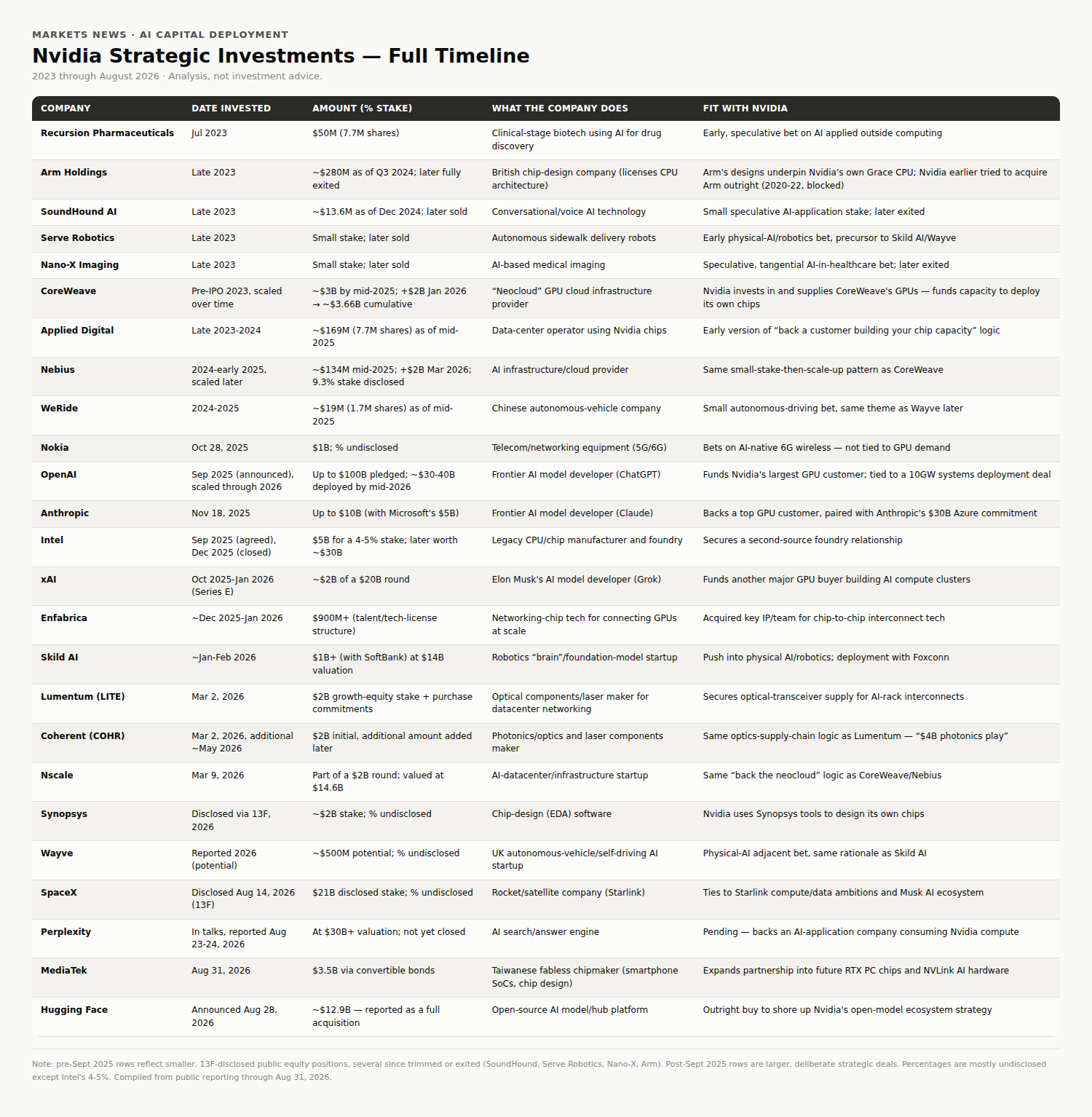
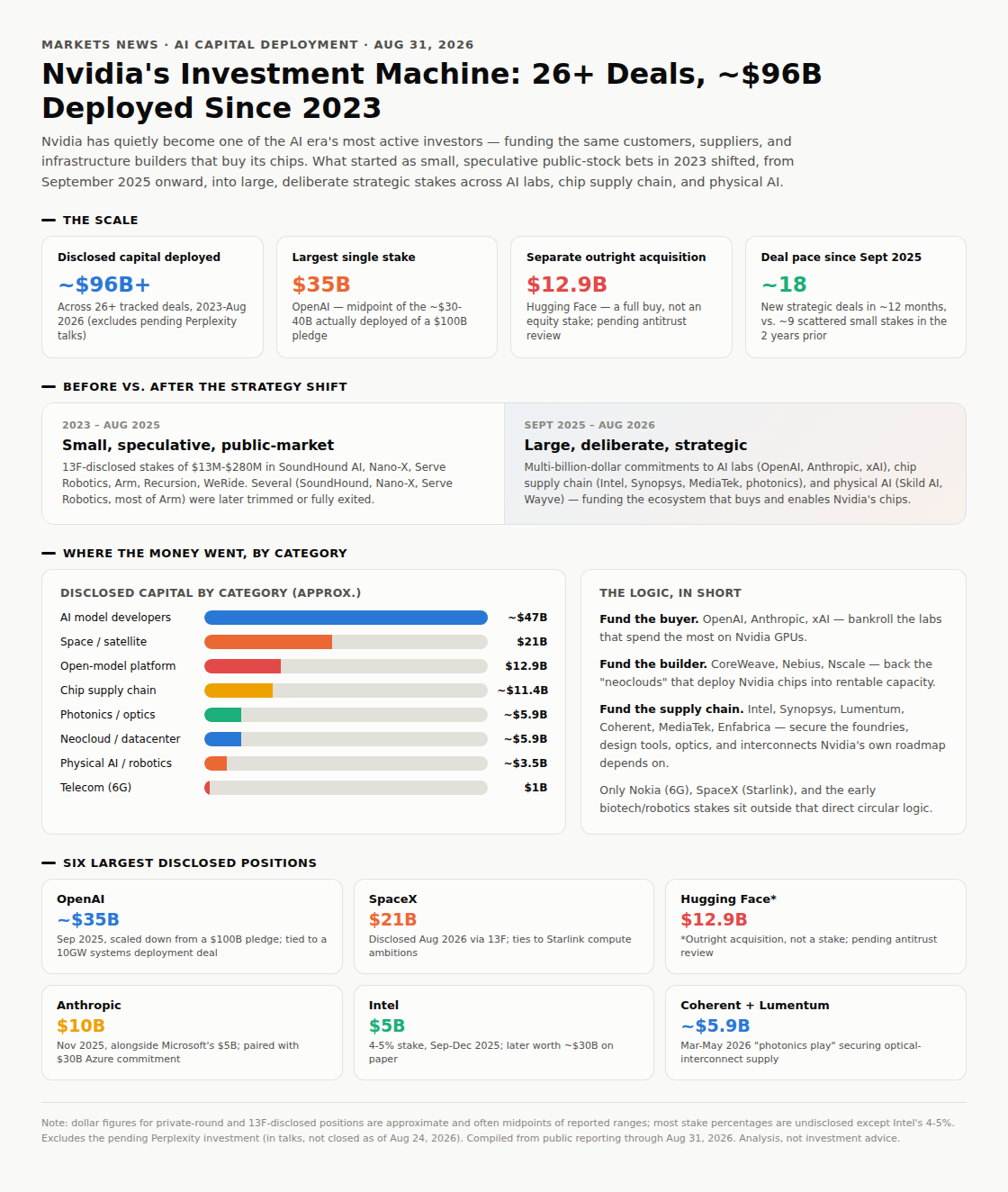
The first and largest bucket is demand insurance: fund the buyer. OpenAI, Anthropic, and xAI together account for roughly $47B of committed capital — Nvidia effectively lending money to its own biggest customers so they can keep affording its GPUs. This is the most-scrutinized part of the strategy, since critics call it "circular financing" — Nvidia's revenue partly funds the demand that generates that revenue. The pullback already visible (the OpenAI pledge shrinking from a $100B headline to ~$30-40B actually deployed, and Jensen Huang calling that "likely the last" big check) suggests Nvidia itself is aware of how that looks and is throttling the pace.
The second bucket is supply chain insurance, and it's arguably the more important one strategically. Intel ($5B, a second foundry source), Synopsys ($2B, the design tools Nvidia's own chips depend on), Lumentum and Coherent (~$5.9B combined, securing optical interconnects), Enfabrica ($900M+, chip-to-chip networking IP), and the newest move, MediaTek ($3.5B), all point the same direction: Nvidia is buying insurance against the exact bottleneck we've been tracking all session — the memory/component shortage driving its own price hikes. It's building redundancy into manufacturing, design, and the physical hardware needed to connect racks together, rather than depending entirely on TSMC and a handful of Taiwanese/Korean suppliers.
The third bucket is capacity insurance: fund the builder. CoreWeave, Nebius, and Nscale (~$5.9B combined) are "neoclouds" that exist mainly to rent out Nvidia GPUs — Nvidia investing in the middlemen who deploy its own hardware at scale, smoothing demand even when hyperscalers slow their own capex.
The fourth, smaller but clearly deliberate bucket is optionality beyond current-generation AI: Skild AI and Wayve (~$1.5B combined) bet on physical AI/robotics as the next compute-intensive frontier once language-model scaling matures; the SpaceX stake ($21B) and Nokia stake ($1B) reach further afield into satellite compute and 6G wireless infrastructure — earlier-stage, more speculative hedges on where AI-adjacent compute demand shows up next.