Summary
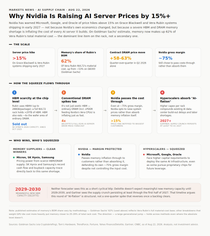
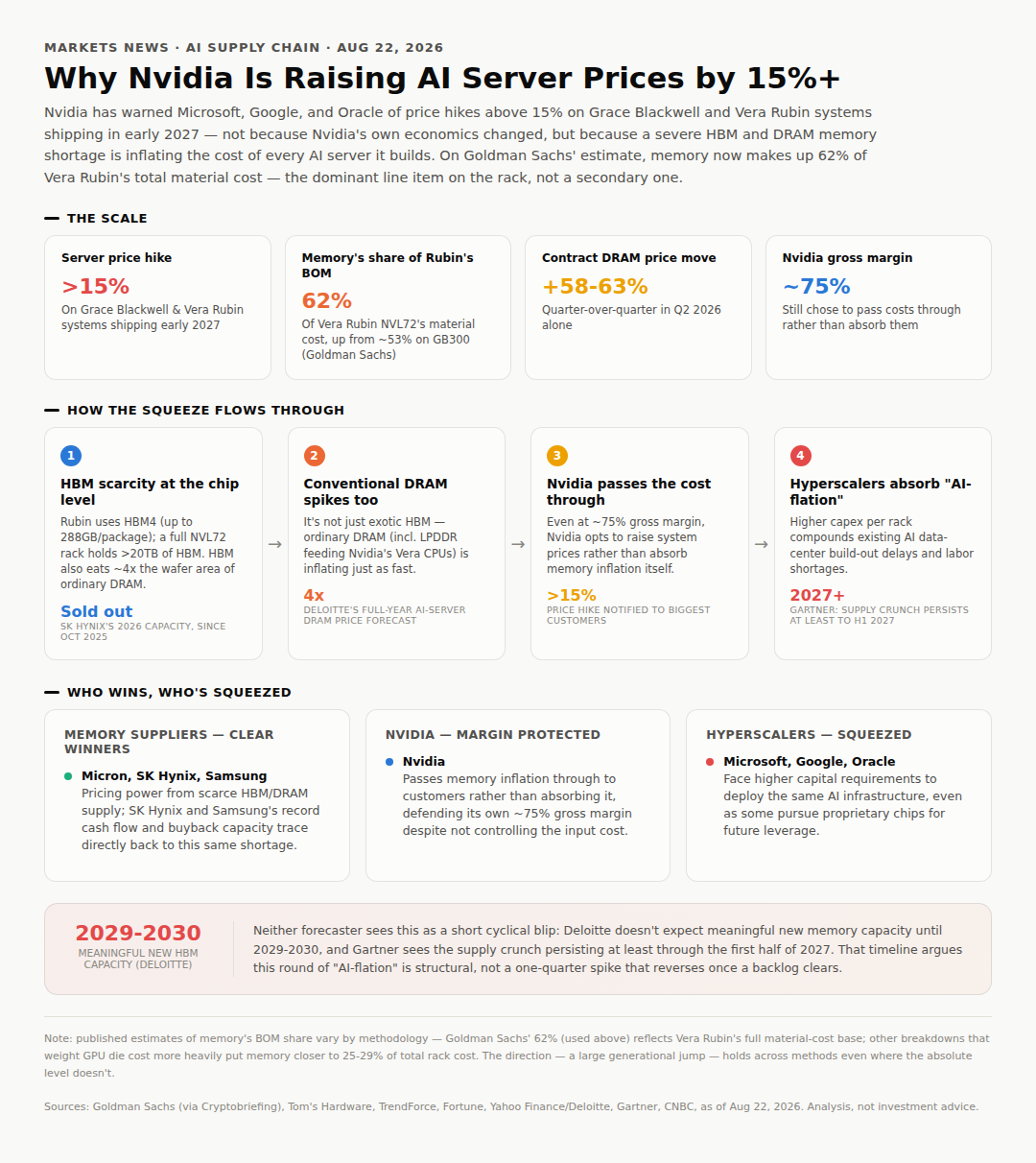
According to multiple news reports, Nvidia has notified its largest customers — Microsoft, Google, and Oracle — of price increases exceeding 15% on Grace Blackwell and Vera Rubin systems shipping in early 2027.
Do you think Nvidia will address its Ai server price hike in upcoming Aug 2026 briefing?
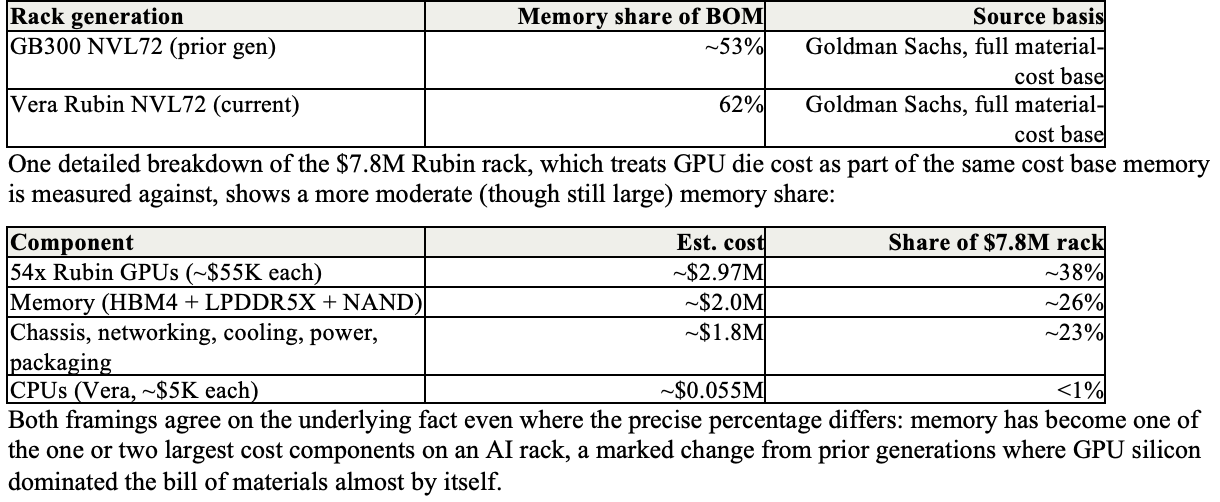
The driver is not Nvidia's own economics: it is a severe, structural shortage of high-bandwidth memory (HBM) and conventional DRAM. On Goldman Sachs' estimate, memory now accounts for 62% of the total material cost of a Vera Rubin NVL72 rack, up from roughly 53% on the prior GB300 generation — making memory the single largest cost line on the rack, ahead of the GPUs themselves on that basis.
Even Nvidia, sitting on roughly 75% gross margins, has chosen to pass this cost through to customers rather than absorb it, which is itself a signal of how severe the shortage has become. This is the direct demand-side mirror of the SK Hynix, Samsung, and Micron shareholder-return story already in motion: the same HBM scarcity fueling record memory-maker cash flow and buybacks is what is forcing Nvidia to raise prices on its own customers.
 Company Reports
What happened
Nvidia reportedly warned its biggest server-building customers of price increases above 15% on AI server systems built around its Grace Blackwell and Vera Rubin platforms, with the higher pricing applying to systems shipping in early 2027. The increases vary by chip generation and memory configuration, but the underlying cause is consistent: memory input costs have risen far faster than Nvidia can absorb internally.
The scale of the memory bill on a Rubin rack is substantial. A full Vera Rubin NVL72 rack carries an estimated bill of materials of approximately $7.8 million. Estimates of memory's exact share of that total vary by methodology:
Who's affected?
●Direct: the hyperscalers named in reporting — Microsoft, Google, and Oracle — face materially higher capital costs to deploy the same amount of AI compute capacity, on top of existing project delays and labor shortages in the data-center build-out.
●Direct beneficiaries: memory suppliers — Micron, SK Hynix, and Samsung — control the great majority of global DRAM and HBM production and are capturing outsized pricing power as demand outstrips supply. This is the same dynamic underpinning SK Hynix's and Samsung's record cash flow and the large buyback-and-cancellation programs both companies have announced this year.
●Nvidia: protected on margin (it is passing the cost increase through rather than absorbing it) but exposed on demand — if 15%+ higher system prices cause any hyperscaler to slow or reallocate AI infrastructure spending, that is a second-order risk to Nvidia's own volumes.
●Indirect: any enterprise or cloud customer renting AI compute capacity from the affected hyperscalers, who may eventually see the cost passed one layer further down the chain.
Market expectations
What was priced in before: the broad expectation through much of 2026 was that memory would be a rising cost input for AI hardware, but not that it would eclipse GPU silicon as the largest single cost component of a flagship rack system.
Surprise magnitude: large. Contract DRAM prices rose 58-63% quarter-over-quarter in Q2 2026 alone, and Deloitte's full-year forecast calls for AI-server DRAM prices to roughly quadruple — a pace well above typical cyclical memory price swings.
Observed reaction: Nvidia's decision to raise prices rather than absorb the cost is itself the market signal — a company with substantial margin cushion (~75% gross margin) and historically strong negotiating leverage over its supply chain has opted not to shield customers from the increase, which suggests internal expectations are for the shortage to persist rather than resolve quickly.
Reaction vs. justified: passing the cost through protects Nvidia's own margins in the near term, but it also transfers real risk to hyperscaler capex plans; whether that reaction is 'justified' depends on whether AI infrastructure demand is elastic enough that a 15%+ system price increase changes hyperscaler build-out pace at the margin — a question the market has not yet had to answer at this scale.
Forward read: the market is effectively watching whether memory suppliers' pricing power (and by extension, capital-return capacity — see SK Hynix's 40 trillion won buyback-and-cancellation program and Samsung's, Micron's, SanDisk's, Kioxia's, Western Digital's, and Seagate's own return programs) continues to compound, or whether either new capacity or a hyperscaler demand pullback intervenes first.
 YU GU
YU GU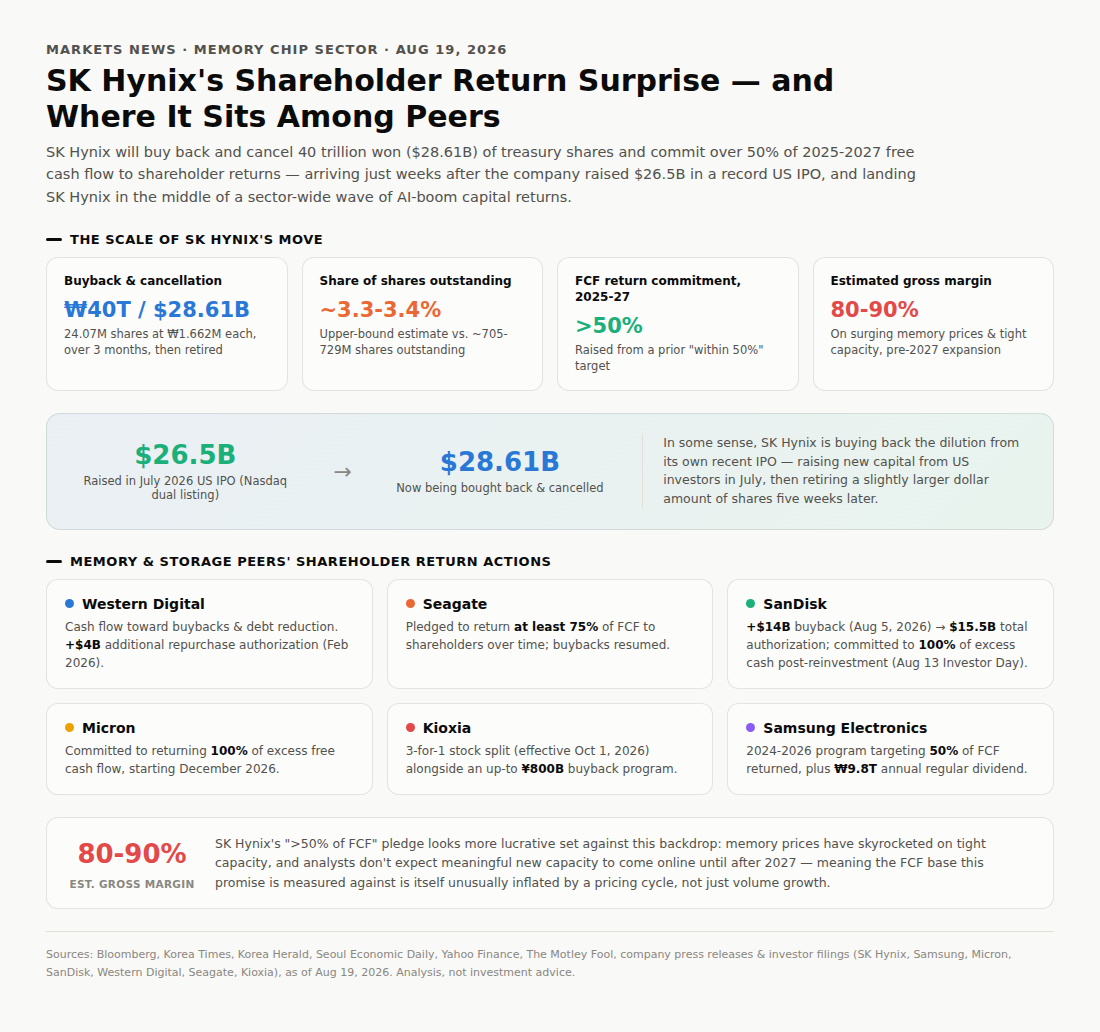
What to watch
●Whether hyperscalers push back on pricing, slow AI infrastructure orders, or accelerate their own proprietary silicon programs in response to a sustained 15%+ cost increase on Nvidia systems?
●Q3/Q4 2026 memory-maker earnings (Micron, SK Hynix, Samsung) for confirmation of whether DRAM/HBM pricing power is still accelerating or beginning to plateau?
●Any signal on new HBM capacity coming online meaningfully earlier than Deloitte's 2029-2030 estimate, which would be the clearest signal this shortage is closer to resolution than currently priced in?
●Whether Nvidia's own reported margins hold at current pass-through levels, or whether competitive or customer pressure eventually forces some cost absorption?