
America’s AI infrastructure binge is printing exactly where the street least expected it: the trade deficit.
The U.S. goods-and-services deficit spiked 24.4% in July to $88.6 billion. Imports rose while exports fell, so this was hardly an AI-only issue.
But under the hood, capital-goods imports increased by $14.4 billion, stacking $6.9 billion in computers, $6.6 billion in computer accessories and $1.2 billion in semiconductors. These three tech buckets alone tacked on $14.7 billion from June, albeit the overall category rose only $14.4 billion because other categories declined.
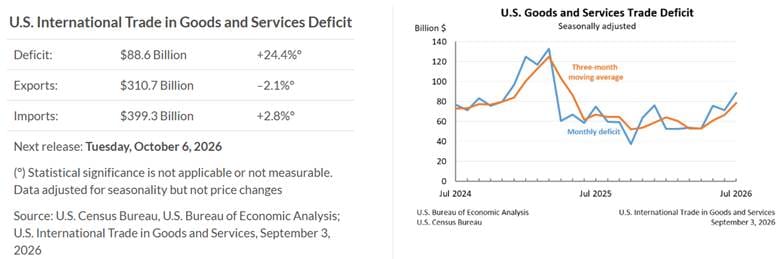
Source: BEA
None of these categories is an AI-only measure. They also include ordinary enterprise, consumer and industrial equipment, and the July values are nominal rather than price-adjusted. Still, the concentration of the increase in computers, accessories and semiconductors is consistent with—not proof of—the AI infrastructure buildout showing up in the trade data.
U.S. companies are pouring money into data centers, accelerators, servers and networking gear. And a big chunk of the physical kit still comes from abroad.
This tees up a wonky macro setup: the same AI spending juicing U.S. investment can also make the trade numbers look worse.
What do you think is the biggest risk in the U.S. AI buildout?
The AI boom can lift investment and drag on GDP at the same time
Imports subtract from GDP, but that does not mean importing a $1 million AI server mechanically makes the economy $1 million smaller. The server also shows up as a business investment on the other side of the ledger. The import subtraction is there to strip out the portion that was produced overseas rather than in the U.S.
So the relevant question is not whether an imported server is “bad for GDP.” Its foreign-produced value is excluded by design. The GDP question is how much domestic value—construction, power infrastructure, installation, software and related services—the broader buildout generates alongside the imported equipment.
Right now, the answer looks like yes, but with a pretty chunky haircut from trade.
After the July trade report, the Atlanta Fed’s GDPNow model put third-quarter real GDP growth at 4.7% annualized. At the same time, it estimated real private domestic investment growing 20.8%, while net exports were knocking 1.46 percentage points off GDP growth.
Put simply, investment is ripping, but trade is leaning the other way.
The Fed has also tried to isolate this more directly. Its rough proxy for the AI buildout shows software, data centers, power facilities and computer equipment adding about 1.18 percentage points to annualized GDP growth in Q1 2026. Computer-related net exports took back 0.45 points, leaving a net contribution of roughly 0.73 points. In Q4 2025, the import drag almost wiped out the entire gross contribution.
My take is that saying AI is “nuking GDP” goes a bit too far. The better read is that imported hardware is diluting how much of the AI capex boom turns into current U.S. GDP.
 Ana Frincu
The U.S. is buying the hardware before it gets the payoff
This trade deficit looks different from one driven by imported TVs or sneakers. This AI gear is supposed to produce something.
Private U.S. data-center construction was blazing at a $75.2 billion annualized pace in July, gapping up from $44.7 billion at the end of 2024.
Investment in computers and peripheral equipment has gone from about $186 billion annualized in Q4 2024 to a massive $401 billion in Q2 2026.
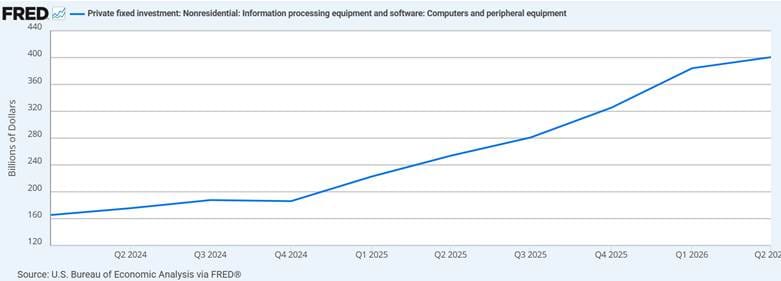
Source: FRED
The numbers get bigger and bigger and they tell us the U.S. isn’t simply consuming foreign technology; rather, it is installing foreign-made components inside a rapidly expanding domestic computing base.
The bull case is pretty simple because a GPU fabricated in Asia and plugged into a Virginia server farm weighs on net exports today, but it may support U.S.-based cloud revenue, software, research and productivity for years.
The better question is duration. The Federal Reserve staff find AI-exposed industries are showing some stronger productivity readings, but there still isn’t a clear economy-wide break from historical trends. In other words, the capex is here and is printing, but the broad productivity dividend is still more promise than print.
That’s what I care about as an investor. If spending keeps compounding while measurable productivity eventually catches up, today’s import bill looks like the upfront cost of building a much more productive economy.
If the productivity payoff stays elusive, the same capex starts looking a lot harder to justify.
“Made in America” still has a long way to go
The other takeaway from the trade numbers is just how global the supposedly American AI boom still is.
The U.S. cornered less than 10% of global semiconductor manufacturing capacity in 2024, a brutal bleed down from 37% in 1990, according to the Commerce Department. Taiwanese players have since penciled in at least $250 billion in commitments for U.S. semi, energy, and AI capacity, but getting a fab fully online and scaling yields is a multi-year grind.
You can see the exact same supply-chain leverage on the server side.
Mexico’s trade data show a regional production hub embedded in an Asian supply chain: the country exported $82.9 billion of servers in the first half of 2026 while importing $28.4 billion of servers from Taiwan. The U.S. absorbed 93.9% of Mexico’s server exports over the 12 months through June.
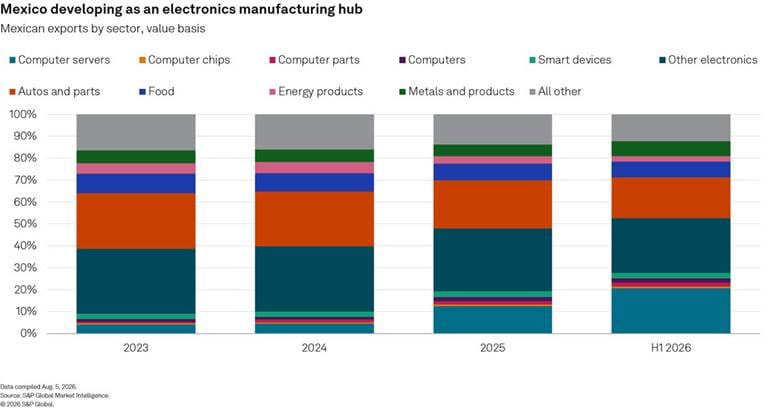
Source: SPGlobal
These gross trade figures do not reveal how much value Mexico added or how much of the U.S. import price reflects components produced elsewhere. What they do show is that near-shoring can change the final shipping route more quickly than it eliminates foreign content.
Nearshoring helps, but it doesn’t magically turn imports into domestic production.
Here’s what traders should watch next
The next trade report lands on October 6. I’d watch the same three buckets, computers, accessories and semiconductors, before getting too excited about one month’s spike. If they stay elevated, the AI capex cycle is clearly bleeding into the trade account rather than just creating July noise.
Then watch the net-export contribution in GDPNow, currently at -1.46 points, against investment growth. Watch whether GDPNow continues to show rapid aggregate investment growth alongside a worsening net-export contribution. The two measures are not directly comparable, but together they indicate whether domestic demand remains strong while more of that demand leaks into imports.
Finally, keep an eye on the domestic semiconductor output and data-center construction. U.S. semiconductor and electronic-component production has already climbed sharply, with the Fed’s production index reaching 188.0 in May versus 150.2 at the end of 2024.
This is the secular tell.
The AI boom is blowing out the import tab right now because America still relies heavily on overseas hardware. But if domestic chip production, server capacity and productivity close the gap, this trade drag gets smoothed out over the long haul.
For now, I wouldn’t read the wider deficit as evidence that AI is hurting the economy.
I’d read it as the invoice hitting the desk before the returns do.
What would most strengthen the bull case for U.S. AI investment?
Sources
Atlanta Fed: GDPNow — Current and Past GDPNow Commentaries
Bureau of Economic Analysis: U.S. International Trade in Goods and Services, July 2026
Federal Reserve: The AI Buildout and the Economy: Publicly Available Data to Assess AI’s Impact
S&P Global Market Intelligence: Picture This — Mexico Server Boom, AI Data Center Supply Chains
U.S. Department of Commerce: Fact Sheet — Restoring American Semiconductor Manufacturing Leadership