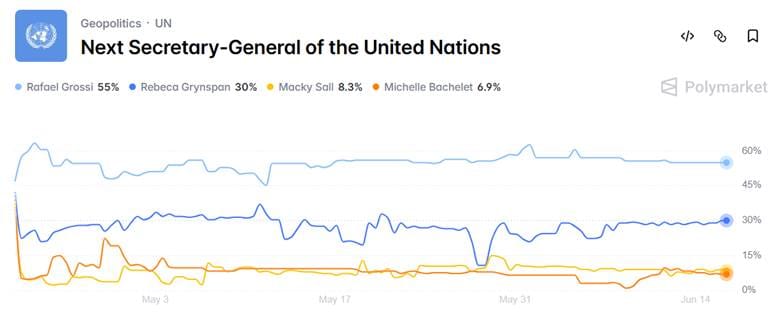
Polymarket’s “Next Secretary-General of the United Nations” market has Rafael Grossi well ahead of the field. As of this writing, Grossi is priced in the mid-50s, with Rebeca Grynspan around 30%, Macky Sall around 9%, and Michelle Bachelet near 7%. The contract resolves to the person formally appointed as the next UN Secretary-General.
Grossi runs the International Atomic Energy Agency, has handled nuclear diplomacy around Iran and Ukraine, and looks like the kind of serious technocrat major powers could live with. This makes sense, but the price may be leaning too hard on one assumption: that Grossi’s IAEA résumé is a Security Council asset, not a liability.
The better market question is whether Grynspan is too cheap at 30%. The Security Council process may reward a lower-friction reform candidate with UN experience, development credibility, and first-woman reset appeal.
Moreover, Reuters reported on June 16 that six candidates are now vying to replace António Guterres, with María Fernanda Espinosa and Carolyn Rodrigues-Birkett joining the race, while this market is still centered on four named outcomes.
The next UN Secretary-General is not picked like a normal election winner. The public campaign helps, but the harder test comes inside the Security Council. A candidate can look strongest on paper and still run into trouble if one permanent member objects.
This is why Grossi’s résumé is only half the trade. The other half is whether the major powers actually let him through.
Grossi’s lead makes sense. The assumption behind it is less certain
The Secretary-General is formally appointed by the General Assembly, but only after the Security Council recommends a candidate. In practice, this means the five permanent members (the US, China, Russia, France, and the UK) matter more than public visibility, debate performances, or even broad UN membership enthusiasm.
Grossi can be the strongest candidate on paper and still be overpriced if one major power decides he is not the right person for the job. The market is pricing him as though his profile is a shield. It may turn out to be one. But in this process, prominence can also create friction.
For example, his IAEA profile gives him credibility, but it also ties him to issues where the permanent members often disagree. The agency has been deeply involved in Iran’s nuclear program, nuclear safety risks around Ukraine, transparency disputes, sanctions pressure, and inspection access. Reuters has also noted that some critics think Grossi went too far in trying to cut deals with Iran.
Because of this, Grossi is not only highly visible but also quite exposed. A lower-profile candidate can sometimes be easier to tolerate.
So, the main question: Is Grossi’s résumé reducing the risk, or just making the risk harder to price before the Security Council shows its hand?
Here’s why Grynspan is the cleaner repricing risk
If Grossi weakens, the most obvious named beneficiary is Grynspan. She is already second on Polymarket at 30%, so this is not some buried long shot. Grynspan combines three things that may matter more in the final selection: regional fit, reform credibility, and a lower-conflict profile.
She is Costa Rica’s nominee, a former vice president, and the current Secretary-General of UN Trade and Development. She also has senior UN experience, including work at UNDP, and became the first woman to lead UNCTAD in its 60-year history.
All of this could matter because the next Secretary-General will inherit a UN under pressure to prove relevance while managing tighter finances. Reuters has reported that the organization is dealing with a severe funding strain, including billions in unpaid US arrears and donor cuts. In this environment, Grynspan’s pitch around restoring trust, peacemaking, regional cooperation, and reform matches one of the main problems the next UN chief will have to manage.
There is another reason the favorite may be less protected than the price implies: the UN has never had a woman as Secretary-General. But this is also where the Grynspan case needs more pressure, because she is not the only candidate who can trade on this argument. Espinosa, Rodrigues-Birkett, and Bachelet also crowd the first-woman/reform lane. In other words, Grynspan cannot simply be priced as "the woman candidate"; she needs to become the consolidation candidate in this lane.
Finally, Reuters reported that Grynspan stepped back from UNCTAD duties until September to avoid conflicts of interest while campaigning, while Grossi has continued in his IAEA role. This doesn’t settle it, but it helps her present herself as a cleaner candidate.
This is why Grynspan’s 30% may be light if early Council signals show Grossi is not fully P5-cleared.
Certainly, gender alone will not decide the race, but no woman has ever held the role, and several candidates give governments a way to combine regional balance, reform, and institutional renewal in one appointment.
What to watch next? Three triggers to keep an eye on
Grossi may simply be the candidate best positioned to survive the P5 process, because Reuters notes diplomats see him as a frontrunner after years spent keeping lines open with the five permanent Security Council members.
But things could change quite quickly. The first trigger is any credible Security Council read in late July. If early straw-poll reporting suggests Grossi has broad P5 tolerance, his 55% will look much safer. If there are signs of resistance from even one permanent member, the market should move.
The second trigger is consolidation around Grynspan. If diplomats, regional blocs, or major governments begin treating her as the main alternative rather than just one of several reform candidates, the current spread between Grossi and Grynspan becomes harder to defend.
Surely, there is competition for this lane. Bachelet, Espinosa, and Rodrigues-Birkett also make the gender argument relevant, splitting the vote rather than helping Grynspan. But Grynspan is already the highest-priced woman in the Polymarket market and the clear second name on the board.
For traders, the next read is whether Grossi shows quiet P5 clearance in the first Security Council signals. If he does, the mid-50s price is easier to defend. If he does not, Grynspan’s 30% becomes the cleaner place for the market to move into the high-30s or even low-40s.
Sources:
1. Reuters: Candidates for UN's top job urge its renewal and bolstering human rights
2. Reuters: Ecuadorean candidate to head UN calls for body to be shrunk responsibly
3. Reuters: Explainer: Who are the candidates running for UN secretary-general?
4. Reuters: UN leadership candidates vow to pursue reform and core principles
5. UN Trade and Development: Secretary-General / Rebeca Grynspan biography
6. United Nations in Türkiye: Who will lead the UN next? Selection process gets underway