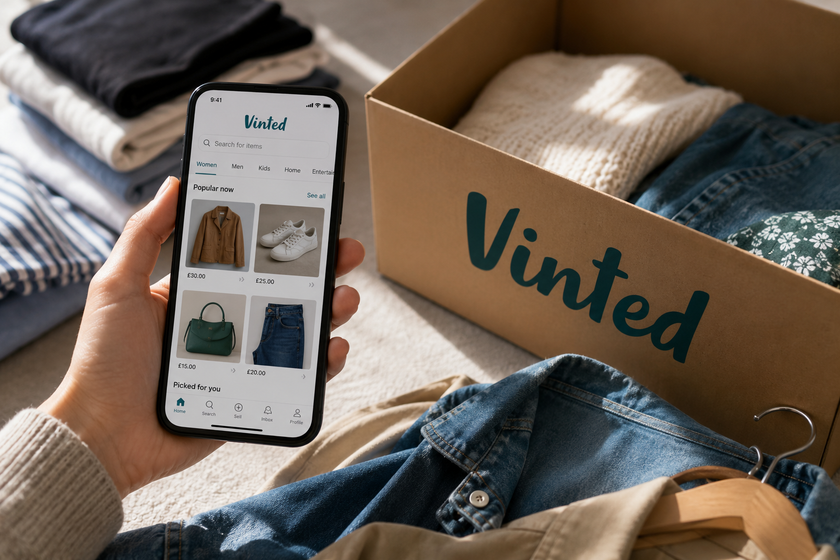
Thomas Plantenga unabashedly says he’s been “stealing” from companies across the globe. The chief executive officer of Vinted, Europe’s biggest consumer-to-consumer fashion marketplace, says he freely borrowed from their strategies to put together an online platform that’s now shaking up the region’s €500 billion ($573 billion) fashion industry.

Founded in 2008 as a platform for individuals to buy and sell secondhand clothes, Vinted has created such a formidable marketplace that the platform, along with some of its rivals, is eating into the sales of fashion and luxury houses. McKinsey’s State of Fashion 2026 report says the secondhand market will grow two to three times faster than the firsthand one from 2025 to 2027 as penny-pinching consumers seek bargains.
“The risk for the overall sector is that secondhand clothing cannibalizes the sale of new fashion,” analysts at RBC Capital Markets wrote in a note this month, also pointing out that many international labels are rushing to blunt the impact with resale offers of their own.
Will the global resale apparel market grow faster than the firsthand apparel market in 2027?
With the taboo around buying and selling secondhand clothes evaporating, celebrities like Paris Hilton, Paul Mescal and Chloë Sevigny openly talk about their sales on such platforms.
As economic necessity and a sustainability-conscious new generation lift the stigma around used clothes, about 60% of global consumers are likely to shop resale this year, McKinsey estimates.
The global resale apparel market is expected to reach $317 billion by 2027, the consulting firm said, a 23% jump from last year. The scale and technology of the marketplaces have brought them to “an inflection point,” letting them turn millions of transactions into profits, the report said.
“The real driver is the consumer,” said Poonam Goyal, a senior retail analyst at Bloomberg Intelligence. After years of inflation, shoppers have become more value-conscious, while younger generations increasingly see buying secondhand as mainstream, she said. “People are proud of buying resale. They want to show off the deal they found. It’s a completely different mindset.”
Vinted has led the pack in Europe by massively investing in logistics, payments and technology to draw in more buyers and sellers to its platform. That’s given it the scale and critical mass to keep it ahead of its rivals.
The company, valued at €8 billion during a secondary share sale this year, counts EQT, BlackRock, Ontario Teachers’ Pension Plan and Schroders Capital among investors, and is gearing up for what could be one of Europe’s largest technology-based initial public offerings in recent years.
The US push pits Vinted against established rivals including the industry’s “original gangster” eBay, which this year bought fashion platform Depop for about $1.2 billion to strengthen its secondhand offering, Facebook Marketplace, Poshmark and ThredUp.
“Whether we will be able to actually compete and win in that market is a very big question,” Plantenga said, declining to share details of its plans there. Vinted is in early-stage testing in the US and is encouraged by initial results, he said. Wells Fargo analysts covering eBay, said in their July note that Vinted’s US daily active users jumped more than six-fold in the second quarter from a year earlier following its January market entry.
The global appetite for resale fashion has spawned a slew of players. They include platforms like Japan’s Mercari; the UK’s Hardly Ever Worn It and Depop; Vestiaire Collective in France; The RealReal in the US, among several others. Many have struggled to translate demand into consistent profitability.
Vestiaire Collective expects to post its first annual profit in 2026, more than 15 years after it was created, while in Asia — one of the fastest-growing regions — platforms like Alibaba-backed Idle Fish, Poizon, Mercari and Kream are scaling rapidly.
Can Vinted take meaningful market share from Depop, Poshmark and eBay in the US?
Access to inventory — either through brands looking to offload excess supplies or individuals looking to make a buck from items they no longer wear — is one of the biggest hurdles for the platforms.
After taking over in 2016, Vinted’s Plantenga overhauled the company’s business model, most notably by removing seller fees and charging buyers instead. The changes attracted more inventory, improved marketplace liquidity and laid the foundation for profitability, allowing Vinted to invest heavily in its infrastructure that investors now view as its key competitive advantage.
Vinted processed €10.8 billion of merchandise in 2025, up 47% from a year earlier, while revenue rose 38% to €1.1 billion. Net profit fell 19% to €62 million as it accelerated investment in Germany and in Vinted Go, its logistics business. That drop didn’t stop investors from valuing the company at €8 billion this year, up from €5 billion in 2024.

Sweden’s EQT, which first invested in Vinted in 2021 and remains one of its largest shareholders, argues the company’s competitive advantage now extends well beyond secondhand fashion. Brochado says the company increasingly resembles scaled marketplace companies like Airbnb, Uber and MercadoLibre because of its network effects, technology infrastructure and expanding ecosystem.
The company has continued expanding across Europe and entered new product categories, including electronics, books and toys. Through Vinted Go, it operates more than 18,000 pickup and drop-off points across Europe, including lockers and designated shops, while Vinted Pay extends its reach into the payments ecosystem.
Vinted’s model is simple: Selling on the platform is free for the seller, who gets to keep 100% of the listed price. Sellers simply take photos of the items they want to sell, add a description, set the price and publish the listing on the app. When someone purchases an item, Vinted charges the buyer a small fee and provides the seller with a pre-paid shipping label. The seller then packs the item and drops it off at a local shipping point. Once the buyer acknowledges receipt, Vinted releases the money into the seller’s virtual wallet.
It’s that model that the company wants to bring to the US. Whether Vinted’s buyer-fee service can be replicated in the US remains an open question. Bloomberg Intelligence’s Goyal says US buyers would be much more resistant to paying a fee, especially if it’s added in separately instead of being built into the price.
But “if they can make it work in the US, they could end up setting a new standard that competitors might eventually follow, making the whole sector more profitable,” she said.
Plantenga said he’s already seeing signs of the shift. Rivals including Poshmark, Depop and Mercari have all moved toward Vinted’s buyer-fee model in recent years — a sign, he argued, that the European approach is setting the industry standard.