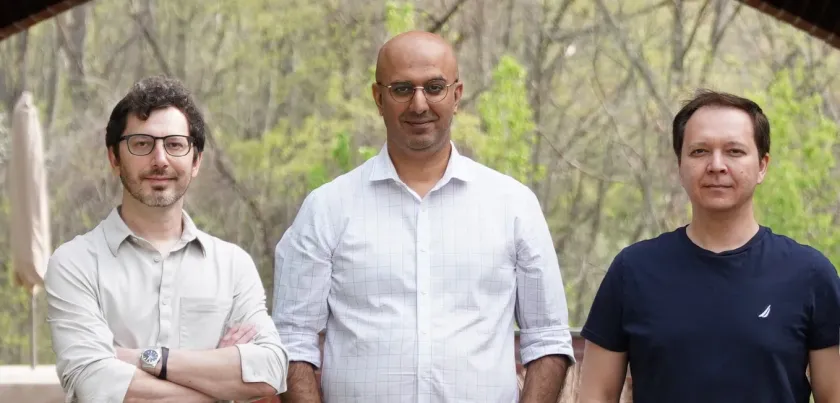
Sooth Labs, a new artificial intelligence lab founded by former Meta Platforms Inc. employees, is raising about $50 million in funding to build AI models meant to help businesses forecast the likelihood of specific geopolitical and market events taking place.
Felicis Ventures is set to lead the round, which would value the startup at roughly $335 million, including the money raised, Sooth’s co-founders told Bloomberg News. The company has also secured backing from Yann LeCun, a former Meta executive and an AI pioneer, as well as from Google Chief Scientist Jeff Dean. Meta Chief Technology Officer Andrew Bosworth is advising the firm.
Financial institutions, including banks and insurance companies, commonly use forecasting algorithms that combine statistical models with machine learning techniques. Sooth aims to do better by training its models on large cross-industry datasets, including data owned by its clients, and allowing that information to be easily queried. It’s also working to develop its models with a mix of inputs, including video, audio and text.
In a demonstration, Sooth’s software let the user query the probability of specific events happening, including the likelihood that the World Health Organization declares another pandemic by 2028 (16%) and that Anthropic PBC goes public this year (33%).
The Pittsburgh-based startup wants to enable businesses to make better decisions in areas like capital allocation and risk management, said Chief Executive Officer Yaser Sheikh. The company said it’s in discussions with potential customers in finance, defense, insurance and real estate.
Sooth’s team includes Ruslan Salakhutdinov, a Carnegie Mellon University professor, and disciple of AI godfather Geoffrey Hinton. Salakhutdinov, frequently cited for his research in deep learning, served as Apple’s first director of AI research before moving on to conduct AI research at Meta. Sheikh is a consulting professor at Carnegie Mellon and previously served as a vice president at Meta.
Sooth’s push coincides with surging interest in prediction markets such as Kalshi and Polymarket, which let people wager on everything from who the next James Bond will be to the chances of a major meteor striking Earth before 2030. Those firms have also raised billions of dollars in funding from investors.
“Because Kalshi and Polymarket have been so successful, the world has started thinking in bets,” said Aydin Senkut, founder and managing partner at Felicis. “Everyone’s mind has shifted to, ‘What do I know that gives me an edge to predict X happening?’”