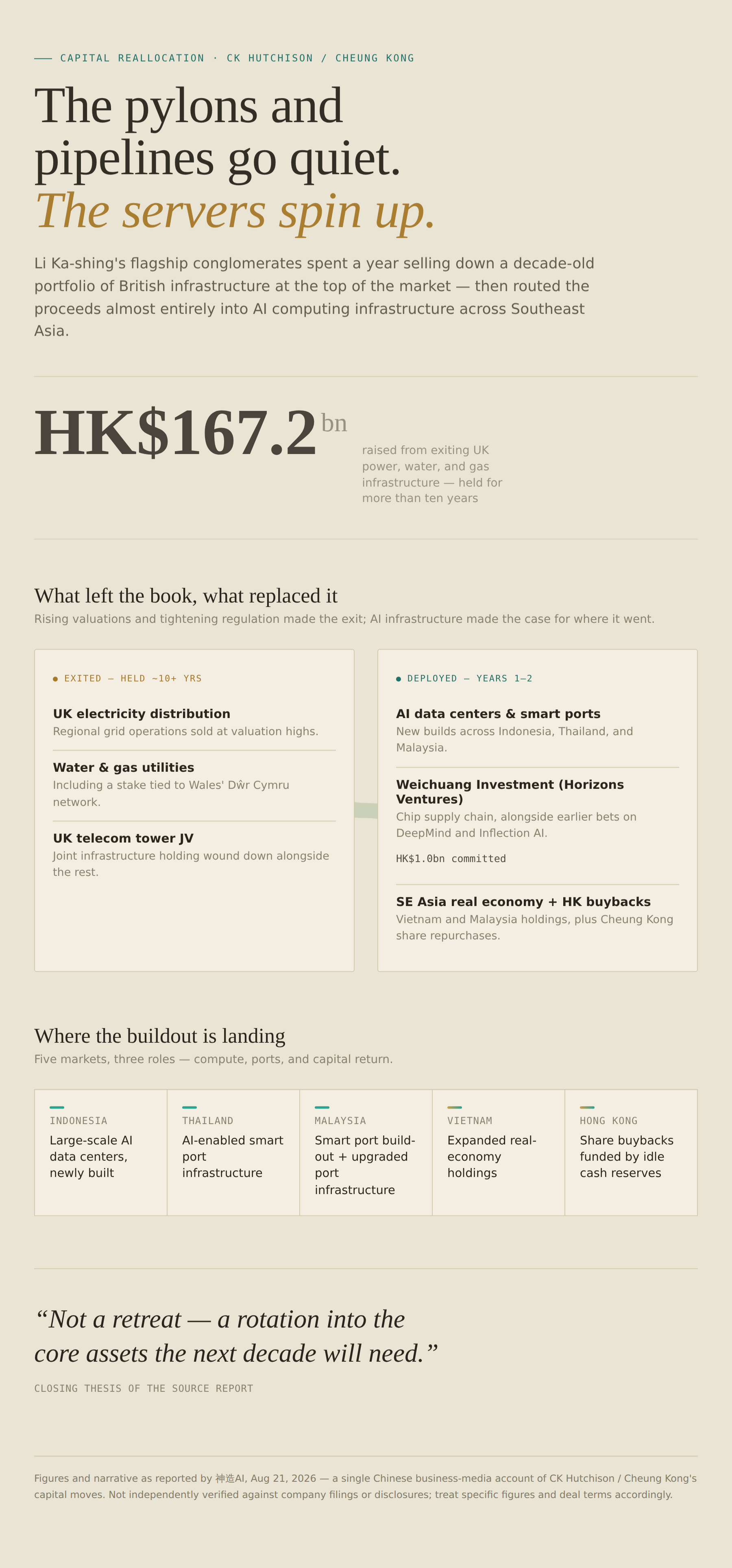
Li Ka-shing's CK Hutchison and Cheung Kong could be redirect HK$167.2 Billion from asset sales into AI Computing.
What have CKH sold?
Over the past two years, the most crucial move for CK Hutchison has been a thorough asset swap. Within a year, they cleared out over a decade's worth of core British infrastructure assets for a combined 167.2 billion HKD.
The sell-off involved three core asset blocks: UK electricity distribution, water and gas business, and Wales' Dwr Cymru-affiliated water utility stakes. Built over ten-plus years of steady operation, these assets had consistently delivered stable annual returns — low volatility, steady yield.
What could be some underlying reasonings?
The reason for this clean break comes down to one core issue: overseas European asset valuations kept climbing, while regulatory scrutiny, tax burdens, and nationalization risk kept increasing — returns on overseas assets became "chicken feed," uncertain, no longer matching the risk. With valuations still at highs, this was the exit window — consistent with the group's style of never chasing the last dollar and selling at strength.
Could the cash flow into AI?
The cash raised has been rotated in one direction: entirely toward AI. This isn't chasing a fad — it's a deliberate long game. The core is AI computing infrastructure.
CKH's playbook has always been pragmatic: build early, build where demand is heading. In the past, they steadily made money on power grids, ports, and railways; now they're applying the same model to data centers and computing power. AI computing is the water and electricity of this era — the growing demand for digital and physical infrastructure fits Changjiang and Hutchison's operating model perfectly.
The current buildout is spread widely, not limited to one point. In Indonesia they're building large-scale AI data centers; in Thailand and Malaysia they're jointly building AI smart ports; they're investing 1 billion HKD through "Weichuang Investment" (Horizons Ventures), building on earlier relationships with AI firms like DeepMind and Inflection AI to connect underlying technology and hardware supply chains.
Beyond that...
Beyond AI computing, the remaining capital heads in two directions: returning to Southeast Asia, increasing holdings in Vietnam and Malaysia's real economy to capture the region's industrialization dividend; and buying back CKH's own shares in Hong Kong, using cash reserves to stabilize the stock and support financial stability.
In summary, this is a large-scale, logically consistent capital reallocation: exiting low-value, high-risk overseas nationalized assets, refocusing on longer-cycle, better-economics AI infrastructure, while keeping a foothold in Southeast Asia's industrialization wave. It isn't a retreat — it's a classic top-tier capital shift, positioning for the core assets the next decade will need.