Summary
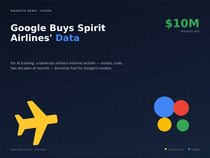
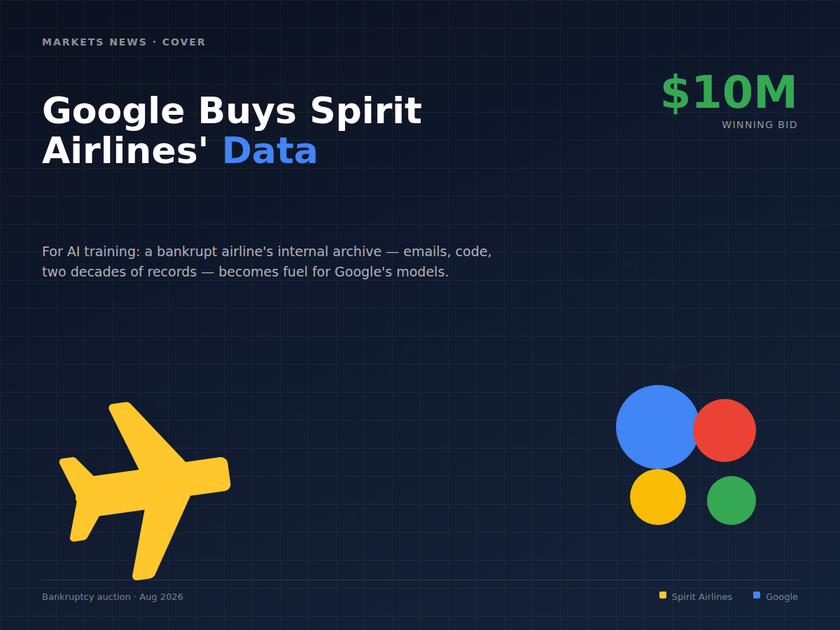
Google won a bankruptcy auction for Spirit Airlines' internal business data at $10 million, edging out a $7.5 million bid from AI hiring platform Mercor. The dataset — over 100 million emails, hundreds of millions of Teams messages, 30M+ lines of code, and 7.5 billion passenger transaction records spanning two decades — is intended as AI/LLM training material. Against Alphabet's $4.201 trillion market cap the deal is financially invisible; its real significance is as a data point in AI labs' growing appetite for large, non-public operational datasets sourced from distressed companies, not as a market-moving transaction.
Will Gemini launch next 'Pro' version in 3Q2026?
What happened?
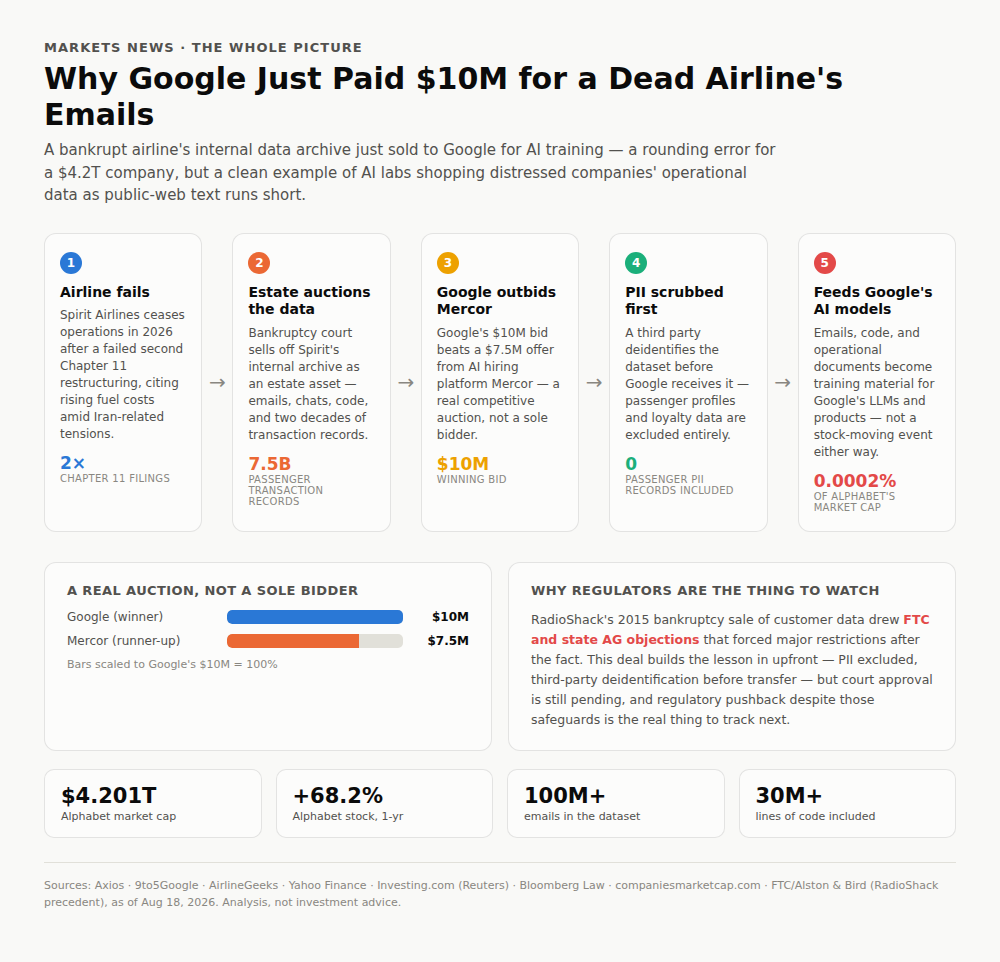
Spirit Airlines ceased operations in 2026 after failing to emerge from its second Chapter 11 bankruptcy, reportedly driven in part by rising fuel costs tied to Iran-related geopolitical tensions. As part of the bankruptcy estate's asset disposition, Google's $10 million bid beat Mercor's $7.5 million offer for a large internal-data package. A federal bankruptcy judge still needs to approve the sale before it closes.
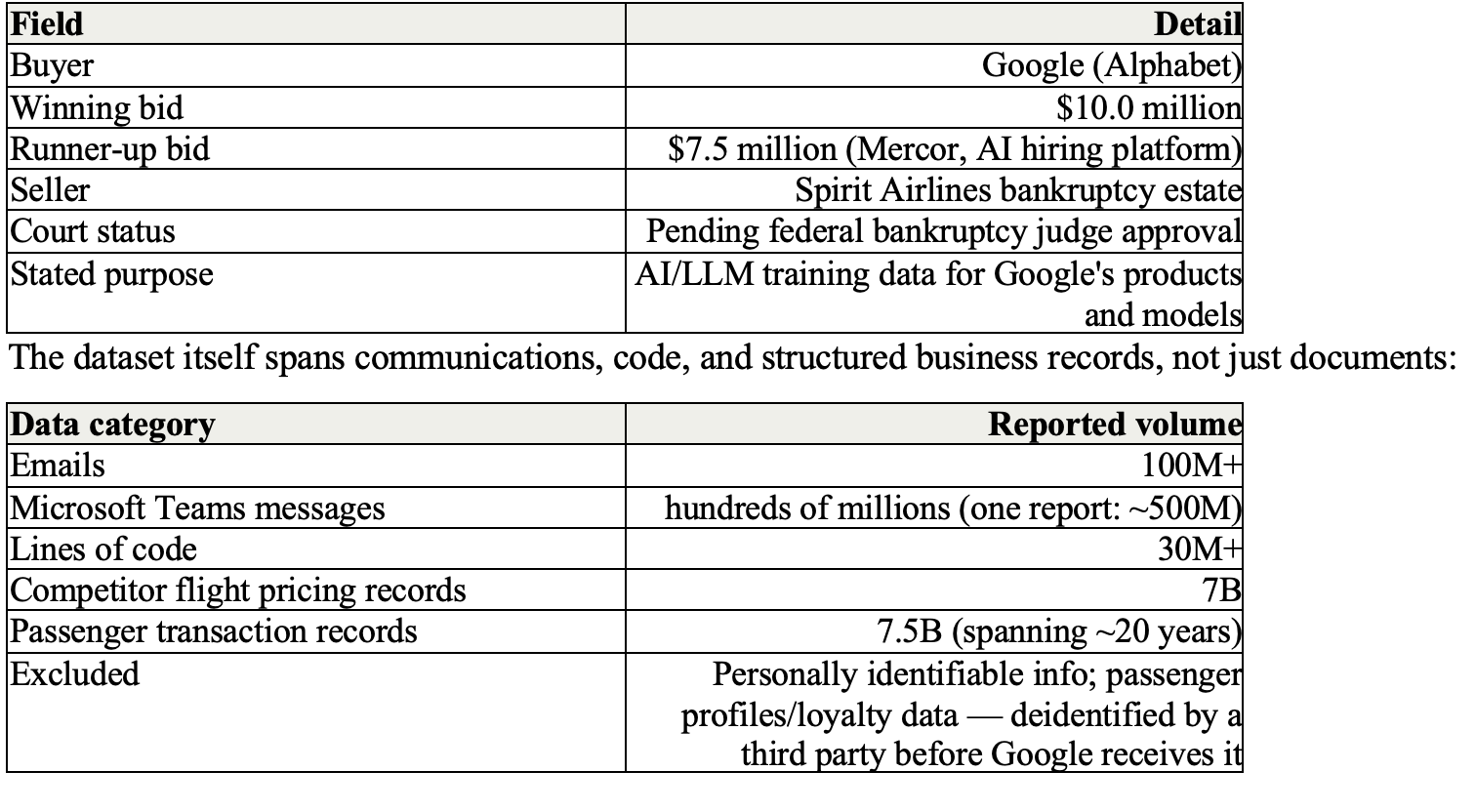
Significance of the event
Financial Scale: financially trivial — $10 million against Alphabet's $4.201 trillion market cap is roughly 0.00024% of market value, and a rounding error against Alphabet's ad/cloud revenue run-rate.
Novelty? it isn't novel that AI labs buy training data, but the source and composition are notable — a large, structured, non-public operational dataset (proprietary code, two decades of transaction records, competitor pricing intelligence) rather than scraped public web text. This reflects the broader, well-documented AI-industry scramble for data as public-web text supply is increasingly exhausted relative to frontier model appetite.
Narrative: reinforces, rather than complicates, the existing "AI data scarcity" narrative — labs increasingly sourcing proprietary, structured corpora (code, internal operations, transaction history) as a complement to public text.
Does it actually help Google's model training?
Directionally - YES but it matters to separate what kind of help:
Genuine incremental value: this dataset (emails, code, two decades of transaction records, competitor pricing intelligence) is structured, real operational business data — different in kind from scraped public web text. In principle it could help a model perform better on enterprise-workflow, code-understanding, and business-analysis tasks. That's a real, if narrow, training-data-diversity benefit.
But it's not the lever that actually determines model competitiveness right now: look at where Alphabet is actually putting its money — the $195-205B capex is almost entirely data centers, custom silicon (TPUs), and compute, not data acquisition. Frontier model capability today is overwhelmingly driven by compute scale. A $10M dataset purchase is a marginal, nice-to-have addition inside that system, not something that changes Google's competitive position on model quality.
What to watch out?
Gemini execution risk? Whether the next Gemini release lands on a credible timeline or slips again — the stock's ~9% drawdown from its April high has already been tied to "Gemini delays," not to any data deal, so further slippage (or another high-profile departure beyond the ones already reported) is the more direct read on execution risk than anything in this transaction.
Regulatory/antitrust track, not just this deal's own approval. Watch for rulings, discovery timelines, or settlement terms on either, since those carry far more financial/reputational weight than a $10M bankruptcy auction.
Actual capex spend vs. guidance, and how it's financed. Alphabet has already revised 2026 capex guidance upward twice (most recently to $195-205B) — watch whether the next quarterly print shows real spend tracking that number or running ahead of it. Separately, watch the financing side specifically: beyond the $22.93B bond and $18B equity offering already completed, check for additional debt/equity raises, and — more importantly — for off-balance-sheet structures. That's the harder-to-see leverage that matters more than the headline guidance number, and it's where hyperscalers in this cycle have shown a pattern of getting creative.
source: