
October Brent settled at $87.93 on July 31 and fell to $79.36 a barrel by August 4—a 9.7% decline—after Washington called off planned strikes and signaled that a deal with Tehran was close. By August 12, it had recovered to $88.98, slightly above where the comparable October contract started, after gaining 5% on August 10 alone as those diplomatic prospects faded again.
Kpler counted eight ships making the crossing through the Strait on August 11. The pre-war average was 130 to 140 a day. Whatever pushed Brent through this roughly ten-dollar round trip, it wasn’t a change in how much oil is actually leaving the Gulf, and according to EIA and IEA, this isn’t about to change once the diplomacy resolves either.
On Tuesday, the EIA put average global output near 100.8 million bpd against demand of about 102.7 million, with 600,000 bpd of Middle Eastern production expected to stay shut through 2027. The IEA followed a day later, cutting its 2026 forecast to 102 million bpd, a 4.3 million-bpd decline and sharper than the 3.7 million-bpd drop it saw a month ago.
Reopen the Strait, runs the logic, and the barrels come back quickly. Still, reopening Hormuz doesn’t equal restoring every shut-in field, terminal, and refinery.
The volatility suggests traders are repeatedly repricing between two paths: a rapid diplomatic reopening and a prolonged physical disruption.
Next Hormuz ceasefire headline hits. What does Brent do?
Reopening is not recovery
EIA’s own numbers, supply and demand from the same report, put the 2026 deficit at 1.9 million bpd. This gap already assumes Hormuz traffic begins recovering in September. A faster reopening would narrow it, but not erase it overnight: EIA still expects shut-in fields and damaged export infrastructure to return in stages into 2027.
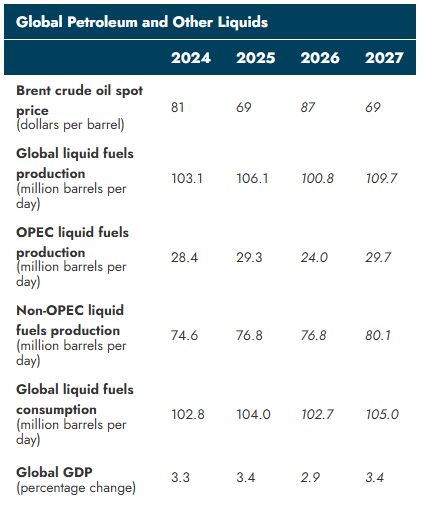
Source: EIA
EIA August 2026 STEO: A 1.9 million-bpd deficit in 2026 gives way to an implied 4.7 million-bpd surplus in 2027. Data are annual averages for total liquid fuels.
In July, on the strength of the June 18 memorandum of understanding between Washington and Tehran, the EIA assumed most shut-in crude would return to near pre-conflict levels by year-end, with the bulk of the rest clearing by the first quarter of 2027.
The July STEO, released on July 7 and based on the June 18 memorandum, was overtaken almost immediately as hostilities resumed. By August, the EIA expected about 600,000 bpd to remain disrupted through the end of 2027, even after most regional production and trade recovered earlier that year.
Hostilities resumed in early July, the Strait effectively closed again, and the August STEO pushed a chunk of that production offline through the end of 2027 regardless.
The IEA’s own forecast moved on the same timeline, milder in July and cut hard again this week, as the numbers above show.
The physical market is already tight
Brent’s prompt spread flipped back into backwardation in July, per the IEA’s own report, after North Sea Dated jumped $25.67 on the month to close near $97 and trade around $92 as of this writing.
Global observed inventories plunged 69 million barrels in July alone. Total stocks are down 410 million barrels, or 2.7 million bpd on average, since the war started in February. The Strategic Petroleum Reserve, at 298.7 million barrels, is sitting at a four-decade low.
This unwinds when barrels physically show up, but Gulf infrastructure hit since February doesn’t repair itself on a diplomatic timeline.
The bear case isn’t wrong, just early
Both agencies’ own 2027 numbers point to a glut, not a deficit, once the region does recover.
The IEA expects global supply to rebound by 8.3 million bpd to 110.3 million bpd in 2027, while demand grows by 2.4 million bpd. That produces a projected surplus of approximately 4.6 million bpd—conditional on de-escalation and the restoration of Gulf production. The EIA’s 2027 Brent forecast of roughly $69 reflects its expectation that supply will recover and inventories will rebuild.
Put simply, the deficit belongs to the near term. The real risk isn’t that Brent falls when Hormuz reopens. It’s that it falls too fast, before the barrels that take until 2027 to come back have actually come back.
Here’s what to watch next
The thesis holds if September’s STEO still shows at least 4 million bpd shut in during the fourth quarter, Gulf exports remain below 18 million bpd, observed stocks stay under 7.9 billion barrels and prompt Brent keeps at least a $1 premium over the next month.
It breaks if Gulf exports top 20 million bpd for four straight weeks, the EIA cuts fourth-quarter shut-ins below 2 million and inventories build by at least 30 million barrels. Five sessions of prompt Brent trading at a 25-cent discount would settle it.
One counter-signal arrived on August 12: U.S. commercial crude inventories rose 17.4 million barrels, driven largely by unusual import and export flows. One U.S. reporting week does not reverse the IEA’s global stock draw, but it complicates a purely one-directional tightness narrative.
As we argued in June, reopening Hormuz is a sequence rather than a switch. The August forecasts now put numbers on that delay.
 Ana Frincu
 Bennet Caldwell
Where do you come down on Brent through year-end?
Sources
CNBC: Hormuz Deadlock: Where Oil Prices Could Head Next as Prospects for an Imminent Deal Fade
EIA: Short-Term Energy Outlook – August 2026
EIA: Short-Term Energy Outlook – August 2026, Full Report
EIA: Short-Term Energy Outlook – July 2026
EIA: Weekly Petroleum Status Report
IEA: Oil Market Report – August 2026
IEA: Oil Market Report – July 2026
IEA: Oil Market Report – June 2026
Reuters: Global 2026 Oil Supply Shortfall to Deepen as Hormuz Reopening Remains Elusive, IEA Says
Reuters: Hormuz Shipping Traffic Falls to One-Week Low Amid Hostilities
Reuters: Oil Climbs 5% as Iran and U.S. Demand Compensation and Hormuz Hopes Fade
Reuters: Oil Prices Dip as Investors Weigh Lower Demand Forecasts Against U.S.–Iran Talks Deadlock
Reuters: Oil Prices Drop 7% After Trump Cancels Iran Attack
Reuters: Oil Prices Settle 5% Lower After Claims of Progress in U.S.–Iran Talks
Reuters: Some Middle East Oil Output Will Stay Shut Through Next Year, U.S. EIA Says