Brief Analysis
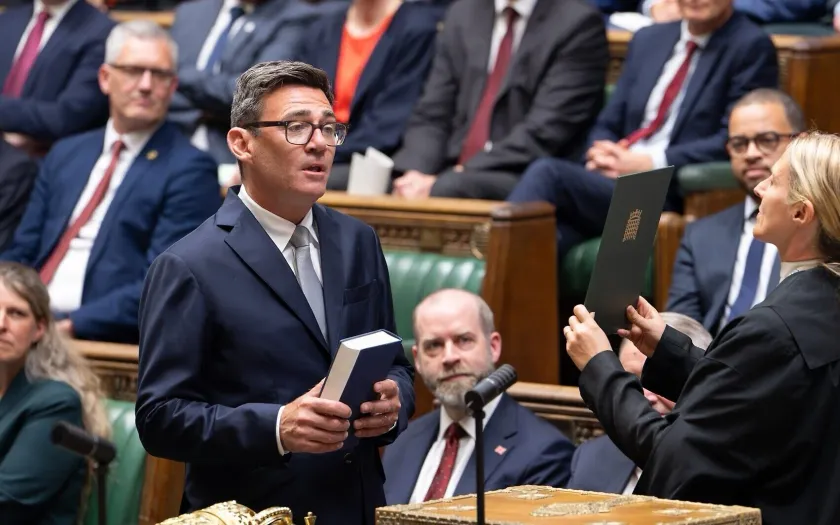
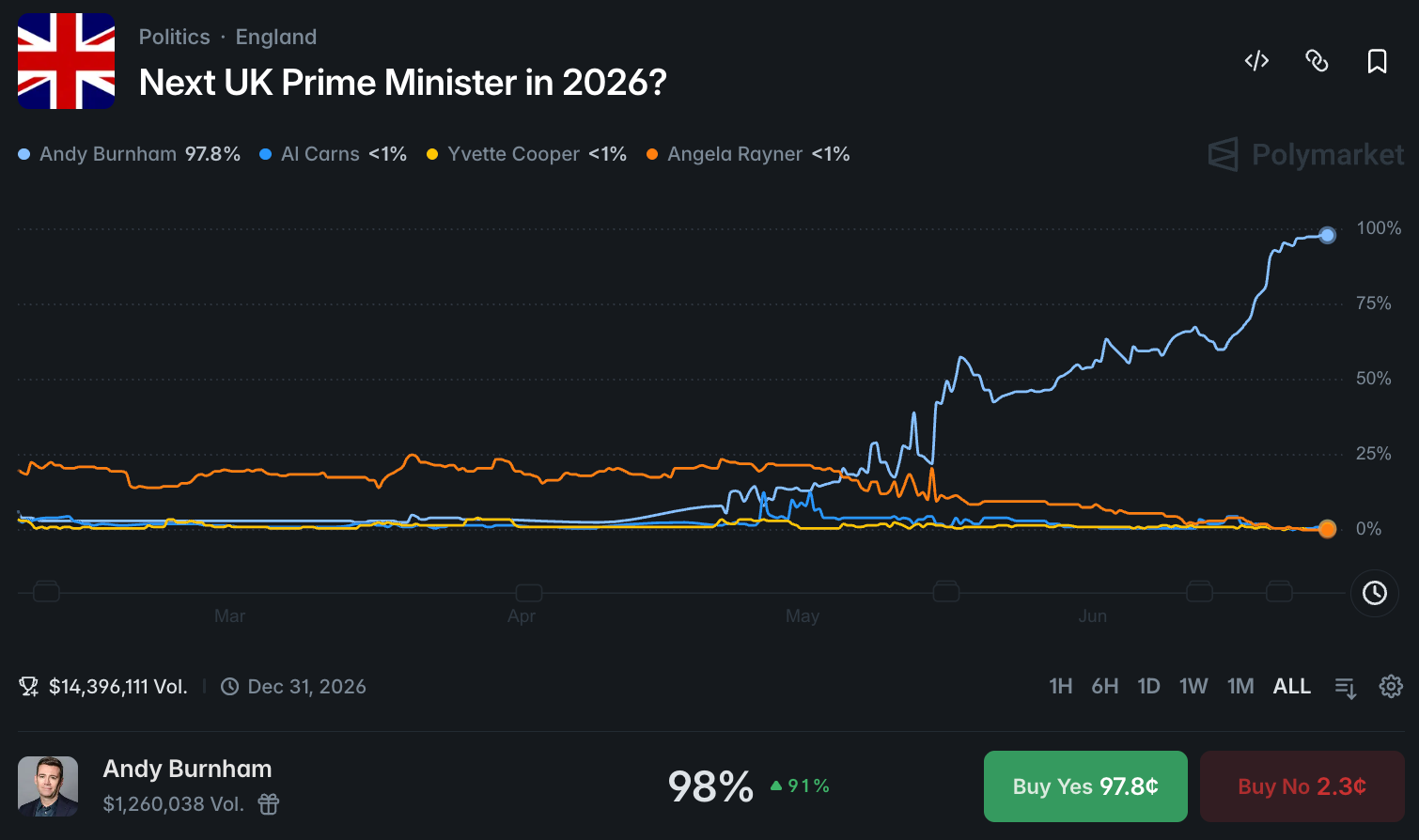
Andy Burnham is not just the frontrunner to replace Keir Starmer. He is now being treated by both Labour insiders and prediction markets as the almost-certain Britain’s next prime minister.
Reuters reported that Darren Jones, a key ally of Starmer, ruled himself out of the leadership race and backed Burnham after receiving reassurance about his economic plans. Burnham is currently the only declared candidate, and Labour figures are increasingly preparing for what could become a fast, low-drama transition.
That is why the question has shifted. This is less about whether Burnham is strong enough to win, and more about whether anyone else can still clear the formal threshold to make him fight for it.
Viewpoint Quote: “The market may be right about the winner, but the unresolved question is the route: does Labour crown Burnham quickly, or does the party still demand a contest before handing him No. 10?”
On Polymarket, Burnham has been trading as the overwhelming favorite in the “Next UK Prime Minister in 2026?” market. But the more delicate contract is the one asking whether Burnham will be unopposed in the 2026 Labour leadership contest.
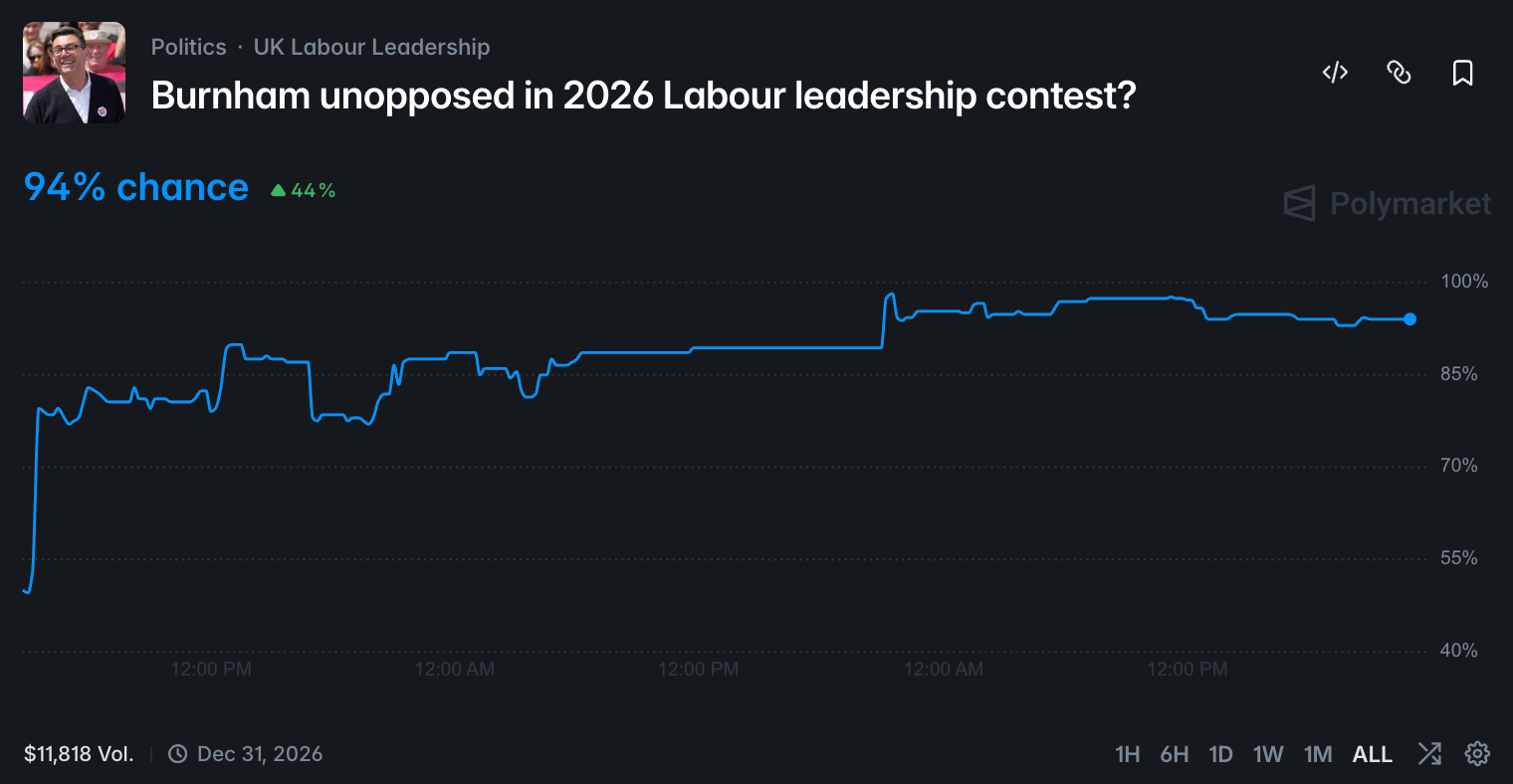
Will Andy Burnham be unopposed in the Labour leadership contest?
This distinction matters. A challenger does not need to beat Burnham to change the story. They only need to clear the nomination threshold.
The current evidence still points toward a coronation. Jones has stepped aside. Chancellor Rachel Reeves has backed Burnham.
Reuters has reported that Burnham is the sole candidate so far and could be in office by mid-July. Those are not small signals; they suggest the party’s senior ranks want speed, unity, and economic reassurance after Starmer’s resignation.
But “likely coronation” is not the same as “zero contest risk.” Sky News reported that some Labour MPs are under pressure from local party members who would prefer a leadership contest rather than a coronation, partly because they want to see Burnham’s plans tested in public. The Guardian has also reported that some backbenchers had seen Darren Jones as a possible candidate to scrutinize Burnham’s economic agenda, even as senior Starmer loyalists urged him not to run.
That does not point to an organized anti-Burnham rebellion. It points to a narrower, more realistic risk: some MPs and party members may want scrutiny, while Labour’s rules still leave room for another qualified candidate if they can gather enough support.
A Burnham coronation would send a clear message. Labour wants a clean handover, minimal internal damage, and a new prime minister who can quickly focus on the economy, public services, and the party’s weak polling position.

A contested race would send a different signal. It would not necessarily mean Burnham is vulnerable. It would simply show that parts of the party want him to explain his fiscal policy, borrowing plans, and post-Starmer direction before he enters Downing Street.
For markets, that is the key difference. The Burnham-to-win trade may already look crowded. The sharper question is whether Labour’s internal incentives favor a clean handover or whether enough pressure for scrutiny remains to put another name on the ballot.
If Burnham becomes prime minister, the first market question may be almost settled. The next one is more political: will Labour crown him quickly, or make him earn the job in public?
Original Article
Reuters — “Starmer ally Jones backs Burnham after being reassured on economic plans”
https://www.reuters.com/world/uk/key-starmer-ally-jones-rules-himself-out-contest-be-britains-next-pm-2026-06-24/