Summary
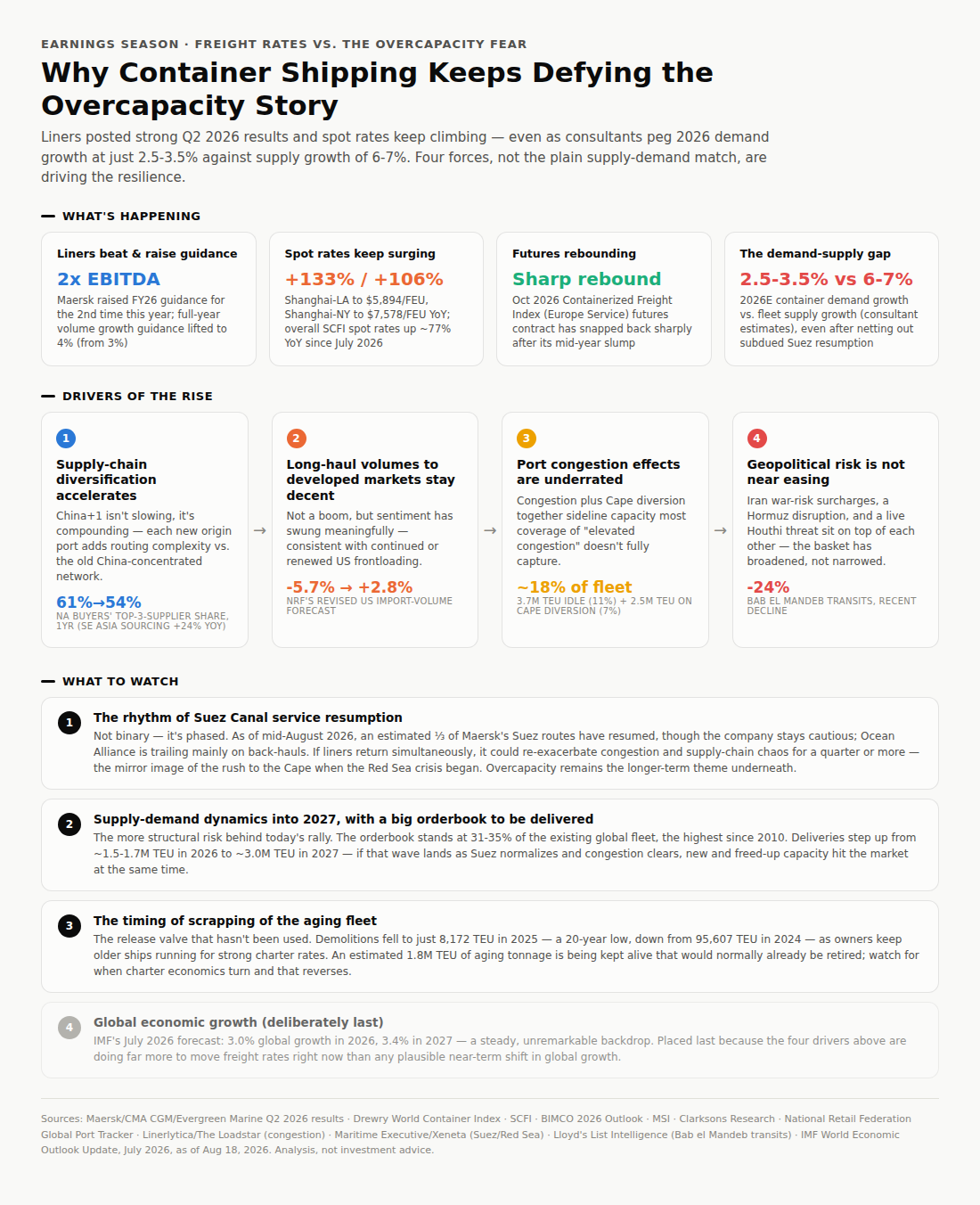
Against the concerns on overcapacities and economic uncertainties, leading global liners reported solid 2Q2026 results (such as Maersk, CMA CGM, and Evergreen Marine), and they seem to remain cautiously optimistic into 3Q2026. Meanwhile, container spot freight rates have continued to surge since July 2026. The industry could be dynamically driven by supply-chain diversification, geopolitical uncertainties, port congestions/operational constraints, rather than the plain supply-demand match (or overcapacity-mismatch as many have feared).
Will global container shipping volume growth will exceeds 4%Y/Y in 2026?
will be based on well-recognized industry sources.
What's happening?
Global liners reported strong 2Q2026 results - such as CMA CGM, Maersk, and Evergreen Marine. Maersk raised guidance for the second time of the year, with EBITDA targets of 2x. Moreover, the company's full-year volume growth guidance is raised to 4% (vs prior 3%), showing confidence in overall global trade.
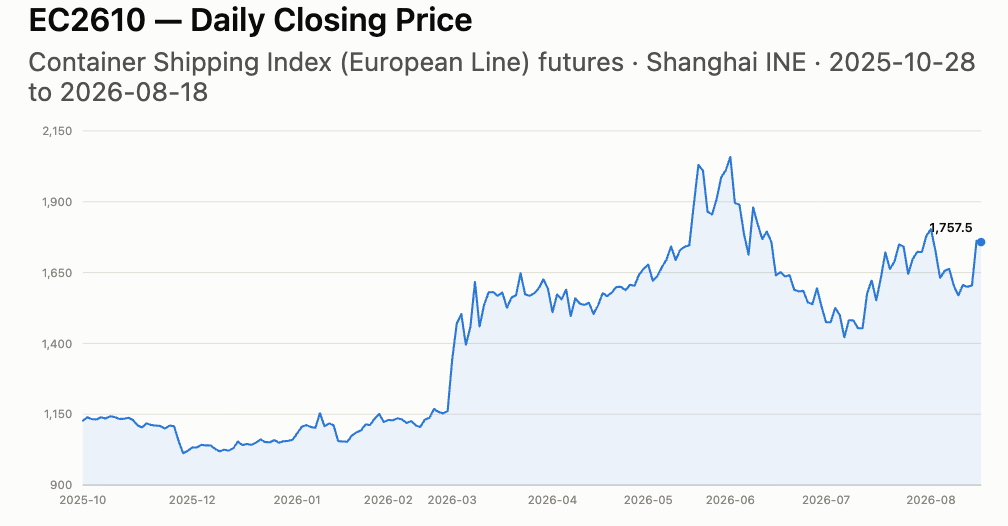
Container spot freight rates continue to surge. Since July 2026, Shanghai-Los Angeles spot rates up 133%Y/Y to $5,894/FEU, Shanghai-New York up 106%Y/Y to $7,578, and overall SCFI spot rates roughly up by 77%Y/Y. As an indicator, for October 2026, the Containerized Freight Index (Europe Service) Futures Contract has been rebounding sharply after mid-year slump.
Interestingly, this is all against the overcapacity concerns looming over the industry. Industry consultants are forecasting a 2026 full-year demand growth of 2.5-3.5%Y/Y, while supply is expected to grow at a much faster pace of 6-7%Y/Y. Noted this has also taken into account of the subdued Suez Canal service resumptions. But what's driving the resiliency of container shipping industry?
Drivers of the rise
Supply-chain diversifications further accelerates. North American importers' concentration in their top-3 sourcing countries has fallen from 61% to 54% over the past year, and Southeast Asia sourcing volumes are up 24%Y/Y — both signs that the China+1 shift isn't slowing, it's compounding. Each additional origin port (Vietnam, India, Bangladesh, Mexico) adds routing complexity relative to the old network, since cargo now moves through less-optimized port pairs and feeder connections. That structural fragmentation itself supports the freight rates and supply-demand dynamics, let alone the demand driven by local economic demand growth — as more ports and markets are being integrated into global supply chain.
Long-haul volumes to developed regions stayed decent. Estimates vary by source, but the consistent theme is that developed-market demand hasn't collapsed even as headline trade growth forecasts sit in the low single digits (BIMCO's 2026 estimate: 2.5-3.5% container demand growth). The U.S. National Retail Federation actually revised its import-volume forecast upward in the past few months, from a projected 5.7% decline to a 2.8% increase, consistent with continued or renewed frontloading into the US. That's a meaningful swing in sentiment even if it's not a demand boom.
The effects of port congestions are underrated. The scale here is easy to undersell in a single "congestion is high" headline. Roughly 3.7 million TEU of capacity is currently idle at berths — about 11% of the entire global container fleet, and comparable to a top-5 carrier's entire operating fleet sitting motionless instead of moving cargo. That's not a marginal drag: it's capacity that would otherwise be available to absorb the current freight-rate spike, and its removal from effective circulation is arguably doing more to tighten the market day-to-day than any of the demand-side numbers above. Congestion of this scale, layered on top of the Cape of Good Hope diversion (another ~2.5 million TEU, ~7% of fleet, still tied up from the 2024 Suez rerouting), means close to 18% of the global fleet is currently unavailable for normal service — which is a much larger effective supply cut than most coverage of "elevated congestion" implies.
geopolitical risks are not near easing. If anything the risk basket has broadened rather than narrowed. Iran-related war-risk surcharges, a Strait of Hormuz disruption, and a Houthi threat to resume Red Sea attacks are all live simultaneously — Bab el Mandeb transits have recently declined by around 24%, showing carriers are still actively avoiding the route rather than testing a return. This is a meaningfully different situation from "the Red Sea crisis is resolving": multiple independent flashpoints (Iran, Yemen/Houthi, broader Gulf tensions) each carry their own reversal risk.
What’s to watch out?
The rhythm of Suez Canal service resumption. This isn't a binary "open or closed" question — it's happening in phases, and the pace matters enormously for effective global capacity. As of mid-August 2026, it is estimated that 1/3 of Maersk's Seuz routes have been resumed, but the company remained cautious. For OCEAN Alliance, they seems to be trailing only on back-hauls.
The interesting part is — if all liners go back simultaneously, it could further exacerbates port congestions and supply-chain chaos by at least a quarter (the way they shifted to Cape of Good Hope when Red Sea Crisis began). While overcapacity could be the theme in the longer-term.
Supply-demand dynamics into 2027, with a big orderbook (TEU capacity) to be delivered. This is the more structural risk sitting behind the current rally. The current orderbook stands at 31-35% of the existing global fleet, the highest level since 2010. Deliveries are scheduled to step up from about 1.5-1.7 million TEU in 2026 to roughly 3.0 million TEU in 2027. If a meaningful chunk of that 2027 wave lands around the same time Suez routes normalize and congestion clears, you get new capacity and freed-up diverted capacity hitting the market simultaneously — which is the scenario many have flagged as the real risk to durability, distinct from today's tight, friction-driven market.
The timing of scrapping of aging fleet. Scrapping is the release valve that hasn't been used. Demolition activity collapsed to just 8,172 TEU in 2025 — a 20-year low — down from 95,607 TEU in 2024, because owners are keeping older vessels in service to capture strong charter rates from Red Sea diversion demand. An estimated 1.8 million TEU of aging tonnage is being kept alive that would, in a normal cycle, already be retired. That's a coiled spring in both directions: if rates soften, scrapping could accelerate quickly and help offset new deliveries; but as long as charter economics stay this attractive, owners have every incentive to keep marginal ships running, which means the "natural" capacity offset isn't currently doing any work — worth watching specifically for when (not if) that changes.
Last but not least, global economic growth (deliberately putting in the end, as those other factors actually could be more relevant).