Kalshi Inc. and Polymarket are slinging weighty accusations at each other as the prediction market rivalry heats up and the nascent industry comes under intense scrutiny in Washington.
While the platforms have sparred frequently in the past, the rhetoric has escalated in recent days after Kalshi launched a pointed advertising campaign and its employees publicly criticized Polymarket.
“Polymarket’s irresponsible, dangerous, and illegal behavior threatens legal American prediction markets,” Benjamin Freeman, who works on political and election markets at Kalshi, wrote in a social media post on Monday.
The accusations quickly sparked a heated back-and-forth between the companies.
“We welcome competition, but believe the discussion should be grounded in facts. Misinforming the public only harms the industry as a whole and participants,” Polymarket said in a statement.
Elisabeth Diana, a spokesperson for Kalshi, responded: “That’s laughable, coming from a company whose majority of trading volume is offshore and unregulated, and whose policies allow death markets.”
The feuding comes as Polymarket and Kalshi battle for leadership of the fast-growing prediction market industry, which has opened up a new way for Americans to wager on everything from sports to elections. The startups have both registered one record trading week after another, with nearly $6 billion in notional trading volume between them in recent weeks, according to user-compiled data on Dune Analytics.
Differences in how the exchanges are set up and operate are at the heart of the dispute. Kalshi’s platform is based in the US and overseen by the Commodity Futures Trading Commission, while Polymarket’s primary exchange operates offshore. Polymarket has used its operations outside the US to list contracts tied to military conflict — including the war in Iran — which Kalshi has said are unethical and illegal.
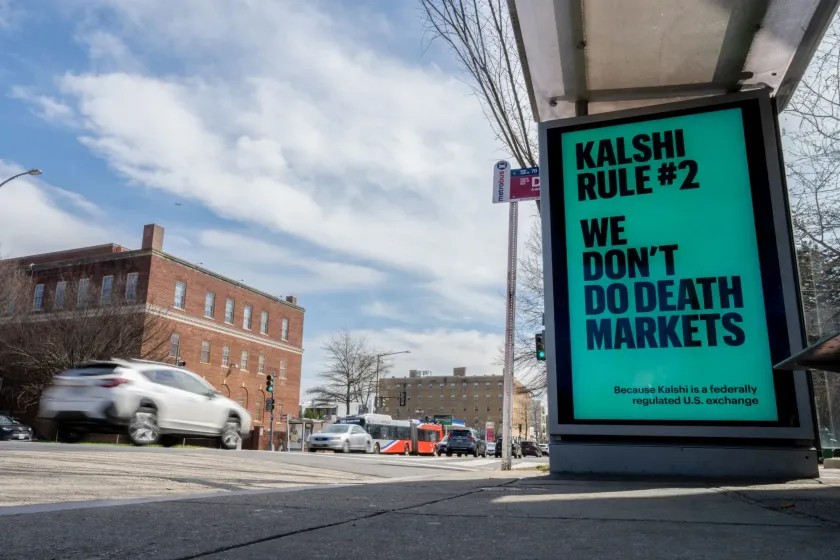
“We don’t do death markets,” one of Kalshi’s ads reads.
The Kalshi marketing, which is presented as a list of the company’s rules, began showing up at bus stops and subway stations in Washington at the beginning of this week.
“Rule #1: We ban insider trading, because Kalshi is a federally regulated US exchange,” says one. The subtext, apparent to industry observers, is that Polymarket’s main exchange is outside the reach of US regulators.
Congress has focused on insider trading following allegations of improper bets tied to US military activities in Iran and Venezuela. Kalshi has been more proactive in confronting the issue — fining and suspending customers it has accused of wrongdoing. Polymarket has taken a more hands-off approach, though it recently announced its own rules on insider trading as scrutiny grew.
“We want to highlight those big distinctions,” said Diana, the Kalshi spokesperson. “We think it’s at a point where there’s a lot of conflation between Kalshi and Polymarket and the approach to regulation.”
In addition to its offshore exchange, Polymarket also has a US-regulated platform that is currently in beta mode. The company said in a statement that both its venues enforce “the same strict market integrity standards, including prohibitions on insider trading and manipulation, with active monitoring and ongoing engagement with regulators and law enforcement.”
A few months back, Kalshi co-founder Luana Lopes Lara tried to lower tensions between the rivals. She wrote in an October social media post that she hopes the industry can move beyond “destructive infighting” and work together.
That now appears unlikely, especially after a Kalshi adviser and former CFTC commissioner, Brian Quintenz, joined the fray. Responding to reports that prosecutors are probing insider trading, Quintenz suggested on social media this week that the investigation should focus on Polymarket. Quintenz declined to comment further when contacted by Bloomberg News.