Introduction: The End of the "Peace Dividend" and the Dawn of the Super-Cycle
The secular pivot in European defense is no longer a theoretical commitment; it is a structural reallocation of capital. For institutional investors, defense has completed a radical repricing, transitioning from an ESG outcast to a sovereign safe-haven asset. Following decades of post-Cold War atrophy—where spending collapsed from historical highs above 3% of GDP according to Funcas—the base-effect acceleration is now indisputable. Official data from the European Commission highlights that the bloc's combined defense budget expanded to €350 billion in 2024, establishing the institutional foundation for permanent military readiness, accelerated by the structural pivot of US strategic priorities away from the European theater. Confirming this immediate momentum, NATO's 2026 report documents a 19.6% real-term spending surge in 2025, pushing the average allocation across European Allies and Canada to 2.33% of GDP. This marks the definitive end of the peace dividend and the onset of an unprecedented multi-decade capital allocation super-cycle.
I. The Demand Shock: From Political Constraint to Structural Budgetary Rule
For institutional investors, the defense super-cycle represents a regime change driven by captive demand and multi-year revenue visibility, strictly decoupled from the civilian macroeconomic cycle. The catalyst is political: an EPRS report reveals that between 2022 and 2023, 78% of EU defense acquisitions were sourced outside the bloc. This capital flight forced a protectionist pivot, systematically locking public procurement within the European Defense Technological and Industrial Base (EDTIB).
Consequently, the budgetary execution is staggering. European Defence Agency (EDA) projections forecast a total defense budget of €454 billion for 2026, reaching 2.4% of GDP. Crucially, this is a hardware-driven Capex super-cycle. The EDA confirms €163 billion will be allocated strictly to equipment and investments in 2026, an explosive 158.7% increase compared to 2021. This permanently transforms European prime contractors into cycle-immune assets with guaranteed income.
II. Capacity Bottlenecks: Historical Book-to-Bills and Supply Rigidity
For institutional investors, the defense sector paradigm has decisively shifted from demand generation to execution risk. A massive influx of public capital is currently colliding with profound supply rigidity, exacerbated by a critical dependency on imported raw materials. The ReArm White Paper explicitly warns that the European supply chain is heavily constrained by slow production capacities and structural fragmentation, making industrial scale-up a critical operational challenge.
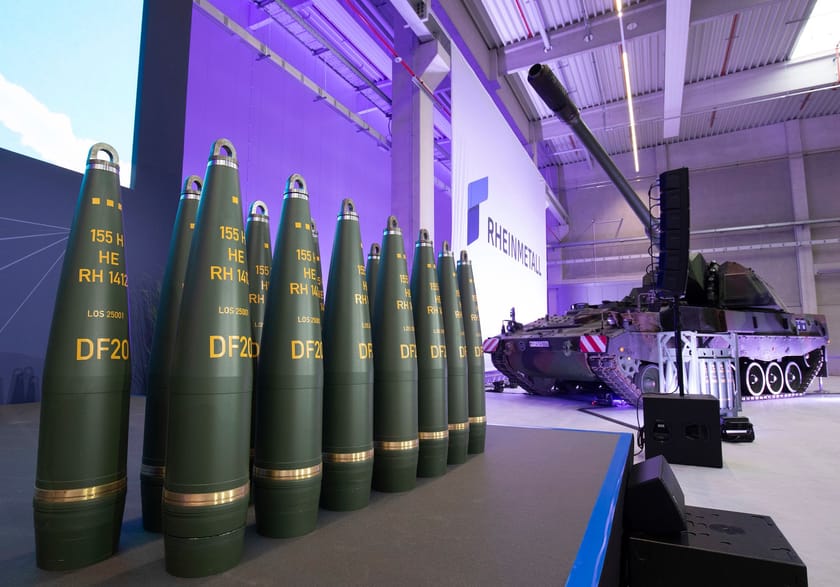
This severe inelasticity of supply is mathematically proven by recent corporate earnings, as prime contractors book contracts at an unsustainable velocity relative to their billing capabilities. Rheinmetall perfectly exemplifies this capacity saturation, reporting a record backlog of €63.8 billion, which represents a 36% year-over-year explosion. Concurrently, the firm maintained strong pricing power, achieving an exceptional 18.5% operating margin. Similarly, Thales recorded a massive €25.26 billion in order intake, aggressively driving its total backlog above the €50 billion threshold.
In light of the severe capacity bottlenecks across the European defense sector, what is your primary equity allocation strategy for H2 2026?
III. The Sovereign Equation: Fiscal Space, Crowding-Out, and the Defense Eurobonds Bet
Financing the NATO defense mandates purely through national balance sheets is fracturing the eurozone. As Reuters highlights, sovereign heavyweights like France, Italy, and the UK face immediate budgetary strain, proving that isolated funding models are structurally exhausted.
This fiscal exhaustion triggers severe macro-financial risks. IMF Working Paper 26/53 (Furceri et al.) demonstrates that defense fiscal multipliers are highly asymmetric: while reaching 1.9 under optimal conditions, this efficacy collapses in high-spread environments. If heavily indebted peripheral states issue uncoordinated debt, skyrocketing borrowing costs will crowd out private investment and crush economic growth. Furthermore, market participants cannot simply rely on the European Central Bank’s Transmission Protection Instrument (TPI) to endlessly absorb defense-driven deficits without unanchoring inflation expectations.
Mutualization is therefore a mathematical necessity for yield curve stability. BBVA Research validates that the €150 billion SAFE instrument is vital to bypass the lethal "snowball effect" that compresses fiscal space. To protect peripheral issuers and prevent fatal spread widening across the continent, Defense Eurobonds remain an absolute necessity.
With European national deficits widening under the weight of accelerated rearmament, how are you pricing the eurozone sovereign risk?
Conclusion: The Binary Allocation Hour
The era of broad-brush defense exposure is dead. As Morgan Stanley’s June 2026 downgrade from "Overweight" to "Equal Weight" signaled, buying sector Beta no longer works amidst stretched valuations and fading momentum. The market has returned to raw fundamentals: Reuters’ Q2 2026 earnings reporting underscores that top-line narratives are over, and bottom-line execution is king. Investors must pivot to strict stock-picking (Alpha), targeting only high-conviction executors capable of converting backlogs into cash.
This execution mandate collides directly with BlackRock’s 2026 Midyear Outlook framework on the twin scarcity of materials and capital. Supply chain bottlenecks strangle unequipped contractors, while soaring debt issuance puts immense upward pressure on yields.
Our ultimate portfolio directive is binary: go long ultra-selective defense equities that master execution, while shorting or underweighting vulnerable European sovereign bonds as a hedge against fiscal slippage and unmutualized debt strain. Capital demands real delivery—position the desk where cash is collected, not spent.
References
I. Institutional & Policy Frameworks
- BlackRock Investment Institute (2026). Mid-Year 2026 Global Outlook: Scarcity vs. Abundance (The Sovereign Cost of Security).
- Consilium of the European Union & European Defence Agency (2026). EU Defence in Numbers.
- European Commission (2024). European Defence Industrial Strategy (EDIS). Brussels.
- European Commission (2025). White Paper on the Future of European Defense (ReArm Europe Plan).
- European Parliamentary Research Service - EPRS (2024). Improving the quality of European defence spending. Briefing.
- Funcas Intelligence (2025). EU defense spending and trade outlook. Policy Paper.
- North Atlantic Treaty Organization - NATO (2026). Annual Report 2025–2026, presented by Secretary General Mark Rutte.
II. Economic Research & Sovereign Analysis
- BBVA Research (2025). EU Priorities: Defence Spending & Multipliers. Economic Watch.
- International Monetary Fund - IMF (2026). Furceri et al., Working Paper Vol. 2026, Issue 053: Macroeconomic Impacts of EU Defense Spending.
III. Corporate Disclosures & Market Intelligence
- Morgan Stanley Research (June 2026). European Defense Shares Retreat Following Morgan Stanley Sector Downgrade. Equity Research Note.
- Rheinmetall AG (March 2026). Financial Report: FY 2025 Results. Düsseldorf.
- Reuters (Spring/Summer 2026). Analysis: NATO defence push already strains Europe's budgets & European corporate outlook continues to improve as earnings season gathers steam.
- Thales Group (March 2026). Full-Year 2025 Financial Results. Paris.