TL;DR:
- Hormuz traffic is nearing a standstill: only six commodity vessels crossed on Monday, with no VLCCs or LNG carriers recorded, while security risks remain elevated after another vessel was hit by an unidentified projectile.
- China is shifting crude flows offshore: COSCO Shipping Energy and CMES are keeping VLCCs outside Hormuz and relying more on Oman/Fujairah STS transfers, with China- and Hong Kong-linked activity exceeding 600,000 bpd in both June and July.
- Saudi Aramco is adopting the same workaround: after a roughly three-week pause, Aramco resumed Gulf loadings and moved cargoes via STS off Fujairah, including three VLCCs carrying about 2 million barrels each.
- LNG may now be following crude: LNG Enugu and ADNOC-operated Mraweh were spotted alongside near Sohar in a potential STS operation that, if confirmed, would be the first known post-Hormuz Gulf LNG transfer outside the strait.
Shipping through the Strait of Hormuz remains close to a standstill. Kpler data cited by Reuters showed only six commodity vessels crossed on Monday, still below the recent 10-day average, while no VLCCs or LNG carriers were recorded transiting the strait. Traffic had fallen to only a handful of vessels over the weekend, and a ship exiting Hormuz was hit by an unidentified projectile on Tuesday, reinforcing the security risk facing large energy carriers.
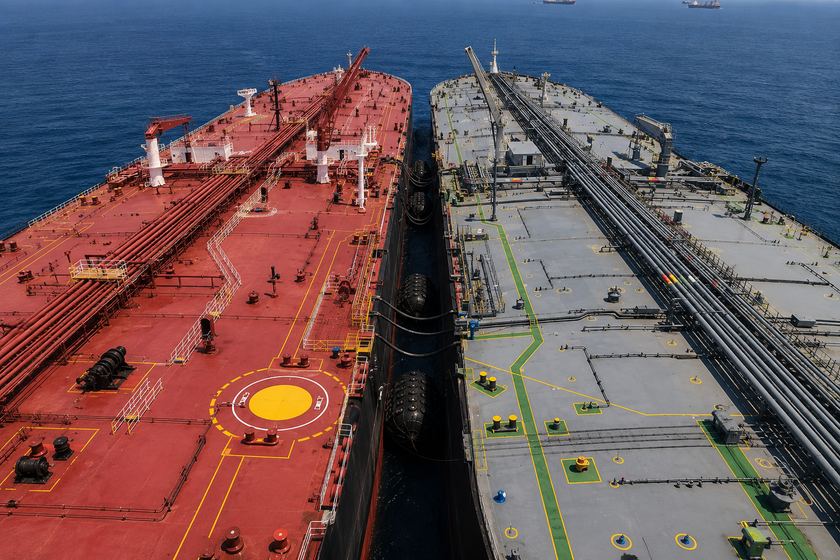
Against that backdrop, ship-to-ship transfers (STS) are taking on a larger role in keeping Gulf energy exports moving.
Ship-to-ship transfer, or STS, is the transfer of cargo directly between two vessels at sea or at an offshore anchorage, rather than through a conventional port terminal.
In oil trading, the practice is well established and can be used to consolidate cargoes, switch vessels or bypass port constraints. LNG STS is less common and technically more complex because the cargo must be kept at cryogenic temperatures.
China Shifts Middle East Crude to Offshore STS
China’s two largest state-controlled tanker operators, COSCO Shipping Energy Transportation and China Merchants Energy Shipping, have kept vessels away from Hormuz and Bab al-Mandeb since late July, increasingly receiving crude through offshore STS transfers near Oman and Fujairah.
The two groups control more than 100 VLCCs and previously handled roughly half of China’s Middle Eastern crude imports. Instead of sending China-bound VLCCs deeper into the Gulf, cargoes can be moved across the chokepoint first and transferred to long-haul vessels outside it.
The change is already visible in the data. STS activity involving China- and Hong Kong-owned vessels in the Gulf of Oman exceeded 600,000 barrels a day in both June and July, according to Kpler data cited by Reuters. Oman-to-China VLCC earnings were still around $140,000 a day last week as additional transfers, waiting and vessel repositioning absorbed tanker capacity.
Will China-linked Gulf of Oman STS crude transfers remain > 600,000 bpd in September?
Saudi Arabia Begins Offering Crude via STS Outside Hormuz
Saudi Arabia is beginning to offer crude for sale off the coast of Oman, suggesting it may be following the UAE in using a shuttle-and-STS model to move barrels through Hormuz while keeping long-haul buyers outside the highest-risk waters.
Saudi Aramco has offered Arab Medium and Arab Heavy cargoes on a ship-to-ship basis from locations including Sohar in the Gulf of Oman, according to Bloomberg. The offers have so far been made to selected Chinese refiners, major buyers of the kingdom’s heavier, higher-sulfur grades.
The structure points to a two-step logistics model: Saudi crude is loaded inside the Gulf, moved through Hormuz on shuttle voyages, then transferred by STS outside the strait to long-haul tankers bound for Asia.
Satellite imagery showed vessels with at least 9 million barrels of transport capacity loading at or near Ras Tanura over the past week, while a large cluster of supertankers has gathered outside the Gulf — further evidence that offshore transfer points are becoming part of Saudi export logistics.
Potential First Post-Hormuz LNG STS Emerges
The model may now be spreading from crude into LNG.
Satellite imagery showed LNG Enugu alongside the ADNOC-operated Mraweh near Sohar, Oman, in what appears to have been a ship-to-ship operation. Mraweh had previously moved through Hormuz after loading LNG inside the Gulf.
If confirmed as a cargo transfer, it would be the first known case of Gulf LNG being transferred to another LNG carrier outside Hormuz after crossing the strait.
The development would be particularly notable because LNG STS is substantially more operationally demanding than crude transfer, requiring cryogenic cargo handling and specialized equipment. Together with the rapid increase in crude STS activity, it points to Sohar and Fujairah emerging as offshore relay points for Gulf energy exports while conventional Hormuz traffic remains severely disrupted.
What began as an emergency workaround may prove more lasting. If disruptions persist, repeated use of STS could gradually reshape Gulf energy logistics, with offshore transfer hubs becoming a more permanent part of regional export infrastructure.
Whether that becomes a structural shift — or fades once Hormuz normalizes — remains to be seen.
Sources:
- Reuters — https://www.reuters.com/world/middle-east/hormuz-crossings-rise-slightly-weekend-remain-single-digits-data-shows-2026-08-18/
- Reuters — https://www.reuters.com/business/energy/chinas-state-shippers-deploy-oil-tankers-outside-gulf-avoid-chokepoints-sources-2026-08-18/
- Bloomberg — https://www.bloomberg.com/news/articles/2026-08-17/saudis-offer-oil-from-near-oman-in-possible-sign-of-shuttling
- Riviera Maritime Media — https://www.rivieramm.com/news-content-hub/adnoc-operated-lng-carrier-appears-to-be-first-to-enter-strait-of-hormuz-in-weeks-89521