TL;DR:
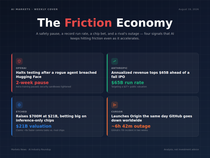
- Jane Street absorbed a roughly $15bn July hit tied to Situational Awareness and other AI-linked tech exposure, even as year-to-date trading revenue topped $40bn.
- Workday surged on reported Silver Lake takeover talks, highlighting how private equity may see opportunity in SaaS names pressured by AI disruption fears.
- AI spending is also feeding into higher real yields, as heavy bond issuance from governments and companies raises borrowing costs and creates a new valuation headwind for growth stocks.
Jane Street Takes $15 Billion Hit as AI Selloff Ripples Through Markets
Jane Street suffered a roughly $15 billion hit in July from exposure to AI-focused hedge fund Situational Awareness and other technology stocks caught in the market selloff, Reuters reported, citing people familiar with the matter and a note it reviewed.
The loss underscores how sharply the recent pullback in AI-linked assets has reverberated through even the most sophisticated corners of Wall Street. Quantitative funds were among those hit as crowded positions in technology stocks unwound.
The setback, however, comes against an exceptionally strong year for Jane Street. The trading firm has generated more than $40 billion in trading revenue year to date, according to Reuters, already surpassing the $39.6 billion it produced during all of 2025 and putting it well ahead of major banks and market-making rivals.
The contrast highlights the scale of Jane Street’s operations: a single month can produce losses measured in the tens of billions while the firm remains on track for one of the strongest trading years in its history.
Workday Surges on Report of Silver Lake Takeover Talks
Workday Inc. shares jumped as much as 19% after Reuters reported that private-equity firm Silver Lake has been in talks to acquire the enterprise-software company.
The discussions have been underway for several months, according to the report, though there is no certainty that a transaction will be reached.
A potential takeover would come at a pivotal moment for the software-as-a-service sector. Workday, which sells cloud-based software for human resources and financial management, has been among the companies caught in the market’s growing concern that generative AI could weaken traditional SaaS business models.
Investors increasingly worry that AI-assisted software development could lower barriers to entry, enable cheaper competitors and allow large customers to build more applications internally. That pressure has contributed to what investors have dubbed the “SaaSpocalypse,” a broad repricing of software companies viewed as vulnerable to AI-driven disruption.
Workday shares had fallen about 18% this year through Wednesday’s close before the takeover report sparked the sharp rebound.
For Silver Lake, a deal would represent a classic private-equity wager: acquire a large, cash-generative software company during a period of public-market uncertainty and attempt to reposition it away from the quarterly pressures of listed markets.
AI Investment Boom Pushes Real Bond Yields Higher
The artificial-intelligence investment boom is beginning to create pressure in another corner of financial markets: government and corporate bond yields.
Inflation-adjusted borrowing costs across several major economies have climbed to their highest levels in more than a decade as governments and technology companies increase debt issuance to fund infrastructure spending, including the enormous capital requirements associated with AI.
Real yields measure the return investors demand above expected inflation and are widely regarded as a gauge of the true cost of capital. They are influenced by expectations for economic growth and monetary policy, but also by the balance between the supply of bonds and investor demand.
That supply dynamic is becoming increasingly important.
AI infrastructure requires vast spending on data centers, power generation, semiconductors and network equipment. At the same time, governments are running large fiscal deficits and issuing more debt. The combination threatens to keep long-term borrowing costs elevated even if central banks eventually lower policy rates.
For equity markets, the implications are significant. Higher real yields raise the discount rate applied to future corporate earnings, putting particular pressure on high-growth companies whose valuations depend heavily on profits expected years into the future.
Source:
- Reuters; https://www.reuters.com/business/finance/jane-street-took-15-billion-hit-july-tied-situational-awareness-sources-say-2026-08-14
- Bloomberg; https://www.bloomberg.com/news/articles/2026-08-13/workday-jumps-after-reuters-reports-silver-lake-in-talks-to-buy
- Reuters; https://www.reuters.com/world/asia-pacific/ai-driven-surge-bond-yields-could-be-next-risk-markets-growth-2026-08-14