Polymarket, the long-time leader in prediction market trading volume, has fallen behind its chief rival as it faces a growing list of operational stumbles in its attempt to reach a crucial audience: US customers.
A string of delays, in addition to the startup’s disruptive approach to an already disruptive industry, has drawn blowback from customers and lawmakers, and at times even tested the patience of its biggest investor, Intercontinental Exchange Inc., according to people familiar with the situation.
The setbacks are shaping a battle for the soul of a booming industry that is trying to change the nature of both gambling and finance by offering a new way to bet on just about anything.
For most of the last few years, Polymarket had more trading volume than any other prediction market exchange, and it continues to grow and attract as much attention as any player in an industry it dominates along with Kalshi Inc. Recently, though, its global trading volumes have been eclipsed by those of its main rival, according to user-compiled data on Dune Analytics.
Kalshi also moved ahead of Polymarket when it announced new fundraising last month that pushed its valuation to $22 billion. Polymarket was recently valued at $15 billion when it received a $600 million investment from ICE, Bloomberg reported this week.
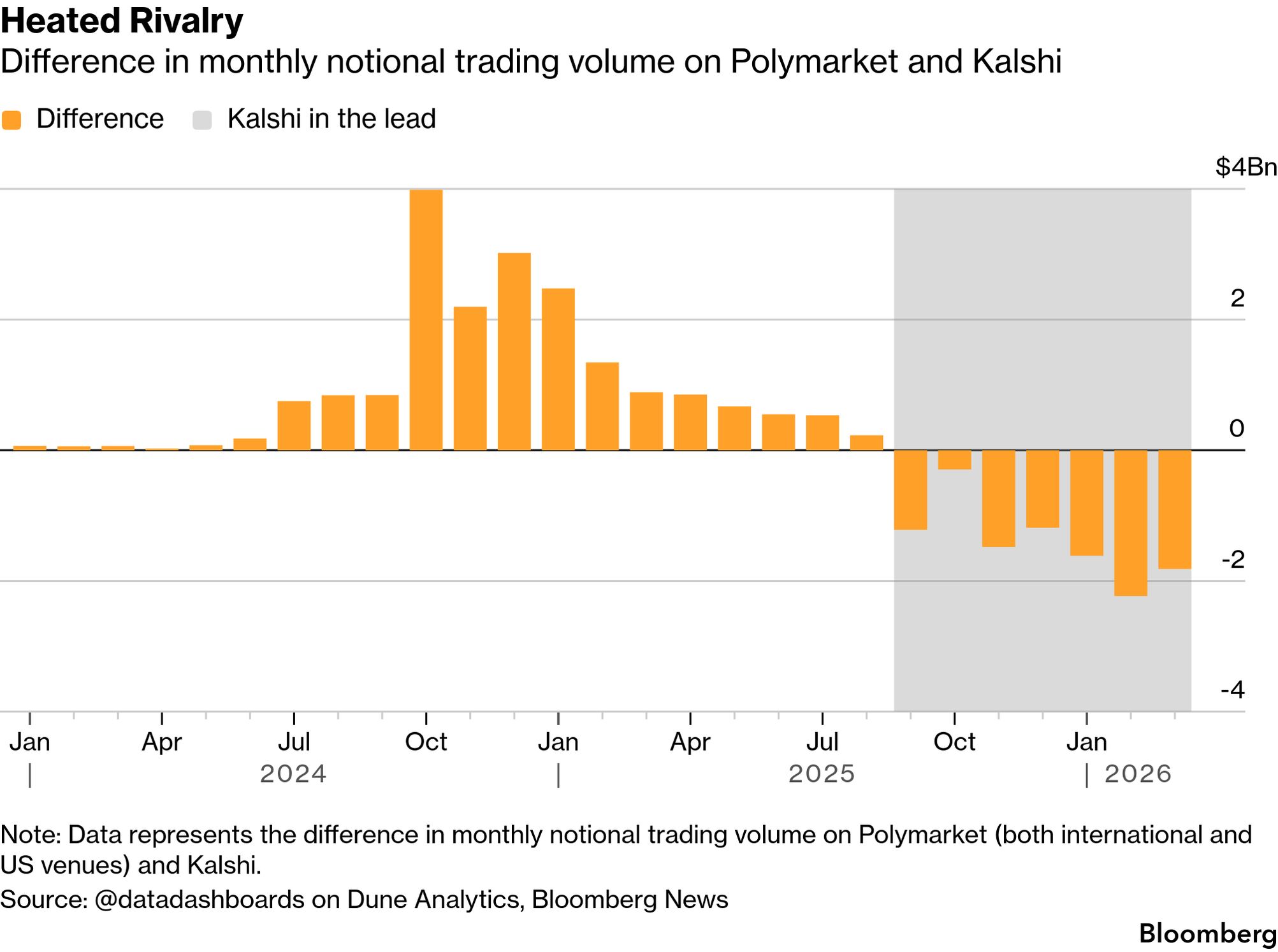
Note: Data represents the difference in monthly notional trading volume on Polymarket (both international and US venues) and Kalshi.
Gaffes, delays in product rollouts and Coplan’s unconventional management style are contributing to the strains on various fronts, said the people, who asked not to be named describing private business relationships.
An anything-goes spirit pervades the prediction market space and no purveyor — including Kalshi — has been immune to growing pains, as state officials fight to shut down the exchanges in court and critics accuse them of escalating a gambling epidemic.
But while Kalshi has recently gone to pains to paint itself as a friend to regulators and big institutions, Polymarket has stood out for its willingness to buck regulatory and financial conventions. It has let customers wager on topics — like war and nuclear detonations — that its competitors and some lawmakers have said should be illegal. It has also been slower than rivals to crack down on insider trading and continues to rely on a blockchain network on its offshore exchange that allows users to operate pseudonymously.
The brash attitude was a selling point during its meteoric ascent, giving it a reputation as a crypto-native disruptor, a prized quality in Silicon Valley and among people close to President Donald Trump. The president’s son is an adviser and investor, through the venture fund 1789 Capital, where he’s a partner. Now, though, those same qualities are creating tension as the nascent industry tries to go mainstream.
“What worked to this point isn’t what will push Polymarket and the prediction market industry to the next stage,” Matt Lamers, a data analyst at prediction markets analytics platform EventWaves, wrote in a recent post on Substack chiding the company for being out of step with the industry on several issues. “As a huge believer in prediction markets, I hope Polymarket starts acting more responsibly.”
A spokesperson for Polymarket said the company is taking a deliberate approach, and that new technologies take time to mature.
“As a company, we’re focused on safety and integrity,” the spokesperson said. “We’d rather be slower and methodical, than just launching and causing issues.”
Prediction markets like Kalshi and Polymarket are booming. They also face a widening legal battle with US states and criticism over alleged user insider trading. Here’s how they got so controversial. Source: Bloomberg
Many of the challenges relate to Polymarket’s difficulty launching in the US, the single biggest market, and one where its competitors are already operating. Its offshore exchange made it an industry leader when US regulators were holding back domestic prediction markets. Now, though, the center of gravity has moved to the US after the Trump administration embraced the industry.
Polymarket’s US app, which it has been teasing since last year, remains in beta mode with relatively little trading, despite securing the necessary licenses. The slow progress has been due, in part, to the blockchain-based architecture of Polymarket’s international exchange, giving it a separate set of challenges from its primary rivals, people familiar with the planning said. Meanwhile, smaller competitors that came later have already launched fully operational US platforms.
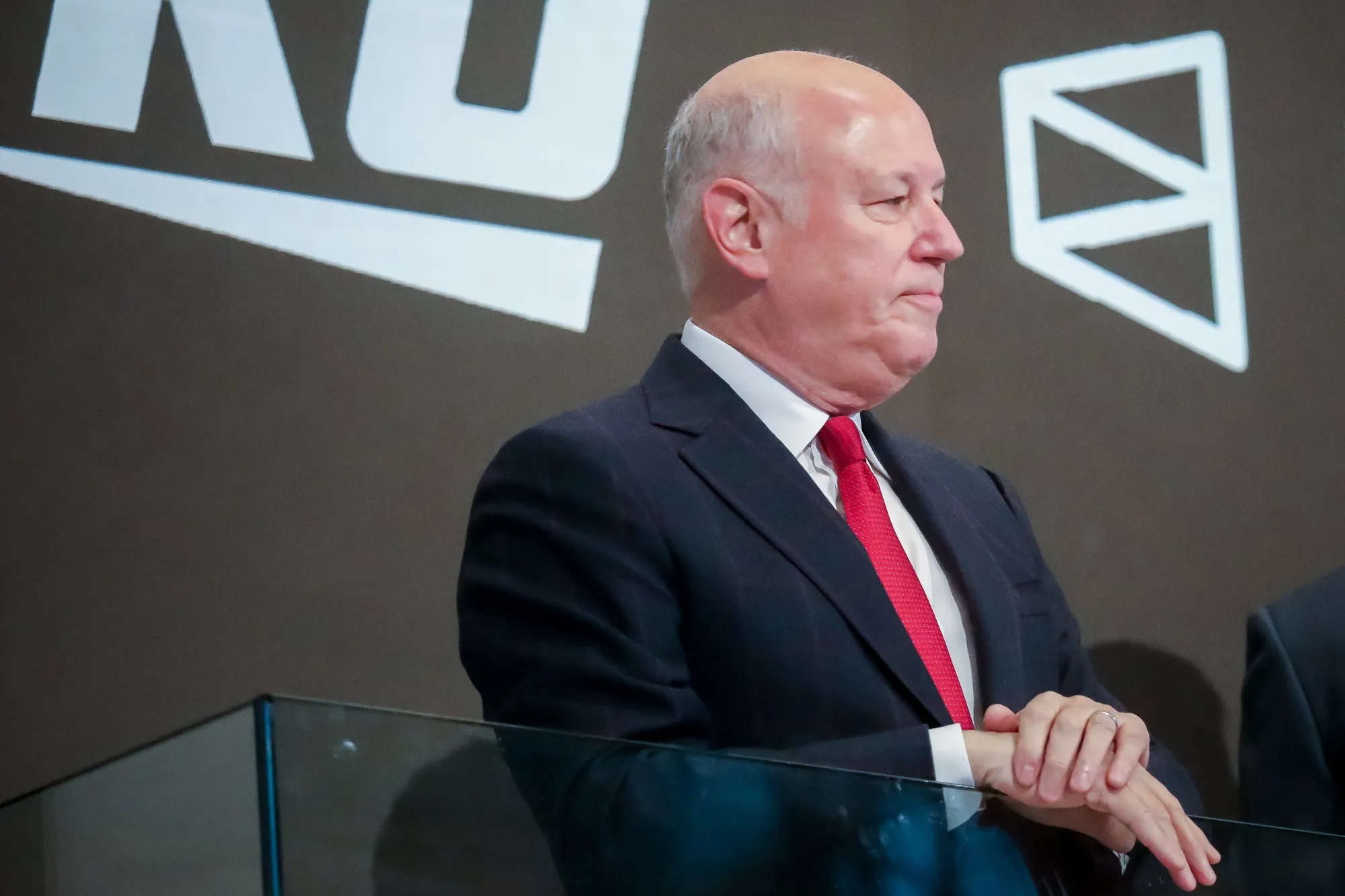
The chief executive officer of ICE, Jeffrey Sprecher, said in an interview that he remains a believer in the potential of the business, and the independent, entrepreneurial approach of Coplan — who he called a “genius.” He has, though, offered Coplan advice on what they should do to enter the US more quickly.
“You’re not going to be a prime time company unless you can access the US legally,” Sprecher recalls telling Coplan about the company’s efforts to enter the US. “They are starting to realize this isn’t easy.”
ICE invested $1 billion in Polymarket last year at a $9 billion valuation. Last month, the exchange operator said it invested an additional $600 million, showing a willingness to provide funding at the higher valuation of $15 billion, according to people familiar with the deal.
While Coplan’s quirks are in many respects standard fare for charismatic tech CEOs, some business associates, who declined to be named discussing private meetings, expressed frustration with his focus and timing. He is regularly late to private meetings, has attended at least one of them barefoot, and is easily distracted, texting and taking phone calls in the middle of conversations, the people said.
He has been late to public functions and the company’s biggest promotional event, a pop-up bar in Washington, received negative media coverage for a rough opening after numerous technical snafus. A few weeks earlier, the company’s first pop-up promotion — a grocery store — also opened late.
The company, meanwhile, has backtracked and apologized for botched launches, including a recent rollout of new fees that surprised and confused many customers, according to posts on its chat boards.
“The rollout was terrible,” a person identified as a Polymarket employee wrote on the company’s official Discord chat room for customers. “We’re adding way more checks before anything like this can be pushed out in the future.”
On Monday, trading on the exchange went down for more than an hour, as part of a scheduled restart that was expected to last five minutes. Over the weekend, the company said it was delaying an upgrade of its exchange infrastructure for at least a week.
Such setbacks may be temporary: even well-funded startups experience technical issues. The Polymarket spokesperson said that it would not be possible to “build the most interesting consumer financial product of the last few years without being a methodical operating machine.”

Rivals have been looking to capitalize on the growing list of problems. The head of the Coalition for Prediction Markets, which represents Kalshi and a number of other large players in the industry, recently took to social media to distance the coalition from Polymarket.
“Good to see the press differentiating between unregulated platforms where these scandals keep happening and U.S.-based regulated ones, where they don’t,” the coalition’s head, Sean Patrick Maloney, wrote on social media in response to a recent news story about alleged insider trading on Polymarket.
The current difficulties are hardly the first hurdles that Polymarket has faced, and it has overcome big ones in the past. In 2022, the startup reached a settlement with US regulators that forced it to shut off US customers. Two years later, the FBI raided Coplan’s apartment as part of a probe into Polymarket’s adherence to the settlement.
The Trump administration later dropped the probe and Sprecher has said that the way Coplan handled the FBI raid showed that he had real “grit.”
Kalshi picked a different path and spent those earlier years challenging the Commodity Futures Trading Commission to win US approval for regulated contracts, which allowed it to take off once the Trump administration signaled that it would allow the markets to expand more quickly in the US. The exchange’s most popular topic for trading is sports, setting the stage for its legal standoffs with states.
Coplan has been indicating that Polymarket was preparing to launch its regulated US business since last summer, when it purchased a CFTC-regulated exchange and opened a waiting list for customers.
“I’ve waited a long time to say this: Polymarket is coming home,” he wrote on social media in July.
Polymarket has acquired QCEX, a CFTC-regulated exchange and clearinghouse, for $112 million.
This paves the way for us to welcome American traders again.
I've waited a long time to say this:
Polymarket is coming home 🇺🇸🦅 pic.twitter.com/Qjd5ZbUwKi
— Shayne Coplan 🦅 (@shayne_coplan) July 21, 2025
Some analysts were surprised when the US app didn’t launch by the beginning of the football season last fall, a crucial time for sports betting, and even more when the Super Bowl and March Madness came and went. This has been more glaring because DraftKings and FanDuel, two gambling companies, both got their own prediction market operations up and running before the Super Bowl.
“I know from even before they launched here, their plan was to have product parity with Kalshi by the Super Bowl,” said Jordan Bender, managing director of gaming equity research at Citizens. “Clearly that didn’t happen. And I think a lot of it is the infrastructure is taking a long time to get up and running.”
Select customers have been invited to use a test version of the US app, but the volumes were roughly one-twentieth of Kalshi’s in March, according to the Dune data.
Isaac Rose-Berman, a consultant on gambling and prediction markets, said that “it’s frankly embarrassing” that a company of Polymarket’s size would not have a functioning US app. “As of right now, they’ve done a poor job onboarding liquidity. There are problems with their matching engine. User experience is bad,” he said.
In the meantime, Polymarket’s international exchange has come under scrutiny for skirting US rules. Its blockchain system allows people to sign up without the identity checks required by regulated financial exchanges. While its terms of service bar US customers, traders have spoken publicly about circumventing the company’s restrictions by using a virtual private network that obscures a user’s location.
The company has also offered controversial products that are not available elsewhere. It apologized last month for listing a contract tied to the likelihood of downed US pilots in Iran being rescued — what critics called a “death contract.” It has, though, continued to offer other markets tied to military conflict, which Kalshi and other exchanges have said they consider to be illegal in the US. Democrats in Congress sent a letter to the CFTC urging the agency to intervene to stop Polymarket.
“We don’t want to stifle the value of social good that can come out of these markets, on important geopolitical events,” the Polymarket spokesperson said. “That said, we also are extremely focused on the integrity of our markets and are fully collaborative with all relevant law enforcement authorities.”
The company has spent relatively little on lobbying in Washington relative to other big players in the space.
Still, Coplan was invited in February to join the CFTC’s new Innovation Advisory Committee. Polymarket has also struck major marketing partnerships with media companies and top-tier sports leagues. It agreed to pay more than $200 million to become the official prediction market partner of Major League Baseball, according to a person familiar with the deal.
Sprecher said that he understands the risks that come with Polymarket’s bold strategy, but also thinks it offers huge upside, which he expressed through the kind of odds that Polymarket itself might offer.
“My Polymarket on these things is either a complete wipeout or they are going to be home runs,” Sprecher said. “And obviously we are betting they are going to be home runs.”