A record quarter, a strong guide - and why the shares still fell more than 9%
AMD shares fell more than 9% after hours despite better-than-expected second-quarter results. The selloff reflected elevated expectations rather than weak fundamentals.
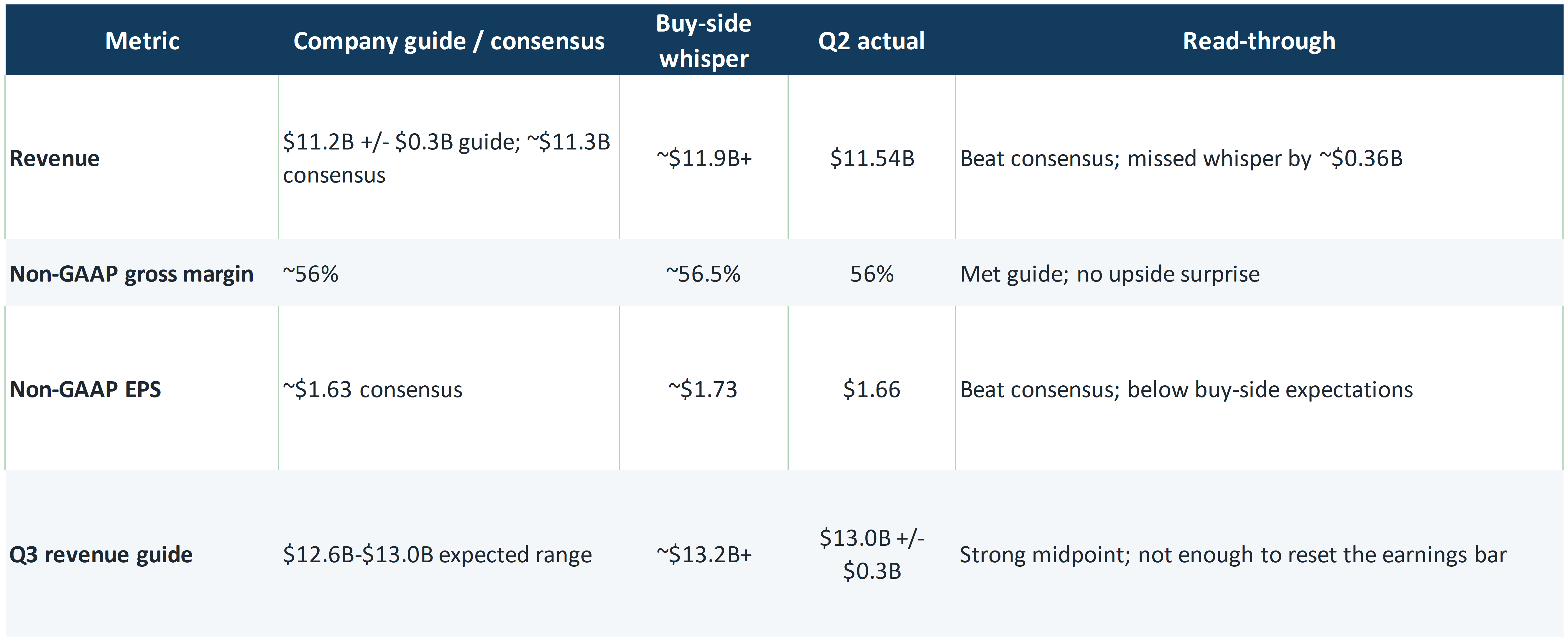
AMD guided Q3 revenue to about $13 billion, plus or minus $300 million, implying 41% year-over-year growth, with non-GAAP gross margin at roughly 56%. While above published consensus, the outlook lacked the revenue upside, margin expansion and AI deployment visibility bullish investors had expected. With significant optimism already priced in, a solid guide was not enough.
$11.54B Q2 revenue | $6.72B Data Center | $13.0B Q3 midpoint | 56% Q3 non-GAAP GM |
Subjectively, was AMD’s post-earnings 9% selloff an overreaction?
The Beat Was Real - and So Was the Expectations Gap
AMD posted the kind of quarter that would usually support a rally. Revenue rose 50% to a record $11.54 billion and adjusted earnings reached $1.66 a share. Non-GAAP operating profit climbed to $3.09 billion, while adjusted operating margin expanded to 27%.
Will AMD raise its guidance again in 3Q2026?
The reaction makes sense only when two benchmarks are separated: published consensus and the higher threshold implied by investor positioning. AMD beat the first, but did not decisively clear the second.
Data Center Has Become the Company
The most important operating result came from Data Center, where revenue rose 107% to $6.72 billion. The segment represented 58% of total sales, up from 42% a year earlier, and generated $2.10 billion of operating income. Its operating margin reached 31%, compared with a loss in the prior-year period.
That performance shows AMD’s growth is no longer dependent on a single AI accelerator thesis. EPYC server processors continue to gain share and benefit from the broader expansion of AI infrastructure, which increases demand for general-purpose compute, networking and data preparation alongside GPUs. Instinct accelerator shipments are scaling at the same time.
Management said Data Center growth should accelerate during the second half. The product and customer pipeline supports that confidence: AMD is beginning the Helios rack-scale ramp, Microsoft plans to deploy Helios systems on Azure, and Anthropic has agreed to deploy as much as two gigawatts of MI450-series GPUs.
Still, announced capacity is not the same as recognized revenue. A GPU shipment does not mean an entire rack has passed customer acceptance, and system delivery does not necessarily mean every component can immediately be booked as sales. That distinction is crucial as AMD moves from selling chips toward supplying complete AI systems.
The $13 Billion Guide Was Good, Not Transformative
For the third quarter, AMD projected revenue of about $13 billion, plus or minus $300 million. At the midpoint, that implies approximately 41% year-over-year growth and 13% sequential growth. The guidance exceeded the published consensus, which was around $12.5 billion to $12.6 billion.
On its face, the outlook was strong. It was simply not large enough to settle the questions that mattered most. Some investors had expected guidance closer to $13.2 billion, with the most bullish scenarios extending toward $14 billion. More importantly, the company did not provide enough detail on MI450 and Helios revenue recognition during the third and fourth quarters or on the contribution expected in 2027.
The market was looking for measurable evidence: initial MI450 volumes, confirmed Helios system revenue, deployment schedules and a clearer bridge between customer commitments and financial results. Instead, investors received a healthy company-level forecast with limited visibility into the AI accelerator ramp.
Cash Flow Shows the Cost of the Ramp
Capital expenditure reached approximately $808 million, nearly three times the market estimate cited in the source reports and more than double the prior quarter. Operating cash flow was about $2.37 billion, producing free cash flow of approximately $1.56 billion and a 14% free-cash-flow margin, down from 25% in Q1.
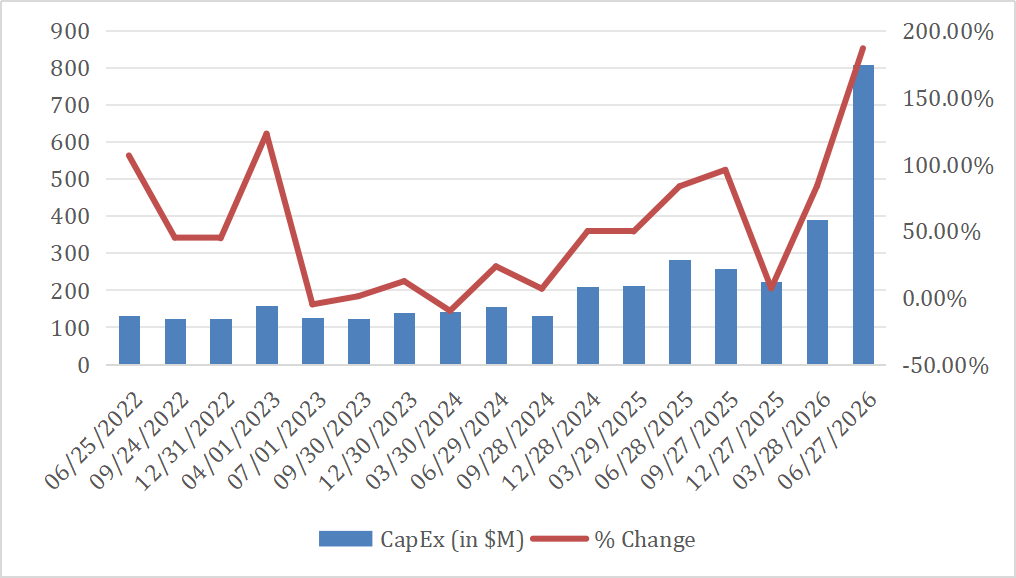
$808M Capital expenditure | $1.56B Free cash flow | $7.28B Receivables | $8.47B Inventory |
The balance sheet can absorb the investment: cash and short-term investments were about $13.11 billion versus debt of roughly $3.23 billion. Liquidity is not the concern. Conversion is.
· Constructive reading: inventory and receivables are being built ahead of large AI system deployments.
· Risk reading: if working capital keeps rising faster than sales, growth may generate less cash than the headline revenue suggests.
The Rest of AMD Is Stable, Not Spectacular
Client revenue increased 23% to approximately $3.06 billion, supported by Ryzen demand and market-share gains. Gaming revenue fell 31% to $779 million as semi-custom demand weakened. Embedded revenue rose 19% to $977 million and generated an operating margin near 40%.
The mix leaves AMD with a concentrated investment case:
· Data Center provides the growth, incremental profit and valuation narrative.
· Embedded adds high-margin stability but is too small to determine the share-price direction.
· Client is recovering, while Gaming remains a drag during the mature console cycle.
What the 9% Selloff Actually Says
The post-earnings decline was not a rejection of AMD’s AI strategy. Data Center more than doubled, EPYC momentum remained strong and the Helios ecosystem gained credible customers. The fundamental case is intact.
The selloff reflects a higher burden of proof. After a major share-price appreciation, investors had already paid for meaningful accelerator growth and market-share gains. A conventional beat was no longer enough; the stock required evidence of an earnings and cash-flow inflection.
Source: