
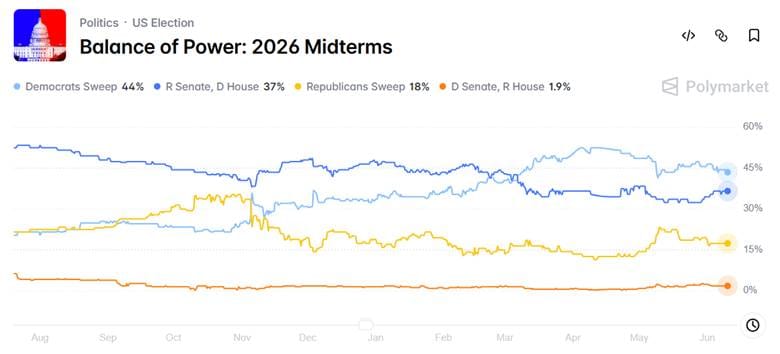
Polymarket is not sleeping on Republican midterm risk. That much is clear from the 2026 balance-of-power market.
The market is giving “Democrats Sweep” a slight edge at around 44%, but the supposed “safer” split-Congress outcome (Republican Senate, Democratic House) is still right behind it in the mid-30s.
It is a reasonable read. Maybe even the obvious one.
But now, the question is whether a 44% Democratic sweep price is still too cautious. A generic ballot around D+6, a still-competitive Maine race, a North Carolina pickup sliding from plausible to central, and a Georgia race that doesn't become a clear GOP gain would all point in this direction.
The issue is not whether Republicans face midterm risk, because this is already clear and priced in.
Are traders underestimating how correlated the House and Senate outcomes could become if the national environment keeps moving against Republicans?
Why the split-Congress price makes sense
The market’s base case is not hard to defend. The House is exposed, the Senate is better protected, and the usual midterm pattern points against the president’s party.
If the economy feels expensive, if Trump’s approval weakens, or if voters simply want a check on Republican control, the House is the easiest place for that frustration to show up.
The president’s party has lost House ground in 20 of the past 22 midterm elections since 1938, with 1998 and 2002 standing out as the rare exceptions. The generic ballot is pointing the same way, with Silver Bulletin recently showing Democrats around D+6.6, close to their position at this stage before the 2018 midterms.
The Senate does not bend as easily.
Democrats need a net gain of four seats, and the map does not give them many obvious places to find them, which is why the Senate is such a grind. They need strong candidates, messy Republican primaries, good turnout, and no surprise losses of their own.
Maybe even a national mood sour enough to drag Republican candidates down in states where the party would normally have room to breathe.
Here's where the Democratic sweep case gets stronger
The split-Congress price leans heavily on the Senate map. Fair enough; Republicans do have the better structure, and Democrats need several pieces to land at once. But structure only gets you so far if voters start treating Senate races as another way to cut into Republican control.
This is especially important because the likely pressure points in 2026 are not abstract policy debates. Cost of living, housing, healthcare, insurance, immigration, and trust in government are all issues that can cut through local campaign messaging.
If enough of those voters decide the country feels worse under Republican control, the backlash may not politely stop at the House.
The races that could make the Democratic sweep price look too low
The best way to test this is not to look at every competitive Senate race equally, but to watch the races that tell us whether the market’s split-Congress assumption is holding.
Maine is the obvious starting point. Susan Collins has spent her career running as a Republican who can stand slightly apart from the national party. This brand has been valuable for years, but with Graham Platner now the Democratic nominee after Janet Mills suspended her campaign, the race also tests whether a weak Republican national environment can overcome Democratic candidate risk. If Collins weakens anyway, the Senate is not as insulated as the market thinks. Will the race become more about Platner than Collins, with his controversies giving Republicans an opening?
Traders should not dismiss North Carolina too quickly, either, because it clearly deserves more weight. It is an open Republican-held Senate seat, with Michael Whatley projected as the GOP nominee, but Cook calls it the GOP seat Democrats are most likely to flip. In other words, it could be the link between a likely Democratic House win and a real Senate path.
Georgia is a defensive test for Democrats. Ossoff is the Democratic incumbent, and Republicans still need their runoff to settle who runs against him, so for Democrats, it's rather simple: do not let Georgia become the seat that cancels out gains elsewhere. If Ossoff holds up and Democrats are gaining in Maine and North Carolina, the Senate market has strong reason to move toward Democratic control.
None of these races has to become easy for Democrats. This is not the point. They need enough of them to confirm that House weakness is bleeding into the Senate. In this case, the 44% Democratic sweep price may start looking too low.
The better way to read the markets
At first glance, this looks like a market about who controls Congress. But that is only the surface-level read.
Beneath the balance-of-power label, this is a market on the severity of the Republican backlash.
The split-Congress price is basically a bet on a contained backlash. Enough voter anger to cost Republicans the House, not enough to break the Senate map.
Republicans can survive a normal midterm drag because the map gives them cover. They may not survive as easily if voters stop separating individual Senate races from the bigger question of Republican control. At this point, geography still matters, candidate quality still matters, but the party label starts doing more of the work.
This is the part that traders may be too relaxed about. They are clearly pricing Republican risk in the House. The mistake may be assuming that the same risk can be fenced off before it reaches the Senate.
From here, the sweep case should rise or fall on four signals:
- Do Democrats stay near D+6 or better on the generic ballot?
- Does Maine remain competitive despite Platner's baggage?
- Can North Carolina become a real pickup rather than just a theoretical one?
- Does Georgia stay stable enough for Democrats to protect Ossoff?
If the answer is yes, then the split-Congress price may be leaning too hard on Senate insulation. That's because a Democratic sweep does not require every Senate race to be easy; it only needs enough races to confirm that the backlash is no longer contained.
The split-Congress bet says 2026 is a warning shot.
The Democratic sweep bet says it becomes a verdict.
Sources:
1. 270towin.com: Cook Political Report 2026 Senate Ratings
2. Brookings: What history tells us about the 2026 midterm elections
- CookPolitical.com: The Cook Political Report
- CNN: Elections 2026
- Silver Bulletin: Who's ahead on the generic congressional ballot?