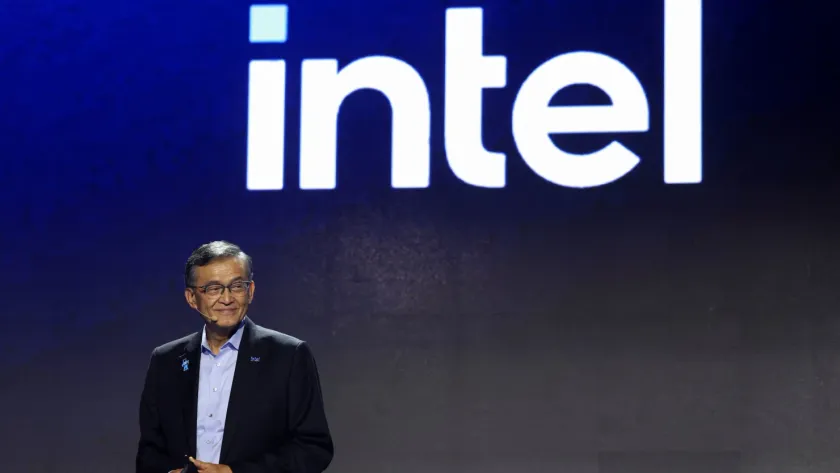
Intel’s stock jumps as chipmaker rides AI boom to fastest revenue growth in almost 15 years (July 23, 2026, after trading hours, local time).
In what price range will Intel's stock price close on July 24, 2026?
TL;DR:
AI/DCAI acceleration is real and broadening. AI-driven businesses collectively grew over 70% YoY and now contribute roughly 70% of total revenue, and Intel said its data center operations cannot keep up with orders, leaving the company unable to fully meet customer demand — a supply-constrained, not demand-constrained, problem.
18A yields are genuinely improving. Yields on 18A reportedly climbed to about 85%, up from roughly 65% the prior quarter, and Intel was the first company to deliver high-volume logic chips using High-NA EUV, per ASML, with 85% yields now comparable to TSMC N2's ~90%.
Credible external validation of foundry. Apple and Microsoft have both confirmed as 18A design partners, and Panther Lake shipped on 18A across 200+ OEM designs. External foundry revenue nearly doubled QoQ ($174M → $293M), the first real proof point that IFS isn't purely an internal cost center.
Beat quality was broad, not just a one-line surprise — CFO Dave Zinsner said the quarter exceeded guidance on higher factory yields and faster production cycles, and management is "meaningfully increasing investments in equipment, clean room space, and substrates" to chase demand rather than defend margin.
Key Debates:
Is 18A actually solving the yield problem, or is the market front-running a headline number?
What's the expectation on IFS going foward?
Intel vs AMD in AI/data center - how's the competition?
Does the CapEx ramp ($20B→more in 2027) get rewarded or penalized?
According to the company:
“AI is driving unprecedented demand for compute, and as we continue to execute, Intel is well-positioned to capture sustainable growth across our CPU franchise, ASICs, advanced packaging and vast wafer foundry network,” said Lip-Bu Tan, Intel CEO. “Our Q2 results represent our strongest revenue growth in more than fifteen years, enabled by greater speed, accountability, and customer focus.”
Intel also said it’s starting to craft long-term agreements with customers for its server CPUs, some with pricing locked in and others focused on chip volume.
It’s a move that’s becoming common, particularly in memory, as vendors try to preserve current high pricing and market power in case the AI market turns. Intel said it had reached 10 long-term agreements, and CFO David Zinsner said the company is supply constrained, with data center customers demanding more than it can produce.
“Customers continue to signal a strong and sustainable spending environment,” Zinsner said on an earnings call with analysts.
Revenue in the company’s client computing group, which makes chips for PCs, rose 13% to $8.9 billion. It’s still Intel’s biggest unit, but the robust growth is coming from its data center business, where revenue rose 59% to $6.3 billion. Intel said it expects flat PC sales in the third quarter because of the memory shortage.
Intel is boosting its capital expenditures, targeting a “meaningful increase” next year, as it aggressively tries to morph into a manufacturer of chips for other companies. Zinsner told CNBC’s Kristina Partsinevelos that the company’s latest manufacturing process, called 14A, is ahead of where older technologies were at the same point in the cycle. Intel said its foundry reported $5.8 billion in sales, up 31% on an annual basis.
(check out our prior post on Intel's Capex plan)
 Reuters
Source:
- CNBC; https://www.cnbc.com/2026/07/23/intel-intc-earnings-report-q2-2026.html
- Reuters; https://www.reuters.com/business/intel-forecasts-upbeat-quarterly-revenue-profit-strong-ai-driven-server-chip-2026-07-23/
- Intel official announcement; https://www.businesswire.com/news/home/20260723707213/en/Intel-Reports-Second-Quarter-2026-Financial-Results