China is injecting RMB300 billion ($45 billion) into major banks and insurers in its largest financial-sector recapitalization in nearly two decades, aiming to strengthen balance sheets and sustain lending as economic growth slows.
The Ministry of Finance (MOF) will issue special government bonds to recapitalize eight financial institutions, including Industrial & Commercial Bank of China Ltd. (ICBC), Agricultural Bank of China Ltd. (AgBank) and People’s Insurance Company (Group) of China Ltd., according to official announcements on Sunday.
AgBank plans to raise up to RMB160 billion through a private placement, while ICBC is targeting RMB100 billion. Both banks said the proceeds will be used entirely to replenish core Tier 1 capital. The MOF will subscribe to RMB130 billion of AgBank’s offering and RMB70 billion of ICBC’s, with China National Tobacco Corp. also participating as a major investor.
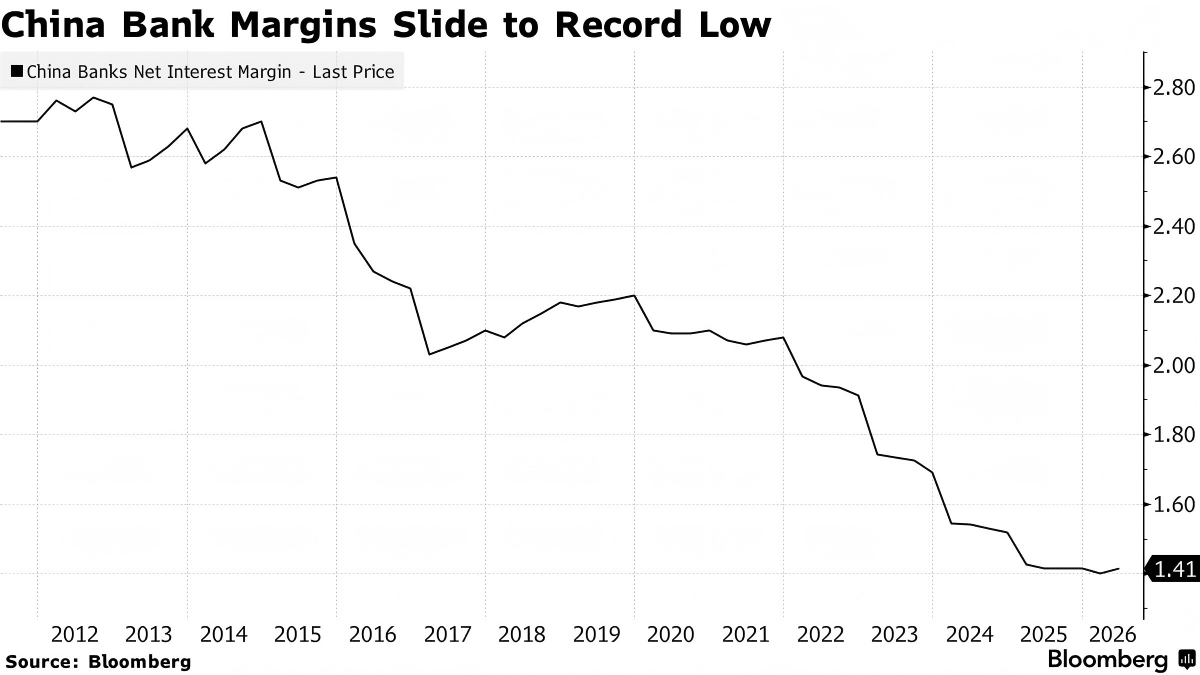
The move comes as profitability pressures make it harder for banks to build capital organically. The sector’s average net interest margin has fallen to historic lows, constraining capital accumulation through retained earnings. As of June, Chinese banks reported an average capital adequacy ratio of 15.26% and a core Tier 1 capital ratio of 10.72%.
The recapitalization also supports China’s six largest state-owned banks as they prepare for the second phase of global Total Loss-Absorbing Capacity (TLAC) requirements. Several of the lenders, particularly the Big Five, are designated global systemically important banks and therefore face additional loss-absorbing capacity requirements.
| Financial Institution | Raising Capital | MOF Contribution |
|---|---|---|
| Agricultural Bank of China | 160 | 130 |
| China Exim Bank | 30 | 30 |
| China Export & Credit Insurance | 10 | 10 |
| China Life Insurance | 35 | 35 |
| China Reinsurance | 3 | 3 |
| China Taiping Insurance | 7 | 7 |
| ICBC | 100 | 70 |
| PICC | 15 | 15 |
| Total | 360 | 300 |
Insurers are facing similar balance-sheet pressures. A prolonged low-interest-rate environment has reduced investment returns and increased the risk of a mismatch between asset yields and liability costs. Regulators have previously said they were studying measures to strengthen capital positions at major insurers.
Last week, the National Financial Regulatory Administration also published draft amendments to the Insurance Law, including tighter oversight of insurers’ shareholders. The proposed changes would mark the first major revision of the law since 1995.
For Beijing, the broader objective is to support economic activity without weakening financial stability. Stronger capital buffers give banks and insurers greater capacity to absorb losses linked to the property downturn, local-government debt and weak household demand, while allowing banks to continue extending credit to the economy.
According to Bloomberg Intelligence, ICBC and AgBank could face annualized EPS dilution of about 3.5% and 6.3%, respectively, from their planned RMB100 billion and RMB160 billion core Tier 1 capital raises.
Source: