Two signals have been moving in opposite directions. On July 17, the Philadelphia Semiconductor Index closed 20.2% below its June 22 record, entering a technical bear market after its worst week in more than a year. The selloff deepened later in July, although chip stocks staged an 8.2% rebound on July 30 after strong Microsoft and Amazon results.
At the same time, Alphabet, Amazon, Meta and Microsoft are still on course to spend roughly $720 billion to $745 billion on capital investment this year. Three have raised or tightened their spending outlooks, while Microsoft says its underlying expansion plans remain intact despite an accounting change that reduced reported capex.
The apparent contradiction is therefore still real, but more precise: chip stocks are questioning the returns and valuations attached to the AI buildout, while the companies placing the orders continue to report strong demand.
So is AI spending in trouble, or is it fine and chip stocks just had a rough month? Which is it?
What's your read on the chip drawdown?
The bear case: The buildout is eating the cash that funds it
The number to watch is free cash flow, but not because it represents a dedicated budget for the next round of chips. Free cash flow measures what remains after operating cash has covered capital expenditure (capex). When it turns negative, the buildout is no longer being financed entirely from internally generated cash.
That does not force chip orders to fall immediately.
Cash reserves, debt, leases and outside financing can keep spending going. But it introduces a second constraint: the buildout must satisfy not only management’s conviction, but also lenders’ required returns and credit-market appetite.
Alphabet’s free cash flow went negative for the first time since it went public in 2004.

Source: Alphabet
Meta reported on July 29 that it made $31.9 billion in cash from operations and spent $31.1 billion on capex, leaving $784 million. That left Meta with free cash flow equal to roughly 2.5% of its operating cash flow. Its stock fell about 10%, even though revenue grew 28%.
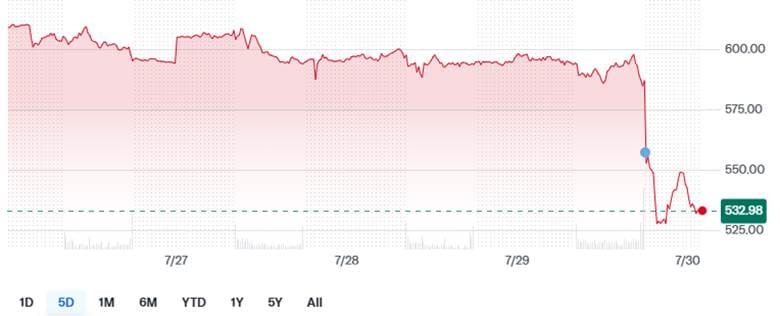
Source: Yahoo Finance - GOOGL
Alphabet posted negative quarterly free cash flow, while Meta retained only $784 million. Microsoft remained strongly positive at $19.6 billion, although that was down 23% year over year. Amazon’s trailing-12-month free cash flow, which is not directly comparable with the quarterly figures, turned negative by $7.6 billion.
For two years, this buildout was paid for out of pocket, and money spent out of pocket needs no one's approval. From here, a growing share of it gets borrowed, and borrowed money comes with terms, whether it is a coupon, a maturity, and a lender's view of how long AI demand lasts.
Chipmakers sit at the end of that chain and don't get a vote in it. They find out when the order arrives. Or doesn't.
The bull case: Two years of being wrong about this exact call
The bear case has a weakness: betting against hyperscaler capex has lost money for two straight years.
Goldman Sachs found that at the start of both 2024 and 2025, most analysts expected spending to grow about 20%. It actually grew more than 50% both years. As of June, Goldman still thinks analysts are underestimating and expects roughly $1.1 trillion in 2027.
The demand-side numbers haven’t cracked, either. Google Cloud’s backlog sits near $514 billion, roughly 5x where it was a year ago. TSMC, the world’s biggest chipmaker, beat expectations and raised its own spending plans during the same week the chip index crashed, and its stock fell anyway.
When good news doesn’t help a stock, the problem is usually investor mood rather When strong results fail to lift a stock, the gap often lies in valuation and prior expectations rather than current operating performance. Investors may believe the good news was already priced in, or that future returns will not justify the capital required to deliver it.
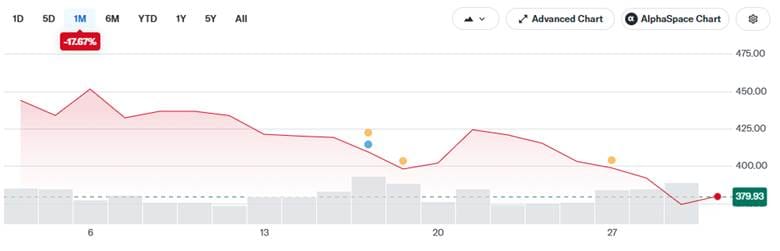
Source: Yahoo Finance - TSM
My read: this is no longer about whether AI demand is strong enough (backlog numbers & capex increases already answered this). The actual question is, can spending approaching $1 trillion a year be sustained long enough to keep clearing a bar the market has priced for flawless execution?
Put simply, this looks more like the SOX’s 105% run from its March low to the June peak finally meeting a bar it couldn’t keep clearing. A 45%-plus year-to-date gain surviving a 20% drawdown is a market that priced in flawless execution and is now pricing in merely very good execution.
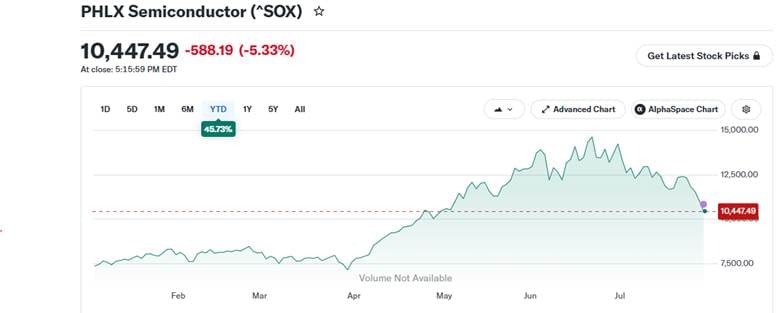
Source: Yahoo Finance - SOX
 YU GU
YU GU
What actually resolves this
Now, it’s a matter of whether capex nearing $1 trillion a year can keep being funded, and chip stocks, not hyperscaler stocks, are where this question gets tested first.
This is not a question a single earnings report answers. It gets resolved, one way or the other, over the next two quarters.
- Free cash flow, not capex headlines.
Spending covered by operations answers to a CEO's conviction, but spending covered by bond issuance answers to credit markets, which can change their mind in a quarter for reasons that have nothing to do with AI. If FCF keeps compressing through Q3 and Q4, they’ll likely need to issue more debt, sooner, and possibly a larger amount at once.
Once a larger share of the buildout requires external financing, chip orders become more sensitive to interest rates, credit spreads, lease terms and lender appetite—in addition to underlying AI demand.
- Whether Korea is a fundamentals signal or a leverage unwind.
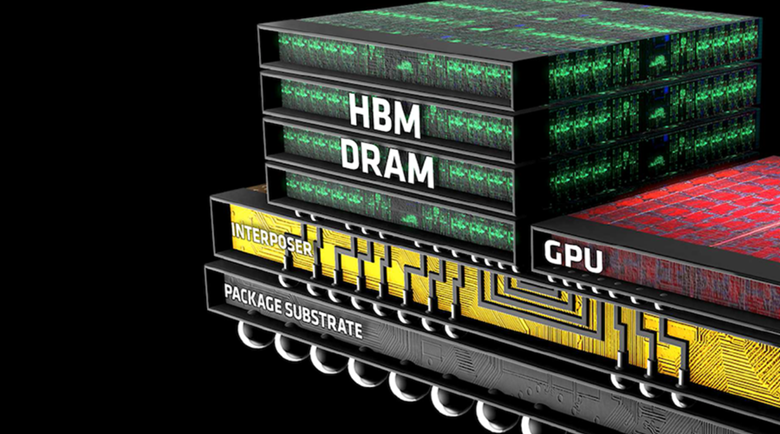
SK Hynix is one of the clearest upstream indicators of AI accelerator demand because it is a leading supplier of high-bandwidth memory. But its share price is not a pure demand signal: it also reflects memory-cycle expectations, valuation, Chinese competition and unusually heavy leverage in the Korean market.
Reuters reported signs of forced unwinding and found that leveraged products had amplified market volatility. The cleaner comparison is therefore between HBM contract pricing, shipment guidance and the share price. If operating indicators remain firm while the stock continues falling, that would strengthen—but not prove—the case that positioning and leverage are driving much of the decline.
- Whether Kimi K3 changes workload economics.
Moonshot AI says Kimi K3 approaches leading U.S. models at substantially lower cost, although its own technical report still places it behind the strongest proprietary systems overall. Benchmark performance alone does not establish that enterprises will move production workloads. Reliability, security, integration, latency and migration costs matter as much as token pricing.
The effect on chip demand is also ambiguous. A more efficient model may require less compute for each task, but lower costs can expand the number of tasks companies are willing to run. Watch for named enterprise migrations, declining contracts at incumbent AI providers and sustained changes in accelerator utilization—not benchmark scores alone.
Which happens first?
 Ana Frincu
Sources
Business Insider: Goldman Sachs says the AI boom is bigger than investors think
CNBC: Philadelphia SE Semiconductor Index
Reuters: Meta cash flow craters as Zuckerberg doubles down on AI spending
Yahoo Finance: Meta, Microsoft, Amazon, and Alphabet are about to spend a shocking amount of money to dominate the AI era
Reuters: China's Moonshot unveils world's largest open AI model, closing in on US rivals