Intel beat by $1.7 billion, posted its fastest quarterly revenue growth since 2011, and still watched the stock's after-hours pop land short of the 12.52% swing options traders had already priced in for the day.
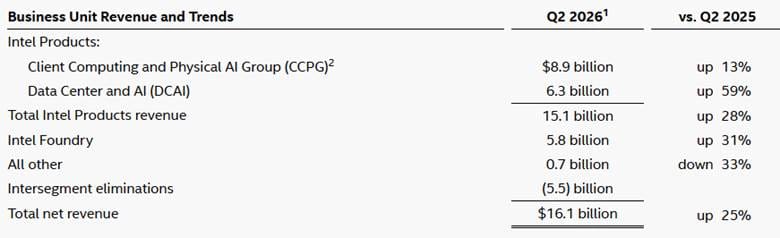
Data Center and AI (DCAI) revenue hit $6.3 billion, up 59% year over year, year-over-year growth accelerated from 22% in Q1 to 59% in Q2.
So does that settle it?
Not quite.
Nobody's arguing anymore about whether AI is pulling CPU demand higher. Agentic workloads add CPU-intensive orchestration, tool execution, data processing and security around the model inference that still runs primarily on GPUs. Intel management said training systems commonly use seven or eight GPUs per CPU, compared with roughly three or four for inference, while agentic and multi agent deployments could move toward parity or even become more CPU-intensive. AMD has described a similar shift from approximately 1:8 or 1:4 toward 1:1, although these remain company estimates rather than independently measured industry-wide ratios.
What the market is still deciding is whether Intel is winning sockets, or just standing in the way of a check written to the whole industry.
My read is that the demand is Intel's to bank, but the share is not yet Intel's to claim. These are two different clocks, and Thursday's call kept them running at two different speeds.
Intel just posted its best quarter in 15 years. Were you expecting a beat this big?
The earnings beat was broader than DCAI
The CPU thesis is that deploying AI creates considerably more computing work around them, and Q2 results are consistent with this.
DCAI's operating margin hit roughly 40% of revenue, up from 31% just one quarter ago. Intel attributed the improvement to higher revenue, better product margins and lower operating expenses. At the company level, better yields, average selling prices and product mix lifted gross margin, while shorter factory cycle times created additional volume.
Together, these signals suggest AI-related CPU demand is extending beyond a narrow training buildout. This makes this a higher-quality beat than another quarter driven mainly by price.
Source: Intel
This is exactly what the bull case ordered, but it's also a concentration risk. If DCAI cools from here, there isn't much elsewhere in the business to pick up the slack.
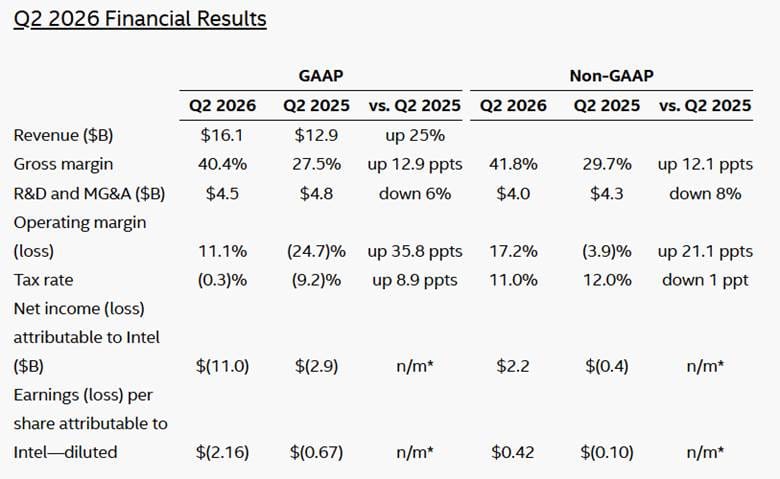
One number needs unpacking before it spooks anyone reading the release cold: GAAP EPS was a loss of $2.16, compared with a loss of $0.67 a year earlier, despite much stronger operating performance.
The headline $11.0 billion GAAP net loss did not represent an equivalent operating cash loss. Intel generated $1.8 billion of GAAP operating income and $7.0 billion in operating cash flow, but recorded a $12.5 billion non-cash mark-to-market charge on escrowed shares tied to its agreement with the U.S. government. Because the liability is linked to Intel shares, a higher stock price can increase the accounting charge, all else equal.
Non-GAAP net income of $2.2 billion therefore provides a clearer view of underlying operations, although it also excludes stock-based compensation, restructuring charges and several other items.
Source: Intel
Q3 revenue guidance of $15.8-16.8 billion came in well above the roughly $15.1 billion consensus, and Intel raised its 2026 capex outlook from about $18 billion to more than $20 billion, with 2027 spending expected to run significantly higher still.
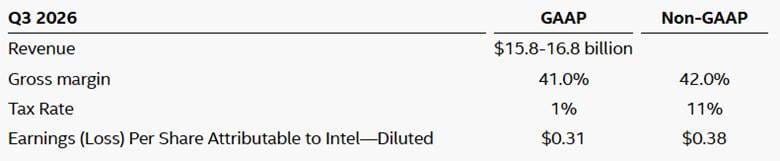
Source: Intel
The increase is a meaningful signal of management’s demand confidence, particularly because Intel cited long-term customer agreements and stronger purchase commitments. It is not proof, however, that every dollar of additional capacity is covered by firm orders. Intel is now committing multi-year capital to capacity that only pays off if the demand it's currently rationing is still there in 2027 and 2028.
But there’s a gap: AI CPU demand vs. Intel share gain
Asked point-blank about server share against AMD and Arm, Tan said Intel is still behind on some performance metrics and pointed to Clearwater Forest, Diamond Rapids and Coral Rapids roadmap as the way to close that gap eventually; a project, not a result already on the books.
Mercury Research put AMD at 33.2% of x86 server units and 46.2% of x86 server revenue in Q1. This left Intel with 66.8% of units, but only 53.8% of revenue. Put simply, Intel still ships twice as many x86 server processors, yet AMD is close to matching it in sales because it captures more revenue per unit.
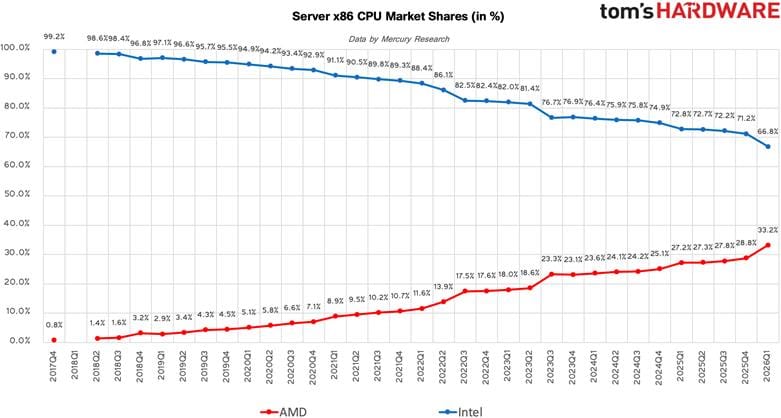
Source: Tom’s Hardware using data by Mercury Research
On Arm, his tone softened into something closer to a business partner than a rival, useful for foundry work and IP, not a threat to Xeon.
Pressed to quantify the CPU-to-GPU ratio shift underpinning the whole demand thesis, Zinsner declined to give a number, pointing instead to the long-term agreements Intel is now signing with server customers, some with locked-in pricing, others structured around volume. It’s real evidence of demand visibility, but it is not direct evidence that agentic AI is causing the growth. Nor is it evidence of Intel share gain, although management did not claim that it was.
Intel guided PC volumes sub-seasonal for the second half, pointing to memory costs and supply constraints. I made this same case last week: the physical shortage still has room to run, but the stocks trading on it have gotten pickier about rewarding good news. Intel just handed this same argument a second data point, from a different aisle of the same supply chain.
What to watch next
To confirm a broader CPU cycle, demand needs to stay strong after today’s supply constraints ease and as more inference and agentic systems enter production. Intel’s separate challenge is turning that demand into market share and better margins.
My earlier capex analysis made the same distinction: suppliers benefit while spending occurs; buyers must justify it later through revenue and productivity.
Mercury’s Q2 figures, once released, will be the cleanest test of whether Intel’s record DCAI growth stabilized its x86 share. They will not capture Arm-based servers, so they are an important test, not a complete one.
Third-quarter guidance hints that conversion may become harder. The $16.3 billion revenue midpoint is only slightly above the second quarter’s $16.1, while the 42% adjusted gross-margin forecast is just 0.2 percentage points higher.
Holding or beating these numbers would show the company can sustain the higher run-rate after the Q2 supply release. A miss would suggest the quarter pulled forward demand or exhausted the easiest manufacturing gains.
Chances are, we’re looking at a plateau next quarter, not an immediate second leg. This would not invalidate the broader CPU cycle, but it would show that Intel’s ability to capture it is still constrained by supply, product mix, and competitive share.
Where does INTC trade three months from now?
Relevant Reading:
 Reuters
 YU GU
YU GU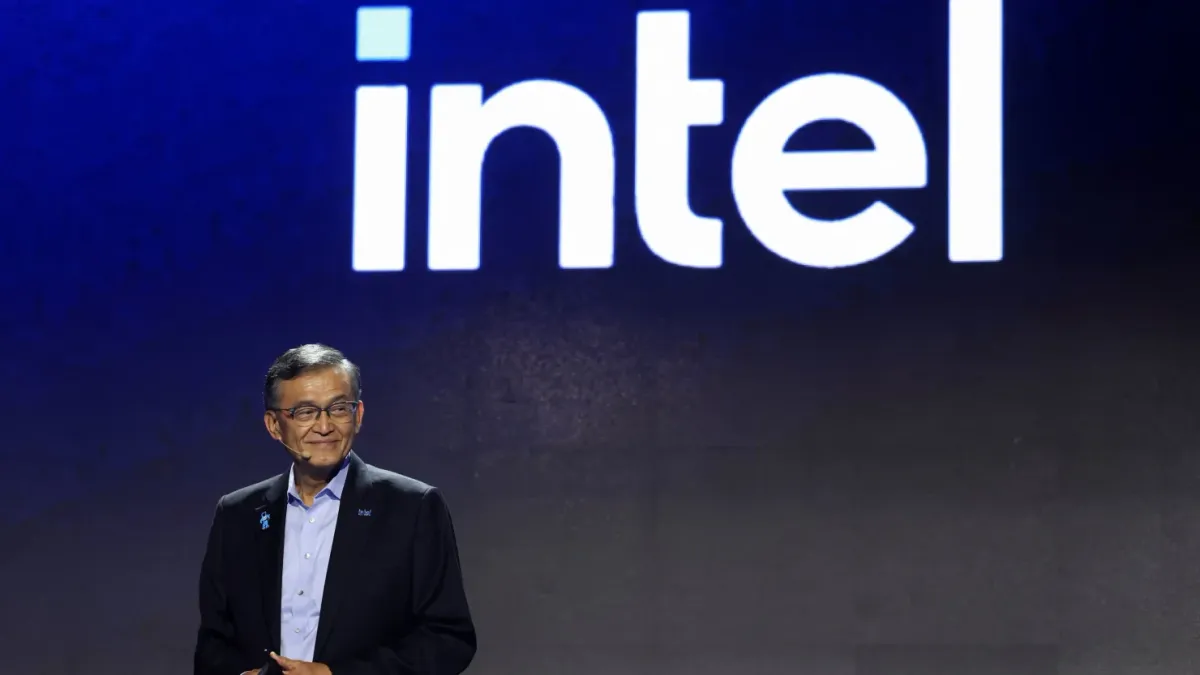
Sources
CNBC: Intel’s stock jumps as chipmaker rides AI boom to fastest revenue growth in almost 15 years
Intel: Intel Reports Second-Quarter 2026 Financial Results
Yahoo Finance: Intel Q2 Earnings Call Highlights