Premier info portal for prediction markets. The start point of information market.
‘Death Markets’ and Attack Ads: Prediction Rivalry Turns Nasty
News
RegulatoryBusinessPrediction Market

‘Death Markets’ and Attack Ads: Prediction Rivalry Turns Nasty

A fierce public spat between Kalshi and Polymarket is exposing deep regulatory and ethical divides in the booming prediction market industry just as Washington scrutiny intensifies.

PoliticsEconomics & Finance

Kalshi Inc. and Polymarket are slinging weighty accusations at each other as the prediction market rivalry heats up and the nascent industry comes under intense scrutiny in Washington.

While the platforms have sparred frequently in the past, the rhetoric has escalated in recent days after Kalshi launched a pointed advertising campaign and its employees publicly criticized Polymarket.

“Polymarket’s irresponsible, dangerous, and illegal behavior threatens legal American prediction markets,” Benjamin Freeman, who works on political and election markets at Kalshi, wrote in a social media post on Monday.

The accusations quickly sparked a heated back-and-forth between the companies.

“We welcome competition, but believe the discussion should be grounded in facts. Misinforming the public only harms the industry as a whole and participants,” Polymarket said in a statement.

Elisabeth Diana, a spokesperson for Kalshi, responded: “That’s laughable, coming from a company whose majority of trading volume is offshore and unregulated, and whose policies allow death markets.”

The feuding comes as Polymarket and Kalshi battle for leadership of the fast-growing prediction market industry, which has opened up a new way for Americans to wager on everything from sports to elections. The startups have both registered one record trading week after another, with nearly $6 billion in notional trading volume between them in recent weeks, according to user-compiled data on Dune Analytics.

Differences in how the exchanges are set up and operate are at the heart of the dispute. Kalshi’s platform is based in the US and overseen by the Commodity Futures Trading Commission, while Polymarket’s primary exchange operates offshore. Polymarket has used its operations outside the US to list contracts tied to military conflict — including the war in Iran — which Kalshi has said are unethical and illegal.

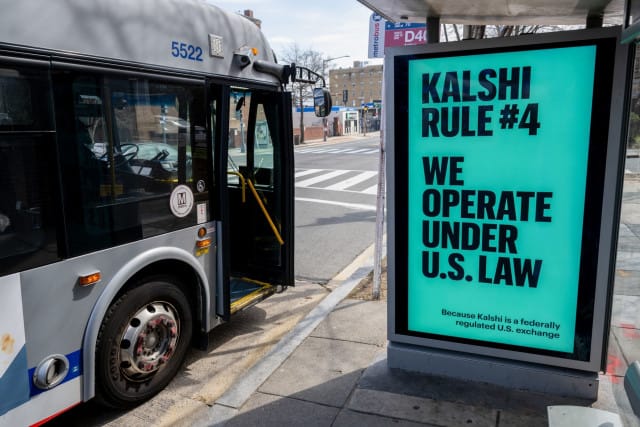
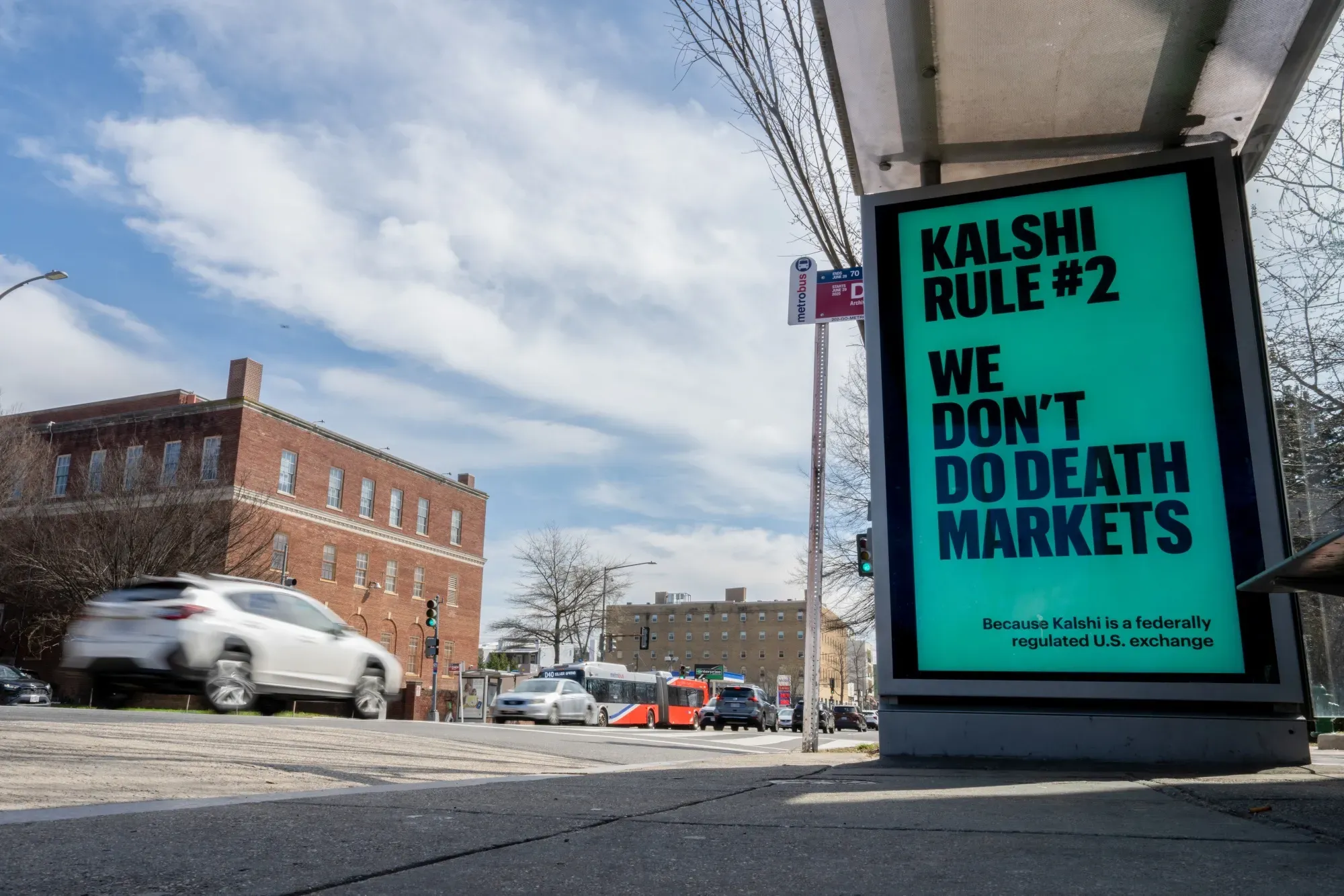
“We don’t do death markets,” one of Kalshi’s ads reads.

The Kalshi marketing, which is presented as a list of the company’s rules, began showing up at bus stops and subway stations in Washington at the beginning of this week.

“Rule #1: We ban insider trading, because Kalshi is a federally regulated US exchange,” says one. The subtext, apparent to industry observers, is that Polymarket’s main exchange is outside the reach of US regulators.

Congress has focused on insider trading following allegations of improper bets tied to US military activities in Iran and Venezuela. Kalshi has been more proactive in confronting the issue — fining and suspending customers it has accused of wrongdoing. Polymarket has taken a more hands-off approach, though it recently announced its own rules on insider trading as scrutiny grew.

“We want to highlight those big distinctions,” said Diana, the Kalshi spokesperson. “We think it’s at a point where there’s a lot of conflation between Kalshi and Polymarket and the approach to regulation.”

In addition to its offshore exchange, Polymarket also has a US-regulated platform that is currently in beta mode. The company said in a statement that both its venues enforce “the same strict market integrity standards, including prohibitions on insider trading and manipulation, with active monitoring and ongoing engagement with regulators and law enforcement.”

A few months back, Kalshi co-founder Luana Lopes Lara tried to lower tensions between the rivals. She wrote in an October social media post that she hopes the industry can move beyond “destructive infighting” and work together.

That now appears unlikely, especially after a Kalshi adviser and former CFTC commissioner, Brian Quintenz, joined the fray. Responding to reports that prosecutors are probing insider trading, Quintenz suggested on social media this week that the investigation should focus on Polymarket. Quintenz declined to comment further when contacted by Bloomberg News.

Source: https://www.bloomberg.com/news/articles/2026-04-01/-death-markets-and-attack-ads-prediction-rivalry-turns-nasty

Brazil’s B3 Eyes Election Bets as It Enters Prediction Markets
News
RegulatoryBusinessPrediction Market

Brazil’s B3 Eyes Election Bets as It Enters Prediction Markets

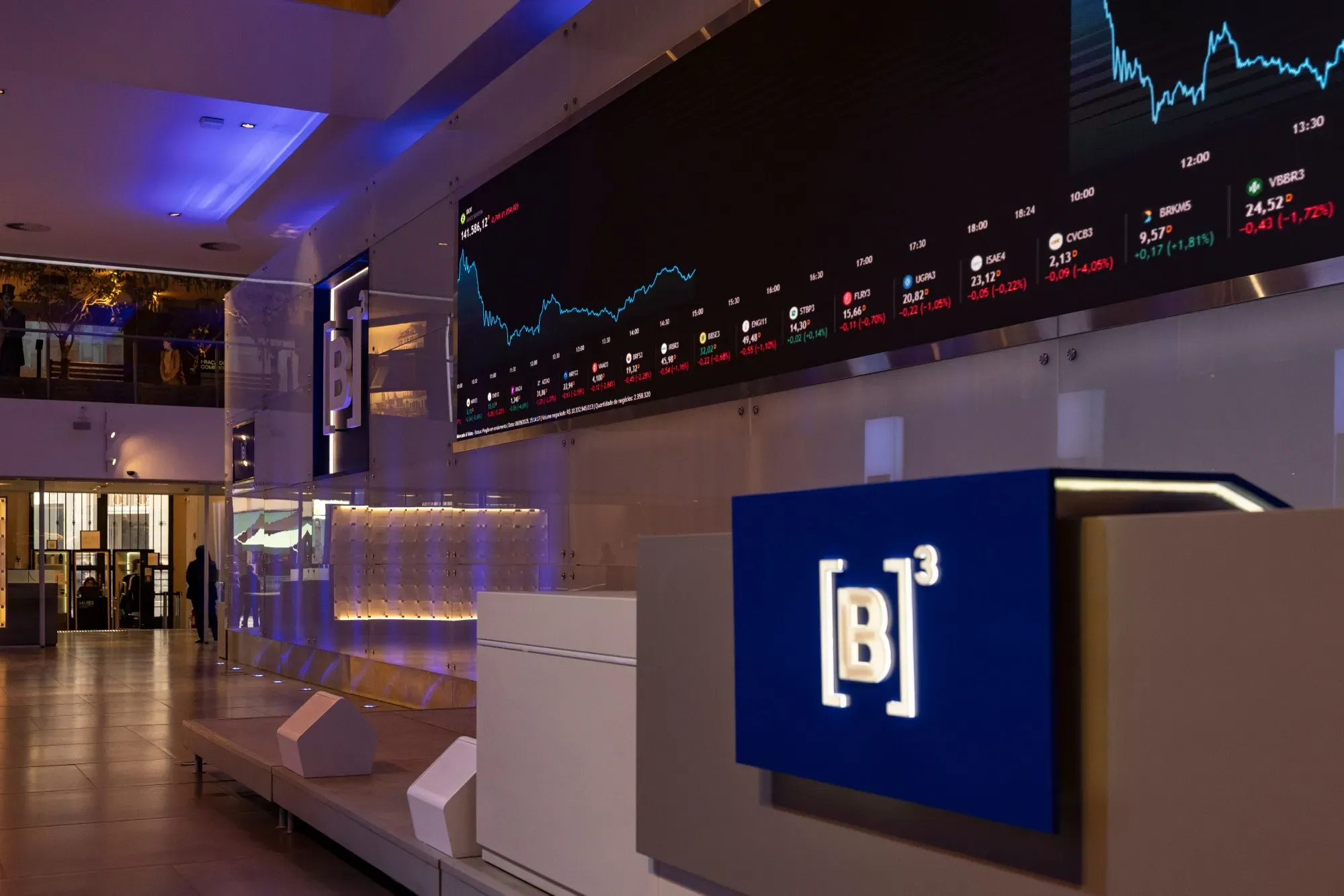
Brazil’s B3 is entering prediction markets with new event contracts on assets and possibly elections, testing Brazil’s regulatory gray zone while targeting professional investors ahead of October’s presidential vote.

Politics

Leia em português.

Brazil’s stock exchange B3 SA is moving into prediction markets with a set of contracts tied to key local assets and economic indicators. It is also considering offering election-linked products, according to two people familiar with the matter.

The exchange has sought a legal opinion on whether Brazil’s legislation imposes any restrictions on event contracts tied to elections, one of the people said. Both requested anonymity because the discussions are private. B3 didn’t comment specifically on election-linked contracts when asked about its plans.

Election-linked contracts could be available in time for Brazil’s presidential vote in October. The race between President Luiz Inacio Lula da Silva and Senator Flavio Bolsonaro is expected to be tight, with opinion polls showing Jair Bolsonaro’s eldest son tying or surpassing Lula in a potential runoff.

B3 has so far confirmed it will launch six new contracts on April 27 linked to the Ibovespa equity index, the Brazilian real and Bitcoin.

“We have been monitoring the evolution of prediction markets abroad in order to bring new event contracts to Brazil,” Luiz Masagao, B3’s vice president of products and clients, said in a statement about the six contracts being launched this month. “These products are designed to provide a simplified trading experience while preserving B3’s high standards.”

The contracts have been authorized by Brazil’s securities regulator, known as CVM, initially for trading exclusively by professional investors — those with more than 10 million reais ($1.9 million) in assets or holding a technical certification issued by the regulator.

Brazil still lacks a specific regulatory framework for prediction markets. International platforms such as Polymarket and Kalshi offer products related to the country, though they are traded abroad. Kalshi has also partnered with XP Inc. to offer yes-or-no contracts tied to Brazilian economic indicators, including inflation and interest-rate changes.

Source: https://www.bloomberg.com/news/articles/2026-04-01/brazil-s-b3-eyes-election-bets-as-it-enters-prediction-markets

Homophones, Plurals and Language ‘Rulescucks’ Are Roiling Prediction Markets
News
Prediction MarketLegal

Homophones, Plurals and Language ‘Rulescucks’ Are Roiling Prediction Markets

Prediction markets’ push to turn messy language into binary bets is forcing platforms into increasingly arbitrary, code-friendly rulebooks that undermine their claims to objective truth.

Politics

It was the fourth quarter of the Pinstripe Bowl at Yankee Stadium on Dec. 27 when Penn State defensive end Dani Dennis-Sutton darted between two hapless blockers and sacked Clemson quarterback Cade Klubnik. Or as the game announcer described it: “Dennis-Sutton wraps him up and turfs him!”

This was good news for Penn State fans, en route to a 22-10 win. It might have been even better for the traders on prediction market platform Kalshi who’d wagered that the announcer would say the word “turf.” At 3:18 p.m., right after Dennis-Sutton’s sack, the market’s odds on “Yes” surged from 25% all the way up to 99%, indicating a surefire win.

But Kalshi ultimately resolved the turf market to “No,” ruling that the announcer’s utterance didn’t count. Many traders complained, but the rules were the rules: According to Kalshi’s policy at the time for so-called mention markets such as this one, “tense inflections” on verbs didn’t count. (For the market to have paid out, the announcer would have had to use “turf” as a noun or say something like, “He sure did turf him.”)

There’s a term in the prediction market community for a bet that resolves unfairly on a technicality: a “rulescuck.” (We’ll tell you the full etymology when you’re older.) The turf rulescuck — one influential trader classified it in the subcategory of “verbcuck” — was just one of many disputes Kalshi users have debated on the platform’s Discord channel in recent months. Should homophones count? What about words spoken as part of proper nouns or URLs? How about mispronunciations, acronyms, abbreviations, compound words and foreign-language terms?

In early March, Kalshi tried to clear up the confusion by releasing a new set of rules for mention markets. The guidelines, which stretch to seven pages, settled some long-running disputes: Verbs that are spelled the same as plural nouns do count. (Too little, too late for the “turfs” gang.) Acronyms (“AI”) count except when uttered in their expanded form (“artificial intelligence”). Plurals count if the given word is singular, but singulars don’t count if the given word is plural. Numbers count only when spoken exactly, not as part of a larger number.

On the surface the rules document is a curious, even amusing, glimpse into a flavor of lawyerly hairsplitting. But it also reflects the broader challenge prediction market platforms face in their attempt to reduce reality to a series of yes-or-no bets: Kalshi and its rival Polymarket pitch themselves as sources of truth, but the truth is often hard if not impossible to establish. Many of the best-known disputes involve angels-on-a-pinhead-type debates: Did Cardi B “perform” at the Super Bowl? Did Ukrainian President Volodymyr Zelenskiy wear a suit? Did the US “invade” Venezuela?

The language disputes are even narrower, and Kalshi’s new rules are its latest attempt to set the terms. But linguists interviewed for this story say the English language isn’t easily wrangled to such ends. To them, Kalshi’s rules lacked consistency and foundation, all but guaranteeing more Discord debate.

Consistency vs. Ambiguity

Kalshi doesn’t attempt to explain or justify its language rules. Karlos Arregi, a linguistics professor at the University of Chicago, says they appear to be arbitrary rather than based on a particular theory or philosophy of language. “This looks like the kind of rules you’d have in a game like Scrabble,” he says. “It’s obvious to me these rules were not done by a linguist.”

Rivka Levitan, a professor of computer science and linguistics at Brooklyn College CUNY, describes them as “more legalistic than linguistic.” A good set of rules, she suggests, ought to prioritize logical consistency. Instead, Kalshi’s rules seem to draw lines for no clear reason. They allow for certain types of inflections (such as -s for plural) but not others (such as -ed, -ing, -er, or -est). If the “strike” word — that is, the one listed on the mention market — is “veteran,” then “veterans” counts. But if the strike word is “veterans,” then “veteran” doesn’t count. This is unambiguous, but it’s also illogical. Similarly random-seeming are rules that allow deviations from the strike word when it comes to meaning but not form: If traders bet on a football announcer mentioning “wind,” for instance, their bet still hits for “the clock winds down.” But if the strike word is “run,” then “ran” or “running” doesn’t count.

Then there’s the distinction between open and closed compound words. If the strike word is “fire,” then “fire station” counts, as does the hyphenate “fire-resistant,” but “firefighter” doesn’t. This doesn’t appear to be based on any linguistic theory, Levitan says, but rather on the convention. Kalshi relies on Merriam-Webster and the Oxford English Dictionary; if either spells the term as an open compound or hyphenate, then it counts.

Alejandro Lopez Lira, a professor of finance at the University of Florida who studies mention markets, suspects the rules’ guiding principle is the ease with which they might allow outcomes to be decided automatically. “They’re trying to make rules that computer code would be able to easily catch, because that would save a lot of cost,” he says. That would explain why homonyms (“bass guitar”; “bass fishing”) count but homophones (“write”; “right”) don’t. It also explains the preference for open compound words and hyphenates over closed compound words, says Gregory Guy, a professor of linguistics at New York University. The former are easier to detect automatically, since they’re separated by spaces or hyphens, whereas closed compounds would require parsing letter by letter.

Asked about the thinking behind the new rules, a Kalshi spokesperson said: “It is important that we are proactive about making sure that our rules are as clear and well-defined for our traders as they can be. Clear rules create both a meaningfully better user experience and produce better price discovery outcomes.” The spokesperson didn’t respond to questions about whether the rules were designed for ease of automatic parsing or whether the company had consulted any linguists.

No Perfect Rulebook

Despite Kalshi’s drive for clarity and specificity, traders are already pointing out that ambiguity remains. On one recent Discord thread, they debated the rule on portmanteaus, which aren’t allowed unless they contain the strike word “as a distinct, unaltered element.” According to Kalshi, if the strike word is “MAGA,” then “MAGA-nificence” — a neologism uttered by Jimmy Kimmel — counts. But this definition left traders wondering whether “Obamacare” is a compound word combining “Obama” and “care” or a portmanteau of “Obama” and “health care.” Or what about “Trumpification” — should it be spelled with a hyphen or not? Merriam-Webster and the OED are silent on this question.

When it comes to mispronunciations, the rules can be outright subjective. “Minor unintentional mispronunciations [of the strike word] COUNT if context makes intent clear,” the rules say. “Severe mispronunciations” that make the word “unrecognizable,” however, don’t. Left undefined is who determines intent, what constitutes “severe” and to whom the word is “unrecognizable.”

“That’s not going to get rid of any argument,” Levitan says. That’s especially true, she points out, when you factor in dialects and the accents of non-native English speakers. For example, according to Kalshi, “Mandani” counts for “Mamdani” — this one has caused problems before. But what about, say, “Ryan” for “Brian”? Or John Travolta’s infamous botching at the 2014 Oscars of Idina Menzel’s name as “Adele Dazeem”?

To be fair, the rules are likely designed with the average trader in mind, not linguists. And by this standard they arguably succeed. “In the context of this kind of market, being clear is perhaps more important than linguistic consistency,” says Ken Adams, a lawyer and author of A Manual of Style for Contract Drafting. His only linguistic quibble: The verb structures in the document itself are “a little erratic.” For instance, it uses “shall”and “will” interchangeably. “That suggests to me that whoever compiled the rules felt they should sound legal but was half-hearted about it,” Adams says.

How would the linguists themselves design the rules? Levitan says she would “allow for more inflections besides plural -s, such as -ed, -ing, -er, and -est,” wouldn’t distinguish between hyphens and spaces, and wouldn’t allow homonyms or homographs. Arregi says he’d eliminate the rule about mispronunciations, since it’s too subjective.

But, he points out, there’s no perfect rulebook: “I do think that this particular set of rules is arbitrary, but that’s just how rules in a game work.” And linguists probably wouldn’t be the best people to design them, Arregi adds, given their frequent disagreement over the basics: “The question of what a word is — it’s actually a very complicated question.”

Source: https://www.bloomberg.com/news/articles/2026-03-27/kalshi-faces-growing-problem-with-grammar-language-disputes

CFTC Forms New Task Force for Crypto, AI, and Prediction Markets
News Flash
SignalsLegalPrediction Market

CFTC Forms New Task Force for Crypto, AI, and Prediction Markets

The CFTC launched an Innovation Task Force covering crypto, AI, and prediction markets. Michael J. Passalacqua will lead the new unit under Chairman Michael S. Selig. The task force will work with the Innovation Advisory Committee and coordinate with agencies, including the SEC.

Politics

The Commodity Futures Trading Commission (CFTC) has launched an Innovation Task Force focused on crypto assets, artificial intelligence, and prediction markets. This marks the agency’s latest move to build policy around fast-growing areas of the derivatives market.

The task force was announced Tuesday by CFTC Chairman Michael S. Selig, who said the group will work on developing clearer rules for firms building products tied to emerging technologies. The initiative will operate in partnership with the agency’s Innovation Advisory Committee and coordinate with other federal bodies, including the Securities and Exchange Commission (SEC) and its Crypto Task Force.

Focus on crypto, AI, and event contracts

According to the CFTC, the new group will concentrate on three areas: crypto assets and blockchain technologies, artificial intelligence and autonomous systems, and prediction markets and event contracts.

The agency said the task force will support its broader innovation agenda by working on policy issues tied to these emerging sectors, which have drawn increasing attention from regulators as new products enter the market.

SEC and CFTC move toward a shared crypto framework

The task force arrives shortly after the SEC issued a March 17 policy interpretation laying out one of its clearest positions yet on crypto assets, while the CFTC said it would administer the Commodity Exchange Act consistently with that framework.

The SEC said most crypto assets are not themselves securities and introduced a five-part taxonomy covering digital commodities, digital collectibles, digital tools, stablecoins, and digital securities. The interpretation also addressed how non-security crypto assets may become subject to, and later cease to be subject to, an investment contract, while clarifying how federal securities laws apply to airdrops, protocol mining, protocol staking, and wrapped assets.

The coordinated stance adds context to the CFTC’s new task force, which is being formed as both agencies move toward a more defined approach to crypto oversight.

Leadership and coordination

Michael J. Passalacqua, a senior advisor to Chairman Selig, will lead the Innovation Task Force.

The CFTC said the group will coordinate innovation-related work across federal agencies and departments. That includes engagement with the SEC, which has also been increasing its focus on crypto market structure and oversight.

Part of a wider regulatory push

The task force comes as the CFTC continues to take a more active role in questions surrounding digital assets and prediction markets.

In recent weeks, the agency has taken additional steps tied to emerging market activity, including work around event contracts and crypto-related market structure. The new task force brings those issues under a more formal policy umbrella inside the agency.

Also Read: US CLARITY Act Targets Stablecoin Yield, Allows Activity-Based Rewards
Georgia’s 50% Trap: Pricing Runoff Risk in the 2026 Ossoff Race
Analysis
SignalsElection

Georgia’s 50% Trap: Pricing Runoff Risk in the 2026 Ossoff Race

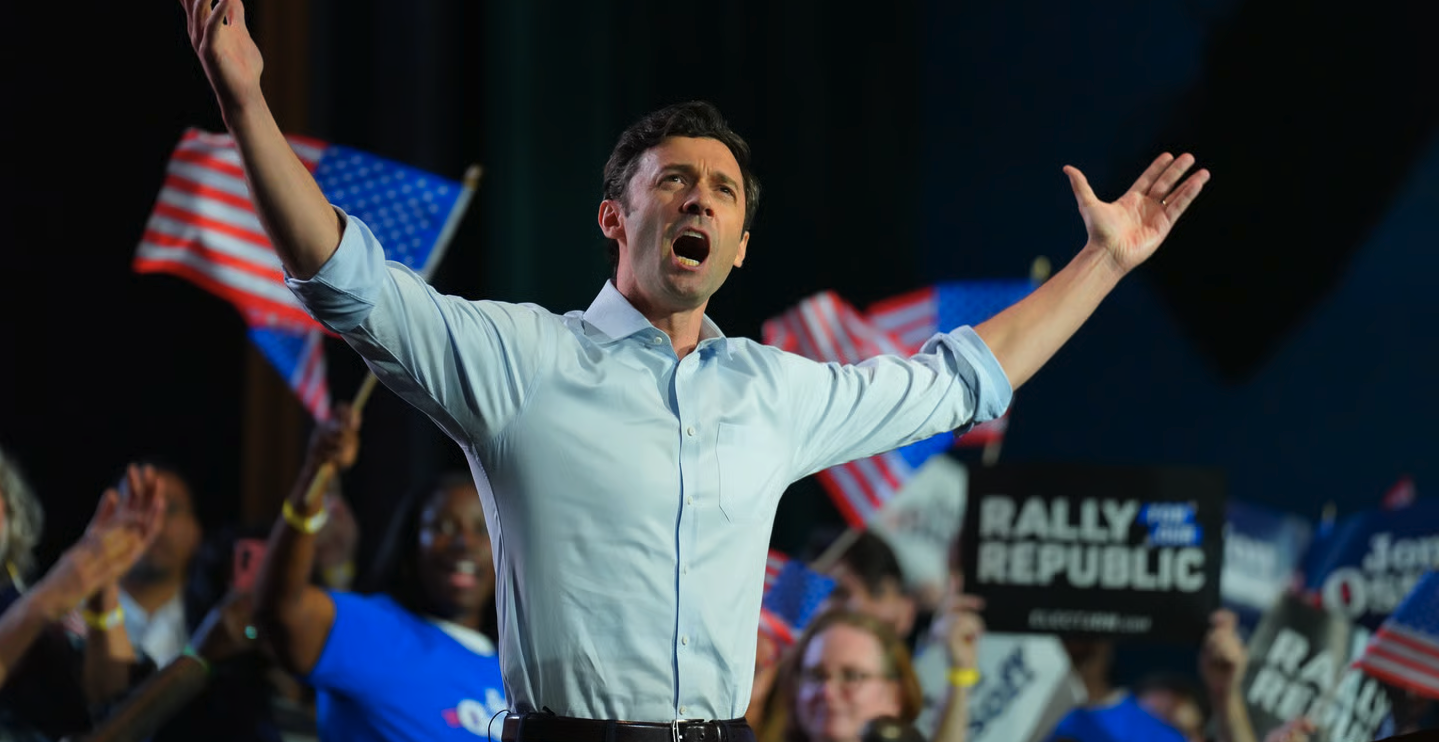
Georgia’s 2026 Senate race is less a binary contest over who leads today than a structural puzzle over whether Jon Ossoff can clear the state’s 50% threshold.

Politics

The Controversy vs. The Consensus

The emotional version of Georgia is always the same: every national mood swing gets projected onto one race, every candidate becomes a referendum on the republic, and every headline tries to turn a state with quirky election law into a morality play. The market’s colder view is much simpler. On Polymarket, the Democrat is currently priced at 83% and the Republican at 17% in the 2026 Georgia Senate race. But that contract resolves on the final winner inclusive of any runoff, which means the market is mostly pricing eventual seat control, not the much messier path required to get there.

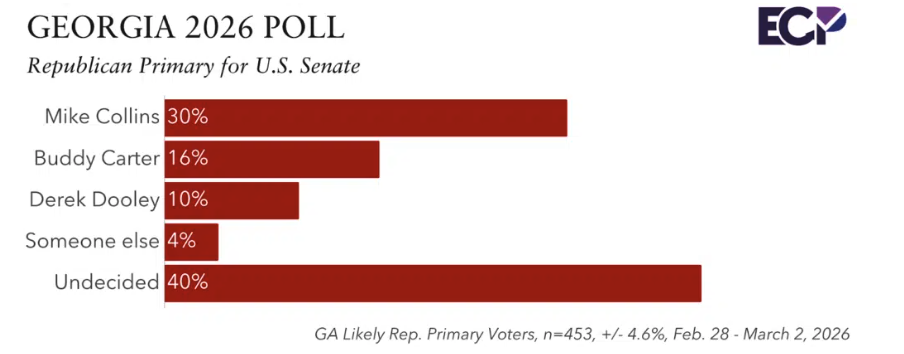
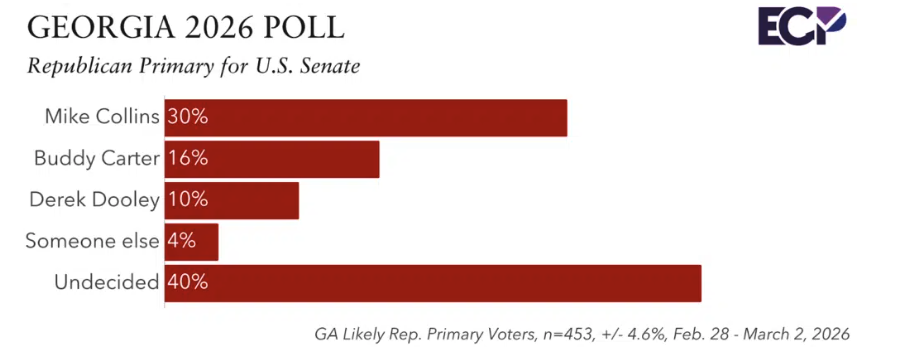
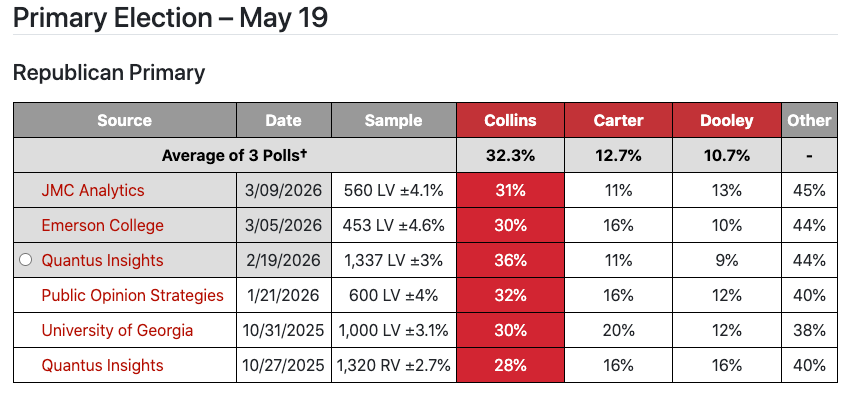
In Georgia, that distinction is not cosmetic. It is the trade. That is why the current quote looks smoother than the underlying reality. Brian Kemp, the Republicans’ strongest theoretical recruit, passed on the race, leaving the GOP with an unsettled field rather than a fully formed challenger. Polymarket now makes Rep. Mike Collins an 84% favorite to win the Republican nomination, but actual primary data are much less decisive: the 270-to-Win polling average has Collins at about 32%, and Emerson’s March poll found 40% of Republican primary voters still undecided. The Georgia GOP chair has already said a primary runoff is “more likely than not”. Markets are pricing a destination, but the state is still arguing over the route.

The Data-Driven Reality

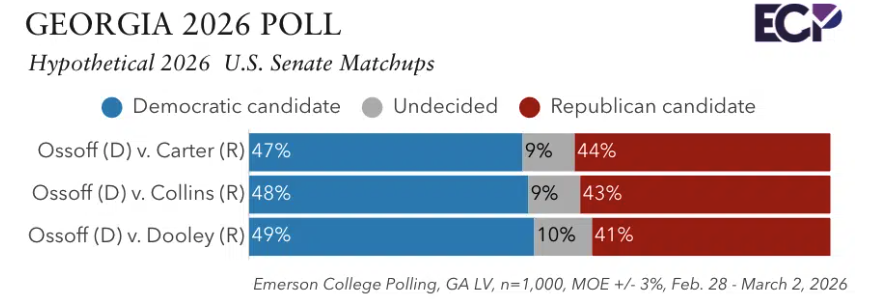
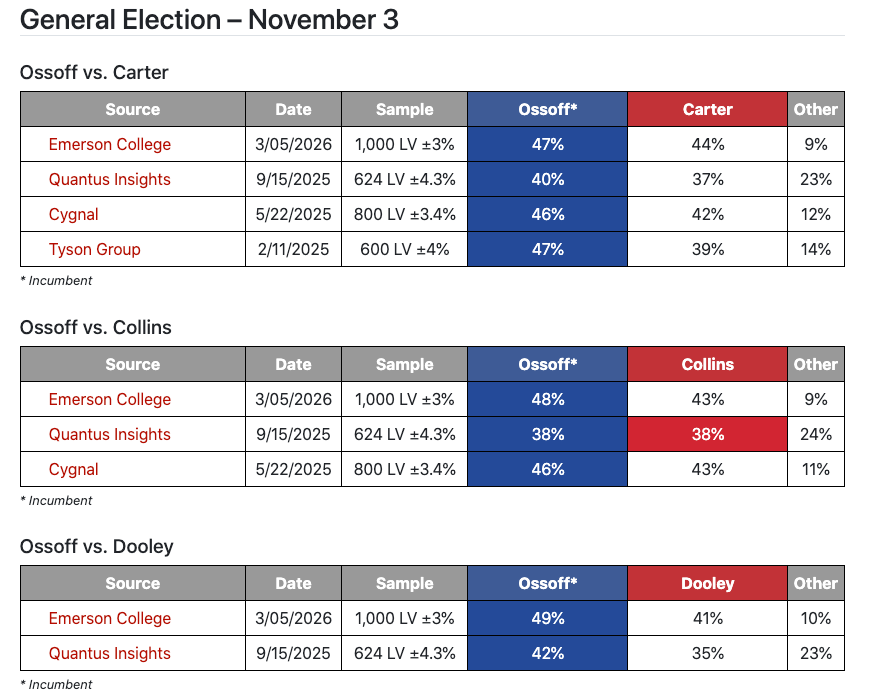
Start with the key fact that casual political coverage keeps flattening: Georgia is a majority-vote state. If nobody clears 50% on November 3, the top two go to a runoff on December 1. So when traders see Ossoff at 47%, 48%, or 49% in head-to-head polling and ment11ally round that up to “basically winning”, they are making a category error. Emerson’s March 2026 poll has Ossoff ahead of Buddy Carter 47-44, ahead of Mike Collins 48-43, and ahead of Derek Dooley 49-41. That is a good position for an incumbent. It is not yet a clean-exit position. In Georgia, 49 is not “almost done”. It is “overtime still live”.

Recent Georgia Senate history reinforces the point. In 2020, David Perdue led Jon Ossoff 49.7% to 47.9% in November and still got dragged into a runoff, which Ossoff then won. In 2022, Raphael Warnock led Herschel Walker 49.4% to 48.5% in November and still had to survive a December runoff. Georgia does not care whether you are ahead. It cares whether you are above 50. If you are pricing this race as though plurality lead equals resolution, you are trading the wrong state.

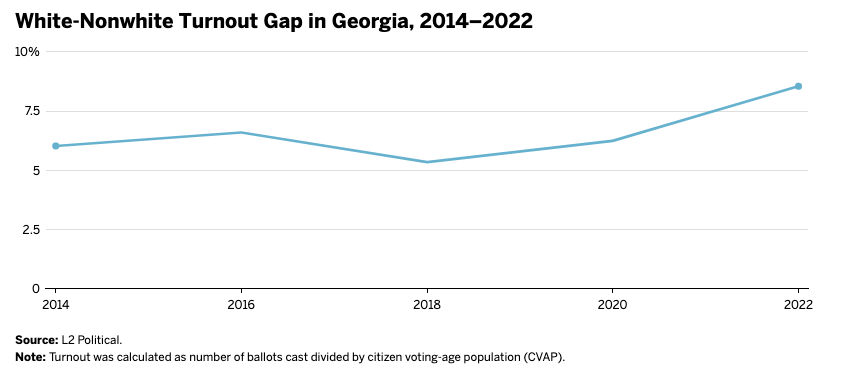
The demographic mechanics push in the same direction. Catalist estimates that Black voters made up 29% of Georgia’s 2022 electorate, and Warnock won 96% of them. The Brennan Center estimates that white turnout in Georgia’s 2022 midterm exceeded nonwhite turnout by 8.6 percentage points.

If nonwhite turnout had merely matched the white rate, more than 267,000 additional ballots would have been cast, including about 176,000 Black ballots. That is the real runoff math. The no-runoff path for Democrats is not mainly about persuading a few extra suburban moderates at the margin. It is about getting very high participation from Black voters, younger voters, and metro Atlanta coalition voters in November, then being able to reproduce enough of that effort four weeks later if needed. Emerson’s current poll is consistent with that story: Ossoff’s edge is strongest with independents, women, and voters under 50.

This is also why the fundraising gap matters so much. Ossoff’s FEC filing shows roughly $25.55 million cash on hand at year-end 2025. Roll Call reports Collins at about $2.3 million, Dooley at about $2.1 million, and Carter at about $4.2 million after including a personal loan. That gap does not guarantee victory, but it does buy insulation. It lets Ossoff define an opponent early, stay on air longer, and exploit a Republican field that may have to spend through both a May primary and a June runoff before it even gets to the general election. Financially, Ossoff is already in the general. Republicans are still paying admission to the primary.

One more uncomfortable number for the emotional trade: Trump is underwater in Emerson’s Georgia sample, with 42% approval and 51% disapproval. That does not make Georgia blue. It does mean the Republican nominee cannot simply assume a favorable partisan tide will do the work. Collins, Carter, or Dooley still need to close the gap with independents and with women while also holding a primary electorate that remains highly sensitive to Trump cues. Emerson found that 47% of likely GOP primary voters say a Trump endorsement would make them more likely to support a candidate. In other words, the Republican nomination is not fully endogenous yet. A meaningful share of the field is waiting for permission.

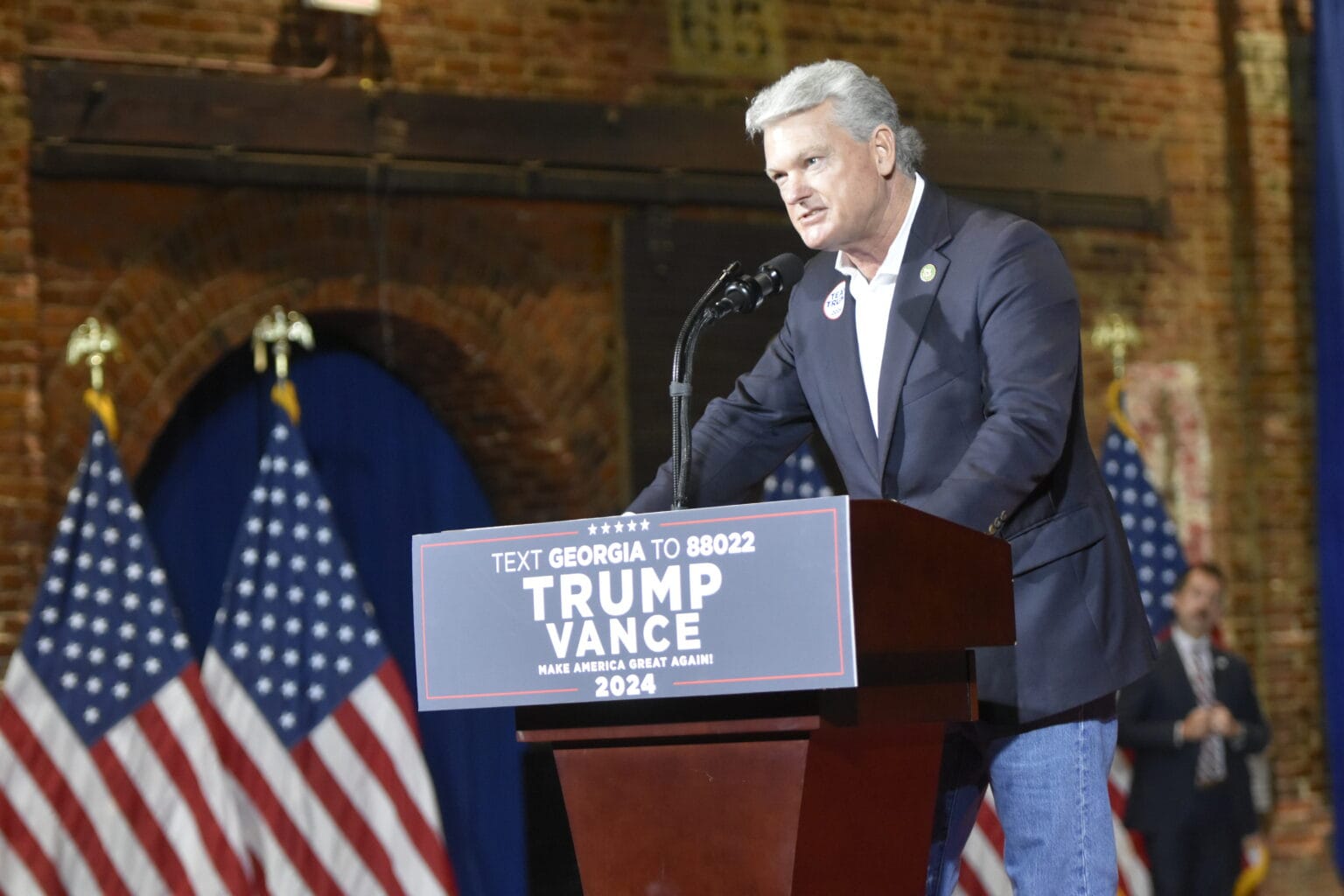
U.S. Rep. Mike Collins speaks at a Trump rally in 2024. File photo. Ross Williams/Georgia Recorder

Volatility Catalysts

There are three dates, and one non-date, that matter much more than the next hundred hot takes.

The first is April 15, 2026, the next regular FEC quarterly filing deadline for congressional committees. That report will tell traders whether the GOP field is actually consolidating around money, or just around chatter. A candidate who is still polling in the low 30s but suddenly posts a serious fundraising jump becomes much more dangerous than a candidate living off earned media and name recognition.

The second is May 19, 2026, Georgia’s primary. If Collins wins outright, markets will probably interpret that as a regime change: uncertainty collapses, Republicans stop bleeding time, and the race moves from speculative nomination politics into direct Ossoff-versus-Collins combat.

The third is June 16, 2026, the Republican primary runoff if no one clears 50% in May. This is the date most likely to be underappreciated by traders outside Georgia. A runoff would extend GOP fragmentation, burn money, delay nominee definition, and very likely create a temporary bid for Ossoff’s outright-win price.

Then there is the non-calendar catalyst: Trump’s endorsement, or continued refusal to endorse. Since nearly half of likely GOP primary voters say his blessing would move them, one post can change the shape of the primary faster than a month of conventional campaign activity. Traders should treat that as event risk, not noise.

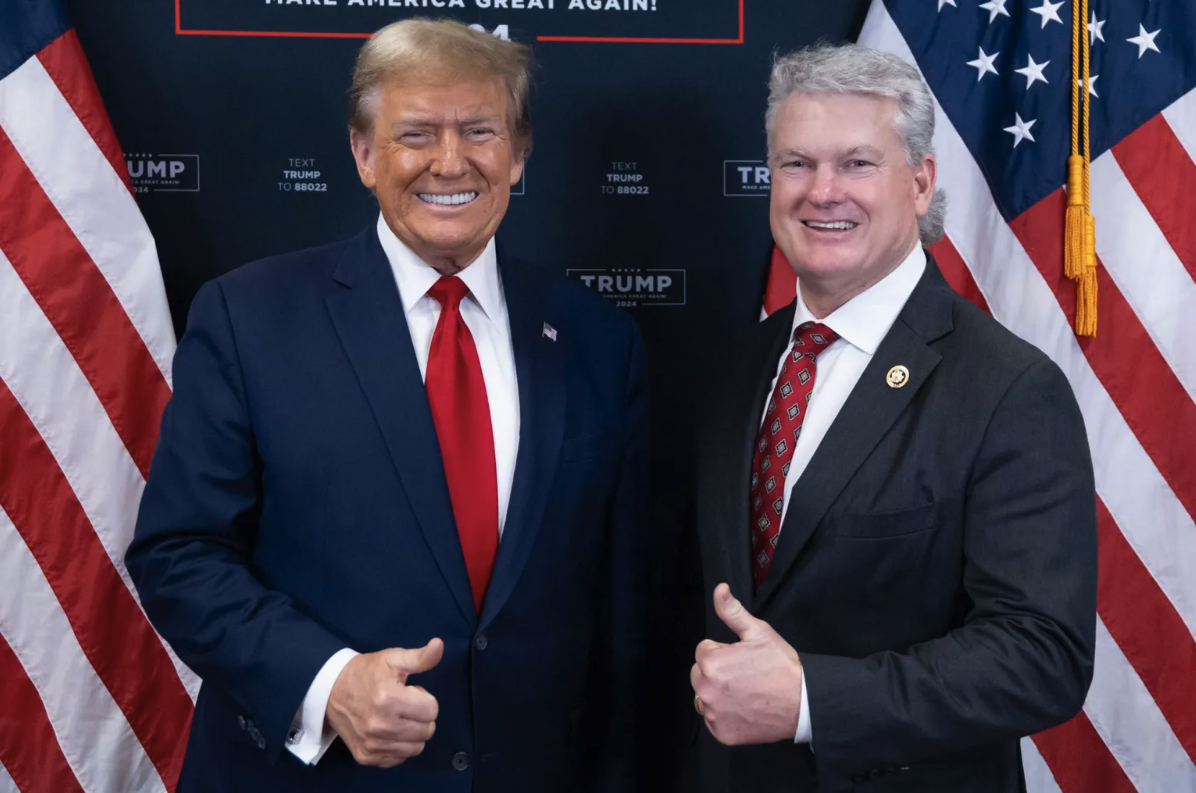
Photo courtesy Rep. Mike Collins / Twitter

Actionable Trading Insights & Strategic Takeaways

My view is that the outright winner market is directionally correct but path-blind. Ossoff should be favored against the current Republican field. He leads every public general-election test, he has a massive cash advantage, and the strongest GOP recruit is not running. But 82% reads more like a “final-owner-of-the-seat” price than a realistic assessment of how frictionless that ownership will be. Georgia’s majority threshold means a candidate can be leading and still be structurally vulnerable to overtime.

So the cleaner alpha is not necessarily “short Ossoff”. It is buy runoff risk whenever the market cheapens it too aggressively. My own base case would put the probability of a November general-election runoff somewhere in the rough 35% to 45% range right now. That number follows directly from the current ingredients: Ossoff is still below 50 in every named matchup, Georgia has repeatedly produced Senate runoffs when frontrunners stalled just short of majority, and the demographic coalition Democrats need to avoid a runoff is precisely the coalition that is hardest to maintain at uniform intensity in a midterm. If you can trade a “won outright / no runoff” market and the YES side is being priced like the obvious default, that is where I would lean against consensus.

The even cleaner fade may actually be on the Republican nomination side. Collins may well end up the nominee, but 84% is an aggressive price for a candidate currently sitting around 30% to 32% in public primary data, with about 40% undecided in Emerson’s sample and open discussion inside the Georgia GOP that a runoff is likely. If Trump endorses Collins and the field collapses, that price will look brilliant. Without that catalyst, it looks like the market is paying for certainty that the polling does not yet show. I would rather fade “Collins is basically done” than make a large outright anti-Ossoff bet here.

Source: 270towin.com

If Mike Collins is not the Republican nominee, the current data suggest that the alternative would most likely be either Buddy Carter or Derek Dooley, and those two are not equivalent general-election nominees. Georgia remains a state that Trump carried in 2024. Carter, however, has real money comparatively: the latest FEC reports show that he started 2026 with about $4.2 million in cash on hand, while Dooley had about $2.1 million. The public polling gap versus Ossoff is also only modestly worse for Republicans than it is under a Collins matchup. Even AJC coverage portrays Dooley as struggling despite Kemp’s active support.

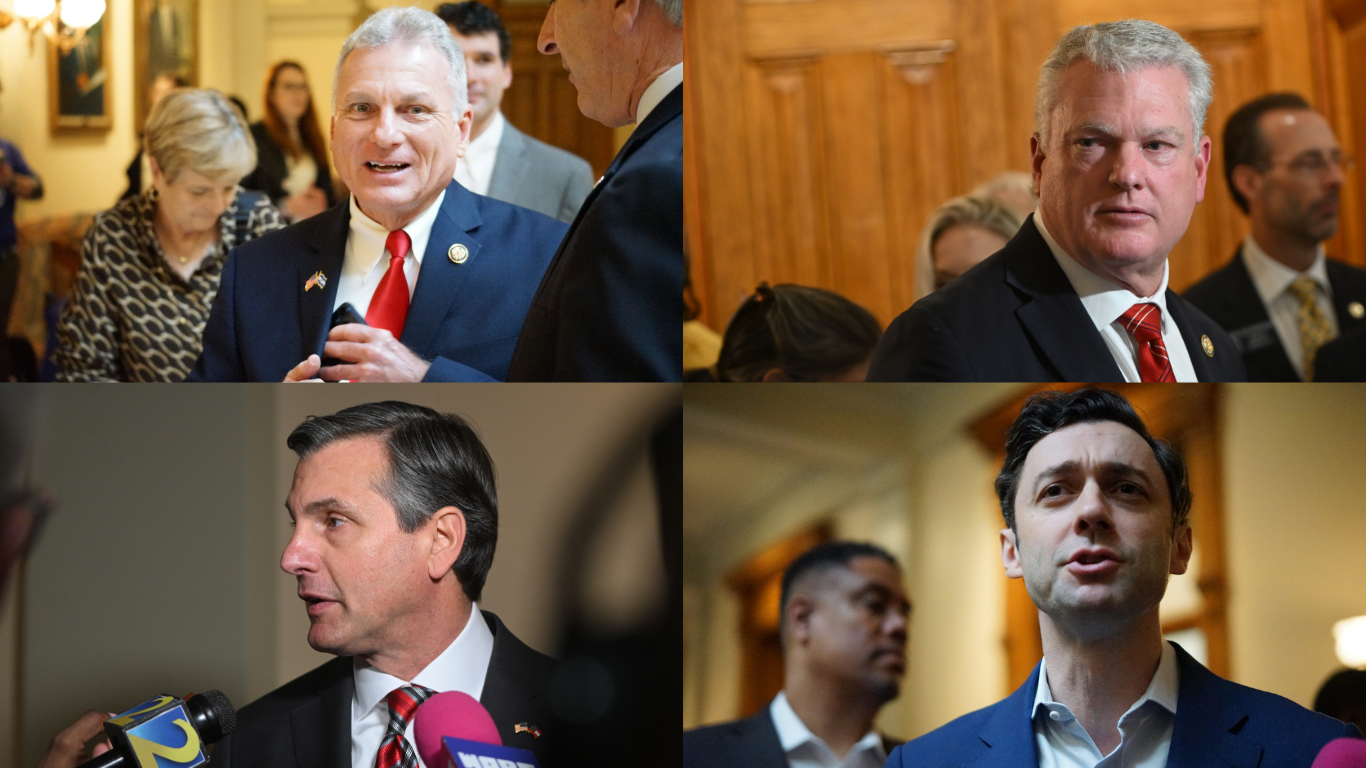
Candidates for U.S. Senate from Georgia from left, top: Congressman Buddy Carter, Congressman Mike Collins, bottom: Derek Dooley, Sen. Jon Ossoff. Ross Williams and Alander Rocha/Georgia Recorder

If the substitute is Carter, who is almost as strong as Collins but slightly weaker, the Senate race remains structurally similar, and the probability of a runoff would likely decline only by single digits. However, if the substitute is Dooley, my models forecast that the runoff probability may decline by around 20%.

Source: 270towin

The overarching takeaway is simple. Stop treating Georgia as a binary partisan referendum and start treating it as a sequencing trade. The important question is not just who wins the seat. The important question is whether anyone gets through the state’s machinery cleanly. Right now the data say Ossoff is advantaged, the Republican field is not settled, and the majority-vote rule keeps overtime very much alive. In a race like this, the market headline is usually less interesting than the path dependency underneath it.

Nevada Wins Temporary Ban on Sports Betting on Kalshi
News
EconomicsRegulatoryLegalPrediction Market

Nevada Wins Temporary Ban on Sports Betting on Kalshi

Nevada’s ban on Kalshi’s sports and election contracts underscores an escalating clash between state gambling regulators and federal derivatives authorities.

Politics

Nevada on Friday won a temporary restraining order to prevent prediction-market platform Kalshi from offering event-based contracts related to sports, elections and entertainment.

Kalshi must obtain all required state gambling licenses and prohibit users under 21 years old from using its platform to offer such contracts, according to the order from Nevada’s First Judicial District Court. Nevada gambling regulators had sought the order from the court. The ban will last for 14 days, with a hearing to be held April 3.

Kalshi sent an email to users Saturday informing them of the ban. Customers will be able to sell their positions related to the banned markets or wait for them to resolve, but they won’t be able to buy new contracts in those markets, it said. Contracts related to all other markets, including the weather and cryptocurrencies, are still available, Kalshi said.

“We built Kalshi to give everyone fair and open access to markets,” the email said. “Citizens of Nevada should not be forced into a business model designed to penalize winners and maximize user losses.”

A spokeswoman for Kalshi declined to comment.

Kalshi and Polymarket, a competing prediction-markets platform, offer event-based contracts tied to everything from politics to the weather. A large amount of betting is focused on professional and college sports, putting the platforms in competition with betting sites like FanDuel and DraftKings.

Polymarket has a data partnership with Dow Jones, the publisher of The Wall Street Journal.

The order is the latest blow against Kalshi’s efforts to continue operating in all 50 states as battle lines form between officials at the federal and state level over whether event-based contracts are distinct from online betting. Just a few days earlier, Arizona filed criminal charges against the parent companies of Kalshi, accusing them of operating an illegal gambling business without a license.

Nevada, the country’s gambling capital, has become a key battleground, with the state arguing that Kalshi must obtain gambling licenses to keep operating in the state.

“Kalshi has repeatedly stated that its operations are legal in 50 states, which is clearly not true,” Mike Dreitzer, chairman of the Nevada Gaming Control Board, said in a statement. “Prediction markets, to the extent they facilitate unlicensed gambling, are illegal in Nevada, and we have a statutory duty to protect the public.”

States including Massachusetts and Michigan have sued Kalshi for illegal sports betting, arguing that the nascent and fast-growing industry offers illegal betting.

Kalshi in recent months has sued states including Arizona, Iowa and Utah to stop what it believed were impending bans. The company said its event contracts were regulated by federal jurisdiction, rather than the states.

Kalshi is regulated by the Commodity Futures Trading Commission, as is Polymarket’s U.S. platform launched late last year, which focuses primarily on sports and is smaller than its main international platform. The commission in February filed a “friend of the court” brief in the Ninth U.S. Circuit Court of Appeals arguing that it had exclusive jurisdiction over the commodities-derivatives market, including event contracts.

Source: https://www.wsj.com/business/media/nevada-wins-temporary-ban-on-sports-betting-on-kalshi-2f7aadfa

How ‘Irrelevant’ Prediction Market Detail Led to Death Threats
News
EconomicsSignalsBusinessPrediction Market

How ‘Irrelevant’ Prediction Market Detail Led to Death Threats

Fast-growing prediction markets are exposing a core weakness as disputed contracts and after-the-fact trading create incentives to distort information and intimidate reporters.

PoliticsPop Culture

A Polymarket contract on whether Iran would strike Israel on March 10 was designed to forecast the future. Instead, more than 90% of the betting volume on the prediction market came after the fact, as users attempted to profit from a dispute that hinged on the source of a single blast.

The stakes turned personal. Emanuel Fabian, a Times of Israel military correspondent, received death threats after reporting that a missile had struck outside Jerusalem, making him an obstacle to one side of the trade. The people behind the messages demanded he change the story to say that an intercepted projectile was responsible, which wouldn’t count as a strike.

“It’s such an irrelevant, inconsequential detail,” Fabian said in an interview. “It doesn’t matter to the average person.”

The episode exposed a vulnerability in how prediction markets resolve contested outcomes — a process that, on Polymarket, relies on holders of a third-party cryptocurrency voting in a public chatroom rather than any centralized authority. It also showed how contracts designed to aggregate information can create financial incentives to distort it.

The dispute over a single word — missile or fragment — is only the most recent controversy to hit the fast-growing prediction market platforms in recent weeks. In the opening days of the war in the Middle East, there was intense debate about how to resolve contracts on Polymarket and its chief rival Kalshi on whether Ayatollah Ali Khamenei would be out as Iran’s leader.

These episodes undercut the central promise of prediction markets: that by offering yes-or-no bets they can harness the wisdom of the crowd to produce accurate forecasts on everything from politics to the economy and sports. One example of their potential came in 2024, when they gave Donald Trump higher odds of winning the presidential election than traditional polls.

Some of the controversy stems from how the contracts are designed. Polymarket, which hosted the bets on its main platform outside the US, allows anyone to propose how a market should resolve by posting a small amount of collateral. If there’s a disagreement, another user can dispute the outcome. The matter is then put to a vote among holders of a cryptocurrency called UMA, with traders debating the evidence in a public Discord chatroom. Polymarket itself rarely intervenes to decide a market’s resolution.

More than 90% of all shares traded on the Israel strike market were swapped after March 10, while the outcome was being disputed, according to a Bloomberg analysis of trading data from Dune Analytics. This process is called “bonding,” where traders see a possibility to make money on the market resolving after the event in question takes place. Total trading volume eventually climbed to $23 million.

That looks a lot like the earlier Khamenei contract. Much of those wagers were placed after the military strikes on his offices were first reported, which quickly pushed up the odds. Many large wallets also continued to wager on the supreme leader’s removal even after the probability hit 99%, earning a quick but small profit before the market was resolved.

In the end, Fabian did not change his story about the missile strike, despite receiving threats like this one: After “you make us lose $900,000 we will invest no less than that to finish you,” a message said, according to Fabian’s account.

Polymarket condemned the incident in a social media post on Monday, adding that it had banned several accounts and will pass on the information to the relevant authorities, without elaborating on how it had identified the accounts involved. The platform’s main venue is not overseen by US regulators and does not conduct identity checks on its users. The company did not respond to a request for additional comment.

The contract has since been settled to say a missile did strike on March 10, in line with Fabian’s reporting.

Source: https://www.bloomberg.com/news/articles/2026-03-19/how-irrelevant-prediction-market-detail-led-to-death-threats

Criminal Charges Amp Up Growing State Resistance to Kalshi
News
CompetitionRegulatoryLegalPrediction Market

Criminal Charges Amp Up Growing State Resistance to Kalshi

Prediction markets’ rapid growth has triggered a jurisdictional clash as state regulators and attorneys general escalate civil and criminal actions against platforms.

Politics

The rapid expansion of prediction markets is facing increasingly aggressive pushback from state officials pursuing a sprawling patchwork of lawsuits and cease-and-desist orders.

The stakes in these legal battles were amped up on Tuesday after Arizona’s attorney general brought criminal charges against Kalshi, the largest prediction market platform in the US, accusing it of running an illegal gambling operation in the state.

Prediction markets have exploded in popularity over the past year by offering novel financial contracts that make it possible to bet on the outcome of everything from the Super Bowl to the leadership struggles in Iran.

While federal regulators have claimed oversight, and allowed the markets to grow, states, many of which rely on tax revenue from gambling companies, have stepped into the fold to take on prediction markets, which don’t pay state gambling taxes. The Arizona criminal charges come on top of more than a dozen other lawsuits currently moving forward in courts across the country.

Kalshi co-founder Tarek Mansour pushed back against the new charges on Wednesday, calling them “a total overstep” in an interview with Bloomberg Television. “These charges have nothing to do with gambling or the merits,” Mansour said. “If it was about gambling or the merits, they would let the judicial process run its course in the federal courts.”

The mounting court clashes underscore how states have emerged as the most potent source of resistance to prediction markets, moving into the vacuum left by the federal regulators and lawmakers.

“As the federal government steps away from consumer protection, state AGs have stepped up,” Massachusetts attorney general Andrea Joy Campbell said in an email to Bloomberg this week. Campbell’s office won an injunction against Kalshi in January in a civil enforcement case. That has been fast-tracked to the state’s supreme court after Kalshi challenged it.

The Commodity Futures Trading Commission, which oversees Kalshi and other US prediction market platforms as derivatives exchanges, restricted their growth during the Biden administration. But since Donald Trump took office last year, the agency has effectively allowed Kalshi and its competitors to expand into new areas, such as sports betting, and to offer trading nationwide, even in states where gambling is illegal.

The freewheeling activity has attracted criticism from foreign governments, former regulators, Democrats in Congress and state officials, who have raised several concerns about the exchanges. The criticism has focused most of all on their vulnerability to manipulation, but also on the lack of consumer protections of the sort that traditional gambling companies have to offer.

These critics, though, aren’t expecting much of a response out of Washington, in part because of the president’s ties to the industry. Donald Trump Jr. is an adviser to both Kalshi and Polymarket. And the Trump Media & Technology Group has also created its own prediction market version — Truth Predict — in partnership with Crypto.com, which is facing several state enforcement actions.

Several recent bills proposed by Democrats in Congress are not likely to make much progress as long as Republicans are in charge.

State officials, on the other hand, have looked to take advantage of the fact that casinos and sportsbooks have traditionally come under state oversight. A number of states have reported in recent months that legal gambling activity has declined as prediction markets have become more popular.

Attorneys general and gaming regulators in over a dozen states, including Massachusetts, Tennessee and Ohio have argued in enforcement letters and court documents that Kalshi and its peers are violating state gambling laws. Several states have joined forces by filing legal briefs backing each other’s efforts in court.

Kalshi has had some success in fighting off these lawsuits, arguing that if it answers to the CFTC it cannot also answer to state regulators. The company has continued doing business across the country and has preemptively sued several states that have talked about bringing enforcement actions, including Arizona. After the charges were filed on Tuesday, a spokesperson for Kalshi said the company is not going to back down.

“States like Arizona want to individually regulate a nationwide financial exchange, and are trying every trick in the book to do it,” the Kalshi spokesperson said. “As other courts have recognized and the CFTC affirms, Kalshi is subject to federal jurisdiction.”

Michael Selig, who recently took the helm of the CFTC, has taken the unusual step of directing the agency to support prediction markets in their fights with states, arguing that these exchanges answer only to his agency. He reiterated that support on Tuesday after Arizona announced its charges.

“This is a jurisdictional dispute and entirely inappropriate as a criminal prosecution,” Selig wrote in a post on X on Tuesday afternoon. “The @CFTC is watching this closely and evaluating its options.”

A number of recent court decisions have suggested that the states have begun to gain something of an edge in at least some of the cases making their way through federal courts. Soon after the Arizona charges were filed this week, a federal judge denied Kalshi’s previous request for a restraining order against enforcement in the state.

Another federal judge ruled this month against Kalshi and in favor of the Ohio Casino Control Commission, which had sent the company a cease-and-desist letter. A few weeks earlier, though, a judge in Tennessee ruled in Kalshi’s favor in a similar case.

Many legal analysts anticipate that the wide array of states pushing the issue — and the split court decisions — will elevate the battles to the Supreme Court, where the fate of the industry is likely to be decided.

“We’re in uncharted waters,” said Kevin Frankel, a lawyer who works in the state attorneys general practice at Benesch. “None of this is going to be resolved in any of these state court proceedings. It’s going to be hard to do that before it gets to the Supreme Court.”

So far, Nevada, the home of America’s gambling industry, has had some of the most success in using the courts to shut prediction markets down. As of February, Kalshi is the only prediction market operating legally in the state, after the state won injunctions against its competitors Polymarket, Coinbase, Robinhood and Crypto.com.

The Nevada Gaming Control Board is now pursuing a civil enforcement action to ban Kalshi as well. The company failed to move that case to federal court, and it’s possible that the Nevada court will force Kalshi to geofence its offerings to keep out customers in the state.

In the meantime, the criminal case in Arizona may change the legal calculus for prediction market platforms, especially if other states pursue a similar strategy. Arizona has opted to bring misdemeanor, rather than more serious felony charges, and the potential fines are relatively small. But Daniel Wallach, founder of Wallach Legal, said the Arizona case could allow the state to attempt to shut down operations rather than merely impose fines.

“It may reflect a fine-tuning of states’ strategies on how to attack prediction markets,” Wallach said, “by using state court civil and criminal enforcement remedies instead of the tired approach of sending cease-and-desist letters.”

In some states, legislators have also introduced bills trying to restrict certain aspects of prediction markets operations. New York and Connecticut both have pending legislation that would prohibit individuals under 21 from placing bets on prediction markets, a limit that is already in place for gambling companies, but not for other financial products.

“From my point of view, it’s much better if the feds take the lead on this rather than having 50 states do their own thing,” Connecticut Governor Ned Lamont said in an interview. “But since the feds aren’t doing anything really significant about this, I wanted to start by having a level playing field with say, the sports betting we’ve got right now, and protecting young people.”

These bills, though, are expected to be dependent on whether the courts ultimately give the states any jurisdiction over prediction markets.

There are now several different federal courts where judges are close to reaching decisions on whether the states have any authority over prediction markets. In Maryland, after a federal judge sided with the state, Kalshi appealed to the 4th US Circuit Court of Appeals, where arguments are scheduled to start in May. The Supreme Court often takes up issues when multiple circuit courts offer conflicting opinions.

Source: https://www.bloomberg.com/news/articles/2026-03-18/criminal-charges-amp-up-growing-state-resistance-to-kalshi
Polymarket Seeks Chief Risk Officer After Legal Hiring Spree
News
EconomicsRegulatoryLegalPrediction Market

Polymarket Seeks Chief Risk Officer After Legal Hiring Spree

Prediction market platform Polymarket is beefing up risk and legal leadership to satisfy CFTC demands as it pushes deeper into regulated US business while rivals also professionalize.

Politics

Prediction markets platform Polymarket is looking to hire a chief risk officer as it works to expand its regulated business in the US, according to people familiar with the matter.

The Commodity Futures Trading Commission, which regulates Polymarket’s US operations, has stipulated that the platform needs to hire a chief risk officer to oversee its US entities. CFTC rules prohibit listing some of the more controversial contracts in the US, such as those related to war, that Polymarket offers in its international business.

The search for a chief risk officer comes after Polymarket added a bench of legal expertise in recent months to work with chief legal officer Neal Kumar, a former partner at Willkie Farr & Gallagher, the people familiar said.

The legal team recently hired Olivia Chalos from Sullivan & Cromwell as Kumar’s deputy. Matthew Lischin, who led the North American global markets law group at RBC Capital, also joined Polymarket, along with Erin Savoie from Proskauer Rose and Bailey Springer from Sullivan & Cromwell.

A representative for Polymarket declined to comment.

The platform has courted controversy by listing contracts tied to assassination, terrorism and war in its offshore venue, with critics on both sides of the aisle in the US.

Rival Kalshi Inc. is also hiring from the world of mainstream financial services. The prediction exchange recently hired Udesh Jha, the head of post-trade services at CME Group, to run quantitative analysis. In February, Kalshi tapped Andy Ross, the former head of prime and financing at Standard Chartered Plc to help build its business serving institutional investors.

Read: CFTC to Craft New Prediction Market Rules, Chairman Says (2)

Source: https://www.bloomberg.com/news/articles/2026-03-18/polymarket-seeks-chief-risk-officer-after-legal-hiring-spree

2026 Primary Barometer: Kalshi’s Trending Contracts Signal Major Shifts in Texas and Illinois
Analysis
ElectionPrediction MarketSignals

2026 Primary Barometer: Kalshi’s Trending Contracts Signal Major Shifts in Texas and Illinois

2026 Election Odds, Prediction Market Alpha, Kalshi Primary Trading, Texas Senate Odds 2026, Illinois Democratic Primary Forecast, Trump Endorsement Effect.

Politics

CHICAGO/AUSTIN — As the March 2026 primary cycle intensifies, capital flows on Kalshi, the CFTC-regulated prediction market, are providing a clearer picture of the political landscape than traditional polling. With massive volume surging into Texas GOP battles and Illinois Democratic strongholds, the "smart money" is signaling a departure from established narratives.For traders looking for 2026 Election Odds, these six trending contracts offer the most significant data points for the upcoming cycle.

The "Trump Premium" in the Lone Star State

In Texas, the battle for the Republican Senate Nominee has become a high-stakes proxy war for the soul of the GOP.

  • Texas Republican Senate Nominee: While incumbents typically hold a statistical edge, Kalshi traders are pricing in a significant "Trump Endorsement Premium." Challenges aligned with the 2026 Trump agenda are seeing aggressive buy-side pressure.
  • Texas Senate Winner: This contract isn't just about the primary; it’s a general election forecast. The high liquidity here suggests that the market views the winner of the GOP primary as the presumptive favorite for the seat, creating a "winner-takes-all" volatility profile for the nominee contract.

Illinois: The Establishment Under Siege?

Unlike ideological warfare in Texas, the Illinois Democratic primaries (IL-09, IL-02, IL-08) are serving as a litmus test for the party's internal power dynamics in 2026.

  • The "Safe" Bets (IL-09 & IL-08): In the IL-09 and IL-08 Democratic Nominee markets, win probabilities for incumbents remain anchored above 85%. For the low-risk trader, these contracts represent "yield-style" plays, though the limited upside reflects the deep-rooted incumbency advantage in these districts.
  • The IL-02 Volatility Spike: The IL-02 Democratic Nominee contract has defied the trend. Recent high-volume trades suggest a potential upset or a significant shift in labor union backing. Because Kalshi users are often hyper-local stakeholders, this price action often precedes "breaking news" regarding local endorsements or scandals.

Market Efficiency: The Kalshi Lead

Sophisticated participants focus on Kalshi for its Price Discovery advantages. Because it is a US-regulated exchange, its order books for specific districts like IL-02 are often deeper and more accurate than global platforms. When a gap appears between Kalshi and offshore markets, Kalshi typically acts as the "source of truth," reflecting local intelligence that global traders have yet to digest.

Key Data Points to Watch

  • Most Volatile: Texas Republican Senate Nominee. Expect rapid swings based on social media and endorsements.
  • Strategic Hedge: Illinois Democratic Senate Nominee. A reliable indicator of the broader national Democratic sentiment.
  • The Dark Horse: IL-02 Democratic Primary. Watch for unexplained volume spikes that may signal an upset.

Pro Tip: Monitor Open Interest (OI) on the "Texas Senate Winner" contract. In prediction markets, a sudden surge in volume often signals a major news break is coming—well before the price actually moves.

SEC, CFTC Move to Define Which Digital Assets are Securities
News
EconomicsRegulatoryLegalPrediction Market

SEC, CFTC Move to Define Which Digital Assets are Securities

US securities and derivatives regulators jointly issued long-awaited crypto asset guidance, narrowing what counts as a security and signaling they’ll move ahead without waiting for Congress.

PoliticsEconomics & Finance

The Securities and Exchange Commission issued a long-awaited “token taxonomy” on Tuesday, a key step forward laying out which types of digital assets it deems to be securities.

The guidance carves out payment stablecoins, digital collectives and digital commodities as non-securities. It also clarifies how federal securities laws apply to protocol mining, staking and crypto airdrops, the SEC said in a memo.

Digital securities, or traditional securities that are tokenized, are subject to SEC rules and regulations, according to the guidance.

“We’re not the securities and everything commission anymore,” Chairman Paul Atkins said at the Digital Chamber’s conference in Washington, in a critique of the Biden administration’s stance that most crypto assets should be treated as securities.

Notably, the SEC explained that a non-security crypto asset may stop being an investment contract under securities laws when an issuer has either fulfilled or failed its representations or promises.

The crypto industry has long sought greater clarity on whether particular assets are considered securities, which typically require more regulatory disclosures than commodities.

The Commodity Futures Trading Commission joined in the interpretation, in the latest sign that Wall Street’s two main regulators are no longer waiting for Congress to finalize legislation to delineate which agency has jurisdiction over which digital assets.

The SEC head also said the agency would soon issue a proposed rule teeing up a safe harbor program for startups to launch crypto companies, crypto investment contracts and security tokens without necessarily having to register with the agency.

The goal would be to allow companies to gain access to capital without being subject to enforcement action, said Atkins, adding the safe harbor could last up to four years.

“Such a safe harbor would provide crypto innovators bespoke pathways to raise capital in the US while providing appropriate investor protections,” Atkins said.

Atkins said the latest efforts would give the agencies a “head start” bringing certainty to the digital asset industry but urged lawmakers to continue their work on market structure legislation.

Source: https://www.bloomberg.com/news/articles/2026-03-17/sec-cftc-move-to-define-which-digital-assets-are-securities

Arizona Files Illegal-Gambling Charges Against Predictions Platform Kalshi
News
RegulatorySignalsLegalPrediction Market

Arizona Files Illegal-Gambling Charges Against Predictions Platform Kalshi

Arizona’s criminal case against Kalshi underscores an escalating jurisdictional clash between states and federal regulators.

Politics

Arizona filed criminal charges against the parent companies of Kalshi, a startup prediction platform, on Tuesday accusing them of operating an illegal gambling business without a license.

Arizona Attorney General Kris Mayes said Kalshi accepted bets from residents on sports, elections and events in violation of state law. Arizona doesn’t allow unlicensed wagering businesses and bans elections betting, Mayes said. The state charged the companies with 20 counts of illegal betting and wagering.

“No company gets to decide for itself which laws to follow,” Mayes said.

New York-based Kalshi said, “These state-court charges are seriously flawed. It’s gamesmanship.”

Michael Selig, chair of the Commodity Futures Trading Commission, said the federal agency was watching the Arizona case closely. “This is a jurisdictional dispute and entirely inappropriate as a criminal prosecution,” he said.

Marketplaces like Kalshi and its rival Polymarket have expanded dramatically in recent years with a surge of user interest. Earlier this month, The Wall Street Journal reported that the two companies were in early conversations with investors about fundraising to reach a roughly $20 billion valuation.

Both Kalshi and Polymarket have been under scrutiny for allowing bets on the U.S. striking Iran and the ouster of the country’s supreme leader, Ayatollah Ali Khamenei.

States including Massachusetts and Michigan have sued Kalshi for illegal sports betting and pushed to regulate the prediction markets industry. They argue the fast-growing field, where users can buy and sell event contracts, amounts to illegal betting.

Arizona’s gaming department had sent Kalshi a cease-and-desist letter in May 2025.

Kalshi in recent months has sued a handful of states including Arizona, Iowa and Utah to stop what it believed were impending bans. The company said it thought its event contracts were under federal jurisdiction—not state.

Federal courts recently rejected Kalshi’s attempts to prevent bans on its businesses in Ohio and Nevada. Kalshi has appealed the decisions.

Source: https://www.wsj.com/us-news/law/arizona-ag-sues-kalshi-alleging-illegal-gambling-betting-on-states-elections-b387d276