TL;DR
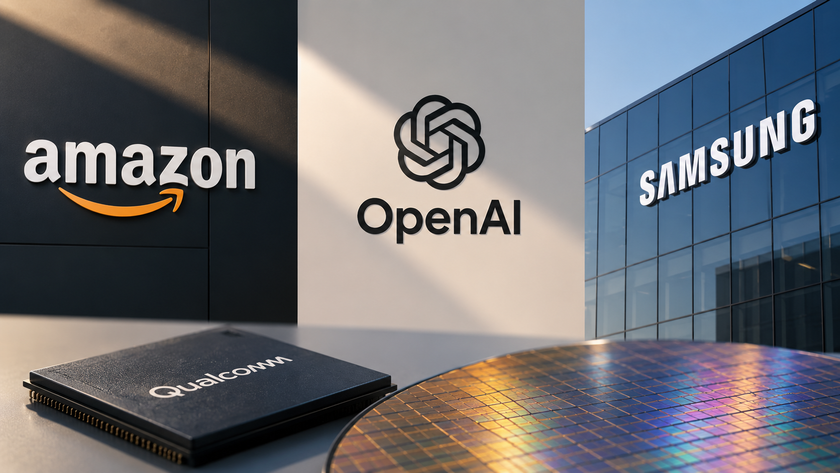
- Amazon could buy up to $60bn of Qualcomm AI data-center products, while receiving warrants to purchase up to 25 million Qualcomm shares as procurement milestones are met.
- OpenAI says it is working with Samsung on joint production and research of next-generation chips, expanding the relationship beyond memory supply.
- OpenAI also says its own AI models helped take its first custom chip, Jalapeno, to tape-out in just nine months.
Will Qualcomm announce another hyperscaler AI chip customer before the end of 2026?
Amazon Gives Qualcomm a $60bn Opening in AI Silicon
Qualcomm has signed a long-term agreement under which Amazon could purchase up to $60bn of its AI data-center chips and related products, marking one of the chipmaker’s biggest moves beyond smartphones.
The partnership covers AI inference chips, optical connectivity reaching 1.6 Tbps, and future-generation technologies. Amazon will also receive warrants allowing it to purchase up to 25 million Qualcomm shares, with vesting linked to procurement progress.
The structure resembles Marvell’s recent deal with Google, where a hyperscaler combines long-term purchasing commitments with equity-linked incentives.
Read more: Marvell’s AI chip deal with Google
 Bloomberg
What matters
- The $60bn is a purchase-linked threshold, not guaranteed Qualcomm revenue. It covers chips, connectivity, systems and manufacturing services.
- The warrants tie Amazon’s potential equity upside to the scale of its purchases, while introducing possible dilution for Qualcomm shareholders.
- Qualcomm is competing on more than accelerator performance: the deal spans compute, connectivity and future chip generations.
- The main financial question is profitability. Qualcomm has said early custom-chip business could reduce chip-segment gross margin by 1.5–2 percentage points, while still adding to operating profit.
OpenAI Moves Deeper Into Custom Silicon
OpenAI is also expanding its role in the semiconductor stack.
OpenAI Korea head Harrison Kim said the company is working with Samsung on “joint production and research” of next-generation chips. The new point is not that OpenAI is developing its own silicon—that was already known—but that Samsung’s role may now extend beyond the previously disclosed memory relationship.
OpenAI’s first custom chip, Jalapeno, was designed with Broadcom for AI inference and is set to be manufactured by TSMC. Samsung and SK Hynix had already agreed to supply memory for the Stargate project.
The exact scope of Samsung’s new role remains unclear. OpenAI has not specified whether it involves foundry manufacturing, HBM, advanced packaging, co-design or another part of the chip-development process.
At the same time, CFO Sarah Friar said OpenAI used its own AI models while developing Jalapeno and reached tape-out in nine months. Tape-out is the stage when a chip design is finalized and sent for manufacturing.
The broader shift is becoming clearer: AI companies are moving deeper into chip design and supply-chain development, while also using AI itself to shorten parts of the semiconductor design cycle.
Source:
- Reuters - https://www.reuters.com/technology/qualcomm-amazon-develop-custom-chips-ai-data-centers-2026-09-08/
- Reuters - https://www.reuters.com/world/asia-pacific/openai-says-working-with-samsung-next-generation-chips-deepening-cooperation-2026-09-09
- Reuters - https://www.reuters.com/world/china/openai-offers-ai-chip-design-touts-cost-advantage-over-open-source-cfo-says-2026-09-09