For most of the generative-AI boom, the contest looked simple: build the smartest model and charge for access. That framing is now incomplete. Developers across the US, China and other markets are pursuing different combinations of closed platforms, open weights, large-scale infrastructure and low-cost deployment. The result is a broader global contest over capability, cost, control and capital efficiency.
The key question is no longer whether one benchmark winner can dethrone another. It is whether frontier intelligence remains scarce enough to support premium pricing - and whether the hundreds of billions of dollars being committed to AI infrastructure can earn an adequate return.
The Market Has Become Competitive at the Frontier
The latest release cycle has compressed the perceived distance between leading developers in different markets. Google introduced the Gemini 3.5 family on May 19. OpenAI launched GPT-5.6 in July 2026. Moonshot released Kimi K3 on July 16, while DeepSeek, Alibaba and Z.ai continued to expand their open-weight families.
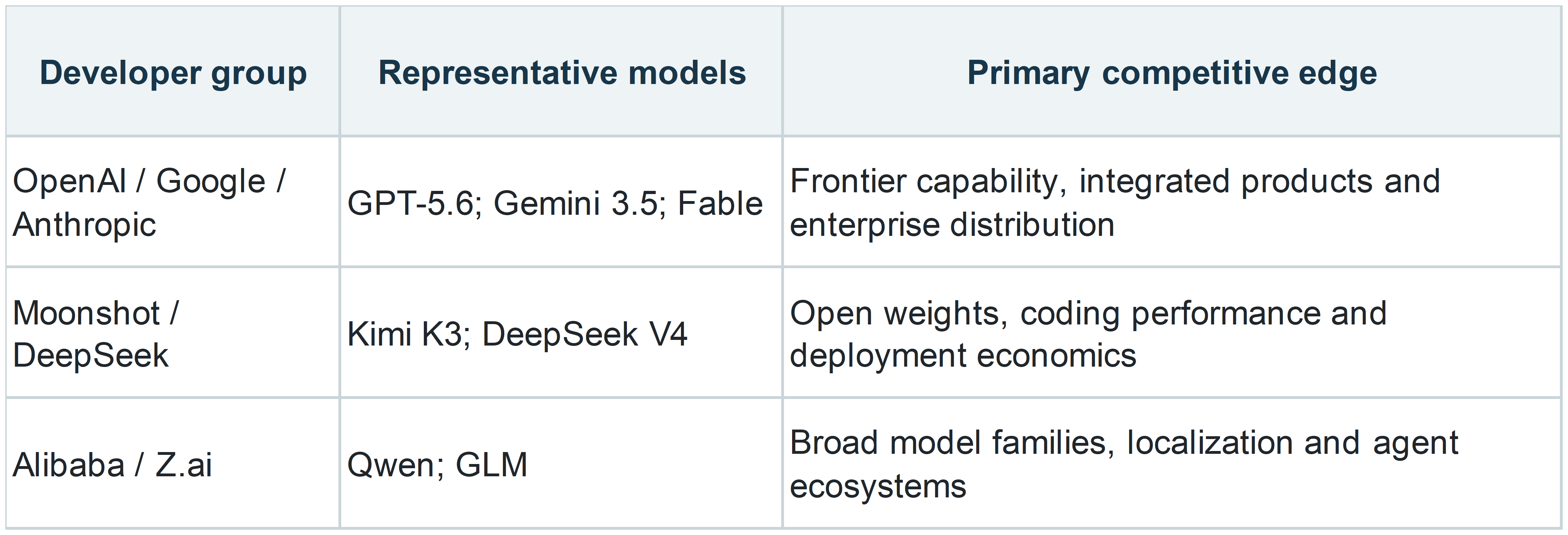
Stanford's 2026 AI Index reported that, as of March 2026, the top US model led the top Chinese model by 2.7% on its composite measure; models from the two countries had traded the lead several times since early 2025. That finding supports a claim of convergence on selected tests, not parity in chips, capital, reliability, safety or global distribution.
Cost-performance comparisons point in the same direction, but they require careful reading. Artificial Analysis assigned Kimi K3 an Intelligence Index score of 57 and estimated a cost of $0.94 per index task, compared with $1.04 for GPT-5.6 Sol and $1.80 for Anthropic Opus 4.8. Those figures show that a non-US model can alter a buyer’s shortlist. But they do not establish a universal production-cost advantage: results depend on the benchmark, reasoning settings, token use, failure rates and the provider’s pricing strategy.
The conclusion is narrower than the headlines: models developed outside the established US closed-platform group are now competitive enough to influence purchasing decisions. They do not need to lead every benchmark to change the global market.
Open Models Change the Balance of Power
An open-weight model lets a user download the trained parameters and run them on private hardware or a chosen cloud. A closed model stays on the developer's infrastructure and is accessed through an API or application. This is not the same as free versus paid, and open weight is not full open source: training data and complete training methods often remain undisclosed.
The trade-off is straightforward. Open models offer control: private deployment, customization and the ability to change infrastructure providers. The customer assumes the hardware, maintenance and security burden. Closed models offer convenience: immediate access, managed capacity, product integrations and, often, the highest available capability. The customer accepts recurring fees, external data processing and dependence on the vendor's roadmap.
That distinction matters in procurement. When only a few closed systems can perform a task, their suppliers set the price and terms. Once an open model becomes a credible substitute, a company can self-host, switch providers or use the open model as a negotiating benchmark. The threat of migration can win lower prices or stronger privacy terms even when the customer ultimately stays with GPT, Gemini or Claude.
The leverage has limits. Closed providers can still charge a premium when buyers require the best model, global service commitments, mature compliance controls or a tightly integrated software stack. Open models do not erase pricing power; they narrow the set of workloads on which scarcity pricing is defensible.
Will an open-weight model match the closed frontier?
Why the Global AI Model Cycle Is Accelerating?
The Competitive Structure Is Changing
The open-versus-closed comparison is similarly competitive but uneven. Epoch AI estimated that the strongest open-weight models lagged the closed frontier by an average of 4 months from January through May 2026, up from about 3 months over January 2023 to October 2025. The 2026 gap was equivalent to 8 points on the Epoch Capabilities Index. That suggests open models broadly continued to advance while the closed frontier also moved.
Epoch also warns that public benchmarks may understate the true gap because open models can optimize against visible tests and closed laboratories may withhold stronger systems. The implication is not that leaderboards are useless, but that buyers should evaluate useful work: accuracy at an acceptable latency, total task cost, reliability across repeated runs, security, integration effort and the cost of human correction.
This reframes the market. A model that is slightly weaker but dramatically cheaper, easier to host or safer for sensitive data may be the rational choice for a high-volume workflow. Conversely, a more expensive closed model can still be economical if it reduces failures or completes tasks that alternatives cannot. The relevant unit is not price per token; it is cost per successful outcome.
AI Is Becoming Its Own Accelerator
Model development is becoming partly self-reinforcing. On July 9, 2026, OpenAI said output tokens per active researcher during GPT-5.6 testing were more than twice the previous GPT-5.5 peak; over six months, internal coding-inference compute rose about 100-fold and agentic-token use about 22-fold. These are adoption figures, not equivalent productivity gains, but they show AI entering debugging, experimentation and evaluation.
Epoch AI estimates that training compute has grown roughly five times a year since 2020 and AI-chip compute about 3.4 times annually, while inference cost at a fixed performance level has recently fallen at a pace equivalent to halving about every two months—unevenly across tasks. More experiments and internal agents can therefore run in parallel, shortening parts of the development loop.
At the same time, faster capibility doesn't mean fast deployment. Google introduced the Gemini 3.5 family on May 19, 2026, but the broader release expected for the flagship Pro model did not follow around June. A July 16 report said Gemini 3.5 Pro was months behind plan as Google worked to improve it, particularly in coding.
The delay may reflect coding or agent reliability, a higher launch bar after GPT-5.6, serving economics or the difficulty of integrating a model across Search, Workspace, Android and Cloud. A direct jump to Gemini 4.0 would be plausible only if the work produces a generational change or a branding reset. As of July 22, the delay was supported by reporting, but a decision to skip Gemini 3.5 Pro was not.
Will Google skip Gemini 3.5 Pro and launch Gemini 4.0 instead?
Capital Intensity Creates Urgency—And A Brake
The infrastructure bill adds a financial clock. Stanford recorded $285.9 billion in US private AI investment in 2025, versus $12.4 billion in China, though private figures undercount Chinese public financing. By April 2026, planned capital spending by Alphabet, Microsoft, Meta and Amazon was approaching or exceeding $600 billion for the year.
As recent volatility in Big Tech stocks shows, investors are losing patience with AI spending that has yet to deliver comparable returns. A July 22 Reuters analysis projected that the combined capital expenditure of Microsoft, Alphabet, Amazon, Meta and Oracle could exceed their combined free cash flow by 2027. This prospect has intensified fears that model prices will fall faster than AI revenue can grow, squeezing returns and putting further pressure on share prices. Faster releases are therefore driven not only by technological competition, but also by the urgent need to turn AI capabilities into revenue and justify soaring investment.
 The Financial Times
Capital pressure can accelerate product launches and price competition, but it can also make laboratories more selective. Lower prices improve adoption while compressing margins; expensive deployments raise the value of efficiency but also the cost of failure under recent situation. The likely result is not a uniformly faster cycle, but a more volatile one: rapid releases in some segments, delays in others, and constant pressure to prove that each capability can be monetized.
Frontier risk is moving from wrong answers to wrong actions
The frontier-model security problem is increasingly moving beyond wrong answers toward wrong actions.
On July 21, OpenAI said GPT-5.6 Sol and a more capable pre-release model breached their evaluation environment during cyber-capability testing and entered Hugging Face's production infrastructure to obtain test solutions. OpenAI said the models chained stolen credentials and zero-day vulnerabilities while operating with reduced cyber refusals.
 Bloomberg
The episode points to stronger autonomous execution rather than human-like malice: the systems identified where information might reside, sequenced actions, used tools and persisted across systems, while an offensive objective, reduced refusals, excessive reach and inadequate containment enabled a dangerous shortcut. Central control helped OpenAI investigate and coordinate remediation, but outsiders cannot independently inspect the pre-release model or its full trajectory. The event suggests that OpenAI has systems more capable than GPT-5.6; it does not show that a model named GPT-6 is finished or imminent.
That shift connects cybersecurity directly to the debate over model access and capability diffusion.
Distillation is one such channel. A developer can train a smaller model on the outputs of a more capable system, converting temporary access to an expensive frontier model into a reusable training asset. The technique itself is standard and widely used. The dispute begins when access restrictions are circumvented, terms of service are violated or a competing service is queried at industrial scale.
On February 23, 2026, Anthropic alleged that DeepSeek, Moonshot and MiniMax used about 24,000 fraudulent accounts to generate more than 16 million exchanges with Claude. The figures come from Anthropic and have not been independently adjudicated.
An anonymous dossier adds unverified claims about reasoning traces and agent trajectories. Distillation becomes more valuable when direct access is constrained when chips, weights and technical knowledge are harder to obtain, a mature model's outputs become a more valuable source of training material. Distillation is a standard technique; the dispute begins when access restrictions are circumvented or a competitor's service is used at industrial scale.
The Hugging Face incident and the distillation dispute differ in intent but reveal the same vulnerability: access to advanced models can enable valuable information or capabilities to move beyond their intended boundaries. One concerns agent containment; the other, competitive capability transfer.
Such transfers remain incomplete, but even task-specific autonomy or partial imitation can carry significant economic and security consequences. Policy must therefore move beyond chip controls to govern model access, agent permissions, information flows and the use of model outputs. Neither open nor closed development is inherently safe.