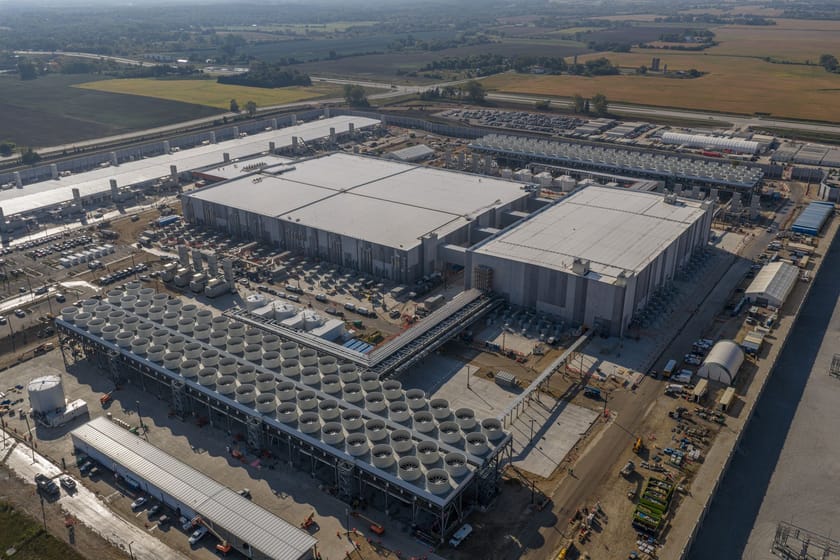
The consensus narrative treating artificial intelligence as a frictionless, zero-marginal-cost software expansion is mathematically invalid. Global equity markets are currently exhibiting a severe structural mispricing by evaluating computational infrastructure through the lens of legacy SaaS multiples. In reality, AI has rapidly mutated into a capital-intensive heavy industry, permanently burdened by an inference tax that imposes a positive marginal cost on every query. Unlike traditional software applications where distribution costs approach zero, every generative prompt or algorithmic adjustment necessitates massive, real-time matrix multiplication within a data center. This mechanism linearly consumes electricity and silicon compute time, creating a permanent structural drag on unit gross margins and fundamentally invalidating the legacy "growth-at-all-costs" SaaS playbook.
The asymmetry between deployed capital and extracted economic value is systemic. As explicitly highlighted by leadership at Norges Bank Investment Management (NBIM), the global financial ecosystem has funneled an estimated $1.4 trillion into physical hardware buildouts, yet direct, verifiable AI revenues struggle to cross a mere $13 billion threshold. For Universal Asset Owners, navigating this transition requires discarding software-era complacency and aggressively confronting the physical constraints of a new industrial reality.
What is the ultimate, non-negotiable constraint on the global AI infrastructure buildout?
The CapEx Wall and the Depreciation Trap
The hyperscaler economic model is colliding with a formidable CapEx wall. Unlike the old industrial economy, where physical assets were comfortably amortized over 30 to 40 years, the computational foundation of AI is trapped in a hyper-accelerated hardware depreciation cycle. State-of-the-art graphics processing units (GPUs), such as the Nvidia H100 or Blackwell architectures, possess a strictly limited economic useful life of just 3 to 4 years before reaching absolute technical obsolescence.
This perpetual reinvestment mandate structurally devours Free Cash Flow (FCF) across the technology sector. The accounting reality is brutally evident in recent financial disclosures: Alphabet’s capital expenditures surged by 74% year-over-year, climbing from $52.5 billion in 2024 to $91.4 billion in 2025. Furthermore, macroeconomic projections anticipate the combined CapEx for the top five US tech giants will hit $1.16 trillion by 2027. Hyperscalers are now forced to rebuild their entire infrastructure base every 48 months, transforming what was once an "asset-light" growth narrative into a deeply capital-intensive race against time.
The Thermodynamic Bottleneck
Computational scaling has definitively collided with the immutable laws of physics, specifically thermodynamics. The ultimate limit on artificial intelligence expansion is no longer algorithmic logic or software engineering, but rather the availability of baseload power generation, advanced cooling capacity, and backlogged grid interconnection queues.
The International Energy Agency (IEA) Electricity 2026 Report exposes this reality: data centers now absorb 22% of Ireland's total national electricity, forcing regulatory freezes on new allocations. Furthermore, data centers are projected to account for 50% of all electricity demand growth in the United States through 2030.
This trajectory triggers a severe physical crowding out effect. Hyperscale infrastructure is preempting access to global energy grids, imposing structural delays on traditional heavy industry projects and establishing a permanently high floor on wholesale energy prices. The bottleneck is no longer digital; it is purely material.
The Sovereign Arbitrage
A profound structural mispricing is unfolding across global markets: hyperscalers cannot simultaneously finance a trillion-dollar silicon depreciation cycle and underwrite the construction of the global power grid. This bifurcated reality creates an unprecedented entry point for Sovereign Wealth Funds (SWFs) and long-term institutional capital. These entities alone possess the balance sheet duration and mandate to absorb this massive infrastructure CapEx. Furthermore, traditional credit markets are facing a systemic liquidity funnel. According to the Bank for International Settlements (BIS), the top 10 global banks now concentrate nearly 60% of all global foreign exchange (FX) derivatives and associated swap lines. This financial architecture is disproportionately mobilized to hedge the cross-border data center deployments of US tech giants. By committing massive tranches of their Risk-Weighted Assets (RWAs) to underwrite hyperscaler expansion, global banks have effectively exhausted their balance sheet capacity, triggering a severe financial crowding-out effect that leaves sovereign capital as the sole unencumbered liquidity provider.
Consequently, sovereign capital is aggressively rotating out of the traditional software sector—a space now relegated to a "valuation doghouse," where 73% of the public SaaS market languishes at a median 3.3x NTM revenue multiple. As evidenced by the 2025/2026 capital allocation doctrines of funds like GIC Singapore and Norges Bank Investment Management (NBIM), institutional preference has pivoted decisively toward mature real-asset operators capable of generating verifiable operational efficiency. These sovereign allocators are actively deploying an "Operator Alpha" framework: stripping away thematic tech premiums to focus exclusively on the rigorous restructuring of internal operating capital and the optimization of physical asset utilization. In this paradigm, engineering resilient Free Cash Flow from legacy infrastructure and heavy industry outranks speculative algorithmic hyper-growth.
By silently securing baseload power generation and controlling the physical bottlenecks of the grid, sovereign capital is transitioning from a passive investor in technology to the ultimate price-setter of the computational era.
As AI energy requirements escalate, who will be the natural owner of the underlying baseload power assets?
References & Institutional Sources
- Alphabet Inc., Microsoft Corp., Amazon.com Inc.: Annual Reports SEC Form 10-K (February 2026)
- Bank for International Settlements (BIS): BIS Quarterly Review (December 2025)
- International Energy Agency (IEA): Electricity 2026 Report
- Morgan Stanley: US Software Outlook 2026 (Big Tech CapEx projections)
- Norges Bank Investment Management (NBIM) & GIC Singapore: Annual Reports and Capital Allocation Doctrines (2025/2026)
- Meritech Capital: Software Pulse and Cloud Index EV/NTM multiples (May 2026)