
A $100,000 edge behind the glass
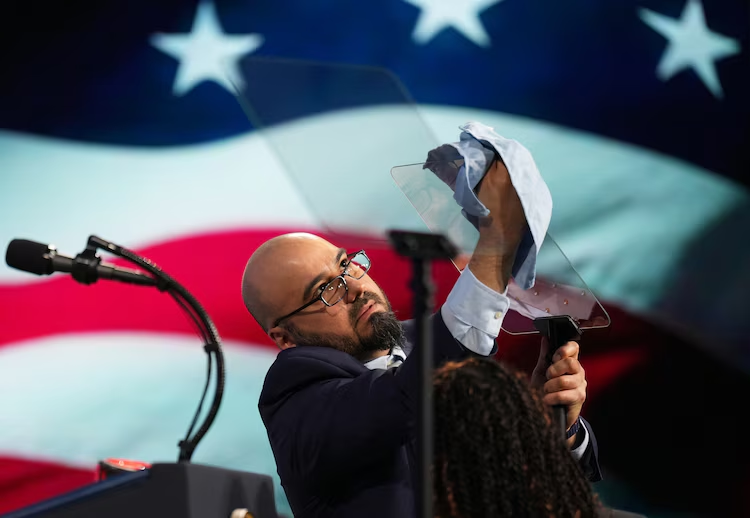
Gabriel Perez had worked as Donald Trump's teleprompter operator since 2016, and the White House's July 2026 staff report listed him as a "Deputy Assistant to the President and Technical Advisor" on a $175,000 annual salary. He had final eyes on nearly all prepared remarks and received last-minute edits, a position that could expose him to the language of a speech before the public heard it.
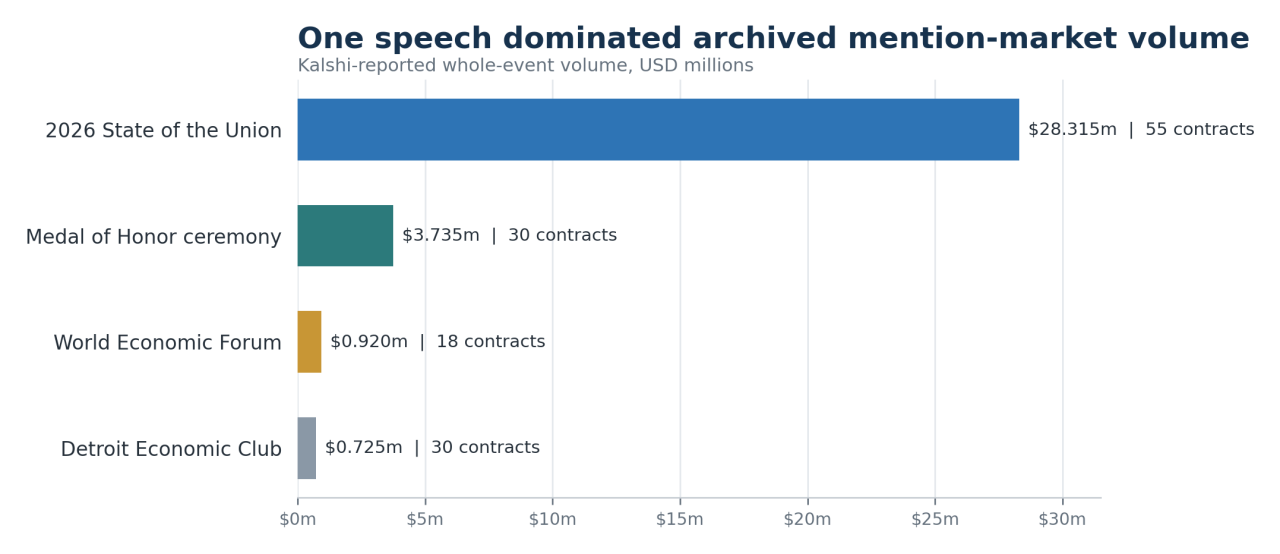
According to ABC News, investigators believed Perez used that access to trade Kalshi contracts tied to whether Trump would say particular words, placing bets around more than a dozen speeches over roughly three months and making more than $100,000. The examples included a December prime-time address, a January speech at the World Economic Forum in Davos, the February State of the Union, a March Medal of Honor ceremony, and an appearance at the Detroit Economic Club.
The most revealing detail is not simply that he may have seen drafts. Investigators found occasions when Perez allegedly exited positions during a speech after Trump skipped a scripted passage containing the target word.
This is useful because Trump frequently departs from prepared remarks. A backstage view of the final script, skipped pages, live edits, and the remaining run of show can therefore be more valuable than a static draft. ABC reported that Perez acknowledged some of the trades when questioned by regulators, while Reuters reported that he was cooperating with the investigation.
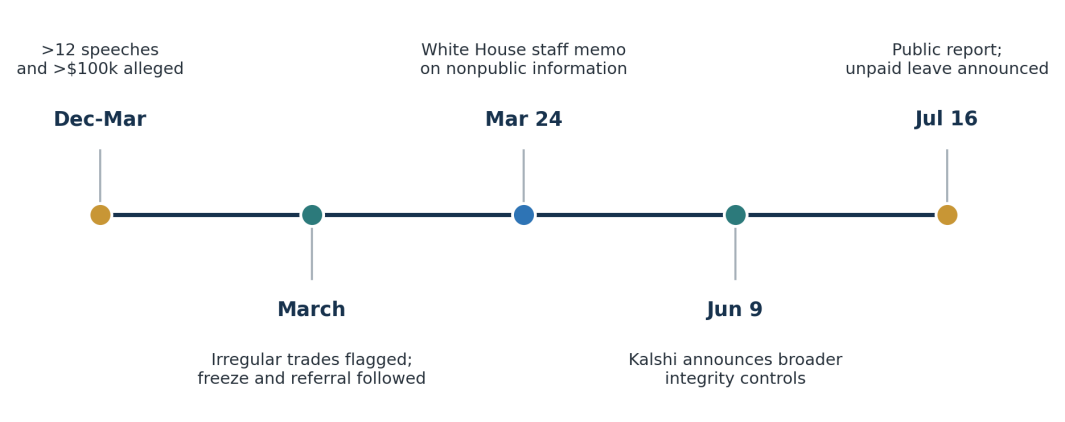
Kalshi said its surveillance systems flagged irregular trading in March 2026. The company investigated, identified the trader as a federal employee and teleprompter operator, froze the account with more than $90,000 in profits before those funds were withdrawn, and referred the matter to the Commodity Futures Trading Commission (CFTC).
On March 24, the White House Management Office warned staff not to trade on prediction markets using material nonpublic information.
On July 16, White House press secretary Karoline Leavitt said Perez had been placed on unpaid administrative leave at Trump's direction.
CFTC settlement discussions could require Perez to return profits and stay out of similar markets. Federal prosecutors in Manhattan had declined to open a criminal investigation. The CFTC said it could neither confirm nor deny the existence of an investigation, and the cited public record contained no final CFTC order.
How a mention market actually works
A mention market page is a bundle of separate binary contracts. Each listed word or phrase is a separate market with Yes and No contracts, its own order book, and a separate result.
| Feature | How It Works |
|---|---|
| Contract Unit | Each word or phrase is a separate Yes/No contract. |
| Word Matching | The listed expression may include plurals and possessives. Other inflections, compounds, or meanings may be excluded by the rules. The exact rules differ across contracts and platforms. |
| Evidence | Qualifying video first. A transcript may be used when the recording is inconclusive. |
| Trading Window | Trading can continue during the event. Rules may permit early closure once the target occurrence is detected. |
| Yes | Logically determined at the first qualifying utterance, although exchange processing and settlement can lag. |
| No | Determined only when the qualifying event ends without the utterance. |
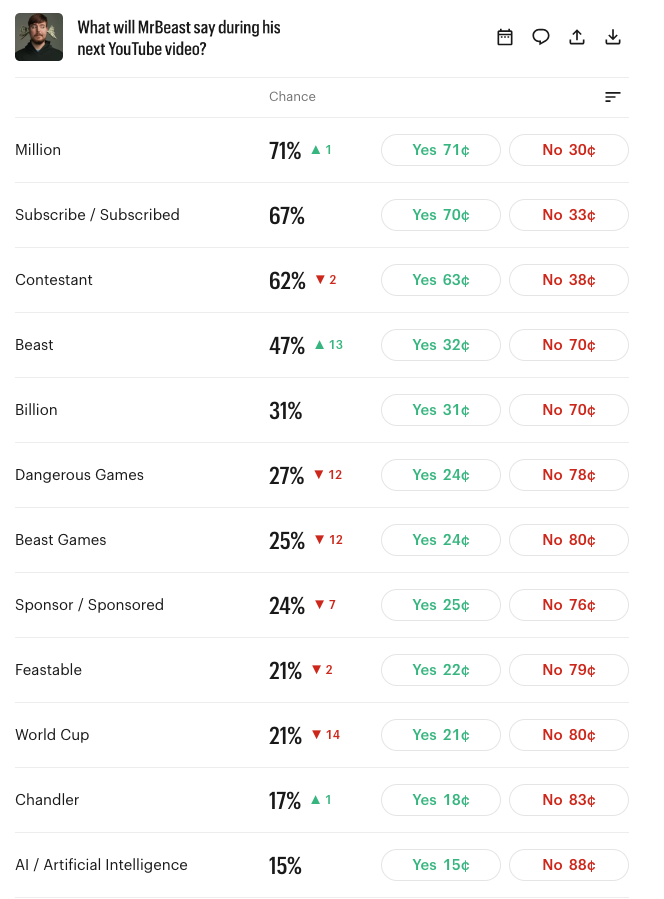
The rules are exact about language. Representative Kalshi mention contracts count the specified word or phrase, including plural and possessive forms, but exclude other grammatical or tense variations and often exclude compounds or uses with a different meaning. One Kalshi example explains that "ICE" meaning Immigration and Customs Enforcement does not count when the speaker merely says "ice water".
Video is the primary resolution source. If no consensus can be reached from the recording, the rules allow an official transcript or another transcription source to be used. The contract is limited to the qualifying live broadcast or stream, not earlier recordings.
Crucially, trading needs not stop when the speaker begins. Representative rules say a market may close early if the target event occurs and otherwise remains open until the stated event-end time. Perez allegedly exited positions mid-speech is direct evidence that live position changes were possible in at least some of the markets under investigation.
In other words, saying the word makes Yes logically certain at that instant, even if the exchange needs time to detect, close, and settle the contract. Not saying it does not make No certain until the qualifying speech or event is over. Therefore, Yes and No are not mirror images.
Only on fucking Polymarket can we debate if “hydrocarbons” counts as a mention of the word “carbon.”
— Jake (@JakeTheLarp) July 23, 2026
$40,000 traded and now we’re arguing about neoclassical compounds. Peak Polymarket.
Read the rules here: https://t.co/zu86J7Fuq7 pic.twitter.com/NwuFuhu35b
Traders are debating whether "hydrocarbons" counts as an occurence of "carbon".
The scale of the prize
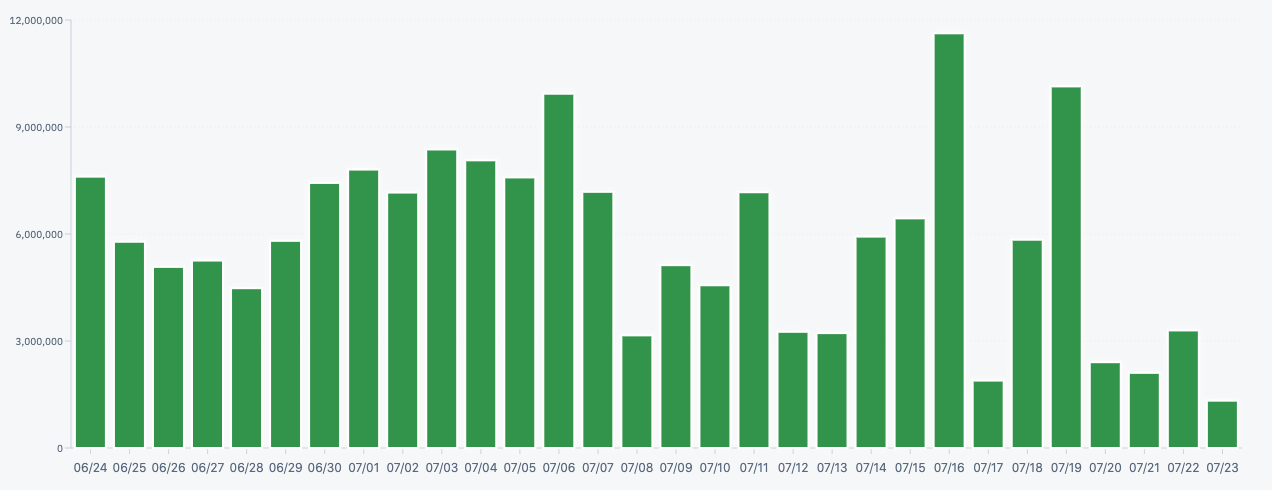
The contracts named in the reporting were not all tiny curiosities. Kalshi's archived event pages show substantial total volume across the mention markets attached to several Trump appearances.
Perez's numbers are striking too. His listed annual salary was $175,000. The alleged winnings are more than $100,000 according to ABC News, while the "more than $90,000" figure reported by Reuters describes profits frozen before withdrawal.
Three kinds of edge for insiders, in one contract
| Risk | Typical Access | Market Edge |
|---|---|---|
| Advance Knowledge | Writers, editors, event staff | Sees a draft or final text |
| Outcome Influence | Speaker, writers, advisers | Can add, remove, or say the word |
| Live Observation | Booth and stage crews | Sees skips, inserts, and time remaining |
Advance knowledge
Speechwriters, editors, technical operators, and people receiving embargoed copies may know before trading closes whether a target word appears in the prepared text. They may still be wrong if the speaker deviates, but their forecast begins with a private document with plenty of useful information.
Influence over the outcome
Some insiders can do more than knowing/forecasting. A writer can add or remove a word. An adviser can suggest a phrase. A speaker can deliberately say the target. The CFTC's 2026 staff advisory discussed a different Kalshi case in which a political candidate influenced the outcome of a market about his own candidacy, illustrating why event contracts can blur the line between prediction and manufacture.
Real-time observation
Other people may not control the words but can observe the production process faster than the public. They can see skipped pages, fresh edits, a last-minute insert, or the approach of the closing line. The allegation that Perez sold positions after scripted text was skipped is a clean example of this third category.These categories can overlap. A teleprompter operator might see the final text in advance, receive changes during the event, and know that a missing page will never be read. A speechwriter may both know and influence. A speaker can potentially do all three. Traditional insider trading is often described as knowing a market-moving fact before everyone else. Mention markets add two twists: some participants help generate the fact, and others watch the fact being generated from a privileged seat.
The information-aggregation paradox
Prediction markets are usually defended as machines for combining dispersed information. Different people bring different evidence, trade, and produce a price that summarizes their collective view.
Mention markets complicate that story. The people with the best information may be precisely the people who should not trade. Once they are screened out, the remaining traders mainly have public material such as past language, the political agenda, word frequency, and speaker patterns. A careful outsider can model a speaker's habits or recognize that a topic has become salient. But it raises a question: is the market aggregating decision-useful knowledge, or merely organizing a lively guessing game?
Here comes the paradox. Barring insiders is essential for fairness. Yet the more completely a platform removes the only participants with strong private information, the harder it may be to claim that a thinly informed price has major public value. A market can be fun without being a public forecasting instrument. Regulators and exchanges should be honest about which one they are selling.
Do mention markets provide meaningful public information?
Disclaimer: The content is for informational purposes only. You should not construe any such information or other material as legal, tax, investment, financial, or other advice. Nothing contained in this article constitutes a solicitation, recommendation, endorsement, or offer by the author(s) or any third party service provider to buy or sell any securities or other financial instruments in your or in any other jurisdiction in which such solicitation or offer would be unlawful under the securities laws of such jurisdiction. The author(s) report(s) no conflict of interest.