The Controversy vs. The Consensus
The emotional version of Georgia is always the same: every national mood swing gets projected onto one race, every candidate becomes a referendum on the republic, and every headline tries to turn a state with quirky election law into a morality play. The market’s colder view is much simpler. On Polymarket, the Democrat is currently priced at 83% and the Republican at 17% in the 2026 Georgia Senate race. But that contract resolves on the final winner inclusive of any runoff, which means the market is mostly pricing eventual seat control, not the much messier path required to get there.
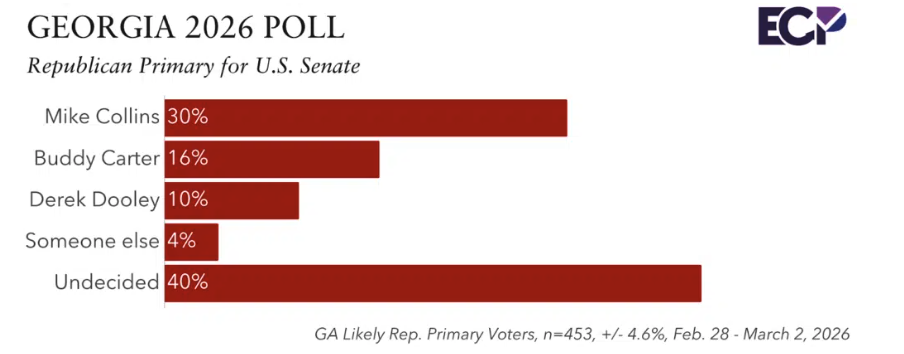
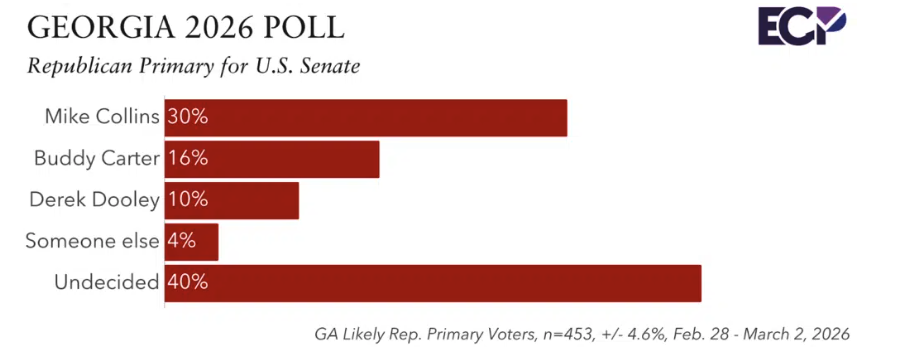
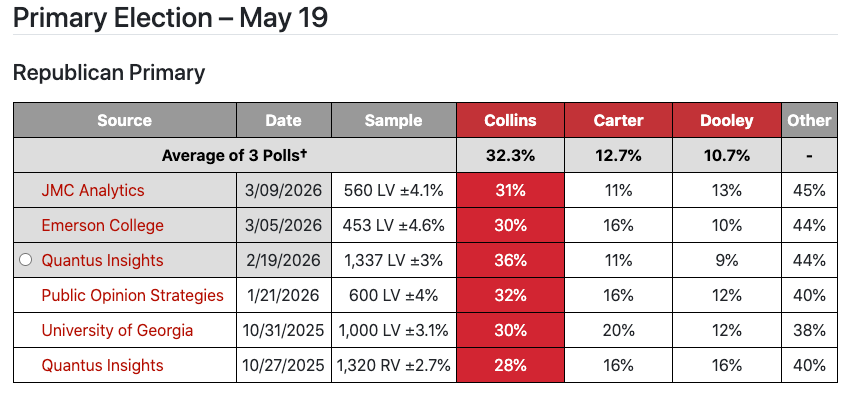
In Georgia, that distinction is not cosmetic. It is the trade. That is why the current quote looks smoother than the underlying reality. Brian Kemp, the Republicans’ strongest theoretical recruit, passed on the race, leaving the GOP with an unsettled field rather than a fully formed challenger. Polymarket now makes Rep. Mike Collins an 84% favorite to win the Republican nomination, but actual primary data are much less decisive: the 270-to-Win polling average has Collins at about 32%, and Emerson’s March poll found 40% of Republican primary voters still undecided. The Georgia GOP chair has already said a primary runoff is “more likely than not”. Markets are pricing a destination, but the state is still arguing over the route.
The Data-Driven Reality
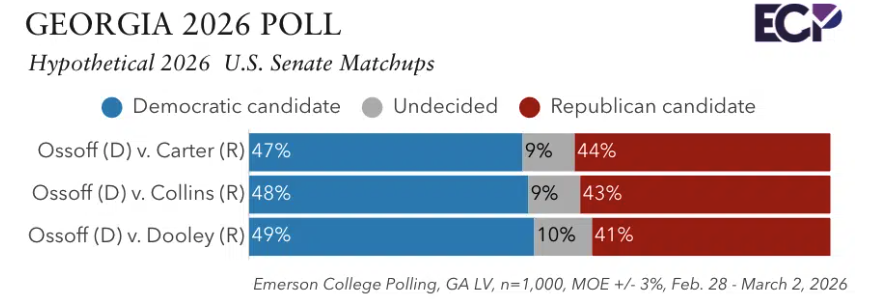
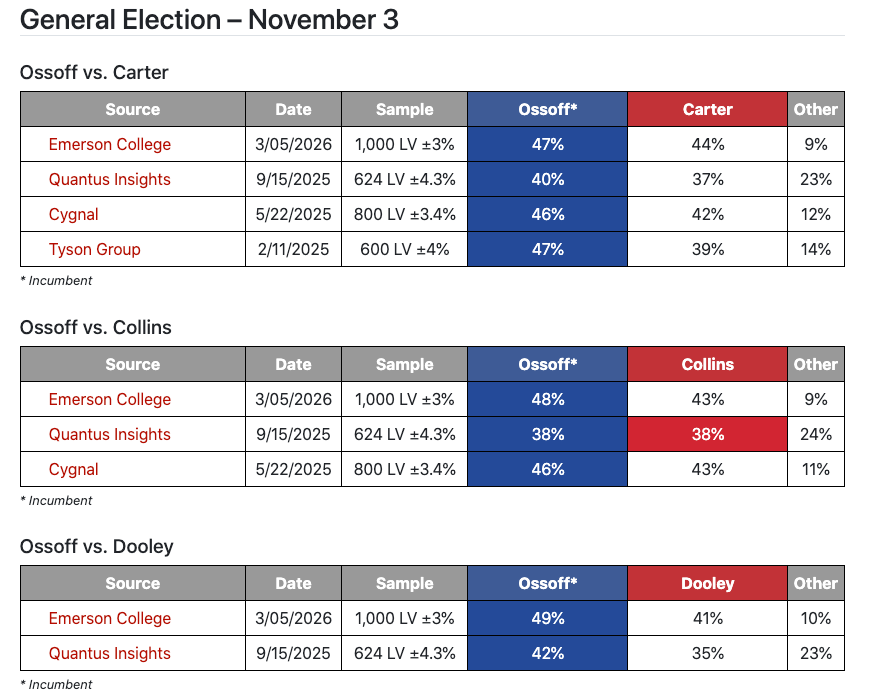
Start with the key fact that casual political coverage keeps flattening: Georgia is a majority-vote state. If nobody clears 50% on November 3, the top two go to a runoff on December 1. So when traders see Ossoff at 47%, 48%, or 49% in head-to-head polling and ment11ally round that up to “basically winning”, they are making a category error. Emerson’s March 2026 poll has Ossoff ahead of Buddy Carter 47-44, ahead of Mike Collins 48-43, and ahead of Derek Dooley 49-41. That is a good position for an incumbent. It is not yet a clean-exit position. In Georgia, 49 is not “almost done”. It is “overtime still live”.
Recent Georgia Senate history reinforces the point. In 2020, David Perdue led Jon Ossoff 49.7% to 47.9% in November and still got dragged into a runoff, which Ossoff then won. In 2022, Raphael Warnock led Herschel Walker 49.4% to 48.5% in November and still had to survive a December runoff. Georgia does not care whether you are ahead. It cares whether you are above 50. If you are pricing this race as though plurality lead equals resolution, you are trading the wrong state.
The demographic mechanics push in the same direction. Catalist estimates that Black voters made up 29% of Georgia’s 2022 electorate, and Warnock won 96% of them. The Brennan Center estimates that white turnout in Georgia’s 2022 midterm exceeded nonwhite turnout by 8.6 percentage points.
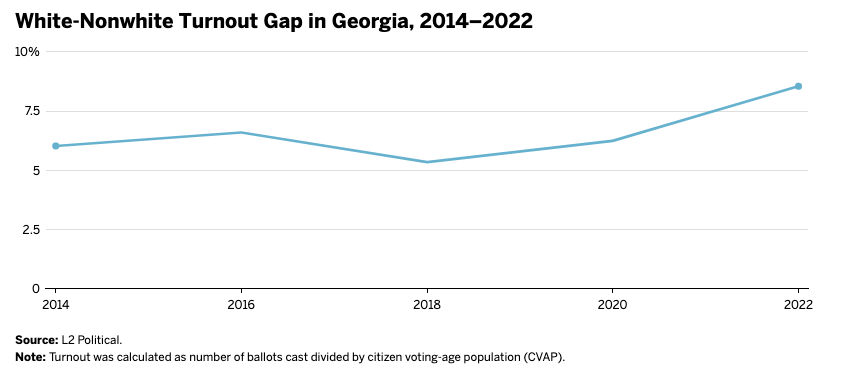
If nonwhite turnout had merely matched the white rate, more than 267,000 additional ballots would have been cast, including about 176,000 Black ballots. That is the real runoff math. The no-runoff path for Democrats is not mainly about persuading a few extra suburban moderates at the margin. It is about getting very high participation from Black voters, younger voters, and metro Atlanta coalition voters in November, then being able to reproduce enough of that effort four weeks later if needed. Emerson’s current poll is consistent with that story: Ossoff’s edge is strongest with independents, women, and voters under 50.
This is also why the fundraising gap matters so much. Ossoff’s FEC filing shows roughly $25.55 million cash on hand at year-end 2025. Roll Call reports Collins at about $2.3 million, Dooley at about $2.1 million, and Carter at about $4.2 million after including a personal loan. That gap does not guarantee victory, but it does buy insulation. It lets Ossoff define an opponent early, stay on air longer, and exploit a Republican field that may have to spend through both a May primary and a June runoff before it even gets to the general election. Financially, Ossoff is already in the general. Republicans are still paying admission to the primary.
One more uncomfortable number for the emotional trade: Trump is underwater in Emerson’s Georgia sample, with 42% approval and 51% disapproval. That does not make Georgia blue. It does mean the Republican nominee cannot simply assume a favorable partisan tide will do the work. Collins, Carter, or Dooley still need to close the gap with independents and with women while also holding a primary electorate that remains highly sensitive to Trump cues. Emerson found that 47% of likely GOP primary voters say a Trump endorsement would make them more likely to support a candidate. In other words, the Republican nomination is not fully endogenous yet. A meaningful share of the field is waiting for permission.
Volatility Catalysts
There are three dates, and one non-date, that matter much more than the next hundred hot takes.
The first is April 15, 2026, the next regular FEC quarterly filing deadline for congressional committees. That report will tell traders whether the GOP field is actually consolidating around money, or just around chatter. A candidate who is still polling in the low 30s but suddenly posts a serious fundraising jump becomes much more dangerous than a candidate living off earned media and name recognition.
The second is May 19, 2026, Georgia’s primary. If Collins wins outright, markets will probably interpret that as a regime change: uncertainty collapses, Republicans stop bleeding time, and the race moves from speculative nomination politics into direct Ossoff-versus-Collins combat.
The third is June 16, 2026, the Republican primary runoff if no one clears 50% in May. This is the date most likely to be underappreciated by traders outside Georgia. A runoff would extend GOP fragmentation, burn money, delay nominee definition, and very likely create a temporary bid for Ossoff’s outright-win price.
Then there is the non-calendar catalyst: Trump’s endorsement, or continued refusal to endorse. Since nearly half of likely GOP primary voters say his blessing would move them, one post can change the shape of the primary faster than a month of conventional campaign activity. Traders should treat that as event risk, not noise.
Actionable Trading Insights & Strategic Takeaways
My view is that the outright winner market is directionally correct but path-blind. Ossoff should be favored against the current Republican field. He leads every public general-election test, he has a massive cash advantage, and the strongest GOP recruit is not running. But 82% reads more like a “final-owner-of-the-seat” price than a realistic assessment of how frictionless that ownership will be. Georgia’s majority threshold means a candidate can be leading and still be structurally vulnerable to overtime.
So the cleaner alpha is not necessarily “short Ossoff”. It is buy runoff risk whenever the market cheapens it too aggressively. My own base case would put the probability of a November general-election runoff somewhere in the rough 35% to 45% range right now. That number follows directly from the current ingredients: Ossoff is still below 50 in every named matchup, Georgia has repeatedly produced Senate runoffs when frontrunners stalled just short of majority, and the demographic coalition Democrats need to avoid a runoff is precisely the coalition that is hardest to maintain at uniform intensity in a midterm. If you can trade a “won outright / no runoff” market and the YES side is being priced like the obvious default, that is where I would lean against consensus.
The even cleaner fade may actually be on the Republican nomination side. Collins may well end up the nominee, but 84% is an aggressive price for a candidate currently sitting around 30% to 32% in public primary data, with about 40% undecided in Emerson’s sample and open discussion inside the Georgia GOP that a runoff is likely. If Trump endorses Collins and the field collapses, that price will look brilliant. Without that catalyst, it looks like the market is paying for certainty that the polling does not yet show. I would rather fade “Collins is basically done” than make a large outright anti-Ossoff bet here.
If Mike Collins is not the Republican nominee, the current data suggest that the alternative would most likely be either Buddy Carter or Derek Dooley, and those two are not equivalent general-election nominees. Georgia remains a state that Trump carried in 2024. Carter, however, has real money comparatively: the latest FEC reports show that he started 2026 with about $4.2 million in cash on hand, while Dooley had about $2.1 million. The public polling gap versus Ossoff is also only modestly worse for Republicans than it is under a Collins matchup. Even AJC coverage portrays Dooley as struggling despite Kemp’s active support.
If the substitute is Carter, who is almost as strong as Collins but slightly weaker, the Senate race remains structurally similar, and the probability of a runoff would likely decline only by single digits. However, if the substitute is Dooley, my models forecast that the runoff probability may decline by around 20%.
The overarching takeaway is simple. Stop treating Georgia as a binary partisan referendum and start treating it as a sequencing trade. The important question is not just who wins the seat. The important question is whether anyone gets through the state’s machinery cleanly. Right now the data say Ossoff is advantaged, the Republican field is not settled, and the majority-vote rule keeps overtime very much alive. In a race like this, the market headline is usually less interesting than the path dependency underneath it.